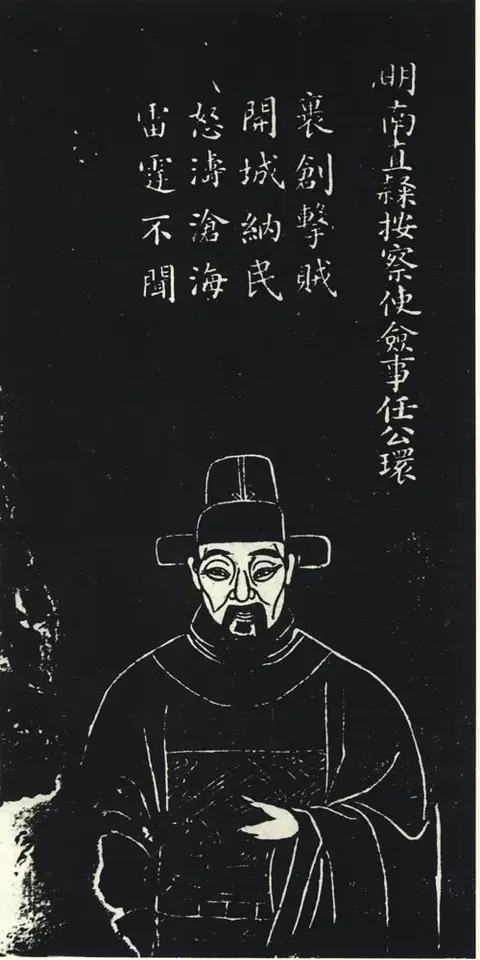
PROFILE
Ren Huan (任环, 1519–1558), courtesy name Yingqian and art name Fu'an, from Changzhi, Shanxi, was an immortal anti-pirate national hero and distinguished military commander of the Ming dynasty during the Jiajing era. Obtaining his jinshi degree in 1544, he initially governed Guangping, Shahe, and Huaxian counties with incorruptible integrity before being elevated to Vice Prefect of Suzhou, where he stood on the front lines of the catastrophic wokou pirate crises that ravaged Southeast China.
Faced with paralyzed coastal defenses, Ren Huan rose above traditional civil official constraints to lead troops into combat. Collaborating with famed military general Yu Dayou, he instituted iron discipline, shared coarse rations with common soldiers, and personally engaged enemies with blade in hand. Across brutal clashes at Baoshan, Taicang, Lujingba, and Lake Yingdou, Ren Huan repeatedly suffered severe blade wounds but refused to retreat, destroying hundreds of pirate vessels and pacifying the Taihu basin. Exhausted by unrelenting campaigning, he passed away in office in 1558 at the age of forty. He was posthumously honored as Right Vice Censor-in-Chief and Vice Minister of War, revered throughout Jiangnan as an unyielding paragon of patriotic devotion.
- Courtesy Name
- Yingqian (应乾)
- Art Name
- Fu'an (复庵)
- Date of Birth
- 1519 (Zhengde 14)
- Date of Death
- 1558 (Jiajing 37)
- Age at Death
- 40
- Ancestral Home
- Changzhi, Lu'an Prefecture, Shanxi (present-day Changzhi, Shanxi Province)
- Highest Office
- Vice Surveillance Commissioner, Right Vice Censor-in-Chief (posthumously granted)
- Historical Identity
- Ming dynasty anti-pirate hero, military commander, incorruptible civil statesman
BIOGRAPHY
Chronology
- 1519 (Zhengde 14) | Birth in Changzhi | Born into an esteemed family in Shanxi, studying Confucian classics and practicing martial archery.
- 1544 (Jiajing 23) | Jinshi Degree and County Magistracy | Passed the imperial examinations and governed Guangping, Shahe, and Huaxian with exceptional civil merit.
- 1553 (Jiajing 32) | Assigned to Suzhou Anti-Pirate Defense | Promoted to Vice Prefect of Suzhou, assuming personal command over coastal defense operations.
- 1554 (Jiajing 33) | Desperate Battles at Baoshan and Taicang | Repelled pirate assaults at Baoshan and Taicang, sustaining three severe combat wounds while rallying troops.
- 1555 (Jiajing 34) | Fire Assault Victory at Lujingba | Orchestrated a joint land-and-water offensive with Yu Dayou at Lujingba, incinerating major pirate armadas.
- 1556 (Jiajing 35) | Annihilation of Pirates at Lake Yingdou | Spearheaded the final naval battle across Lake Yingdou, eradicating pirate remnants in the Taihu basin.
- 1557 (Jiajing 36) | Promotion to Vice Surveillance Commissioner | Elevated to Vice Surveillance Commissioner supervising defense across Changzhou and Zhenjiang.
- 1558 (Jiajing 37) | Passing from Exhaustion | Died in office at Suzhou at age forty from chronic overwork and combat trauma; honored with imperial sacrifices.
Life Course
Northern Scholar and Outstanding County Governance
Ren Huan was born into an illustrious scholar family in Changzhi County, Lu'an Prefecture, Shanxi. From early childhood, he showed deep intellectual poise and moral gravity, immersing himself in the canonical Confucian texts. In 1544, Ren Huan passed the imperial civil examinations with high distinction, obtaining the jinshi degree and entering imperial administrative service as magistrate of Guangping County in North Zhili.
At Guangping, Ren Huan demonstrated fierce intolerance for official corruption, curbing oppressive gentry families and redressing numerous judicial errors. He personally contributed part of his salary to endow local Confucian academies and charity schools. He was subsequently transferred to Shahe County and Huaxian County in Henan, where he promoted river conservancy and lightened fiscal burdens, repeatedly ranking first in provincial performance audits.
In 1553, the imperial court promoted Ren Huan to Vice Prefect of Suzhou. At that time, coastal defense was fracturing under pirate fleets led by Japanese raiders and maritime smugglers. Southern cities were repeatedly besieged, and the Ming court was confronted with one of its greatest national security emergencies.
Frontline Combat at Baoshan and Taicang
In the spring of 1554, large pirate contingents made landfall at the mouth of the Wusong River, raiding Taicang, Baoshan, and Jiading. Demoralized regular garrison troops broke and fled, leaving the fertile countryside in flames. In the face of widespread administrative paralysis, Ren Huan volunteered to take direct command of forward defense forces.
Arriving at the military encampments, Ren Huan dismissed aged and feeble conscripts, replacing them with hardy fishermen, boatmen, and local volunteer militias. When over a thousand elite pirates assaulted Baoshan, Ren Huan led a dedicated counterattack force outside the walls. Facing ferocious opponents armed with muskets and long blades, Ren Huan brandished his broadsword and spearheaded the frontline charge, repelling the invaders.
Shortly afterward, pirates ambushed Ming forces near Taicang. Ren Huan was surrounded and suffered three severe sword cuts, his armor soaked in blood. Rescued by a loyal cook who sacrificed his life holding off pursuers, Ren Huan refused to withdraw to safety. He tightly bound his wounds with linen, re-entered the fight, and directed a counter-offensive that decapitated over a hundred pirate warriors, reversing the panic across southern Jiangsu.
Decisive Joint Victory at Lujingba
In 1555, thousands of pirate raiders fortified a massive encampment at Lujingba northeast of Suzhou, threatening to capture the city. The Ming government dispatched famed veteran naval commander Yu Dayou to reinforce the sector. Ren Huan set aside all civil-military rivalries, meeting Yu Dayou at his naval headquarters to formulate a unified operational plan.
Ren Huan and Yu Dayou devised a synchronized amphibious assault. While Yu Dayou deployed war galleys to seal outward channels and river estuaries, Ren Huan led armored infantry and firearms detachments in a relentless overland attack. Ren Huan's gunners shattered enemy redoubts with heavy artillery and fire-arrows, driving the panic-stricken pirates into narrow mudflats. Yu Dayou's fireships swept into the trapped enemy flotilla, burning hundreds of pirate craft to ashes. The battle broke the two-year siege of Suzhou and became celebrated in Ming annals as the Great Victory of Lujingba.
Final Campaigns across Lake Taihu
Following their defeat at Lujingba, surviving pirate bands retreated into the intricate marshlands of Lake Yingdou near Wujiang. In 1556, Ren Huan organized an amphibious fleet to pursue and eliminate the remaining enemy strongholds. Despite torrential rainstorms, he drove his shallow-draft vessels into the dense reed channels, deploying incendiary weapons and boarders to destroy every remaining pirate boat.
The victory at Lake Yingdou completely purged the waterways of Suzhou, Songjiang, Changzhou, and Zhenjiang of organized pirate confederacies. In recognition of his monumental achievements, the court elevated Ren Huan to Vice Surveillance Commissioner.
Incorruptibility and Immortal Veneration
Ren Huan's military victories were matched by his sterling personal ethics. In camp, he shared coarse vegetable rice with ordinary infantrymen and slept on straw mats in the open rain. When wealthy Suzhou lineages gathered tens of thousands of silver taels to offer him personal tribute, Ren Huan sternly refused, transferring every coin into government pension funds for the families of fallen soldiers.
In 1558, worn down by continuous battlefield exertion and unhealed combat wounds, Ren Huan collapsed in his official residence and passed away at age forty. Upon his demise, he left no personal savings, lacking even sufficient funds for a proper burial. The citizens of Suzhou closed their shops and wept in the streets, taking up collections to conduct his funeral. The Ming court posthumously awarded him the rank of Right Vice Censor-in-Chief, later advancing him to Vice Minister of War and establishing permanent memorial shrines in Suzhou and Changzhi.
Major Achievements
Leading from the Front at Baoshan and Taicang
In 1554 (Jiajing 33), when Wokou raiders penetrated deep into the Jiangnan interior, Ren Huan took the lead as a civil official, personally braving arrows and stones while heavily wounded to fight beneath Baoshan and Taicang, halting the disaster and securing key strategic strongholds guarding Lake Taihu.
Incineration Campaign and Victory at Lujingba
In 1555 (Jiajing 34), Ren Huan collaborated with General Yu Dayou to command a massive amphibious decisive battle at Lujingba, setting fire to hundreds of enemy vessels, wiping out the main pirate force, and initiating a strategic turning point from defense to offense in Jiangnan's coastal defense.
Decisive Water Battle at Lake Yingdou
In 1556 (Jiajing 35), Ren Huan supervised the fleet at Lake Yingdou in Wujiang, conducting a coordinated encirclement of the waterways through heavy downpours, completely annihilating stubborn pirate remnants and securing the peace of Suzhou and Changzhou prefectures.
Upright Governance and Incorruptible Public Duty
Maintaining strict military discipline that protected the common folk, Ren Huan shared every hardship with ordinary soldiers, steadfastly rejected tens of thousands of taels in gifts from wealthy gentry, and died in service leaving no family assets, erecting a lasting moral monument of upright loyalty in the Ming dynasty.
Warship Engineering and Tactical Waterborne Squadron Reforms
Recognizing the fluid mobility of southeast maritime raiders, Ren Huan realized that traditional garrison outposts alone could never suppress piracy. Overriding widespread skepticism, he advised Prefect Shang Weichi to recruit skilled watermen and helmsmen from across Lake Taihu, establishing a large naval shipyard at Dongshan and drafting technical designs for over forty customized double-sail assault cutters and armored warships. To counter pirate incendiary arrows, he ordered vessel prows and gunwales reinforced with treated bronze sheeting and installed firefighting reservoirs. He also equipped vessel sterns with pedal-operated wooden wheel-paddle propulsion mechanisms, enabling swift maneuvering against wind and tide, transforming his troops into a formidable amphibious strike force.
Inscribing His Name and Inspiring Troops with Martyrdom Resolve
Ren Huan united his army not only through iron discipline but through deep compassion and heroic moral resolve. Before each desperate engagement, aware of the hazards of war, he took a brush with dense ink to personally inscribe his name and official titles onto his chest, back, and limbs, declaring to the assembled troops: "Dying upon the battlefield is a soldier's bounden duty to the country! Though my life be extinguished, the body given by my ancestors must not be abandoned to wild beasts. If I fall, I rely upon you, my brothers in arms, to identify my bones and commit them to the earth." Moved to tears by their civil commander's willingness to share their fate, the soldiers fought with unmatched courage. Ren Huan always ate the same coarse rations as ordinary infantrymen and slept exposed upon marshland shores, tending the wounded with his own hands.
Bound Wounds and Ferocious Naval Breakthrough
In autumn 1553 (Jiajing 32), when raiders suddenly assaulted Taicang, Ren Huan galloped alone to the relief. In close combat, he wielded a long saber, slaying several enemies before sustaining three severe blade wounds that soaked his armor in blood, narrowly breaking out with the aid of his devoted camp cook. Before his wounds had healed, new reports arrived of enemy fleets returning. Ren Huan bound his bleeding flesh with strips of white silk, donned heavy armor, and boarded the command vessel. Amid gale-force winds and towering waves that terrified ordinary helmsmen, Ren Huan stood serenely at the prow, rallying his men and directing warships directly into the enemy formation, unleashing volley fire from Frankish breech-loading cannon and fire arrows to sink multiple enemy ships and rout the pirates.
Authoring Shanhai Mantan and Coastal Defense Theory
Beyond his field command, Ren Huan was a profound military theorist. In the intervals of campaign life, he drew upon his extensive combat experience across Jiangnan to write the comprehensive three-volume military treatise Shanhai Mantan (Random Discussions of Mountains and Seas). The work analyzed the tidal currents, navigational channels, and choke points of the Lake Taihu basin, while formulating rigorous counter-tactics against pirate firearms and infiltration tactics through coordinated amphibious encirclement. His treatise provided invaluable strategic guidance for subsequent late Ming coastal operations and was honored with inclusion in the Siku Quanshu Zongmu Tiyao.
Personal Relationships
- Comrade-in-Arms: Yu Dayou, preeminent Ming anti-pirate general who partnered with Ren Huan in the decisive victories of Lujingba and Lake Yingdou.
- Superior Viceroy: Hu Zongxian, Supreme Commander of Coastal Defense who directed broad logistics and endorsed Ren Huan's military reorganizations.
- Subordinate Disciple: Wang Chonggu, prominent military commander who drew lasting operational inspiration from Ren Huan's discipline and tactics.
Historical Evaluation
- The History of Ming records: "Ren Huan commanded military legions as a Confucian scholar, sharing sweet and bitter with common soldiers and brandishing long blades to shatter violent invaders. His glorious victory at Lujingba shook the maritime world. He was so incorruptible that he possessed no private coins upon his death; the people wept for him as for their own parents."
- General Yu Dayou lamented: "Brother Yingqian possessed literary and martial brilliance beyond all his peers. In every combat he charged first and regarded death with serenity. He was the one man I revered above all others."
Related Entries
- [[Yu Dayou]]
- [[Qi Jiguang]]
- [[Hu Zongxian]]
- [[Jiajing Wokou Raids]]
- [[Shanhai Mantan]]
FIGURES ASSOCIATED WITH THIS DYNASTY