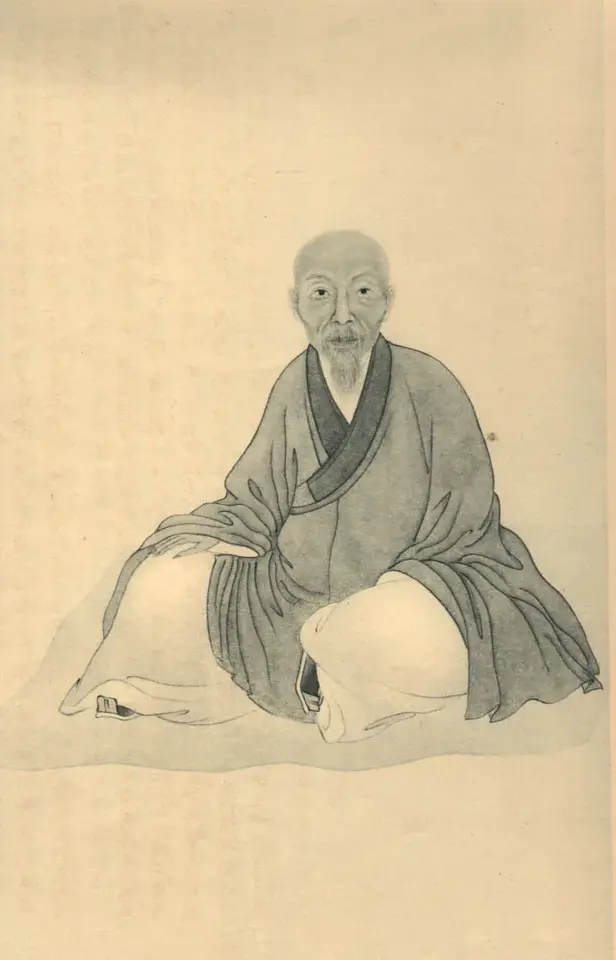
Biography
Family Background and Early Tutelage
Qu Dajun was born on October 10, 1630, in Xichang, Nanhai County, Guangzhou Prefecture. Because his father had married matrilocally into the Shao family, the boy was initially named Shao Long, courtesy name Saoyu. Raised during an era of intensifying dynastic decay and frontier conflict, he developed deep civic consciousness and scholarly ambition from early youth.
In 1645, as Qing armies pushed south into Jiangnan, Qu returned with his father to Panyu to formally re-enter the Qu clan lineage, adopting the name Dajun. In that same pivotal year, he entered the academy of Chen Bangyan, an unyielding scholar-patriot, where he absorbed Neo-Confucian statecraft doctrines and obtained the licentiate degree in Nanhai.
Armed Resistance and Monastic Retreat
In 1648, Chen Bangyan, Chen Zizhuang, and Zhang Jiayu raised righteous armies across Lingnan to resist the Qing onslaught. The nineteen-year-old Qu Dajun threw himself into the military campaign. When their armies were broken and Chen Bangyan was executed, Qu defied death threats from the imperial authorities, secretly gathered the dismembered remains of his mentor, and buried him with reverent rites.
Qu then traveled in disguise to the Southern Ming court of Emperor Yongli in Zhaoqing, submitting the Six Great Canons of Restoration. Impressed by his strategic insight, the Yongli court granted him a secretarial post. However, receiving word of his father's sudden passing, he hastened back home to fulfill filial mourning duties.
In 1650, Qing generals Shang Kexi and Geng Jimao recaptured and sacked Guangzhou. Refusing the shaving of hair and wearing of Manchu attire, Qu fled to Haiyun Monastery on Mount Leifeng in Panyu. Under Abbot Hanfang, he received monastic tonsure, took the monastic name Jinzhong, and named his meditation quarters "Death Cell," symbolizing his spiritual death to the conqueror regime.
Vast Travels and Covert Coordination
Realizing that secluded monastic existence could not preserve Chinese civilization, Qu left his monastery in 1656 under the pretext of mendicant alms-gathering, commencing extensive travels across China. Over the next decade, he crisscrossed Wu, Yue, Yan, Zhao, Qi, Lu, Chu, and Qin, carefully charting strategic mountain passes, waterways, and local sentiments.
During his visits to Nanjing, he wept at the tomb of the Hongwu Emperor; in Beijing, he climbed Coal Hill to mourn the Chongzhen Emperor. Across northern China, he met with renowned loyalist scholars including Gu Yanwu, Li Yindu, and Zhu Yizun, forming intimate pacts to sustain cultural survival. Gu Yanwu lauded him as a young prodigy whose literary and patriotic fame shook all nine provinces.
Qu also ventured beyond the Great Wall to Liaodong, composing impassioned verses at the fortifications once defended by General Yuan Chonghuan. In 1660, he allied with underground resistance leaders Wei Geng and Qi Bansun in Jiangnan to coordinate support for the maritime naval campaigns of Zheng Chenggong and Zhang Huangyan. Following the brutal suppression of the Jiangnan conspiracies, Qu narrowly evaded arrest, taking refuge in secluded hills.
Military Service in the West and Final Retirement
When Wu Sangui revolted against the Qing court in 1673 under the banner of restoring Han dress and customs, Qu answered the call and traveled to Guangxi, accepting appointment as Vice Surveillance Commissioner to oversee Sun Yanling's forces.
However, Qu soon discerned that Wu Sangui was driven entirely by personal aggrandizement and warlord ambitions rather than dynastic restoration. Deeply disillusioned, he feigned illness, relinquished his post, and returned to his southern homestead in Panyu.
Following the Qing conquest of Taiwan in 1683 and the surrender of Zheng Keshuang, all remaining armed outposts of the Southern Ming were extinguished. Qu conclusively turned away from political activism, resolving to preserve the history, culture, and memory of his native land through his writing brush.
Final Years and Posthumous Inquisitions
In his later years, Qu steadfastly refused invitations to serve the Qing administration, rejecting recommendations to participate in the prestigious Erudite Literatus Examination. Living quietly in Panyu, he gathered historical records, gazetteers, and cultural artifacts of Guangdong, compiling Guangdong Wenji, Guangdong Wenxuan, and his monumental Guangdong Xinyu.
Furthermore, despite strict imperial book censorship, he secretly authored Biographies of Martyrs Across Four Ming Reigns, celebrating the heroic sacrifices of Southern Ming loyalists.
On June 27, 1696, Qu passed away in his home at the age of sixty-seven. Decades after his death, during the literary inquisitions under Emperors Yongzheng and Qianlong, his writings were condemned for their intense loyalist fervor. Imperial decrees mandated the complete destruction of his works, and harsh punishments were imposed on those who preserved his manuscripts.
Major Achievements
Compiling the Regional Encyclopedia Guangdong Xinyu
Qu's pinnacle scholarly accomplishment was New Remarks on Guangdong (Guangdong Xinyu), an encyclopedic regional geography spanning twenty-eight volumes. The work rigorously covers Guangdong's astronomy, geography, waterways, economy, flora, fauna, mining, customs, and dialects.
Rejecting the conventional practice of dry textual compilation, Qu insisted on personal investigation and empirical observation across the province. Over two-thirds of the work is devoted to agriculture, handicraft industries, maritime commerce, and popular livelihood. His vivid descriptions of the early Thirteen Factories trade and local industries established the work as an indispensable historical source, earning him widespread acclaim as the regional encyclopedia of southern China.
Creation of the Wengshan Poetic School
As the foremost figure among the "Three Great Masters of Lingnan," Qu composed over 6,700 poems and 300 lyric verses, founding the distinct and influential Wengshan Poetic School.
Adhering to the Confucian principle that poetry should express moral conviction and record authentic history, Qu combined Du Fu's tragic realism and social concern with Qu Yuan's mythic grandeur and lyrical passion. His frontier poems and dirges for the fallen empire carried immense emotional power, prompting contemporaries to praise his verse as an unceasing, majestic cataract roaring down mountain valleys.
During his lifetime, Qu published several poetry and lyric collections, including Daoyuantang Ji, Wengshan Shiwai, and the lyric anthology Saoxie. Though less numerous than his shi poems, his ci lyrics were praised by later critics for their passionate resonance and sweeping emotional momentum. Scholar Zhou Bing noted in his preface that Qu's poems were celebrated and recited across all social strata, from prominent metropolitan scholar-officials to rural intellectuals.
Empirical Observation and Natural Sciences
The scholarly perspective displayed in Qu's New Remarks on Guangdong went far beyond conventional gazetteer compilation, exhibiting a pioneering empirical orientation toward natural and economic sciences. A substantial portion of the work investigates local agricultural techniques, water management, flora and fauna, mineral metallurgy, and herbal medicine.
Qu meticulously documented double-cropping rice cultivation, dike-pond agricultural systems, and alluvial reclamation along the Pearl River Delta. He also systematically recorded tidal fluctuations and typhoon cycles in the South China Sea, as well as the complete smelting technology and commercial distribution networks of Foshan ironworks. Modern historians of science regard his detailed observations as an essential bridge between traditional Chinese local geography and modern empirical earth sciences.
Recording Maritime Commerce and Folk Life
Qu possessed extraordinary sensitivity toward common hardships and economic realities. During his travels and rural retirement, he penned numerous poems detailing peasant distress during famines and military exactions.
Moreover, his famous Canto of Guangzhou Bamboo Branches contains the earliest recorded depiction of the lucrative Western trade at the Thirteen Factories: "Foreign ships race forth as official merchantmen; Cross Gate opens wide toward two oceans; Fine satins of five and eight silks weave wealth; Silver dollars pile high across the Thirteen Hongs." This stanza remains a foundational primary citation for economic historians studying early global maritime exchange in Guangzhou.