Birth in Central India
Born into a Brahmin family in Central India; mastered the Five Traditional Sciences, astronomy, and medicine in his youth.
394 CE–468 CE
求那跋陀罗
Gunabhadra (求那跋陀罗, 394–468), Sanskrit name Guṇabhadra, translated into Chinese as Gongdexian (功德贤) and honorifically styled Mahayana (摩诃衍), was an eminent Buddhist monk and prolific translator of Buddhist scriptures from Central India during the Liu Song period of the Northern and Southern Dynasties. Born into a high-caste Brahmin family, he thoroughly mastered the Five Traditional Sciences, including astronomy, mathematics,…
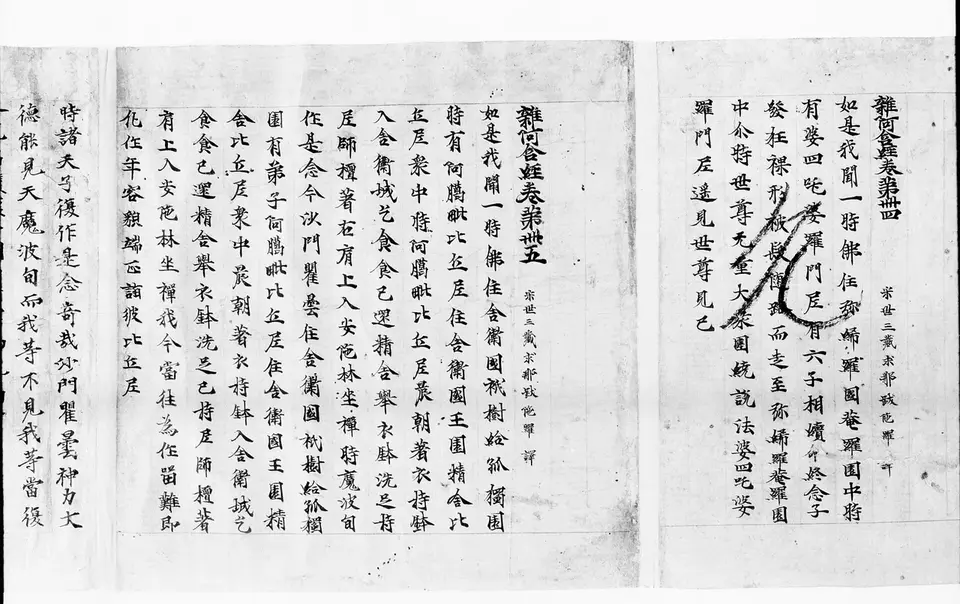
Gunabhadra (求那跋陀罗, 394–468), Sanskrit name Guṇabhadra, translated into Chinese as Gongdexian (功德贤) and honorifically styled Mahayana (摩诃衍), was an eminent Buddhist monk and prolific translator of Buddhist scriptures from Central India during the Liu Song period of the Northern and Southern Dynasties. Born into a high-caste Brahmin family, he thoroughly mastered the Five Traditional Sciences, including astronomy, mathematics, medicine, and logic. After discovering the Hinayana Abhidharma text Samyuktabhidharma-hridaya-shastra, he renounced his secular privileges to enter the Buddhist sangha. Initially mastering the Hinayana Tripitaka, he later converted to the Mahayana path, received the Bodhisattva vows, and traveled extensively across South Asian lands, including Sri Lanka, before resolving to sail east to propagate the Dharma in China. In 435, Gunabhadra arrived in Guangzhou by sea. Emperor Wen of Song (Liu Yilong) dispatched imperial envoys to escort him to the capital of Jiankang with high honors, accommodating him at Jetavana Monastery (Qihuan Temple) and DaChang Temple. Renowned literati such as Yan Yanzhi and imperial princes Liu Yikang and Liu Yixuan revered him as their spiritual preceptor. At Jiankang, Gunabhadra established extensive translation bureaus, rendering into Chinese foundational Mahayana works including the fifty-volume Samyukta Agama, the Mahabheriharaka-sutra, the Shrimaladevi-simhanada-sutra, and the four-volume Lankavatara Sutra, which provided the doctrinal foundation for the Tathagatagarbha and early Yogacara traditions in China. In 446, he accompanied Liu Yixuan to Jingzhou, translating the Sutra on the Causes and Effects in the Past and Present. After Liu Yixuan's failed rebellion, Emperor Xiaowu recognized Gunabhadra's detachment from political intrigue and welcomed him back to the capital with continued veneration. Later honored as a national treasure by Emperor Ming, he passed away peacefully in 468 at the age of seventy-five. His translation of the Lankavatara Sutra was directly inherited by Bodhidharma and Huike, establishing Gunabhadra as the foundational ancestor of the early Lankavatara lineage of Chan Buddhism.
Born into a Brahmin family in Central India; mastered the Five Traditional Sciences, astronomy, and medicine in his youth.
Inspired by the Samyuktabhidharma-hridaya, renounced secular life to enter the sangha; embraced Mahayana and received the title Mahayana.
Survived sea perils and landed in Guangzhou; Emperor Wen dispatched envoys to welcome him to Jiankang, where he resided at Jetavana Monastery.
Sponsored by He Shangzhi, translated the Shrimaladevi-simhanada-sutra and oversaw translation of the Samyukta Agama.
Translated the Angulimaliya-sutra and the four-volume Lankavatara Sutra at DaChang Temple with Baoyun and Huiguan.
Accompanied Prince of Nanqiao Liu Yixuan to Jiangling in Jingzhou; resided at Xin Temple and translated the Sutra on Past and Present Causes and Effects.
Foretold political upheaval in the capital; soon afterward, Crown Prince Liu Shao assassinated Emperor Wen.
Coerced into following Liu Yixuan's rebellion; narrowly escaped drowning during the battle and was restored to honor by Emperor Xiaowu.
Commissioned by Emperor Xiaowu to pray for rain at North Lake during an extreme drought; torrential rain followed the next day.
Foreseeing his departure after witnessing sacred celestial visions, took leave of his disciples and passed away at age seventy-five.
Gunabhadra was born into an illustrious Brahmin family in Central India. As members of the highest social stratum, his family preserved the orthodox Vedic traditions. Possessing exceptional intellect, Gunabhadra systematically mastered the traditional Five Sciences (Pancavidya): linguistics (shabdavidya), technology (shilpakarmasthanavidya), medicine (cikitsavidya), logic (hetuvidya), and inner philosophy (adhyatmavidya). He acquired mastery over astronomical movements, mathematical divination, pharmacology, and esoteric spells. However, upon studying the Samyuktabhidharma-hridaya-shastra, a core Abhidharma treatise of the Sarvastivada school, he realized that worldly intellectualism could not liberate beings from the cycles of suffering, prompting him to renounce his hereditary status and take monastic vows.
Initially, Gunabhadra applied himself to the Hinayana Tripitaka, mastering the Vinaya and Sutra collections under senior teachers. Later, seeking universal liberation, he turned toward Mahayana philosophy. Monastic legend records that when he opened a scripture casket, he unhesitatingly drew forth the Pancavimsatisahasrika Prajnaparamita Sutra and the Avatamsaka Sutra. His preceptor recognized his profound karmic affinity with the Great Vehicle and bestowed upon him the honorary epithet Mahayana. After receiving the full Bodhisattva precepts, Gunabhadra departed Central India on extensive pilgrimages, visiting maritime kingdoms including Sri Lanka. Perceiving that the Great Vehicle was ready to flourish in China, he boarded an ocean merchant vessel bound for the East. Mid-voyage, the ship encountered stagnant doldrums and depleted freshwater supplies, leaving the crew in despair. Gunabhadra calmly organized the passengers to bow before the Buddhas of the ten directions and chant the name of Avalokiteshvara Bodhisattva. Favorable gales and downpours miraculously arose, guiding the vessel safely across the ocean.
In 435, Gunabhadra's merchant vessel arrived safely at Guangzhou. Recognizing the arrival of a renowned Indian master, Governor Che Lang immediately submitted an official memorial to the throne. Emperor Wen of Song, a devout patron of Buddhism, received the report with joy and sent court representatives accompanied by eminent capital monks Huiyan and Huiguan to welcome Gunabhadra at Xinting. Upon his arrival in Jiankang, the imperial court lodged him at Jetavana Monastery. Prime Minister Liu Yikang (Prince of Pengcheng), Liu Yixuan (Prince of Nanqiao), and premier court writer Yan Yanzhi personally paid homage to him, showing immense deference and requesting spiritual instruction.
At the collective entreaty of the monastic community, Gunabhadra inaugurated a grand translation bureau at Jetavana Monastery. Over seven hundred monks and scholarly assistants assembled to support his work. The prominent scholar-monk Baoyun, renowned for his command of Sanskrit, served as primary oral interpreter, while Master Huiguan acted as the principal scribe and stylistic editor. Through rigorous deliberative analysis, Gunabhadra produced the definitive fifty-volume Chinese translation of the Samyukta Agama. At Dong'an Temple, he translated the Mahabheriharaka-sutra and the Samdhinirmochana-sutra (as Xiangxu Jietuo Jing). In 436, with patronage from He Shangzhi, Governor of Danyang, he translated the single-volume Shrimaladevi-simhanada-sutra. In 443 at DaChang Temple, he produced the four-volume Chinese version of the Lankavatara Sutra and the four-volume Angulimaliya-sutra, establishing foundational texts for Chinese Yogacara and Buddha-nature studies.
In 446, Prince of Nanqiao Liu Yixuan was appointed Military Commander of Seven Provinces and Governor of Jingzhou, establishing his headquarters at Jiangling. Revering Gunabhadra's monastic virtue, Liu Yixuan earnestly requested the master to accompany him to western China. Gunabhadra consented and relocated to Jiangling, taking up residence at Xin Temple. In Jingzhou, Gunabhadra continued his prolific translation endeavors, assisted by his chief Chinese disciple Fayong, producing the Asokavadana (one volume), the Astabuddhaka-sutra (one volume), and the four-volume Sutra on the Causes and Effects in the Past and Present, which provided an accessible canonical biography of Shakyamuni Buddha.
During his residence at Jiangling, Liu Yixuan invited Gunabhadra to lecture on the vast Avatamsaka Sutra. Although thoroughly versed in the text's doctrine, Gunabhadra hesitated, feeling his spoken Chinese remained inadequate to articulate the subtle philosophical depths of the scripture. He retreated into the prayer hall, performing sincere penance and praying day and night to Avalokiteshvara Bodhisattva for guidance. Tradition holds that he dreamed of a celestial figure robed in white brandishing a sword who replaced his head with a new one; upon awakening, Gunabhadra discovered he could speak Chinese fluently and delivered his lectures on the Avatamsaka Sutra with profound eloquence. In late 453, noticing ominous signs and strange dreams reported by Liu Yixuan, Gunabhadra presciently warned of impending palace violence in Jiankang, an omen fulfilled shortly thereafter when Crown Prince Liu Shao assassinated Emperor Wen.
In 454, Liu Yixuan joined Zang Zhi in staging a military rebellion against the newly enthroned Emperor Xiaowu (Liu Jun). Gunabhadra tearfully remonstrated with the prince, urging him not to plunge the empire into bloodshed. Disregarding his counsel, Liu Yixuan forcibly compelled Gunabhadra to accompany his expeditionary fleet down the Yangtze. When the imperial forces shattered the rebel navy at Mount Liang, chaos ensued. Facing mortal danger, Gunabhadra calmly plunged into the river clutching a bamboo cane; the water reached only to his knees, and an unidentified youth pulled him ashore on a sandbank. Following the rebellion's suppression, Emperor Xiaowu, cognizant of Gunabhadra's innocence and moral purity, dispatched commanders to locate him and escorted him back to Jiankang with imperial carriages. Gunabhadra petitioned the throne for permission to burn incense in prayer for three years to fulfill his gratitude for Liu Yixuan's past monastic patronage, a request the emperor granted with deep respect for his loyalty.
In 462, a catastrophic drought parched the lower Yangtze region, with conventional religious ceremonies yielding no relief. Emperor Xiaowu commissioned Gunabhadra to pray for rain at the Fishing Terrace on North Lake. The master performed sincere recitations throughout the day; by the following afternoon, thick clouds gathered and torrential rains drenched the provinces. Following Emperor Ming's ascension in 465, the court elevated Gunabhadra to the status of a National Treasure, frequently seeking his spiritual guidance. In February 468, sensing that his earthly duties were completed, Gunabhadra observed celestial flowers and sacred Buddha visions, took formal leave of his disciples, and entered parinirvana in a seated meditative posture at his Jiankang residence at the age of seventy-five.
Gunabhadra's foremost historic contribution was his vast translation output, comprising thirteen works in seventy-three volumes. His translations introduced a cohesive doctrinal system: the Samyukta Agama provided the canonical framework for early Buddhist meditation; the Shrimaladevi-simhanada-sutra and Angulimaliya-sutra explicated the inherent Buddha-nature residing within all sentient beings; and the Samdhinirmochana-sutra introduced early Yogacara theories of the Three Natures. Praised by contemporary scholars such as Fa Ci as simple in phraseology yet profound in metaphysical subtlety, his translations enriched the intellectual landscape of medieval Chinese Buddhism.
Gunabhadra's 443 translation of the four-volume Lankavatara Sutra at DaChang Temple represents a watershed moment in East Asian religious history. Synthesizing the concepts of Tathagatagarbha and Alayavijnana (storehouse consciousness), the text outlined the sudden enlightenment doctrine of Tathagata Chan. This specific translation was directly transmitted by Bodhidharma to his successor Huike with the instruction that it served as the sole canonical verification of mind-to-mind realization. Through this transmission, the early Chan community became known as the Lankavatara Masters, and early Tang historical records like the Record of the Masters and Disciples of the Lankavatara formally revered Gunabhadra as the First Patriarch of the Lankavatara lineage in China.
Contemporary scholar-monk Fa Ci, in his preface to the Shrimaladevi-simhanada-sutra, praised Gunabhadra's translating craft: His translations are carefully conducted; though the wording is unadorned, the philosophical principles are exquisitely profound.
The Biographies of Eminent Monks described his translation sessions: With ongoing deliberation and analysis, they captured the marvelous original intent.
Successive emperors of the Liu Song dynasty held him in supreme veneration, with Emperor Ming officially proclaiming him a National Treasure of the realm.
Tang bibliographers Shi Daoxuan in the Continued Biographies of Eminent Monks and Shi Zhisheng in the Kaiyuan Record of Buddhist Teachings categorized Gunabhadra as one of the paramount translation masters of the Six Dynasties, whose canon formed the bedrock of the Chinese Tripitaka.
In the Record of the Masters and Disciples of the Lankavatara, Master Jingjue enshrined Gunabhadra as the initial patriarch of the Lankavatara Chan tradition.
Modern Buddhist scholar Lu Cheng observed that Gunabhadra's translations of the Samyukta Agama and Lankavatara Sutra systematically integrated the doctrines of Buddha-nature and consciousness-only, placing him alongside Paramartha and Bodhiruci as one of the three greatest translators of the Northern and Southern Dynasties.
FIGURES ASSOCIATED WITH THIS DYNASTY