Birth in Qiongshan
Born into a scholarly family in Qiongshan, Hainan, displaying early brilliance in classical studies.
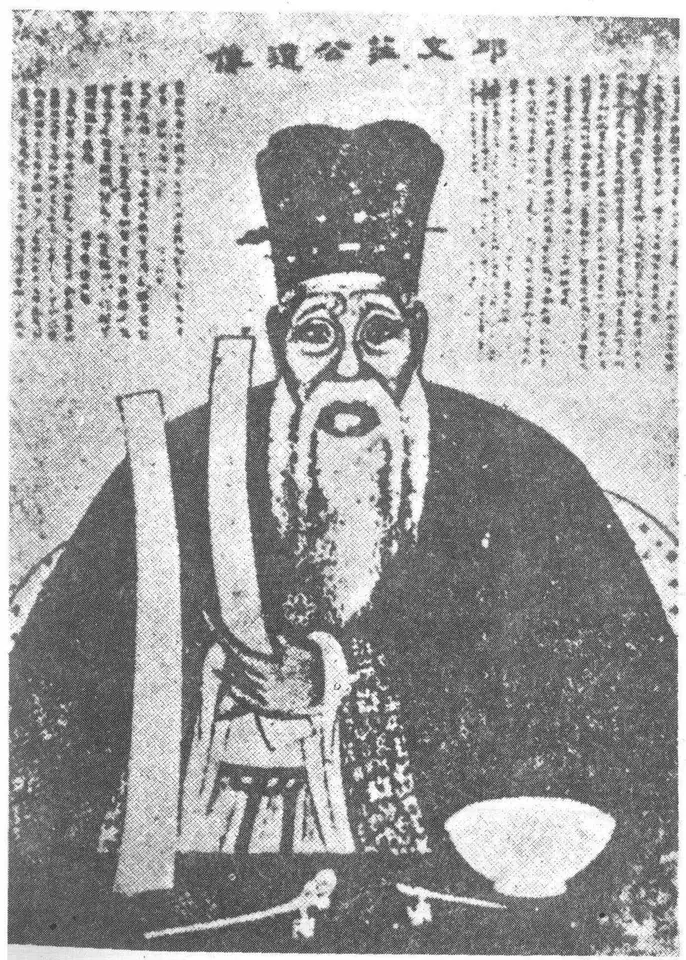
丘濬
Qiu Jun (丘濬, also written as 丘浚) was a preeminent Grand Secretary, Neo-Confucian master, economic theorist, historian, and statesman of the Ming Dynasty, hailing from Qiongshan in Qiongzhou Prefecture (modern Haikou, Hainan Province). Losing his father at age seven, he was raised by his virtuous mother Madame Li, whose strict discipline nurtured his brilliant scholarly intellect. In 1454 (the fifth year of the Jingtai…
Qiu Jun (丘濬, also written as 丘浚) was a preeminent Grand Secretary, Neo-Confucian master, economic theorist, historian, and statesman of the Ming Dynasty, hailing from Qiongshan in Qiongzhou Prefecture (modern Haikou, Hainan Province). Losing his father at age seven, he was raised by his virtuous mother Madame Li, whose strict discipline nurtured his brilliant scholarly intellect. In 1454 (the fifth year of the Jingtai era), he graduated as the bangyan (second-ranked jinshi scholar) in the imperial palace examination and was appointed Compiler in the Hanlin Academy. He served across four successive reigns (Jingtai, Tianshun, Chenghua, and Hongzhi), holding key posts including Chancellor of the Directorate of Education, Vice Minister of Rites, and Vice Minister of Personnel. In 1487, Qiu presented his monumental 160-volume treatise on statecraft and political economy, Supplement to the Exposition of the Great Learning (Daxue Yanyi Bu), which Emperor Hongzhi ordered printed and distributed nationwide. In 1491, Qiu was elevated to Minister of Rites and Grand Secretary of the Wenyuan Pavilion, becoming the very first scholar from Hainan to enter the Grand Secretariat as imperial chancellor. He subsequently rose to Minister of Revenue and Grand Secretary of the Wuying Palace. Renowned for his uncompromising integrity and pioneering economic insights regarding market forces, currency, and maritime trade, he was praised by contemporaries as the "Universal Scholar of our Era." His masterpieces Daxue Yanyi Bu and Classified Annals of Universal History (Shishi Leibian) represent monumental achievements in Chinese political philosophy and institutional history. He passed away in office in 1495, posthumously honored as Grand Guardian with the name Wenzhuang.
Born into a scholarly family in Qiongshan, Hainan, displaying early brilliance in classical studies.
His father died; his mother Madame Li undertook strict tutelage, rising at dawn to supervise his studies.
Attained first place (jieyuan) in the Guangdong provincial examination, astonishing southern scholars.
Graduated second (bangyan) in the palace examination, appointed Hanlin Compiler.
Appointed Chancellor of the Directorate of Education, reforming academic regulations and eliminating corruption.
Promoted to Vice Minister of Rites, regulating state sacrificial liturgy and imperial examination standards.
Submitted the 160-volume Daxue Yanyi Bu to the throne; Emperor Hongzhi ordered its empire-wide promulgation.
Appointed Minister of Rites and Grand Secretary of Wenyuan Pavilion, the first Hainanese grand secretary.
Advanced to Minister of Revenue and Grand Secretary of Wuying Palace, aiding the Hongzhi Restoration.
Died at his official residence in Beijing at age seventy-five; posthumously created Grand Guardian with posthumous name Wenzhuang.
Qiu Jun was born in 1421 in Xiada Village, Qiongshan, Hainan. His grandfather Qiu Pu was a respected local physician and his father Qiu Chuan a learned scholar. When Qiu was only seven, his father passed away, plunging the family into poverty. His mother Madame Li, widowed at twenty-eight, swore to dedicate her life to educating her sons. Rising before dawn each morning, she accompanied Qiu Jun and his elder brother Qiu Yuan as they recited the classics. Whenever Qiu returned from school, she rigorously reviewed his homework and inquired into his moral conduct, inspiring him to "aspire to become a virtuous prime minister who benefits all under heaven."
Under his mother's tutelage, Qiu exhibited astounding photographic memory. In 1444, at age twenty-four, he achieved first place (jieyuan) in the Guangdong provincial examination. In 1454, he took the palace examination and achieved the runner-up position (bangyan), joining the Hanlin Academy as Compiler. Hailing from isolated Hainan Island, he stepped into the highest political councils of the Ming Empire.
From the Jingtai through the Chenghua eras, Qiu served continuously for over three decades in the Hanlin Academy and the Directorate of Education. Early in the Chenghua reign, Emperor Xianzong appointed him Chancellor of the Directorate of Education. At that time, the capital academy was plagued by absenteeism, with aristocratic scions treating it as a stepping stone to unearned office. Qiu instituted rigorous monthly examinations, maintained merit registers, and provided welfare stipends for impoverished scholars.
His lectures emphasized practical statecraft over vacuous literary rhetoric, revitalizing the moral and intellectual atmosphere of the academy. In 1477, he was elevated to Vice Minister of Rites. Directing the compilation of the Veritable Records of Xianzong and verifying imperial library holdings, he was revered by scholars across China as the "Universal Scholar of our Era."
Observing the systemic crises of the mid-Ming period—land concentration, fiscal deficits, and frontier threats—Qiu noted that Southern Song scholar Zhen Dexiu's Exposition of the Great Learning focused on personal moral cultivation while neglecting statecraft. Over several decades, Qiu synthesized historical records, administrative documents, and economic treatises to produce his 160-volume masterpiece, Supplement to the Exposition of the Great Learning (Daxue Yanyi Bu).
Covering twelve comprehensive domains including court governance, bureaucratic administration, fiscal revenue, penal law, and national defense, the work provided a blueprint for empire-wide revitalization. Presented to the throne in 1487, it captivated the newly enthroned Emperor Hongzhi, who praised it as an indispensable guide for governance and ordered the Ministry of Works to carve wooden printing blocks and distribute copies to all government offices.
In 1491, Emperor Hongzhi appointed Qiu Minister of Rites and Grand Secretary of the Wenyuan Pavilion, making him the first scholar from Hainan to enter the Grand Secretariat. In 1493, he was further promoted to Minister of Revenue and Grand Secretary of the Wuying Palace.
Serving alongside senior colleagues Xu Pu and Liu Ji, the septuagenarian Qiu worked tirelessly to support the enlightened administration of the Hongzhi Restoration. He advocated for reducing land taxes in the Yangtze delta, reforming the salt gabelle, reclaiming imperial estates seized by corrupt eunuchs, and reinforcing the northern Great Wall against nomadic raids. During imperial lectures, he spoke candidly, unafraid to challenge imperial errors. He passed away in office in 1495 at age seventy-five. Emperor Hongzhi suspended court audiences in mourning and posthumously honored him as Grand Guardian with the name Wenzhuang.
Qiu Jun's greatest intellectual monument is his 160-volume Daxue Yanyi Bu, celebrated as a pioneering encyclopedia of political economy and statecraft.
Breaking away from traditional Confucian prejudice that despised commerce and private profit, Qiu formulated groundbreaking economic concepts:
During his tenures as Minister of Revenue and Grand Secretary of the Cabinet, Qiu Jun implemented sweeping reforms to tackle deep-seated abuses in Ming land taxation, canal transport, and the salt gabelle.
He advocated auditing the imperial manors and official lands seized by nobles and imperial relatives, cracking down on powerful landlords who concealed land to evade taxation, thereby lightening the burden on grassroots owner-cultivators. He reformed the salt monopoly system, introducing a flexible policy of taxing salt vouchers while permitting private merchants to transport and sell salt, which significantly increased state revenues. On the grain tribute system, he investigated the conservancy of the Yellow River and the Grand Canal, proposing a strategic plan combining maritime and river transport to alleviate grain supply crises in the capital and northern border garrisons.
In historiography, Qiu compiled the 40-volume Classified Annals of Universal History (Shishi Leibian). Breaking free from chronological annals and dynastic limits, he reorganized the entire sweep of Chinese history into thematic categories.
This structure enabled statesmen to compare institutional evolutions horizontally across dynasties, establishing a new model for historical inquiry.
Qiu lived with ascetic simplicity, earning the popular title "the commoner prime minister" (buyi qingxiang). Even as imperial chancellor, his household furnishings were threadbare and his food plain.
Whenever powerful eunuchs or royal in-laws sought illegal privileges, Qiu sternly vetoed their requests in imperial drafts. His moral stature, alongside his fellow provincial hero Hai Rui, made him an enduring symbol of upright Hainanese culture.
In the fiscal administration treatises of Daxue Yanyi Bu, Qiu Jun formulated a milestone theoretical summary of traditional Chinese monetary thought. Confronting the complex reality of depreciating paper notes (baochao), debased copper coins, and the rise of uncoined silver in the mid-Ming dynasty, Qiu proposed an advanced multi-tiered currency theory that surpassed his predecessors.
He perceptively stated: "Copper coins should serve daily market transactions, paper notes should be used for state treasury disbursements, and silver should be utilized for large-scale inter-regional and overseas trade." He opposed the government's reliance on harsh penal laws to enforce unconvertible paper currency, insisting that currency issuance must be backed by state commodity reserves and commercial credit. He also emphasized that copper cash was the indispensable medium of commoners' daily livelihood, obligating the state to guarantee casting quality and adequate supply to prevent counterfeiting and depreciation. Modern economic historians regard these insights as one of the most scientific and forward-looking economic summaries in pre-modern China.
Despite his high imperial rank, Qiu never forgot the ethnic dynamics of his native Hainan. When court hardliners advocated military campaigns against the indigenous Li people in the central highlands, Qiu submitted his famous Memorial on Pacifying the Li People (Fuli Tuyi).
He proposed peaceful integration through moral education, border trade fairs, equal taxation, and the establishment of local Confucian schools for tribal chieftains' sons. His enlightened policies avoided protracted regional conflicts, laying the foundations for ethnic harmony in Hainan for centuries.
Throughout his thirty-year career in the Hanlin Academy and the Ministry of Rites, Qiu Jun shouldered premier responsibilities for state historiography and ritual codification during the mid-Ming period. He served successively as Deputy Chief Director of the Veritable Records of Xianzong and Chief Compiler of the Collected Statutes of the Ming Dynasty (Da Ming Huidian).
Within the history bureau, Qiu adhered strictly to historiographical conscience, cross-examining imperial diaries and ministerial memorials with rigorous philological precision to eliminate exaggerations and concealments from official documentation. In ritual codification, he systematically revised ceremonies for imperial suburban sacrifices, the Empress's Sericulture Rites, and the Crown Prince's classical education, pruning cumbersome procedures to bring Ming dynastic rituals and liturgical institutions to structural maturity.
FIGURES ASSOCIATED WITH THIS DYNASTY