Birth in Taiwan
Born on December 26 in Tongluowan, Miaoli, Taiwan, demonstrating prodigious intellectual talent in early childhood.
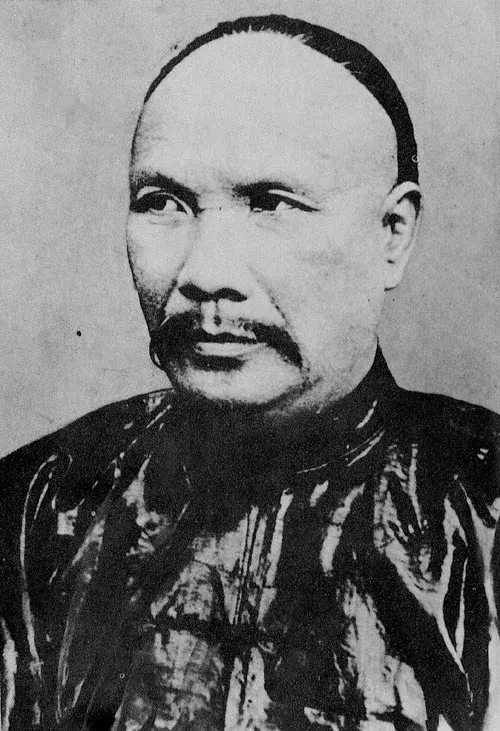
丘逢甲
Qiu Fengjia (丘逢甲, December 26, 1864 – February 25, 1912), courtesy names Xiangen (仙根) and Zhexian (蛰仙), art name Zhe'an (蛰庵), and later known as Nanwu Shanren (南武山人) and Haidong Yimin (海东遗民, Remnant Subject of the Eastern Sea), was a towering patriotic hero, volunteer guerrilla commander, progressive educator, poet, and revolutionary during the late Qing Dynasty. Born in Tongluowan, Miaoli, Taiwan to an ancestral lineage…
Qiu Fengjia (丘逢甲, December 26, 1864 – February 25, 1912), courtesy names Xiangen (仙根) and Zhexian (蛰仙), art name Zhe'an (蛰庵), and later known as Nanwu Shanren (南武山人) and Haidong Yimin (海东遗民, Remnant Subject of the Eastern Sea), was a towering patriotic hero, volunteer guerrilla commander, progressive educator, poet, and revolutionary during the late Qing Dynasty. Born in Tongluowan, Miaoli, Taiwan to an ancestral lineage originating from Zhenping, Guangdong, he was celebrated in his youth as the "Prodigy of Eastern Ning" and obtained his jinshi degree in 1889, briefly holding office in the Ministry of Works before resigning to promote practical statecraft across Taiwanese academies. Following the outbreak of the First Sino-Japanese War in 1894, he organized regional militia brigades. When the catastrophic Treaty of Shimonoseki ceded Taiwan in 1895, Qiu wrote memorials in his own blood vowing resistance, co-founded the short-lived Republic of Formosa as Vice President and Commander of Volunteer Forces, and led fierce guerrilla campaigns against invading Japanese forces until exhaustion forced his withdrawal to mainland Guangdong. His poignant Poems on Leaving Taiwan voiced deep patriotic anguish against treasonous imperial ministers. In Guangdong, he devoted himself to educational modernization, establishing Lingdong Tongwen School and introducing modern science, foreign languages, and female education. Secretly joining the Tongmenghui in 1907, he shielded revolutionaries, supported the 1911 Huanghuagang Uprising, aided Guangdong's declaration of independence, and served as Guangdong's delegate in Nanjing to elect Sun Yat-sen as Provisional President of the Republic of China. He passed away in 1912 with the dying wish that his tomb face south toward his beloved Taiwan. Renowned as a monumental giant of the "Poetic Revolution," his collection Lingyun Hairilou Shichao remains an enduring monument of modern Chinese patriotic literature.
Born on December 26 in Tongluowan, Miaoli, Taiwan, demonstrating prodigious intellectual talent in early childhood.
Ranked first in the Tainan child examinations at age fourteen; Fujian Governor Ding Richang acclaims him as the "Prodigy of Eastern Ning."
Passes the provincial examinations in Fuzhou at age seventeen, winning scholarly renown across Taiwan and Fujian.
Obtains the jinshi degree in Beijing, appointed Secretary in the Ministry of Works; spurning corrupt bureaucratic circles, he resigns to return to Taiwan.
Directs Chongwen Academy in Tainan and Hongwen Academy in Taichung, reforming archaic curricula to emphasize modern world geography and statecraft.
Following the outbreak of the First Sino-Japanese War, he organizes dozens of volunteer defense battalions across northern and central Taiwan.
Protests the Treaty of Shimonoseki with petitions written in blood; co-founds the Republic of Formosa as Vice President and leads fierce combat against Japanese invaders before retreating to mainland China.
Composes the immortal Poems on Leaving Taiwan, lamenting that "Ministers possess the power to cede land, while solitary subjects lack the strength to reverse heaven's course."
Establishes Lingdong Tongwen School in Shantou, introducing math, chemistry, physics, English, Japanese, and physical education.
Founds Tongren School and Zhenping Primary and Agricultural Schools, initiating primary and female education in the Hakka highlands.
Secretly joins the Tongmenghui in Guangzhou, utilizing his legal posts as President of the Guangdong Educational Association to shield revolutionaries.
Elected Vice Chairman of the Guangdong Provincial Advisory Council, championing constitutionalism and impeaching abusive imperial officials.
Facilitates the burial of the Seventy-Two Martyrs of Huanghuagang, aids Guangdong's peaceful independence, and attends the national conference in Nanjing to elect Sun Yat-sen as Provisional President.
Passes away from pulmonary illness on February 25 in Zhenping at age forty-eight, commanding that his grave face south toward Taiwan.
Qiu Fengjia was born on December 26, 1864 (the twenty-eighth day of the eleventh month of the third year of Tongzhi) in Tongluowan, Miaoli, Danshui Subprefecture, Taiwan Prefecture. His ancestral lineage traced back to Zhenping County (modern Jiaoling County), Chaozhou Prefecture, Guangdong, from where his great-great-grandfather Qiu Shirong crossed the Taiwan Strait during the Qianlong era. His father Qiu Longzhang was a revered Taiwanese scholar and village tutor versed in the classical masters. Legend records that because he was born in a jiazi cyclical year and his mother Lady Pan dreamt of an immortal holding a jade seal, his father named him Fengjia, styling him Xiangen and later Zhexian, while adopting art names including Zhe'an and Haidong Yimin.
Qiu exhibited phenomenal literary memory and poetic talent from early childhood. At age four, he began studying classical texts under his father, memorizing thousands of characters daily without forgetting a single phrase. By age six, he composed poetic couplets effortlessly. By age ten, he had committed the Four Books and Five Classics to memory, alongside classical histories like the Records of the Grand Historian and Book of Han, producing elegant, mature compositions that earned him regional acclaim as a child prodigy.
At age eight, Qiu had already mastered Three Hundred Tang Poems and began composing verses following ancient rhymes. One day, a local elder proposed the first line of a couplet: "The ancient monastery's bell shatters the traveler's thousand-mile dream." While the adults hesitated, the eight-year-old Qiu instantly replied: "The cold window's moonlight illuminates the mortal world's boundless sorrow." The couplet's tragic maturity astonished all present. Though delighted by his son's brilliance, Qiu Longzhang worried the melancholic imagery presaged early hardship, thus rigorously training the boy in horsemanship, archery, and topography to cultivate a robust martial spirit.
In 1877, the fourteen-year-old Qiu traveled to Tainan to take the prefectural child examinations. The presiding examiner was Ding Richang, Governor of Fujian and imperial supervisor of Taiwanese defense. Struck by Qiu's handsome bearing and profound policy essays, Ding summoned the youth for a personal interview, presenting difficult extemporaneous queries. Qiu answered with serene eloquence, demonstrating sweeping historical vision.
Thrilled by his brilliance, Ding ranked him first among all candidates across Taiwan and bestowed a poem hailing him as the "Prodigy of Eastern Ning," encouraging him to dedicate his life to moral leadership and national welfare. Ding also presented Qiu with precious classical treatises and world maps, admonishing him never to remain confined to mechanical scholasticism. At fourteen, Qiu became famous across the Taiwan Strait, cementing his intellectual prestige.
In 1880, at age seventeen, Qiu traveled to Fuzhou to take the Fujian provincial examination, successfully earning his juren degree. In 1888, he journeyed north to Beijing to sit for the metropolitan examinations. In the 1889 jichou metropolitan and palace examinations, twenty-six-year-old Qiu obtained the jinshi degree, ranking ninety-sixth in the third class, and was appointed Secretary of the Bureau of Forestry and Hunting in the Ministry of Works.
At that time, imperial governance was mired in bureaucratic inertia and corruption as foreign imperialist aggression deepened. Unwilling to waste his youth in empty clerical routines and sycophantic lobbying in Beijing, the high-minded scholar resigned his official post to return to Taiwan. Back home, at the invitation of Governor Shao Youlian and regional gentry, he served as head lecturer at Chongwen Academy in Tainan, Hongwen Academy in Taichung, and Dengying Academy in Chiayi.
During his tenure at these academies, Qiu overturned the ossified eight-legged essay curriculum. Recognizing the epochal changes transforming global politics, he championed practical statecraft. He introduced modern world geography, international history, natural sciences, and international law into Taiwanese classrooms, urging students to grasp global dynamics and maritime defense. His academies nurtured scores of forward-looking scholars who later formed the vanguard of Taiwanese anti-colonial resistance and social modernization.
At Dengying Academy in Chiayi, Qiu offered dedicated seminars on "Maritime Defense and Foreign Commerce," analyzing Wei Yuan's Illustrated Treatise on the Maritime Kingdoms and Zheng Guanying's Words of Warning in Times of Prosperity. He warned students of imperial Japan's expansionist ambitions following the Meiji Restoration, predicting Tokyo would seize the Ryukyu Islands and Korea before invading Taiwan. Leading students to the Alishan foothills and coastline, he surveyed tidal depths and fortress fortifications, pioneering modern military strategy in Taiwanese academies.
In 1894, the First Sino-Japanese War erupted. Chinese naval and ground forces suffered disastrous defeats at Pyongyang and the Yellow Sea, and imperial Japanese ambitions zeroed in on Taiwan. Perceiving the dire peril threatening the island, Qiu submitted urgent memorials to Governor Tang Jingsong, emphasizing that "Taiwan is the strategic gateway to seven coastal provinces; if Taiwan stands, Southeast China is secure; if Taiwan falls, the imperial maritime frontier is laid bare."
Acting upon Qiu's impassioned warnings, Tang Jingsong appointed him Supervisor of Provincial Militias and Commander of Volunteer Brigades. Qiu liquidated his ancestral family fortune to purchase firearms, ammunition, and provisions, riding ceaselessly across Hakka villages, Minnan communities, and indigenous settlements. Within months, he organized eighteen battalions of anti-Japanese volunteer forces totaling tens of thousands of men, building coastal fortifications, drilling troops, and reinforcing key mountain defiles.
To overcome critical weapons shortages, Qiu dispatched trusted agents across the sea to Hong Kong and Xiamen, using Hakka overseas remittances to covertly procure German Mauser rifles and rapid-fire ordnance. Distributing these to core battalions in Tongluowan and Baguashan, he promulgated the Joint Defense Regulations of Taiwan Volunteer Militias, establishing a mountain guerrilla doctrine based on farming in peace, defending strategic heights in war, and coordinating beacon signals across valleys.
Qiu enforced strict military discipline, prohibiting harassment of civilians and sharing rough rations and cold encampments with the volunteers. He erected an altar in camp, sacrificed cattle and horses, and led a solemn blood-oath binding all warriors to die for their ancestral land. Responding to his call, villagers donated grain and supplies, creating an impregnable wall of popular resistance.
On April 17, 1895, following crushing military setbacks, the Qing court dispatched Li Hongzhang to sign the Treaty of Shimonoseki with Japan, formally ceding the entire island of Taiwan and the Penghu Archipelago. When the catastrophic news reached Taiwan, the entire population erupted in grief and outrage; markets and schools closed, and crowds thronged the streets of Taipei cursing the capitulation.
Overwhelmed by grief, Qiu severed his finger and wrote a series of impassioned memorials in his own blood. Leading tens of thousands of local gentry and commoners, he dispatched dozens of urgent telegrams to the Grand Council and Zongli Yamen, protesting: "The people of Taiwan are united in their vow to resist the invaders unto death! We would rather die as martyrs than live as slaves of Japan!" He pledged to lead volunteer forces in defending the homeland to the last breath. However, the capitulating Qing government ordered all civil and military officials to withdraw to the mainland, commanding soldiers to lay down arms and surrender the island, abandoning four million Taiwanese subjects.
In his blood-written memorial to the Zongli Yamen, Qiu fiercely condemned the capitulation: "Ceding territory to beg for peace contradicts all historical wisdom; never has a dynasty destroyed its own frontier to enrich an enemy! Taiwan possesses rugged peaks, fertile soil, and four million patriotic souls willing to die. Why should the court cast them away like broken tiles to become foreign slaves?" The petition provoked widespread outrage in Beijing, directly triggering Kang Youwei and Liang Qichao's celebrated "Petition of the Examination Candidates" and establishing Qiu as a primary catalyst of the 1898 Reform Movement.
Qiu led gentry delegations to demonstrate before the Governor's Yamen, tearing the imperial cession edicts to shreds and branding Li Hongzhang a traitor. Appealing to provincial governors Zhang Zhidong and Liu Kunyi, he pleaded for munitions and reinforcements, warning that Taiwan's fall would expose the entire southeastern coastline to unending Japanese incursions.
Abandoned by the Qing court and isolated from outside aid, Qiu Fengjia and prominent gentry leader Lin Chaodong proposed an autonomous defense strategy to prevent Japanese takeover under international treaty law. On May 25, 1895, Taiwanese gentry proclaimed the establishment of the Republic of Formosa in Taipei, selecting Governor Tang Jingsong as President, General Liu Yongfu as Grand Commander, and Qiu Fengjia as Vice President and Commander of Volunteer Forces. Adopting the reign title "Yongqing" (Forever Qing) and flying a flag depicting a yellow tiger on a blue field, the island pledged loyalty to Chinese civilization.
On May 29, the Japanese Imperial Guard Division landed at Aodi under heavy naval bombardment. Tang Jingsong panicked and fled to the mainland. Following the fall of Taipei, Qiu refused to yield, joining commanders Wu Tangxing and Xu Xiang to wage ferocious mountain guerrilla warfare across Hsinchu, Miaoli, and Taichung. At the battles of Tongluowan and Dajia River, volunteer forces utilized rugged topography, primitive muskets, and hand-to-hand combat to repulse Japanese assaults, killing Major General Yamane Nobunari and inflicting heavy casualties on invading forces.
During the battles of Damapu and Mount Jianbi, Qiu personally directed defenses from forward trenches. When the Japanese Imperial Guard bombarded positions with naval guns and field artillery, shattering rocky ridges, Qiu held a rifle alongside Hakka volunteers, refusing to yield amid rolling fire. Relying on earthworks and close combat, the volunteers repulsed multiple infantry charges, leaving the battlefield strewn with enemy casualties and shattering Japan's illusions of a rapid conquest.
However, confronting Japanese artillery and combined sea-land assaults, the volunteer forces ran out of ammunition, funds, and grain as the Qing court strictly severed supply lines. Japanese authorities placed a massive bounty on Qiu's head, trapping his remaining forces in rugged peaks. His loyal guards urged him to preserve his life for future restoration. Seeing his forces depleted and the defense lines shattered, Qiu wept bitterly and was forced to board a small vessel that slipped through the Japanese naval blockade, returning to his ancestral home in Zhenping County, Guangdong.
Upon arriving in Guangdong, Qiu was devastated by the loss of Taiwan. Witnessing his homeland fall into enemy hands while imperial courtiers continued decadent revelry, Qiu poured his grief into six immortal Poems on Leaving Taiwan. His famous couplet—"Ministers possess the power to cede land, while solitary subjects lack the strength to reverse heaven's course! A small boat carries me as a wanderer south of the Yangtze, watching with sorrow the surging waves of the Eastern Sea"—struck China like a bronze bell, expressing the heartbreak of abandoned patriots and hurling eternal condemnation at traitorous officials.
Settling in Guangdong, Qiu steadfastly refused all Qing bureaucratic appointments, styling himself Haidong Yimin (Remnant Subject of the Eastern Sea) and naming his study Niantai Xuan (Remembering Taiwan Pavilion). He dedicated his literary powers to patriotic poetry lamenting the loss of his island home, inspiring generations of Chinese intellectuals to pursue national liberation and territorial integrity.
From Niantai Xuan, Qiu ascended mountain lookouts to gaze across the southeastern sea, mourning fallen comrades Wu Tangxing and Xu Xiang. His agonizing lines—"Ten years in exile, longing to return in death; a cuckoo's ten-thousand-mile weeping enters my mournful dreams"—bound his personal life to Taiwan's destiny, transforming his poetry into a monument of modern Chinese suffering and resilience.
In 1897, Qiu established residence in Haiyang (modern Chaozhou). Never ceasing to mobilize overseas Chinese, he maintained frequent correspondence with Singapore scholar Qiu Shuyuan, composing prefaces for his works and urging the diaspora to finance education and safeguard cultural identity.
In the autumn of 1897, Qiu accepted an invitation to direct the prestigious Hanshan Academy in Chaozhou. Finding its faculty steeped in ossified examination drills, Qiu introduced contemporary geopolitical analyses to foster student patriotism. Clashing with conservative school directors who branded his teachings heterodox, Qiu resigned in disgust, adopting the sobriquet "Zhong'e" to convey frustrated ambitions.
In 1898, he directed Dongshan Academy in Chaoyang. When the Hundred Days' Reform was crushed by Empress Dowager Cixi and the "Six Gentlemen" were executed, Qiu responded with profound grief, expressing his sorrow in verses like Hearing of Proposals to Reform the Examinations. In his spare time, he explored regional landmarks, composing dozens of poems praising Lingdong scenery.
While lecturing in Shantou and Chaozhou, Qiu frequently led students to historical sites commemorating Song loyalist Wen Tianxiang and Prime Minister Lu Xiufu. At the dedication of the Dazhong Shrine in Chaoyang, Qiu composed elegies and led nocturnal chants of the Song of Righteousness in tears, invoking Wen's martyrdom to inspire hundreds of Lingdong youths to embrace anti-imperialist resistance and revolutionary ideals.
In the winter of 1898, hearing that his close friend Huang Zunxian had been dismissed and exiled to Meizhou for supporting the Hundred Days' Reform, Qiu braved winter storms to visit him at his newly completed "Renjinglu" villa. The two patriotic giants wept together over the national crisis, and Qiu inscribed an immortal couplet for Huang's studio. In 1899, while lecturing at Jinghan Academy in Chenghai, he composed matching poems with fellow Taiwanese exile Xu Nanying and metropolitan examination zhuangyuan Xia Tonghe, organizing the restoration of Dazhong Shrine in Chaoyang.
Reflecting on the catastrophic defeat of 1895, Qiu concluded that China's humiliation stemmed from autocratic stagnation, widespread illiteracy, and scientific backwardness. He resolved that "to save China, one must first awaken the people's intellect; to awaken intellect, one must prioritize education." In the winter of 1899, he resigned all traditional academy directorships to found the Dongwen School at the Zhenping Guildhall in Chaozhou.
In 1900, the school relocated to Weizhong Shrine, adopting the name "Lingdong Tongwen School." Qiu penned its founding manifesto and administrative bylaws, establishing the guiding philosophy: "Chinese learning as essence, Western learning for practical utility; Chinese learning as the principal axis, Western learning as the functional branches." In May 1901, backed by overseas and regional donors, the institution moved to Shantou, with Qiu presiding as principal.
Lingdong Tongwen School was the earliest modern academy in South China. Eliminating the eight-legged essay, the school instituted graded classes in Chinese classics, history, national literature, Japanese, English, arithmetic, algebra, geometry, physics, chemistry, physiology, and military calisthenics. Employing prominent scholars like Wen Zhonghe and inviting Japanese instructors for natural sciences, it became the intellectual fortress of progressive thought across Eastern Guangdong, educating revolutionary figures such as He Tianjiong, He Tianhan, and Liu Weitao.
Expanding grassroots education, Qiu established Chuangzhao School in Jiaoling and Zhenping Middle School. He toured Shanghang and Wuping counties in Fujian, founding seven modern primary schools and advocating education across Xingning and Wuhua. Braving conservative opposition, he founded female academies and promoted the unbinding of women's feet, inaugurating modern coeducational progress in Hakka South China.
As the Qing monarchy decayed, Qiu's ideological stance evolved from constitutional reformism to revolutionary republicanism. In 1907, he engaged in covert revolutionary activities in Guangzhou, establishing intimate ties with Southern Tongmenghui leaders Xie Liangmu and Gao Jianfu, and secretly joined the Tongmenghui. Leveraging his prestigious posts as President of the Guangdong Educational Association and Vice Chairman of the Guangdong Advisory Council, he repeatedly shielded revolutionary uprisings and secured the release of captured comrades.
In March 1911, the Huanghuagang Uprising erupted in Guangzhou. Following its bloody defeat, Qiu risked execution to secretly assist Pan Dawei in gathering and interring the remains of the Seventy-Two Martyrs at Huanghuagang. When the Wuchang Uprising broke out in October, Qiu coordinated with revolutionary general Chen Jiongming and persuaded Guangdong Naval Admiral Li Zhun to defect, securing Guangdong's peaceful declaration of independence without bloodshed.
Following provincial liberation, the revolutionary government selected Qiu as one of Guangdong's official delegates to the National Conference of Provincial Representatives in Nanjing. In Nanjing, Qiu cast Guangdong's historic vote electing Sun Yat-sen as the first Provisional President of the Republic of China and contributed to drafting the Provisional Organizational Outline of the Republic of China, securing his status as a founding father of the modern Chinese republic.
Following the peace negotiations between the North and South, Sun Yat-sen resigned the provisional presidency, ushering in political turbulence. Exhausted by decades of patriotic struggle, Qiu suffered a severe recurrence of his chronic pulmonary disease while in Nanjing. In early 1912, he returned to his family estate in Zhenping, Guangdong, to recuperate, but his condition worsened rapidly.
On February 25, 1912, Qiu Fengjia passed away in Zhenping at the age of forty-eight. On his deathbed, he grasped the hands of his eldest son Qiu Qiufu, uttering his unforgettable dying injunction: "In life I never forgot Taiwan! After my death, keep the funeral simple and dress me in ordinary robes; bury me facing south, so that my spirit may forever gaze upon my Taiwanese homeland!" Mourned by revolutionaries across the nation, he was buried on the southern slopes of Fengjia Village in Wenfu Town, Jiaoling County, his tomb forever facing south across the sea toward his beloved Taiwan.
Qiu Fengjia stands as an enduring symbol of unyielding patriotism and self-sacrifice in modern Chinese resistance against foreign imperialism. In the darkest hour following China's defeat in 1894, he set aside his scholarly status to shoulder the defense of the homeland. Liquidating his family wealth to arm tens of thousands of volunteer fighters, he raised the banner of armed resistance across Taiwan. Abandoned by the Qing court and confronting advanced Japanese weaponry, he wrote petitions in blood and fought to the bitter end.
During the defense of Taiwan, Qiu demonstrated inspiring military leadership. His volunteer forces in Taichung and the Dajia River utilized terrain and guerrilla tactics to inflict heavy casualties on elite Japanese units, disrupting the invaders' timetable and shattering their illusions of an effortless conquest. His heroic resistance not only wrote a tragic epic in the defense of Chinese sovereignty, but also established an immortal monument of national pride in the hearts of the Taiwanese people.
Qiu's heroic struggle decisively shattered the defeatist psychology that plagued late Qing relations with foreign powers. In the face of complete isolation, he erected a wall of human flesh to proclaim Taiwan's unyielding national spirit, leaving an eternal beacon that sustained Taiwanese anti-colonial resistance across five decades of Japanese occupation.
Qiu is celebrated as a seminal pioneer of modern education in South China. Recognizing educational enlightenment as the foundation of national rejuvenation, he spearheaded a profound educational revolution in the remote Lingdong region. The Lingdong Tongwen School shattered traditional examination-oriented rote learning, institutionalizing mathematics, physical sciences, foreign languages, and physical training as core disciplines.
In his schools, Qiu championed intellectual awakening and practical competence. He encouraged free discussion of constitutional and democratic concepts, while promoting vocational skills and moral integrity. By founding primary schools, agricultural academies, and female schools in Hakka communities, he pioneered grassroots modernization and female education, training thousands of revolutionary cadres, scientists, and teachers who transformed South China.
Qiu's educational philosophy was profoundly democratic and egalitarian. Insisting that "regardless of wealth or status, all children deserve schooling," he instituted tuition-waiver scholarships for underprivileged youths. His accessible textbooks and lectures linked modern science with national destiny, accelerating the transition of rural Chinese society into modern civilization.
In modern Chinese literary history, Qiu holds an exalted status, hailed by Liang Qichao as a "supreme giant of the Poetic Revolution." Rejecting the archaic formalism of late Qing imitation schools, Qiu injected raw patriotic fervor and searing realism into classical verse. His collection Lingyun Hairilou Shichao, containing over a thousand poems, documents the Sino-Japanese War, the cession of Taiwan, guerrilla combat, exile, and the 1911 Revolution, standing as an authentic poetic history of late imperial China.
His poetic style was sweeping, rugged, and profoundly moving, blending the cosmic breadth of Li Bai with the tragic gravitas of Du Fu. He daringly integrated modern political vocabulary, international geography, and anti-imperialist imagery into classical forms, revitalizing Chinese verse with modern consciousness. Connoisseurs from Liang Qichao to Hu Shi celebrated his poems as masterpieces of modern Chinese literature, embodying an undying spirit of national resilience.
In poetic technique, Qiu rejected the ornamental vocabulary of court poetasters, advocating that "one's hand should write what one's mouth speaks, and one's heart should feel the world's pain." His seven-character regulated verses possessed resonant cadence and balanced parallelism without artificial contrivance, while his ancient five-character verse echoed pre-Qin and Han vigor, bridging the transition from classical Chinese verse to modern vernacular literature.
Beyond his political and literary accomplishments, Qiu was an accomplished master of calligraphy. He synthesized the monumental stone inscriptions of the Han, Wei, and Six Dynasties with the expressive brushwork of Tang and Song masters, drawing deep inspiration from Yan Zhenqing's Draft Memorial to My Nephew and the Northern Wei Zhang Menglong Stele. His regular script was solemn, erect, and vigorously structured, while his running-cursive script flowed with tempestuous power, driven by inner moral conviction.
His brushstrokes were rugged and dense, possessing the resonant bite of chisels on ancient steles. Contemporaries observed that "his calligraphy reflected his character—steel strokes and silver hooks radiating pure loyalty." His surviving manuscripts, poetic scrolls, and inscribed plaques are prized both as sublime artistic treasures and as visual testaments to the moral heroism of a modern Chinese martyr.
In aesthetics, Qiu rejected the slick, effeminate conventions of the imperial court examination script (guangeti), championing rugged masculine vigor. He believed that "to write well, one must first be a person of rectitude," fusing his uncompromising patriotism into every stroke. His plaques across Lingdong academies display imposing power, serving as benchmarks of modern stele-model synthesis.
Amid late Qing political crises, Qiu emerged as a visionary democratic statesman. As a leader of the Guangdong Provincial Advisory Council, he championed the rule of law, fearlessly impeaching despotic viceroys, advocating for an elected parliament, and defending regional economic autonomy. He was revered as the intellectual pillar of the Guangdong advisory movement.
During the 1911 Revolution, Qiu crossed imperial institutional boundaries, using his official authority to orchestrate Guangdong's peaceful independence and avert urban devastation. As an accredited delegate in Nanjing, he participated in establishing the Provisional Government, voting for Sun Yat-sen as Provisional President and contributing to early constitutional frameworks. His democratic principles and courageous leadership made indispensable contributions to China's epochal transition from imperial autocracy to modern republicanism.
Qiu was both a founder of the republic and an architect of modern public governance. Integrating Western tripartite separation of powers with Chinese realities, he articulated comprehensive strategies emphasizing industrial development, universal civic education, and parliamentary oversight, leaving a rich democratic legacy that remains profoundly relevant across the Chinese world.
Throughout his life, Qiu viewed Taiwan's fate as the supreme commitment of his existence. During seventeen years of exile on the mainland, he never ceased yearning for his occupied island home and brethren. Styling himself "Haidong Yimin" and naming his residence "Niantai Xuan," his enduring loyalty to Taiwan defined his moral persona.
His dying injunction to be buried facing south toward Taiwan echoes across modern Chinese history as an immortal call of patriotic devotion. It stands not merely as an exile's longing for home, but as a historic proclamation of national sovereignty and the unbreakable unity of the Chinese people, establishing Qiu as a timeless beacon connecting compatriots across the Taiwan Strait in the shared defense of national dignity.
FIGURES ASSOCIATED WITH THIS DYNASTY