Birth in Qixia
Born into a peasant family in Bindu Village, Qixia, Dengzhou; orphaned in early childhood.
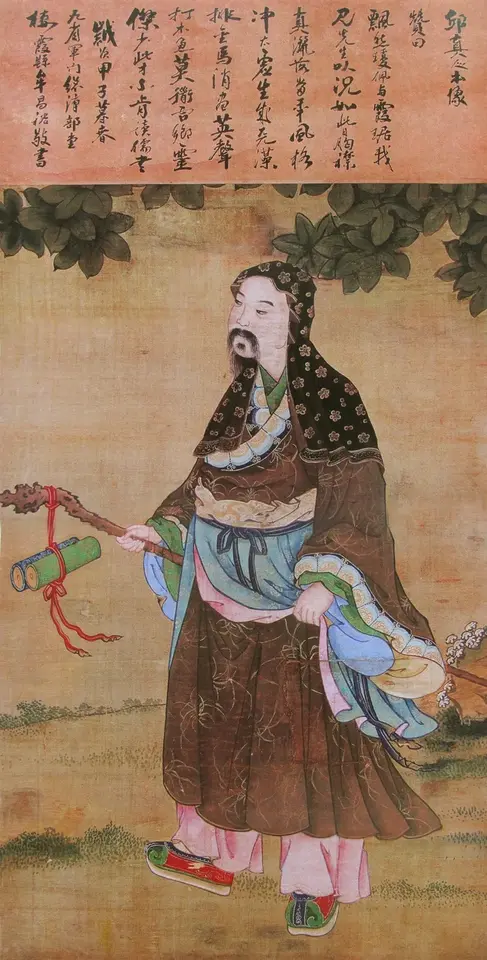
丘处机
[!NOTE] Qiu Chuji (February 10, 1148 – August 21, 1227), courtesy name Tongmi, Daoist title Changchunzi (Master of Constant Spring), and widely known as Qiu Changchun or Master Changchun, was a preeminent Daoist patriarch during the Jin-Yuan transition, the fifth Patriarch of the Quanzhen School, and the founder of the Quanzhen Longmen (Dragon Gate) lineage. Born in Qixia, Dengzhou (modern Qixia, Yantai, Shandong Province),…
[!NOTE] Qiu Chuji (February 10, 1148 – August 21, 1227), courtesy name Tongmi, Daoist title Changchunzi (Master of Constant Spring), and widely known as Qiu Changchun or Master Changchun, was a preeminent Daoist patriarch during the Jin-Yuan transition, the fifth Patriarch of the Quanzhen School, and the founder of the Quanzhen Longmen (Dragon Gate) lineage. Born in Qixia, Dengzhou (modern Qixia, Yantai, Shandong Province), he joined the Quanzhen order under its founder Wang Chongyang in 1168, becoming one of the celebrated "Seven True Daoists of the North" (Beiqizhen). Following Wang's death, he spent thirteen grueling years in ascetic meditation within mountain caves in Panxi and Mount Longmen, Shaanxi, forging an austere system of internal alchemy (neidan) that harmonized Confucian ethics, Chan Buddhism, and Daoist non-action. After assuming leadership of Quanzhen in 1203, he expanded congregations across northern China. In 1220, at seventy-three, he accepted the imperial summons of Genghis Khan, leading eighteen disciples across ten thousand miles of Central Asian deserts to the Hindu Kush mountains (Dashueshan, in modern Afghanistan). In historic audiences in 1222, he urged Genghis Khan to practice statecraft rooted in "revering Heaven, loving the people, and refraining from indiscriminate slaughter" (qubao zhisha). Deeply impressed, the Khan addressed him as "the Immortal," granting him a golden tiger tally, imperial decrees exempting Daoist establishments from taxes and corvée, and supreme jurisdiction over all religious practitioners in northern China. Stationed at the Changchun Palace (modern Baiyun Guan in Beijing), he used imperial protections to issue ordination certificates, rescuing hundreds of thousands of Han Chinese civilians from slaughter and enslavement, and elevating Quanzhen Daoism to its historical zenith.
Born into a peasant family in Bindu Village, Qixia, Dengzhou; orphaned in early childhood.
Entered the Kunyu Mountain Quanzhen Hermitage; became an indoor disciple of Wang Chongyang in 1168.
Escorted Wang Chongyang's coffin from Kaifeng to Zhongnan Mountain, observing three years of filial mourning.
Commenced six years of severe ascetic meditation in a rocky cave at Panxi, Baoji, known as the "Raincoat Master."
Relocated to Mount Longmen in Longzhou for seven years of deep contemplation, establishing the Longmen branch.
Summoned to the Jin capital of Zhongdu by Emperor Shizong, presiding over imperial Daoist liturgies.
Succeeded Liu Chuxuan as fifth Patriarch of the Quanzhen order, actively building temples across Shandong.
Invited by Jin authorities to peacefully pacify Yang An'er's Red Coat insurgent forces in Shandong.
Declined summons from Jin and Southern Song emperors, accepting Genghis Khan's invitation to stop wartime bloodshed.
Led eighteen disciples from Laizhou across the Mongolian plateau and Central Asian steppes toward the Hindu Kush.
Met Genghis Khan at Parwan; advocated governing by revering Heaven, loving the people, and refraining from slaughter.
Returned east to head the Tianchang Temple (later renamed Changchun Palace, modern Baiyun Guan) in Yanjing.
Passed away on August 21 at seventy-nine at Changchun Palace; interred in the Chushun Hall (Qiu Ancestral Hall).
Qiu Chuji was born on February 10, 1148, in Binduli, Qixia County, Dengzhou (modern Qixia, Shandong Province), into a modest rural household. Orphaned in early childhood, he experienced extreme material poverty and early disillusionment with the transience of mortal existence. From youth, he displayed an exceptional spiritual inclination, aspiring to transcend mundane worldly entanglements through Daoist self-cultivation.
In 1167, at the age of nineteen, he left his ancestral village and took monastic vows at the Quanzhen Hermitage on Mount Kunyu. In the spring of 1168, Wang Chongyang, the charismatic founder of the Quanzhen school, arrived in Ninghai from the Zhongnan Mountains in Shaanxi. Visiting the Quanzhen community established at Ma Yu's estate, the young novice was welcomed as an indoor disciple. Wang bestowed upon him the religious name Chuji, the courtesy name Tongmi, and the Daoist title Changchunzi ("Master of Constant Spring"), composing a poem predicting his profound mastery of the cosmic Dao. Alongside fellow disciples Ma Yu, Tan Chuduan, Liu Chuxuan, Wang Chuyi, Hao Datong, and Sun Bu'er, he formed the core circle later venerated as the "Seven True Daoists of the North" (Beiqizhen).
In the autumn of 1169, Wang Chongyang led Ma Yu, Tan Chuduan, Liu Chuxuan, and Qiu Chuji westward. Wang passed away in Bianliang (Kaifeng) in early 1170. Qiu Chuji assisted his senior brethren in escorting their master's coffin to Liu Jiang Village near Mount Zhongnan, observing three years of solitary mourning beside the tomb. In 1174, following the mourning period, the disciples dispersed to pursue independent spiritual paths. Qiu Chuji traveled alone to the precipitous cliffs of Panxi near Baoji, Shaanxi, residing in a natural rock cavern for six years.
At Panxi, Qiu Chuji practiced severe physical austerity. He possessed only a ragged straw raincoat, ate once a day, and walked barefoot through winter blizzards. By day, he ferried peasants and elderly villagers across the turbulent Panxi River on his back without charging fee; by night, he sat in cross-legged meditative absorption, disciplining his mind against physical torment and sensory distraction. In 1180, seeking deeper spiritual seclusion, he relocated to the remote caves of Mount Longmen in Longzhou for seven more years. Through thirteen years of relentless self-cultivation at Panxi and Mount Longmen, he synthesized internal alchemy with the metaphysics of the Daodejing, establishing the ascetic, morally rigorous Longmen lineage of Quanzhen Daoism.
In the spring of 1188, Emperor Shizong of Jin (Wanyan Yong), having heard of Qiu Chuji's reputation for transcendent spiritual virtue, dispatched an imperial envoy to Longzhou, summoning him to the central capital of Zhongdu (modern Beijing). Shizong received the master in an imperial audience, inquiring into the secrets of longevity and statecraft. Qiu Chuji frankly replied: "Nourishing one's nature lies in purifying the heart and diminishing desires; preserving an empire resides in following the Way of Heaven." Pleased with his directness, Shizong bestowed imperial peaches upon him, funded sacred images of Wang Chongyang, and appointed Qiu Chuji to preside over the solemn Universal Peace liturgical offerings (taiping jiao) during the imperial Wanchun Festival at Tianchang Temple.
In 1203, following the demise of the fourth Quanzhen Patriarch Liu Chuxuan, Qiu Chuji succeeded as the fifth Patriarch of the Quanzhen School. Over the next fifteen years, he made the eastern seaboard of Shandong—particularly Penglai, Qixia, Yexian, and Beihai—his primary base of evangelism. He traveled tirelessly among villages and cities, consecrating dozens of new temples and organizing popular lay congregations, embedding Quanzhen spirituality firmly into the fabric of northern Chinese society.
In the autumn of 1214, the brutal "Red Coat" (Hong'ao) peasant uprising led by Yang An'er erupted across Shandong. The Jin court dispatched Supreme Commander Pusan Anzhen with heavy troops to suppress the rebellion with devastating violence. Recognizing Qiu Chuji's immense moral authority among the populace, Jin authorities implored him to intervene as a peace envoy. Seeking to avert the mass slaughter of innocent peasants, Qiu Chuji entered the rebel camps unarmed, successfully persuading tens of thousands of insurgents to lay down their weapons and return to agricultural labor, saving countless lives.
As the Mongol cavalry pressed south, the Jin court fled to Kaifeng, while the Southern Song dynasty remained entrenched along the Yangtze. Emperors of both declining regimes—Emperor Xuanzong of Jin and Emperor Ningzong of Song—dispatched high envoys offering lavish gifts and the rank of National Preceptor to enlist Qiu Chuji's prestige. Astutely recognizing that the Jin dynasty was exhausted and the Song court lacked continental vision, Qiu Chuji firmly declined both imperial overtures.
In May 1219, while stationed in the steppes of Central Asia during his western conquests against Khwarazm, Genghis Khan heard reports from his Khitan counselor Yelü Chucai and imperial envoy Liu Zhonglu praising Qiu Chuji as a transcendent sage possessing the secrets of longevity and heaven's mandates. The Khan dispatched Liu Zhonglu with a golden tiger tally and an extraordinary handwritten edict, inviting the master across the world to an imperial audience.
The seventy-two-year-old patriarch realized that the rapid expansion of Mongol cavalry threatened millions of civilized lives across Eurasia with catastrophic annihilation. He perceived that this unprecedented summons offered the only historical opportunity to directly influence the supreme steppe conqueror toward mercy. In January 1220, Qiu Chuji selected eighteen prominent disciples, including Yin Zhiping, Li Zhichang, and Song Defang, and departed Haotian Temple in Laizhou on their ten-thousand-mile epic trek.
Crossing the Juyong Pass north of Yanjing, the party traversed the arid Gobi Desert, the Mongolian grasslands, the Altai Mountains, and the Irtysh River, entering the oasis kingdoms of Central Asia. Over two arduous years, the elderly master endured blizzards, sandstorms, and treacherous mountain passes. His disciple Li Zhichang kept a meticulous daily diary of the expedition, later published as the invaluable geographical and historical classic The Journey to the West of the Daoist Changchun (Changchun Zhenren Xiyou Ji).
In April 1222, Qiu Chuji crossed the Amu Darya River and traversed the Iron Gate Pass, arriving at Genghis Khan's military camp at Parwan in the Hindu Kush mountains (Dashueshan, in modern Afghanistan). The Khan granted the Daoist master a ceremonial reception, celebrated in history as the "Encounter of the Dragon and the Horse" (Genghis Khan was born in the Year of the Horse, Qiu Chuji in the Year of the Dragon).
In the autumn and winter of 1222, Genghis Khan summoned Qiu Chuji into his imperial yurt for three extended, confidential nocturnal audiences, commanding Yelü Chucai and Liu Zhonglu to record their dialogues. When the Khan eagerly asked whether the master possessed an elixir of immortality, Qiu Chuji candidly answered: "There exist methods for preserving health, but there is no medicine in this world for immortality." Delighted by his absolute honesty, Genghis Khan listened attentively as Qiu Chuji expounded the Daoist philosophy of governance.
Qiu Chuji forcefully argued that the Way of Heaven delights in preserving life and abhors killing. True longevity required "cultivating spiritual energy within and accumulating hidden virtue without." Cultivating energy meant curbing predatory conquests and sensory indulgence; accumulating virtue meant abandoning terror and ending the slaughter of civilians. Qiu Chuji declared: "Heaven possesses no personal favorites, but constantly aids the benevolent. Throughout antiquity, those who would unite all under Heaven must do so without delighting in the slaughter of human beings!" Genghis Khan was deeply moved, exclaiming to his assembled Mongol generals: "The Immortal's words are celestial truths granted by Heaven, matching my own inner thoughts; let my sons and commanders remember them well!" He ordered Yelü Chucai to compile the transcripts of their conversations into Record of the Auspicious Meeting of the Mysterious Wind (Xuanfeng Qinghui Lu).
Following the snow mountain dialogues, Genghis Khan revered Qiu Chuji as a living immortal, issuing an imperial decree inscribed on a golden tiger tablet. The decree proclaimed: "The Immortal Qiu is granted authority over all religious practitioners and virtuous people throughout the empire; no military or civil officials may harass or mistreat them; all Daoist temples and priests are exempt from all taxes, corvée, and military levies; all Daoist matters shall be settled entirely at the Immortal's discretion."
In the spring of 1224, Qiu Chuji returned in triumph to Yanjing. Imperial dignitaries, Mongol governors, and thousands of residents greeted him thirty miles outside the city walls. He took up residence at the Tianchang Temple, which Genghis Khan renamed the Changchun Palace (Changchun Gong, modern Baiyun Guan) by imperial edict in 1227.
During his final years, Qiu Chuji utilized his supreme imperial privileges to launch an unprecedented humanitarian rescue operation. As Mongol forces continued campaigns in northern China, captured cities were routinely subjected to mass extermination or the mass enslavement of Han populations. To save the populace, Qiu Chuji established eight major charitable congregations in Yanjing—such as the Pingdeng, Changchun, and Lingbao societies—and oversaw the restoration of thousands of Daoist temples across Shanxi, Hebei, Henan, and Shandong.
He commanded his disciples to mass-produce and freely distribute Quanzhen ordination certificates (dudie). Tens of thousands of Confucian scholars, displaced artisans, destitute peasants, and prisoners of war took monastic vows and donned Daoist robes, registering as Quanzhen clerics. Under the protection of the imperial decree, Mongol horsemen and local warlords were legally barred from entering Daoist temples or demanding tribute. Through this strategy, Qiu Chuji saved hundreds of thousands of Han Chinese lives from extermination and servitude, safeguarding the cultural elite, administrative knowledge, and demographic vitality of northern China.
On August 21, 1227 (ninth day of the seventh lunar month), having fulfilled his historic humanitarian mission, Patriarch Qiu Chuji passed away peacefully at Baoxuan Hall within Changchun Palace at eighty. Thousands of weeping citizens escorted his coffin to the Chushun Hall. In 1269, Kublai Khan posthumously conferred upon him the title "True Man of Constant Spring Who Expounds the Dao and Presides over Religion" (Changchun Yandao Zhujiao Zhenren). In 1310, Emperor Wuzong of Yuan elevated his title to "True Lord of Constant Spring, Perfected Virtue, Divine Transformation, and Bright Response," venerating him as the eternal patriarch of the Longmen lineage.
Qiu Chuji's most monumental historical achievement was his historic mission to the Hindu Kush mountains to persuade Genghis Khan to practice statecraft based on "revering Heaven, loving the people, and refraining from slaughter" (qubao zhisha), thereby saving millions of human lives and preserving the cultural bedrock of Chinese civilization.
During the early thirteenth-century Mongol expansion, the clash of nomadic military conquest with agrarian civilization threatened northern China with total annihilation. Mongol commanders routinely razed walled cities, massacred populations, and contemplated converting agricultural plains into pastureland.
At seventy-two, Qiu Chuji risked his life to traverse Central Asia on foot to confront the world's most formidable steppe conqueror. Instead of rigid moral lecturing, he strategically engaged the Khan's intense personal desires for longevity and imperial consolidation, demonstrating that longevity was physiologically incompatible with indiscriminate slaughter.
His courage transformed Mongol imperial policy. Following the meetings, Genghis Khan's directives toward conquered cities became substantially more moderate, and his generals adopted policies of pacification rather than slaughter. By sheltering hundreds of thousands of scholars, craftsmen, and farmers under the banner of the Quanzhen order, Qiu Chuji preserved the demographic, administrative, and technological foundations that later enabled Kublai Khan to adopt Chinese administrative institutions and restore national stability. Emperor Qianlong of the Qing dynasty immortalized his legacy in a famous imperial couplet at Beijing's Baiyun Guan: "Eternal life requires no earthly elixirs; with a single word halting slaughter, all under Heaven recognize the true Immortal."
Within the institutional history of Daoism, Qiu Chuji transformed Quanzhen from an informal network of regional ascetic hermits into the dominant, centralized monastic order of northern China. The Longmen (Dragon Gate) lineage that he established remains the principal monastic lineage of modern Daoism.
Drawing from his thirteen years of severe cave asceticism at Panxi and Mount Longmen, he synthesized a systematic spiritual discipline centered upon "the dual cultivation of inner nature and physical life, with priority on nature" (xingming shuangxiu, yi xing wei zhu). In Direct Pointers to the Great Elixir (Dadan Zhizhi) and The Panxi Collection (Panxi Ji), he rejected external laboratory alchemy and superstitious magic in favor of inner moral purification, mental stillness, and self-restraint.
Institutionally, Qiu Chuji established the centralized "Ten Directions Public Monastery" (shifang conglin) system, establishing Changchun Palace (Baiyun Guan) as the supreme national headquarters. He instituted standard rules of monastic ordination, dress, and wandering pilgrimage, formulating the enduring genealogical generation-poem of the Longmen lineage. This rigorous monastic discipline earned Quanzhen immense respect across all social strata, cementing its enduring institutional hegemony.
Qiu Chuji was also a visionary reformer who translated the philosophical syncretism of the "Three Teachings" (Confucianism, Buddhism, and Daoism) into active grassroots social welfare. While Wang Chongyang had championed the ideological harmony of the Three Teachings, Qiu Chuji embedded this concept into community service.
He taught that Daoist spiritual self-cultivation was inseparable from social benevolence and practical charity. Under his leadership, Quanzhen temples established charitable pharmacies, orphanages, grain reserves, and communal burial grounds for victims of war and famine. By transforming religious temples into civil society sanctuaries offering material sustenance, spiritual solace, and communal solidarity, he redefined Daoism as an active, socially responsible religion that helped reconstruct civic life in war-torn northern China.
FIGURES ASSOCIATED WITH THIS DYNASTY