Birth in Mianzhu
Born into an esteemed scholar-gentry lineage in Mianzhu, Guanghan, mastering Confucian classics and natural cosmology.
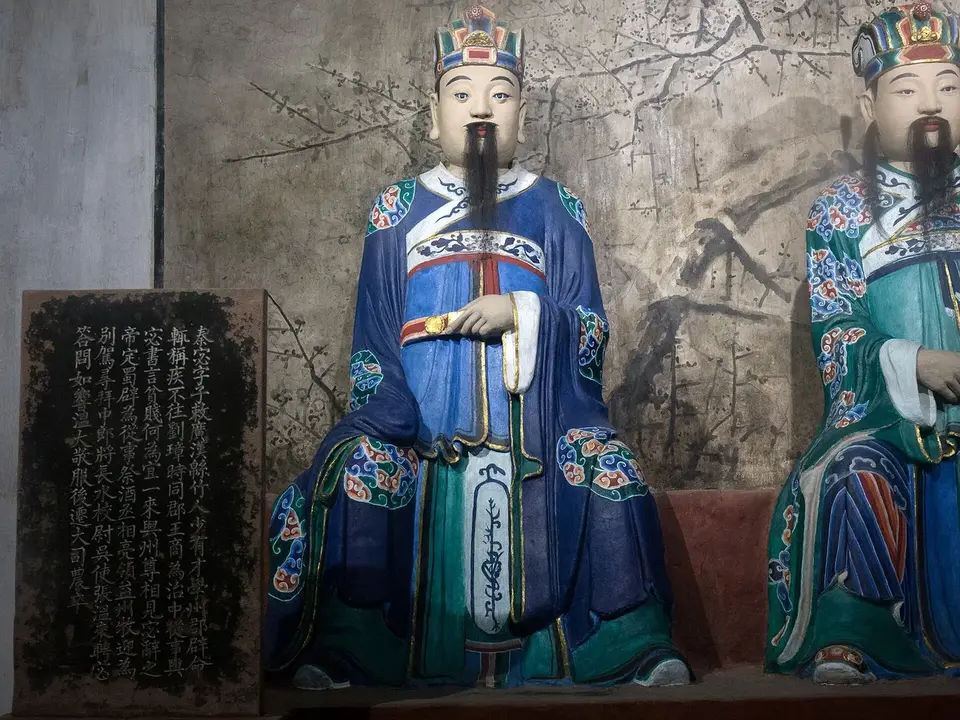
秦宓
Qin Mi (秦宓, ?–226 CE), courtesy name Zichi, was a native of Mianzhu in Guanghan Commandery (modern Luojiang District, Deyang City, Sichuan Province). He was an eminent Confucian classicist, philosopher, writer, and diplomat of the Shu Han state during the Three Kingdoms period, ultimately attaining the prestigious position of Minister of Finance (Da Sinong), one of the Nine Ministers. He also previously held key civil and…
Qin Mi (秦宓, ?–226 CE), courtesy name Zichi, was a native of Mianzhu in Guanghan Commandery (modern Luojiang District, Deyang City, Sichuan Province). He was an eminent Confucian classicist, philosopher, writer, and diplomat of the Shu Han state during the Three Kingdoms period, ultimately attaining the prestigious position of Minister of Finance (Da Sinong), one of the Nine Ministers. He also previously held key civil and military posts, including Senior Attendant of Yi Province, General of the Household of the Left, and Colonel of Changshui. Qin Mi was renowned from his youth for his extraordinary intellect, encyclopedic mastery of canonical texts, and unparalleled eloquence in dialectical disputation. During the warlord regimes of Liu Yan and Liu Zhang in Yi Province, he adamantly declined repeated official summonses by pleading chronic illness, preserving his integrity as an untamed forest recluse. Following Liu Bei's pacification of Yi Province, Qin Mi entered government service, initially serving as Master and Friend to Administrator Xiahou Zuan of Guanghan before joining Liu Bei's provincial administration. In 221 CE, when Liu Bei resolved to launch a massive eastern campaign against Sun Quan to avenge Guan Yu and reclaim Jingzhou, Qin Mi presented an outspoken remonstrance citing unfavorable celestial omens and severe geopolitical vulnerability. This provoked Liu Bei's intense fury, leading to Qin Mi's immediate imprisonment, from which he was later pardoned through the intercession of court colleagues. After Liu Shan ascended the throne and Chancellor Zhuge Liang assumed concurrent governance of Yi Province, Zhuge Liang recruited Qin Mi with paramount ceremonial honors as Senior Attendant of Yi Province. In 224 CE, Eastern Wu envoy Zhang Wen visited Chengdu. Exuding intellectual arrogance based on the cultural prestige of Jiangdong, Zhang Wen sought to humiliate Shu Han courtiers during a state banquet. Zhuge Liang summoned Qin Mi to face the challenge. When Zhang Wen raised intricate and provocative metaphysical questions concerning whether Heaven had a head, ears, feet, or a surname, Qin Mi cited canonical texts such as the Classic of Poetry with dazzling wit and rigorous logic, proving each proposition flawlessly and reducing Zhang Wen to utter astonishment and reverent surrender. This historic confrontation, celebrated as "Qin Mi's Disputation with Zhang Wen," greatly elevated Shu Han's diplomatic stature and cultural authority. Qin Mi later rose to Minister of Finance, supervising national agricultural revenues and grain reserves until his death in 226 CE. Celebrated by Chen Shou as a premier debater of Shu endowed with sumptuous literary talent, his surviving treatises include Disquisition on the Nature of Heaven and Reply to Wang Shang.
Born into an esteemed scholar-gentry lineage in Mianzhu, Guanghan, mastering Confucian classics and natural cosmology.
Repeatedly declined administrative summonses from warlords Liu Yan and Liu Zhang by claiming chronic illness.
Recruited as Master and Friend Libationer by Administrator Xiahou Zuan and recommended to Liu Bei after Chengdu fell.
Imprisoned by Liu Bei after fiercely opposing the punitive expedition against Sun Quan on geopolitical grounds.
Appointed Senior Attendant of Yi Province by Chancellor Zhuge Liang with exceptional diplomatic and cultural protocols.
Overwhelmed Eastern Wu envoy Zhang Wen in an intellectual debate over Heaven during an official state banquet.
Promoted successively to General of the Household, Colonel of Changshui, and finally Minister of Finance.
Passed away in Chengdu; posthumously mourned by Emperor Liu Shan and Chancellor Zhuge Liang.
Qin Mi, styled Zichi, was born in Mianzhu County of Guanghan Commandery in northern Yi Province during the mid-to-late Eastern Han dynasty. Since the civilizing educational reforms of Wen Weng and the literary brilliance of Sima Xiangru in the Han dynasty, the Sichuan Basin had long fostered a vibrant tradition of classical scholarship, rhetorical elegance, and dialectical debating. Born into a distinguished family dedicated to Confucian learning, Qin Mi exhibited precocious intellectual talent, immersing himself in the canonical Confucian scriptures, cosmological texts, and diverse philosophical schools. He developed a keen and agile analytical mind, consistently presenting arguments that were unexpected yet strictly founded upon classical authority.
As a young scholar, Qin Mi embraced the refined temperament of a noble recluse. He withdrew from worldly ambitions, refusing to pursue conventional bureaucratic careers through standard patron-client recommendations. In the twilight decades of the Eastern Han, when regional governors Liu Yan and his successor Liu Zhang controlled Yi Province, both warlords actively sought to co-opt regional literati and magnate families to stabilize their administrative grip. Both father and son dispatched envoys bearing lavish ceremonial gifts to recruit Qin Mi as an Attendant Officer or Bureau Director.
Recognizing that the governance of Liu Yan and Liu Zhang was politically slack and unsustainable amid widespread turmoil, Qin Mi refused to compromise his intellectual autonomy. He repeatedly declined all official overtures, alleging persistent infirmities and confinement to bed. In his native Mianzhu, he established private lecture halls, teaching classical ethics to local students and exchanging statecraft perspectives with fellow scholars, earning widespread renown across western Sichuan as an uncorrupted master of Confucian lore.
In the nineteenth year of Jian'an (214 CE), Liu Bei laid siege to Chengdu, prompting Liu Zhang's unconditional surrender, whereupon Liu Bei formally assumed the governorship of Yi Province. In reorganizing the commandery administrations, Liu Bei appointed Xiahou Zuan as Administrator of Guanghan. Having long admired Qin Mi's extraordinary reputation, Xiahou Zuan traveled in modest carriage to Mianzhu immediately upon arrival to pay homage to Qin Mi, formally honoring him as "Master and Friend Libationer" and seeking his counsel on local governance, agricultural relief, and civil justice.
Deeply impressed by Qin Mi's vast learning, Xiahou Zuan sent an official dispatch to the Senior Attendant of Yi Province, praising Qin Mi's literary and moral stature as equal to the greatest Western Han luminaries, Sima Xiangru and Yang Xiong, and vehemently recommending him to Liu Bei. Pleased by this commendation, Liu Bei issued an official summons inducting Qin Mi into his provincial administrative headquarters as an Attendant Officer.
In 219 CE, Shu Han suffered a catastrophic reverse when Guan Yu lost Jingzhou and was killed by Eastern Wu forces. In 221 CE, Liu Bei declared himself Emperor in Chengdu. Driven by profound grief and the strategic imperative to recover Jingzhou, Liu Bei mobilized the full military might of the newly established empire to mount a punitive expedition against Sun Quan. While generals such as Zhao Yun urged caution, Liu Bei remained adamant.
During a decisive imperial court conference, Qin Mi stepped forward to deliver an uncompromising remonstrance based on astrological portents and military logistics. Qin Mi argued passionately: "Your Majesty has newly ascended the throne, and the realm looks up to your virtue. The celestial signs are currently unfavorable, and the astrological configuration in the southwest signals disaster. An expedition against Wu will yield no tactical advantage and will merely bleed the vital energies of the state. I implore Your Majesty to curb righteous indignation, conserve our troops, and focus on the northern threat of Cao Wei!" Infuriated that Qin Mi publicly predicted military failure during mobilization rituals, Liu Bei ordered the immediate confiscation of his official robes and remanded him to prison awaiting execution. Only through the persistent appeals of Zhuge Liang and other ministers was Qin Mi spared capital punishment and subsequently released. Soon afterward, Liu Bei suffered an overwhelming defeat at the Battle of Yiling against Lu Xun, vindicating Qin Mi's prophetic insight.
In the first year of Jianxing (223 CE), Liu Shan succeeded to the throne, and Chancellor Zhuge Liang assumed comprehensive administration of Shu Han affairs. Fully appreciative of Qin Mi's intellectual brilliance and moral backbone, Zhuge Liang, upon assuming concurrent duties as Governor of Yi Province, invited Qin Mi to serve as Senior Attendant of Yi Province with the highest ceremonial honors. The Senior Attendant served as the chief civilian deputy to the provincial governor, deliberating on all confidential political, administrative, and strategic matters.
A paramount foreign policy objective of Zhuge Liang's early regency was restoring the defensive coalition with Eastern Wu against Cao Wei. In 224 CE, Sun Quan dispatched General of the Household Zhang Wen on a formal diplomatic return mission to Chengdu. Coming from one of Wu's prominent aristocratic lineages and possessing considerable oratorical talent, Zhang Wen behaved with marked condescension, seeking to display the cultural superiority of the southern maritime regions over the inland mountain realm of Shu.
At a grand state banquet hosted by Shu Han for Zhang Wen, attended by the civil and military elite, Zhuge Liang deliberately sent for Senior Attendant Qin Mi. Arriving late with unhurried demeanor and relaxed robes, Qin Mi immediately drew Zhang Wen's attention. Seeking to embarrass the Shu scholar before the entire assembly, Zhang Wen launched an abrupt philosophical challenge: "Sir, since you are reputed to be master of all learning, may I inquire whether Heaven has a head?"
Without an instant's hesitation, Qin Mi answered: "Heaven certainly possesses a head!" Zhang Wen pressed with a skeptical smirk: "Where then is Heaven's head located?" Qin Mi calmly replied: "Heaven's head lies in the West! The Classic of Poetry states: 'He turned his gaze toward the West.' Had Heaven no head in the West, how could it turn to gaze westward?" Startled by this immediate textual rejoinder, Zhang Wen posed another dialectical trap: "Does Heaven possess ears?" Qin Mi retorted: "Heaven resides on high yet hears what is low. The Classic of Poetry proclaims: 'The crane cries in the nine marshlands, and its sound is heard in the heavens.' If Heaven had no ears, how could it hear the cry of the crane?" Zhang Wen inquired further: "Does Heaven have feet?" Qin Mi responded effortlessly: "Heaven indeed has feet! The Classic of Poetry laments: 'The march of Heaven is difficult.' If Heaven lacked feet, how could it march or tread?"
Confounded by Qin Mi's seamless integration of metaphorical canonical literature, Zhang Wen delivered his ultimate riddle: "Tell me then, does Heaven possess a surname?" Qin Mi replied instantly: "Heaven's surname is Liu!" Zhang Wen asked in astonishment for his proof. Qin Mi stated firmly: "The current Son of Heaven bears the surname Liu. Since the Emperor is the Son of Heaven, how could Heaven bear any surname other than Liu?"
Witnessing Qin Mi's unassailable dialectical agility, Zhang Wen shifted his inquiry toward archaic mythology and ancient moral exemplars. Qin Mi expounded from Fu Xi's divination lines to King Wen's elaboration of the Classic of Changes with majestic eloquence and philosophical depth. Thoroughly awed and humbled, Zhang Wen stood up, bowed deeply, and conceded: "Hearing your profound exposition today, I realize that Shu indeed harbors extraordinary talent." This intellectual triumph completely disarmed Eastern Wu's diplomatic arrogance, securing unprecedented cultural prestige and sovereign dignity for the nascent Shu Han court.
Following the disputation with Zhang Wen, Qin Mi's fame resonated throughout Wu and Shu. Zhuge Liang elevated him to General of the Household of the Left and later to Colonel of Changshui, placing him in nominal command of elite guard forces.
Around the third year of Jianxing (225 CE), after Zhuge Liang concluded the Southern Expedition, Shu Han faced the urgent task of restoring agricultural productivity and fiscal balance to finance future northern campaigns. Recognizing Qin Mi's integrity and deep comprehension of administrative principles, the court appointed him Minister of Finance (Da Sinong), one of the Nine Ministers responsible for state agricultural taxes, public granaries, and fiscal transport. In this office, Qin Mi performed diligently, standardizing grain requisitions, maintaining stable granary reserves, and supporting the economic foundations of the realm.
In the fourth year of Jianxing (226 CE), Qin Mi passed away in Chengdu after a severe illness. Emperor Liu Shan issued an imperial condolence decree granting generous funeral provisions, while Zhuge Liang deeply mourned the loss of a trusted state counselor.
Beyond his diplomatic and administrative achievements, Qin Mi left a profound legacy in literature and cosmology. His major treatises, including Disquisition on the Nature of Heaven and Reply to Wang Shang, combined rigorous dialectical inquiry with elegant rhapsodic prose. In the Records of the Three Kingdoms, Western Jin historian Chen Shou lauded Qin Mi's literary brilliance and intellectual breadth, ranking him among the finest scholars and debaters of Shu Han and preserving his deeds as an enduring emblem of Bashu cultural excellence.
During the chaotic governance of Liu Yan and Liu Zhang in late Eastern Han Sichuan, Qin Mi repeatedly declined official appointments, preserving his scholarly detachment. By living as an independent commoner educator in Mianzhu, he provided an enduring moral compass of incorruptibility for the intellectual community of the Sichuan Basin.
In 221 CE, in the face of widespread imperial momentum for an immediate retaliatory strike against Eastern Wu, Qin Mi risked his life to dissuade Liu Bei, arguing on cosmological and strategic grounds that the campaign was untimely. Though cast into prison for his outspoken truth, the tragic outcome at Yiling entirely confirmed his exceptional geopolitical foresight and unyielding ministerial fidelity.
During Eastern Wu envoy Zhang Wen's visit in 224 CE, Qin Mi defended the dignity of Shu Han during an official banquet by answering intricate dialectical interrogations on the nature of Heaven using classical canonical verses. His quick wit completely disarmed the envoy's haughtiness, creating the celebrated historical precedent of "Qin Mi's Disputation with Zhang Wen" and elevating Shu Han's international standing.
In his final years, Qin Mi served as Minister of Finance, directing imperial taxation, granary administration, and grain reserves. His upright management provided the vital logistical and financial stability required for domestic reconstruction following the Southern Campaign and prepared the economic groundwork for Chancellor Zhuge Liang's subsequent Northern Expeditions.
FIGURES ASSOCIATED WITH THIS DYNASTY