Birth in Zhongzhou
On January 24, Qin Liangyu was born into a cultured gentry family in Mingyuxi, Zhongzhou, Sichuan.
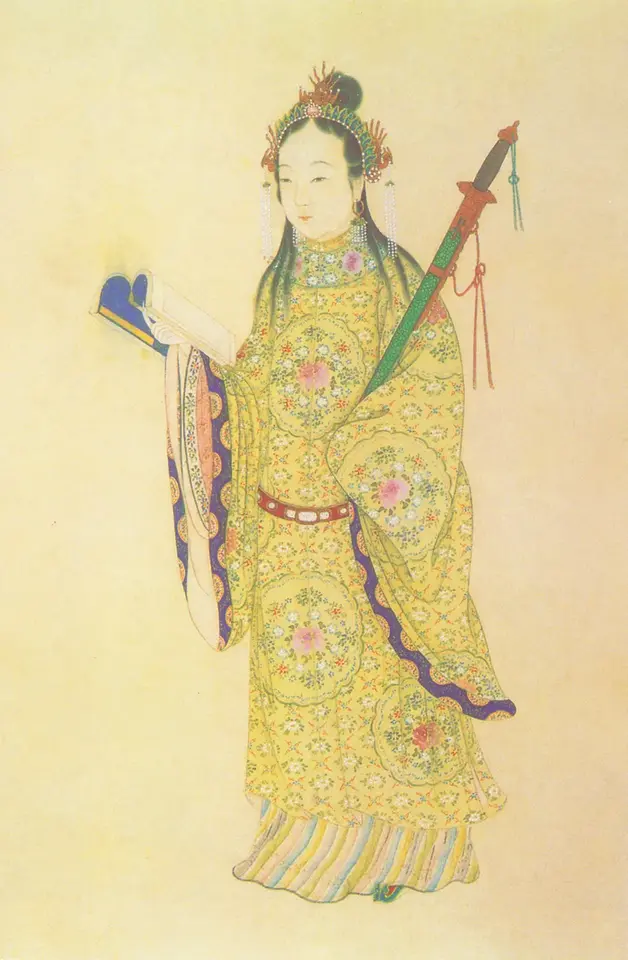
秦良玉
Qin Liangyu (秦良玉, January 24, 1574 – July 11, 1648), courtesy name Zhensu (贞素), was a preeminent female military commander, national hero, and strategist of the late Ming dynasty hailing from Zhongzhou, Sichuan (modern Zhong County, Chongqing). Endowed with extraordinary martial courage and intellectual acuity, she was an expert equestrian archer and classical prose writer whose armies maintained iron discipline. In her…
Qin Liangyu (秦良玉, January 24, 1574 – July 11, 1648), courtesy name Zhensu (贞素), was a preeminent female military commander, national hero, and strategist of the late Ming dynasty hailing from Zhongzhou, Sichuan (modern Zhong County, Chongqing). Endowed with extraordinary martial courage and intellectual acuity, she was an expert equestrian archer and classical prose writer whose armies maintained iron discipline. In her youth, she fought alongside her husband Ma Qiancheng, Pacification Commissioner of Shizhu, during the suppression of Yang Yinglong's rebellion in Bozhou, achieving the foremost military merits along the Nanchuan route. Following Ma's wrongful death in prison in 1613, Qin was officially appointed to succeed him as Pacification Commissioner of Shizhu, drilling and commanding the legendary White Spear Troops. During the late Ming border crises, Qin dispatched her brothers Qin Bangping and Qin Minping to relieve Liaodong against the Later Jin forces. In the ferocious Battle of the Hun River in 1621, Qin Bangping died heroically after slaying thousands of enemy cavalry, whereupon Qin Liangyu personally led three thousand troops to reinforce Shanhaiguan. That same autumn, when She Chongming launched the massive She-An Rebellion in Sichuan, Qin executed the rebel envoys, recaptured Xindu, relieved the siege of Chengdu, and reclaimed Chongqing, earning promotion to Regional Commander and Vice Commander-in-Chief. In 1630, when Later Jin armies laid siege to Beijing, Qin exhausted her household wealth to fund military provisions, leading her forces thousands of miles to relieve the capital, where the Chongzhen Emperor granted her an imperial audience at the platform and composed four imperial poems honoring her service. In her later years, Qin resisted the incursions of peasant rebel leaders Zhang Xianzhong and Luo Rucai across eastern Sichuan, capturing enemy standards in several engagements. After the fall of Beijing and Zhang Xianzhong's proclamation of an empire in Chengdu in 1644, seventy-year-old Qin issued a solemn manifesto vowing to defend her borders to the death; her defensive fortifications prevented the rebel forces from ever crossing into Shizhu. The Southern Ming regimes successively ennobled her as Marquis of Zhongzhen and Grand Preceptor of the Heir Apparent. She died peacefully in 1648 at age seventy-four. In the Twenty-Four Dynastic Histories, Qin Liangyu is the sole female general honored with an independent standalone biography in the official History of Ming.
On January 24, Qin Liangyu was born into a cultured gentry family in Mingyuxi, Zhongzhou, Sichuan.
Married Ma Qiancheng, hereditary Pacification Commissioner of Shizhu, assisting him in military reforms and establishing the White Spear Troops.
Campaigned alongside her husband against Yang Yinglong, capturing seven mountain strongholds and winning top honors.
Following Ma Qiancheng's tragic death in prison due to eunuch extortion, Qin was appointed Pacification Commissioner of Shizhu.
Dispatched her brothers to defend Liaodong, fighting heroically at the Hun River; subsequently led three thousand troops to defend Shanhaiguan.
Defeated She Chongming's rebel forces, lifted the siege of Chengdu, and recaptured Chongqing, elevated to Vice Commander-in-Chief.
Led her troops thousands of miles to defend Beijing against the Later Jin, receiving four imperial commemorative poems from the Chongzhen Emperor.
Routed the joint forces of Zhang Xianzhong and Luo Rucai at Majiazhai, capturing Luo Rucai's commander-in-chief banner.
Refused surrender to Zhang Xianzhong following the fall of Chengdu, fortifying mountain passes to preserve Shizhu territory intact.
Passed away on July 11 at Dahekou in Shizhu at age seventy-four, posthumously honored as Zhongzhen.
Qin Liangyu was born on January 24, 1574, in Mingyuxi, Zhongzhou, Sichuan. Her father, Qin Kui, was an erudite scholar who combined profound classical learning with extensive knowledge of military tactics. Observing the chronic military decay and frontier turbulence of the late Ming period, Qin Kui resolved that all his children, regardless of gender, should master martial arts alongside Confucian scholarship. He provided Qin Liangyu with rigorous training in horsemanship, archery, swordsmanship, and tactical formations. Blessed with remarkable physical stamina, natural courage, and a commanding yet modest demeanor, Qin Liangyu developed formidable combat proficiency while cultivating sophisticated literary skills.
In 1595, at the age of twenty-two, Qin Liangyu married Ma Qiancheng, hereditary Pacification Commissioner of Shizhu and a direct descendant of the renowned Han dynasty general Ma Yuan. Shizhu was an autonomous indigenous chieftaincy situated among the steep karst peaks of eastern Sichuan. Working in close partnership with her husband, Qin Liangyu reorganized the local military establishment. Utilizing the dense, flexible white ash wood native to the region, she designed a specialized long spear equipped with an iron hook at the blade and an interlocking ring at the butt, creating the renowned White Spear Troops. This light infantry force was rigorously drilled in mountain ambushes, wall-scaling, and anti-cavalry formations.
In 1599, Yang Yinglong, hereditary chieftain of Bozhou, launched a massive rebellion across Guizhou and southern Sichuan. In 1600, Ma Qiancheng mobilized three thousand White Spear warriors under Supreme Commander Li Hualong, with Qin Liangyu commanding an elite vanguard of five hundred soldiers to protect military provisions and fortify the strategic pass of Dangkan. When rebel forces staged a nocturnal surprise attack on the imperial encampment, Qin and her husband counterattacked instantly, routing the enemy vanguard and storming seven fortified mountain palisades in rapid succession before capturing Sangmu Pass. Although her tactical performance ranked foremost along the Nanchuan operational corridor, Qin modestly declined to seek personal imperial rewards.
In 1613, Ma Qiancheng fell victim to malicious extortion by court tax eunuch Qiu Chengyun, who falsely accused the commissioner of insubordination when Ma refused to supply extortionate bribes. Ma was arrested and cast into a damp dungeon in Yunyang, where he died of severe illness. Confronted with this personal tragedy, Qin Liangyu conducted herself with exceptional fortitude. Recognizing her unquestioned military authority and loyalty, the Ming court issued a special decree appointing her to succeed her husband as Pacification Commissioner of Shizhu, granting her sole command over the indigenous military forces.
In 1620, the Later Jin under Nurhaci launched massive offensives in Liaodong, capturing key frontier garrisons. The newly enthroned Taichang Emperor issued urgent appeals for provincial reinforcements. Qin Liangyu responded immediately, dispatching her elder brother Qin Bangping and younger brother Qin Minping at the head of several thousand elite White Spear infantry to the northeastern front. The court conferred upon Qin Liangyu third-grade ceremonial robes, commissioning Qin Bangping as Assistant Regional Commander.
In March 1621, Later Jin forces laid siege to the northern metropolis of Shenyang. Upon the fall of the city, Qin Bangping and Qin Minping crossed the Hun River alongside General Chen Ce's Zhejiang troops to engage the Later Jin Eight Banners in a legendary pitched battle. Forming dense spear walls along the riverbanks, the White Spear infantry held their ground against ferocious cavalry charges, killing thousands of elite banner warriors. Overwhelmed by artillery barrages and lacking reinforcements, Qin Bangping and hundreds of his men died heroically on the battlefield, while Qin Minping fought his way out with severe wounds. Upon receiving news of her brother's sacrifice, Qin Liangyu suppressed her grief and marched three thousand reinforcements across the empire to reinforce Shanhaiguan, enforcing absolute discipline that left civilian communities untouched. The Tianqi Emperor rewarded her with second-grade robes and the title Lady of the First Rank.
In September 1621, the Ministry of War ordered Qin Liangyu to return to Sichuan to recruit additional troops. At that critical juncture, She Chongming, hereditary chieftain of Yongning, launched a massive uprising in Chongqing, coordinating with Guizhou rebel An Bangyan in the She-An Rebellion. Rebel commander Fan Long seized Chongqing and dispatched envoys carrying rich treasures to solicit an alliance with Qin Liangyu. Demonstrating unbending dynastic loyalty, Qin executed the rebel envoys on the spot and mobilized the entire military strength of Shizhu. Leading her brother Qin Minping and nephews Qin Yiming and Qin Gongming, she sailed upriver under cover of darkness, seized Nanping Pass to cut off the rebel retreat, and ambushed the enemy flotilla, burning hundreds of rebel vessels and securing the Yangtze gorges.
In 1622, She Chongming concentrated his main armies to besiege the provincial capital of Chengdu. As other regional chieftains hesitated or accepted rebel bribes, Sichuan Governor Zhu Xieyuan summoned Qin Liangyu. Beating war drums, Qin launched a rapid western counter-offensive, capturing Xindu and routing the rebel vanguard outside Chengdu, lifting the hundred-day siege of the provincial metropolis.
Following this triumph, Qin pursued the retreating rebels across eastern Sichuan, storming the mountain fortresses of Erlang Pass and Fotu Pass to liberate Chongqing. The Tianqi Emperor promoted her to Assistant Commissioner-in-Chief, Vice Commander-in-Chief, and Regional Commander. Continuing her campaign, she recaptured Hongyadun, Guanyinsi, and Qingshandun, driving She Chongming to commit suicide and pacifying the central Sichuan basin.
In the winter of 1629, Later Jin ruler Hong Taiji bypassed the fortified Shanhai Pass defenses by crossing the Great Wall through Da'ankou in eastern Hebei, capturing Zunhua and Yongping and advancing directly upon the walls of Beijing. The Chongzhen Emperor declared martial law and issued urgent decrees summoning provincial armies to relieve the capital.
Stationed in remote eastern Sichuan, Qin Liangyu received the imperial call to arms and mobilized immediately. She exhausted her private household treasury to finance arms and provisions, leading thousands of White Spear veterans on a forced march across thousands of miles to Beijing. Arriving in early 1630, her troops were stationed at strategic approaches outside Guangqu Gate and Dongbian Gate, maintaining immaculate discipline and successfully checking the enemy's probing attacks. Following the withdrawal of the Later Jin armies, the siege of the capital was lifted.
Profoundly moved by Qin Liangyu's loyalty and sacrifice, the Chongzhen Emperor granted her an audience at the imperial platform within the palace grounds. The emperor bestowed upon her ceremonial robes, jade ornaments, and sacrificial livestock, while personally composing four seven-character quatrains in her honor. The poems contained celebrated verses praising her mastery of ancient military formations and declaring: "How many outstanding men exist across the realm, yet none can rival General Qin in heroic duty!" Following this high honor, Qin marched her main forces back to Sichuan, leaving her nephew Qin Yiming to garrison the capital approaches.
During the 1630s and 1640s, widespread peasant rebellions swept across central China. In 1634, rebel leader Zhang Xianzhong captured Kuizhou in eastern Sichuan. Qin Liangyu rushed to the scene with her cavalry, causing Zhang to withdraw without giving battle; she coordinated with her son Ma Xianglin to attack the rebels, driving them back into Huguang. In 1640, Zhang Xianzhong and Luo Rucai launched another major incursion into Sichuan. Qin engaged Luo Rucai at Majiazhai, slaying six hundred enemy soldiers, capturing Luo's primary command banner, and capturing several subordinate chieftains.
However, Ming defensive coordination deteriorated under Supreme Commander Yang Sichang and Sichuan Governor Shao Jiechun, who adopted passive defensive postures that surrendered strategic passes. In late 1640, Zhang Xianzhong crossed the Yangtze and routed imperial forces at Zhujunping. Qin Liangyu offered to mobilize twenty thousand indigenous warriors at her own expense if the provincial government would provide partial grain subsidies, but Shao Jiechun declined due to empty granaries, resulting in the collapse of the Sichuan defenses.
In 1644, Beijing fell to Li Zicheng, and Zhang Xianzhong captured Chengdu, establishing the Daxi regime and demanding the submission of all Sichuan chieftains. The seventy-year-old Qin Liangyu assembled her commanders and wept, declaring that both her brothers had fallen in battle and that having enjoyed imperial favor for decades, she would never yield to rebels. She issued a solemn manifesto vowing to defend Shizhu to the last warrior, posting elite forces along every mountain pass. Intimidated by the renowned White Spear Troops, Zhang Xianzhong's armies never dared to cross the borders of Shizhu. In 1646, the Southern Ming Longwu Emperor conferred upon her the noble title Marquis of Zhongzhen and Grand Guardian of the Heir Apparent, while the Yongli Emperor appointed her Grand Preceptor and Pacification Commander of Sichuan. On July 11, 1648, Qin Liangyu passed away peacefully at age seventy-four in Dahekou, Shizhu, and was interred at Mount Huilong.
Qin Liangyu's preeminent contribution to Chinese military history lay in her creation of the White Spear Troops and her tactical innovations in mountain warfare. Recognizing that standard imperial cavalry and heavy chariots were useless across the jagged topography of southwest China, she utilized tough, flexible white ash wood to craft the unique White Spear. The weapon featured a razor-sharp steel spearhead with an auxiliary hooked blade at the top and a durable iron ring at the base. In mountain maneuvers, soldiers hooked the spears end-to-end to create functional scaling ladders over vertical precipices; in combat, the hooks severed horse sinews and pulled armored cavalrymen from their saddles, while the rings could be used for blunt striking.
In military discipline, Qin implemented the stringent principles formulated by Qi Jiguang, enforcing mutual squad accountability and uncompromising behavioral codes. Her troops were strictly prohibited from pillaging civilian property or harming villagers. By sharing the hardships of her soldiers, inspecting perimeter outposts through winter freezes, and distributing supplies equitably, she built a fearless mountain fighting force that earned nationwide renown from the borders of Guizhou to the plains of Liaodong.
The Battle of the Hun River in 1621 stood as one of the most heroic engagements fought by Ming armies against the rising power of the Later Jin. When regional commanders in Liaodong fled in panic following the fall of Shenyang, Qin Liangyu's family led their elite southwestern infantry thousands of miles to confront the Eight Banners in open combat. Under Qin Bangping and Qin Minping, the White Spear infantry formed tight defensive squares along the river, repeatedly repelling the cavalry charges of the Plain Red and Plain Yellow Banners and killing thousands of elite enemy warriors.
Despite being cut off from imperial relief and subjected to intense artillery fire, the White Spear warriors fought to the last breath, with Qin Bangping dying alongside his men on the riverbank. This bloody engagement checked the momentum of the Later Jin advance and demonstrated that disciplined Chinese infantry could stand firm against Jurchen cavalry. Qin Liangyu's willingness to sacrifice her closest kin for dynastic survival earned her household the highest veneration throughout the empire.
The She-An Rebellion represented the most dangerous indigenous uprising faced by the Ming dynasty in southwestern China, threatening to sever Sichuan, Guizhou, and Yunnan from imperial control. When prominent civil officials were besieged in Chengdu and provincial armies disintegrated, Qin Liangyu provided the decisive military leadership that turned the tide of the war.
Deploying rapid amphibious maneuvers along the Yangtze and executing bold mountain flanking assaults, she broke the siege of Chengdu, recaptured Chongqing, and cleared strategic passes including Fotu Pass and Erlang Pass. Over a decade of arduous campaigning, her forces reclaimed dozens of provincial cities, annihilated rebel strongholds, and preserved the political integrity of the southwestern frontier. Her operational brilliance established her as the primary savior of the civilian population of Sichuan.
During the catastrophic collapse of the Ming dynasty, when numerous high-ranking civil governors, imperial dukes, and regional generals defected to either the Qing invaders or peasant rebel forces, Qin Liangyu remained an unyielding pillar of moral integrity. Even as a septuagenarian in a remote corner of Sichuan, she mobilized her indigenous subjects to defend their ancestral territory, transforming Shizhu into an unbreachable sanctuary that sheltered hundreds of thousands of refugees from the horrors of the late Ming wars.
Recognizing her extraordinary military achievements and unquestioned loyalty, the Qing scholars who compiled the official History of Ming under Zhang Tingyu broke with centuries of historiographical convention. Rather than relegating her to the collective Biographies of Exemplary Women, where female figures were traditionally confined, the imperial historians placed Qin Liangyu alongside the foremost male commanders of the era in Biographies Volume 158. She remains the sole female military commander in the Twenty-Four Dynastic Histories to receive an independent, standalone biographical chapter, securing her eternal glory in Chinese history.
FIGURES ASSOCIATED WITH THIS DYNASTY