Detailed Biography
Early Learning and Polymathic Formation
Qin Jiushao was born in 1208 in Anyue, Puzhou (modern Sichuan). His father, Qin Jiyou, earned the jinshi degree in 1193 and served as Prefect of Bazhou. In March 1219, mutinous troops led by Zhang Fu and Mo Jian staged a widespread uprising across northern Sichuan, capturing several strategic cities including Lizhou, Langzhou, and Puzhou. As the rebels stormed Bazhou, Qin Jiyou abandoned the city and fled eastward with his family, eventually arriving in the Southern Song capital of Lin'an (modern Hangzhou).
In Lin'an, Qin Jiyou was appointed Vice Director in the Ministry of Works (Gongbu Langzhong) and Vice Director in the Palace Library (Mishu Shaojian). The Ministry of Works directed major public building works throughout the empire, while the Palace Library housed imperial archives and supervised the Astrological Bureau (Taishi Ju). This privileged administrative environment afforded the young Qin Jiushao unprecedented access to rare mathematical, astronomical, and architectural treatises.
Qin studied astronomical calendars and instruments with royal astrologers, visited civil engineering sites to learn masonry, carpentry, and surveying from master craftsmen, and learned esoteric mathematical techniques from a reclusive scholar. Furthermore, he studied classical parallel prose (pianli) under the celebrated writer Li Liu. Endowed with extraordinary mental agility, Qin became proficient in star-mapping, musical acoustics, calculating art, architectural drafting, archery, swordsmanship, horsemanship, and football (cuju). Contemporaries praised him for his versatile genius across humanities, sciences, and physical arts.
Wartime Service and Regional Posts
In June 1225, Qin Jiyou was appointed Prefect of Tongchuan (modern Santai, Sichuan), and Qin Jiushao returned to Sichuan with his father. With Mongol armies expanding into Gansu and Shaanxi, northern Sichuan became a volatile frontier. The Southern Song government recruited five thousand local volunteers to form guerrilla defense units. At age eighteen, Qin Jiushao was chosen as the commander of these militia forces, coordinating local scouting and defensive positions to protect rural communities.
In October 1229, Qin Jiushao was appointed Sheriff of Qi County (Qixian Wei), formally entering the bureaucratic ranks. In August 1231, he assisted the prominent Neo-Confucian statesman Wei Liaoweng in pacifying tribal disturbances in Luzhou, personally directing the reconstruction of ruined ramparts, parapets, and arrow-slits. In 1233, when Wei Liaoweng and Wu Qian inspected the defense routes of Tongchuan and Chengdu, Qin met Wu Qian, initiating a lifelong political association.
In 1236, Mongol armies launched a massive invasion of Sichuan, ravaging the Jialing River basin. Qin Jiushao served on the frontlines amidst constant warfare, enduring a decade of intense turmoil and peril. Reflecting on this harrowing era in the preface to his Shushu Jiuzhang, he wrote: "Caught in the calamities of foreign aggression and wandering in distant frontiers, I scarcely expected to survive amidst flying stones and arrows; enduring peril and grief for ten years, my heart withered and my spirit sank."
Fleeing the collapsing Sichuan frontier, Qin moved his household eastward down the Yangtze, serving successively as Vice Prefect of Qizhou and Prefect of Hezhou, before establishing his family estate in Huzhou (modern Zhejiang). In local administration, he exhibited formidable executive vigor along with an inclination toward luxury, constructing a sprawling mansion equipped with musical ensembles.
Mourning, Scholarship, and Final Years
In 1238, while observing mourning for his father in Lin'an, Qin noted that local travelers frequently drowned while wading across the flooded Xixi stream. He surveyed the waterway and designed a sturdy multi-arch stone bridge named Xixi Bridge; subsequent mathematicians renamed it Daogu Bridge to honor his engineering contributions.
In August 1244, Qin was appointed Vice Prefect of Jiankang (modern Nanjing), but stepped down three months later upon the death of his mother, returning to Huzhou for the mandatory three-year mourning period. Disengaging entirely from official politics, Qin spent these three years methodically synthesizing decades of accumulated notes on astronomy, calendars, surveying, taxation, and engineering calculations. In September 1247, he completed his masterpiece Shushu Jiuzhang (Mathematical Treatise in Nine Sections, originally titled Shuxue Dalüe). When presented to the court, the work secured him an imperial audience with Emperor Lizong to expound calendar mathematics.
In 1249, the eminent bibliographer Chen Zhensun consulted Qin extensively on mathematical and astronomical treatises. In 1250, Qin was appointed Prefect of Suzhou, overseeing grain transport and tax reserves. His later career proved unstable: he served briefly as Staff Consultant to the Coastal Military Commissioner in 1254, and was named Prefect of Qiongzhou in 1258, being relieved after three months.
When Wu Qian regained the chancellorship in October 1259, he appointed Qin to his planning council and made him an agricultural commissioner in Pingjiang, but Qin was ousted shortly thereafter upon Wu Qian's political downfall. In 1260, Qin was exiled to the remote southern post of Prefect of Meizhou (modern Guangdong). He passed away in office in 1261 at the age of fifty-four.
Major Achievements
Masterpiece Shushu Jiuzhang
Qin Jiushao's crowning contribution to world science was the creation of Shushu Jiuzhang (Mathematical Treatise in Nine Sections). Comprising eighteen volumes and eighty-one applied problems grouped into nine categories, each section is introduced by concise verses explaining the practical application of mathematics to national welfare and governance:
- *Indeterminate Analysis and Chinese Remainder Theorem (Dayan Lei): Qin formulated the Dayan Qiuyi Shu* (Method of Great Extension for Finding Unity), providing a rigorous, general algorithmic procedure for solving systems of simultaneous linear congruences with pairwise coprime or non-coprime moduli. This groundbreaking algorithm predated Carl Friedrich Gauss's 1801 formulation by more than five centuries and is universally celebrated as the Chinese Remainder Theorem.
- *Numerical Solution of Higher-Degree Equations (Shiwu Lei): Building upon Jia Xian's additive-multiplicative root extraction, Qin devised the Zhengfu Kaifang Shu* (Positive-Negative Extraction Method), an algorithm capable of solving numerical algebraic equations of arbitrarily high degree (up to the tenth degree in his book). This method anticipates the nineteenth-century Horner-Ruffini method by over 500 years and is the earliest recorded mathematical text to use decimal notations for approximating irrational roots.
- Polynomial Evaluation Algorithm: He formulated what modern computational algebra terms Horner's Rule or Qin Jiushao's Algorithm, nesting polynomial terms into successive linear operations to minimize computational operations and tabular errors.
- *Geometry and Triangulation (Tianyu Lei): Qin independently derived the Sanxie Qiuji Shu* (Three-Oblique Area Method), computing the area of any scalene triangle directly from its three side lengths. Mathematically equivalent to Heron's formula from ancient Greece, it bridged a critical gap in traditional Chinese geometry.
Engineering, Hydrology, and Civil Administration
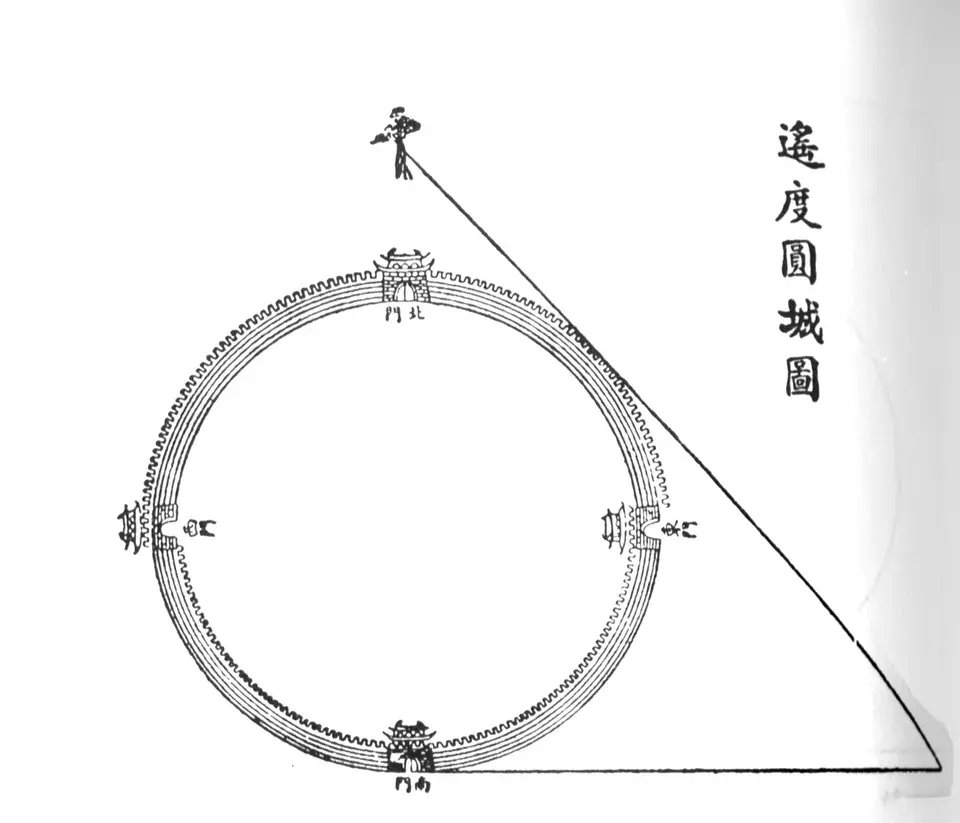
Qin was a dedicated practitioner of applied mathematics. In Shushu Jiuzhang, he established empirical conversion constants for earthworks, notably the ratio "firm earth 3, excavated earth 4, loose earth 5," providing standardized volumetric benchmarks for canal excavations, city rampart construction, and military logistics. His design and construction of the Daogu Bridge in Hangzhou demonstrated sophisticated structural understanding, while his water-control projects in Jiankang and Luzhou safeguarded civilian settlements.
Quantitative Meteorology and Calendar Reform
In the "Astronomical and Meteorological" category (Tianshi Lei) of Shushu Jiuzhang, Qin introduced the world's earliest systematic instruments and geometric methods for measuring precipitation and snowfall. He designed standardized bamboo rain gauges (tianchi ceyu) to compute spatial precipitation depths and developed snow-collecting cylinders (choutong yanxue) to determine snow water equivalence based on compression density. Furthermore, his application of indeterminate analysis to astronomical calendar intervals revolutionized calculations of planetary conjunctions and solstices.