Accession
Duke Gong passes away; Prince Zhao Rong ascends the throne as Duke Huan of Qin.
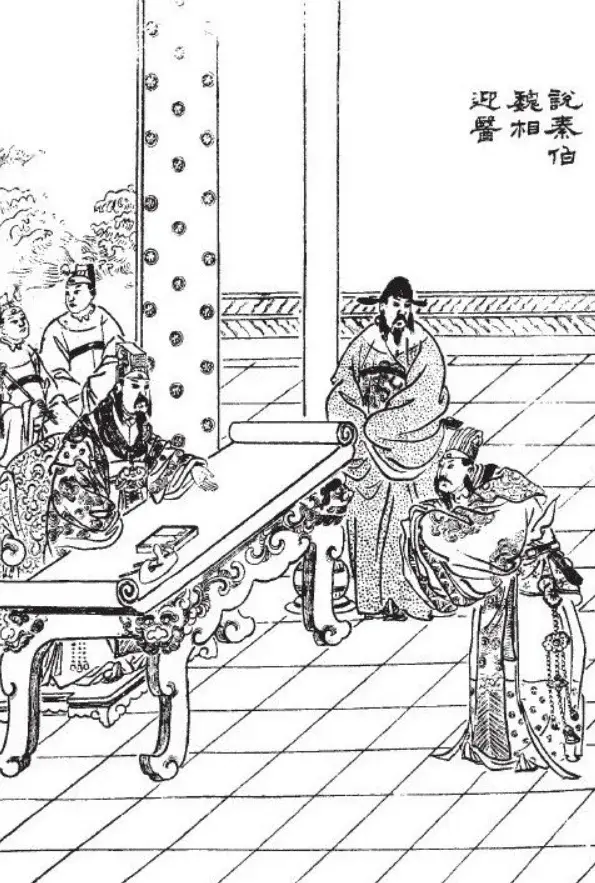
秦桓公
Duke Huan of Qin (died 577 BC), belonging to the Ying ancestral name and Zhao clan, personal name Rong, was the seventeenth sovereign of the State of Qin during the Spring and Autumn Period, reigning for twenty-eight years from 604 BC to 577 BC as the son and successor of Duke Gong of Qin. Inheriting Qin's extensive territorial foundation across the western plateau, Duke Huan spent his reign embroiled in bitter geopolitical…
Duke Huan of Qin (died 577 BC), belonging to the Ying ancestral name and Zhao clan, personal name Rong, was the seventeenth sovereign of the State of Qin during the Spring and Autumn Period, reigning for twenty-eight years from 604 BC to 577 BC as the son and successor of Duke Gong of Qin. Inheriting Qin's extensive territorial foundation across the western plateau, Duke Huan spent his reign embroiled in bitter geopolitical and military confrontations with the eastern superpower of Jin. In 594 BC, Duke Huan mobilized Qin legions to invade Jin territory, culminating in the Battle of Fushi. During the encounter, Jin commander Wei Ke defeated the Qin forces and captured their champion warrior Du Hui, an engagement celebrated in Chinese tradition for the legend of the old man knotting grass to trip the enemy. Seeking strategic respite, Duke Huan concluded the historic Covenant of Linghu with Duke Li of Jin across the Yellow River in 580 BC. However, immediately following the treaty, Duke Huan broke his oath, covertly forging alliances with the northern White Di tribes and the southern State of Chu to stage a joint assault against Jin. This breach provoked profound indignation in Jin. In 578 BC, Duke Li of Jin dispatched Senior Minister Lü Xiang to read a formal indictment breaking diplomatic ties, followed by a joint punitive coalition of eight feudal states including Qi, Lu, Song, Wey, and Zheng under supreme commander Luan Shu. The grand coalition forced the passes, advancing into Guanzhong and inflicting a catastrophic defeat on Qin at the Battle of Masui. Qin armies were shattered, senior generals were taken prisoner, and the state suffered an unprecedented military disaster that crippled its expansionist ambitions for decades. Deeply humiliated and exhausted by the catastrophe, Duke Huan passed away the following year in 577 BC, succeeded by his son Duke Jing of Qin.
Duke Gong passes away; Prince Zhao Rong ascends the throne as Duke Huan of Qin.
Jin armies invade Qin's eastern marches, escalating border hostilities.
Qin invades Jin; Wei Ke captures Qin champion Du Hui amidst the grass-knotting legend.
Concludes a non-aggression pact with Duke Li of Jin, subsequently violating it by allying with the Di and Chu.
An eight-state coalition led by Jin invades Guanzhong, routing Qin forces and capturing senior commanders.
Dies in Yongcheng following the devastation of Masui; succeeded by Duke Jing.
Duke Huan was born Prince Zhao Rong, the son and heir of Duke Gong of Qin. Following the disastrous ambush at the Battle of Xiao during the reign of Duke Mu of Qin, the generational marriage alliances known as the "Harmony of Qin and Jin" dissolved into bitter geopolitical rivalry. Qin sought access eastward through the Hangu Pass into the Central Plains, while Jin utilized the Yellow River and strategic mountain passes to confine Qin within the western plateau.
In 604 BC, Duke Gong died, and Prince Rong succeeded as Duke Huan. Inheriting a militarized state, Duke Huan faced immediate pressure from Jin. In 601 BC, Jin chief minister Que Que led a punitive expedition deep into Qin territory, capturing Qin intelligence officers and intensifying strategic friction along the Yellow River frontier.
In the autumn of 594 BC, observing factional discord among Jin's ministerial clans and Jin's military entanglement with Chu, Duke Huan seized what he perceived as an ideal strategic opening. He mobilized Qin's army and crossed the Yellow River to besiege the strategic border settlement of Fushi.
Duke Jing of Jin ordered grandee Wei Ke to lead the defending forces. In his youth, Wei Ke had honored his father Wei Chou's rational dying wishes by remarrying his father's concubine rather than burying her alive as his father had incoherently demanded during delirium. At Fushi, the two armies clashed on the open plains. Qin fielded a champion warrior named Du Hui, celebrated throughout the western reaches for his colossal stature and battle prowess, whose ferocious assaults threw Jin lines into disorder.
During the height of combat, Wei Ke witnessed an apparition of an elderly man frantically tying dry grass blades into knots along Du Hui's charge path. Charging forward, Du Hui became entangled in the woven grass, stumbled violently, and crashed to the earth. Wei Ke surged forward on horseback and took the disabled giant captive, triggering panic throughout Qin ranks and forcing a chaotic retreat across the river. That night, the elderly man appeared in Wei Ke's dream, identifying himself as the deceased father of the concubine Wei Ke had spared, returning from the underworld to repay the debt of filial virtue. The defeat at Fushi cost Qin its premier warrior and checked Duke Huan's eastward ambitions.
Decades of cross-border warfare severely strained the economic and human resources of both states. In 580 BC, following the accession of Duke Li of Jin, Duke Huan proposed a bilateral summit to normalize relations and establish a permanent peace accord.
The two monarchs agreed to convene at Linghu on the banks of the Yellow River. However, plagued by profound mutual suspicion, neither sovereign would cross the river: Duke Huan encamped at Wangma on the western bank, while Duke Li entrenched at Xia on the eastern shore. The treaty was negotiated and sworn by ministerial plenipotentiaries who met in mid-river to offer sacrifices and sanctify the Covenant of Linghu.
Yet before the ink dried, Duke Huan unilaterally repudiated the agreement upon his return to Yongcheng. Convinced that internal aristocratic rivalries made Jin vulnerable, Duke Huan dispatched envoys laden with gold to the northern White Di tribes, urging them to raid Jin's northern frontiers. Simultaneously, he sent embassies south to King Gong of Chu, seeking a coordinated two-front offensive against Jin. Qin's covert maneuverings were quickly detected by Jin intelligence networks, causing outrage across the Central Plains.
In the spring of 578 BC, Duke Li of Jin resolved to execute a devastating retaliatory campaign against Qin for its flagrant violation of the Linghu pact. Jin dispatched grandee Lü Xiang to Yongcheng to deliver the famous historical indictment, the Severing of Relations with Qin, enumerating Qin's long record of duplicity and formally declaring war.
Duke Li assumed personal command of the expedition, mobilizing the entire multi-corps army of Jin under Senior Minister Luan Shu. Jin assembled a formidable eight-state coalition including the armies of Qi, Lu, Song, Wey, Zheng, Cao, Zhu, and Teng. Tens of thousands of war chariots crossed the Yellow River, breaching defensive redoubts and marching deep into the Guanzhong plain.
Duke Huan committed the full defensive forces of Qin to halt the invasion. On May 4, 578 BC, the opposing armies collided in a monumental clash at Masui north of the Jing River. Outflanked by the allied chariots and overwhelmed by superior numbers, Qin defensive lines disintegrated. Senior commanders Cheng Chai and Buyeng Nüfu were captured alive, and thousands of Qin soldiers fell on the battlefield. The coalition pursued the shattered remnants past the Jing River before withdrawing in triumph.
The Battle of Masui was the most devastating military defeat Qin suffered during the early and mid-Spring and Autumn period. Having squandered the core legions nurtured over generations, Qin was forced into a prolonged strategic retrenchment. Broken by public humiliation and remorse, Duke Huan fell ill and died in 577 BC after a twenty-eight-year reign, passing the crown to his son, Duke Jing of Qin.
Duke Huan's reign reflected an acute awareness of shifting balances of power, seeking to exploit Jin's internal ministerial conflicts to alleviate military pressure on Qin's eastern frontier. His initiative in convening the Linghu summit temporarily established a diplomatic framework for bilateral coexistence, although his subsequent abandonment of the treaty underscored the limits of diplomatic opportunism without matching military superiority.
Despite strategic defeats at Fushi and Masui, Duke Huan maintained administrative control over the Guanzhong plains and the ancestral capital of Yongcheng. His defense mobilization during the Masui invasion demonstrated significant logistical capabilities, laying the institutional foundation that enabled his successor, Duke Jing, to rebuild state finances and eventually mount a successful strategic resurgence.
FIGURES ASSOCIATED WITH THIS DYNASTY