Birth in Qingzhou
Born into a scholar lineage in Yidu, developing an unbending moral disposition.
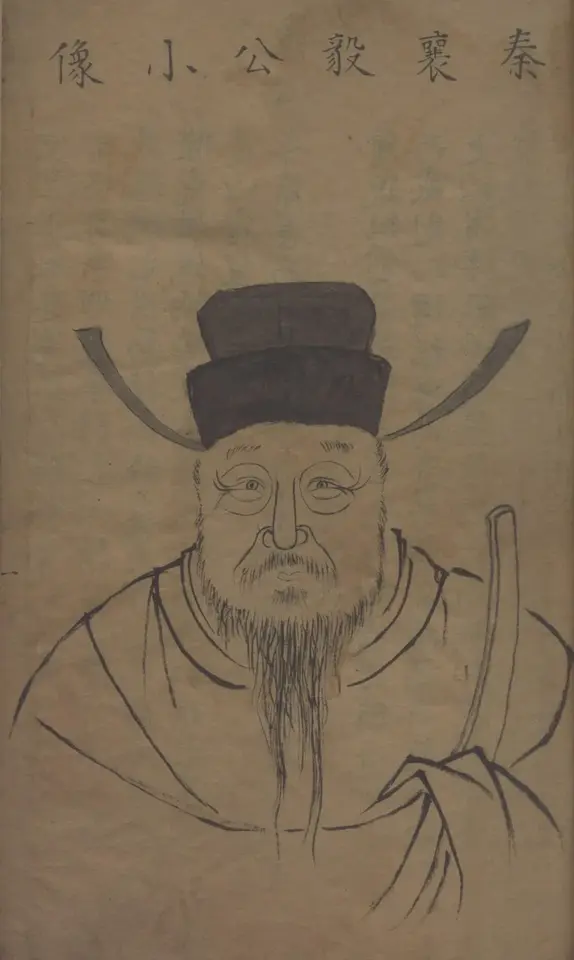
秦纮
Qin Hong (秦纮, 1426–1505), courtesy name Jingzhi (经之), posthumously titled Xiangyi (襄毅), was an illustrious military commander, supreme frontier strategist, and renowned incorruptible statesman across the Jingtai, Tianshun, Chenghua, and Hongzhi reigns of the Ming Dynasty, originating from Yidu, Qingzhou Prefecture, Shandong. Attaining the jinshi degree in 1451, Qin was appointed Censor of Nanjing, where he fearlessly arrested…
Qin Hong (秦纮, 1426–1505), courtesy name Jingzhi (经之), posthumously titled Xiangyi (襄毅), was an illustrious military commander, supreme frontier strategist, and renowned incorruptible statesman across the Jingtai, Tianshun, Chenghua, and Hongzhi reigns of the Ming Dynasty, originating from Yidu, Qingzhou Prefecture, Shandong. Attaining the jinshi degree in 1451, Qin was appointed Censor of Nanjing, where he fearlessly arrested abusive palace eunuchs. Though banished to peripheral posts in Xiong County and Fugu under political persecution, his upright magistrate governance inspired thousands of citizens to journey to Beijing to petition for his exoneration. Promoted to Governor of Shanxi under the Chenghua Emperor, Qin enforced the law against lawless imperial princes of the Qingcheng princely house; when imperial investigators searched his home, they discovered only a few threadbare garments, moving Emperor Xianzong to praise his exceptional austerity. As Governor of Xuanfu, he rebuilt frontier fortifications and routed the invading forces of the Tatar Little King at Baiyaoshan and Xingningkou. Under the Hongzhi Emperor, recommended by the esteemed Minister Wang Shu, Qin served as Supreme Commander of Liangguang, suppressing tribal uprisings in Tianzhou and imprisoning the corrupt military grandee Liu Jing. In 1501, when Tatar cavalry breached Huamachi and threatened Shaanxi, Emperor Hongzhi recalled the seventy-six-year-old veteran as Minister of Revenue and Supreme Commander of the Three Frontiers of Shaanxi. Over three years, Qin constructed thousands of border watchtowers, opened vast military agricultural colonies, invented the "All-Victorious Battle Wagon," and secured total frontier peace. Retiring in 1504 with the title of Junior Guardian of the Heir Apparent, he passed away in 1505 at age eighty and was posthumously honored as Xiangyi.
Born into a scholar lineage in Yidu, developing an unbending moral disposition.
Passed the imperial examination; appointed Censor in Nanjing; demoted for prosecuting an imperial eunuch.
Flogged abusive palace falconers as magistrate; five thousand citizens marched to Beijing to plead for his release from prison.
Following maternal mourning, thousands of local citizens petitioned the throne to retain Qin as Prefect of Qinzhou.
Elevated to Right Assistant Censor-in-Chief; prosecuted corrupt imperial princes; imperial audit revealed only rags in his home.
Transferred to govern Xuanfu; defeated the Tatar Little King at Baiyaoshan and Xingningkou.
Appointed Right Censor-in-Chief; pacified the Cen Qin rebellion in Tianzhou and impeached Marquis Liu Jing.
Recalled at age seventy-six to command Shaanxi; established defensive cordons, extensive agricultural colonies, and battle wagon brigades.
Bestowed the title of Junior Guardian of the Heir Apparent; permitted to return home via imperial post carriage.
Passed away in Yidu in October at age eighty; posthumously granted the title Xiangyi.
Qin Hong was born in 1426 in Yidu, Shandong. From his youth, he was noted for his upright temperament and devotion to civic duty. In 1451, during the reign of Emperor Jingtai, he succeeded in the metropolitan examinations. After training at the Censorate, he was appointed Censor of Nanjing. Qin immediately demonstrated fearless execution of the law by arresting the lawless eunuch Fu Suo'er and submitting outspoken memorials urging the court to cease the frivolous collection of kingfisher feathers and luxury fish in Jiangnan. Targeted by vengeful palace cliques, he was demoted in 1455 to postmaster in Huguang.
In 1457, following the restoration of Emperor Yingzong, Censor Lian Gang recommended Qin for appointment as Magistrate of Xiong County. In 1459, when Imperial Attendant Du Jian abused his authority while hunting swans in Xiong County, Qin arrested and flogged Du's predatory retainers. Du returned to Beijing and slandered Qin, resulting in Qin's arrest and confinement in the imperial prison. In an extraordinary demonstration of public devotion, five thousand citizens of Xiong County traveled to Beijing to petition the throne, convincing Emperor Yingzong to release Qin and assign him as Magistrate of Fugu. In Fugu, Qin cleared corruption and fostered agricultural rehabilitation. In 1464, upon the recommendation of Shaanxi Governor Xu Tingzhang, newly enthroned Emperor Xianzong elevated Qin to Prefect of Qinzhou. When Qin took leave for maternal mourning in 1466, his successor mismanaged the prefecture. Upon completing his mourning in 1469, thousands of Qinzhou elders journeyed to the capital requesting Qin's return. Recommended by Shaanxi Governor Ma Wensheng, Qin was reinstated as Prefect of Qinzhou, before advancing to Prefect of Xi'an and Right Administration Vice Commissioner of Shaanxi.
In July 1477, Qin was promoted to Right Assistant Censor-in-Chief, commanding the Yanmen Pass defenses and governing Shanxi. When Minzhou tribal raiders revolted, Qin mobilized three thousand troops and crushed the rebellion, earning an imperial salary increase.
At that time, several noble princes of the Qingcheng princely household, including Zhu Qijian, Zhu Qidun, and Zhu Zhongxian, engaged in extortion, unlawful kidnapping, and the violent seizure of civilian horses and grain. Successive provincial governors had avoided confrontation out of fear of the royal clan. Upon assuming office, Qin submitted detailed memorials indicting Zhu Qijian's crimes. Prince Qingcheng counter-charged Qin with treason. Emperor Xianzong dispatched imperial investigators to search Qin's private residence. The chief eunuch auditor Shang Heng found nothing in the house except several patched, worn hemp garments. Astonished, the eunuch reported to the emperor, who sighed: "Can Qin Hong truly be this impoverished?" The emperor rewarded Qin with ten thousand strings of cash, cleared his name, and stripped the corrupt royal princes of their ranks and stipends. To prevent further vendettas, the emperor transferred Qin to govern Henan in 1480.
In March 1481, Emperor Xianzong reassigned Qin to govern the strategic frontier garrison of Xuanfu. Qin strengthened border ramparts and instituted rigorous drilling. In July 1483, the Tatar Little King led tens of thousands of cavalry across the border, routing Regional Commander Xu Ning and raiding the Shunsheng plain. Qin joined Xuanfu Regional Commander Zhou Yu at Wanquan, deploying deputy general Jiang Shan in coordinated flanking attacks. At Baiyaoshan, Zhou Yu and Qin Hong joined forces to crush the Tatar host. Weeks later, when a thousand Tatar cavalry raided Xingningkou, Qin personally led a center brigade of a thousand elite infantry, repelling the invaders and recovering thousands of head of stolen cattle. For his border defense, he was promoted to Left Assistant Censor-in-Chief.
Under Emperor Hongzhi, senior minister Wang Shu recommended Qin as Supreme Commander of Liangguang in 1489. In the south, Qin suppressed the Cen Qin rebellion in Tianzhou, stabilized indigenous chieftaincies, and defeated Yao and Li tribal insurgencies. Furthermore, he arrested Marquis of Anyuan Liu Jing for embezzlement and war crimes. Although Liu Jing possessed familial connections to Empress Dowager Zhou, Qin's steadfast evidence secured Liu's conviction, underscoring Qin's unbending judicial integrity.
In 1501, Tatar cavalry breached Huamachi in Shaanxi, defeating Ming forces at Kongbagou and advancing directly toward Pingliang. With the northwest frontier destabilized, Emperor Hongzhi turned to the seventy-six-year-old Qin Hong, appointing him Minister of Revenue and Supreme Commander of the Three Frontiers of Shaanxi.
Arriving at Guyuan after riding day and night, Qin immediately reviewed the garrisons of Yansui, Guyuan, and Ningxia. He arrested defeated generals, replaced incompetent commanders, and reorganized defenses. Recognizing Guyuan's strategic position, he made it his permanent field headquarters, reinforcing defensive garrisons and ending the costly practice of rotating southern interior troops into the frontier. To secure provisions, Qin instituted vast military agricultural colonies along the northern borders, building fortified garrisons every twenty li staffed by five hundred soldier-colonists, yielding 500,000 piculs of grain annually.
Furthermore, Qin constructed over 14,000 frontier watchtowers and fortresses, excavated 6,000 li of defensive trenches, and cut 3,700 li of cliffside barriers. He invented the "All-Victorious Battle Wagon," a combined transport and defensive combat vehicle deployed across northern circuits. Under his three-year administration, the four frontier garrisons remained completely tranquil. In 1504, Qin was rewarded with the title of Junior Guardian of the Heir Apparent. Granting his retirement petition, Emperor Hongzhi provided imperial carriages to convey him home to Shandong. In October 1505, Qin Hong passed away at his estate in Yidu at the age of eighty. He was posthumously honored with the name "Xiangyi."
Qin Hong was a paragon of incorruptibility, civil fortitude, and frontier leadership across four reigns, revered as one of the preeminent regional commanders of the mid-Ming Dynasty.
"Qin Hong was resolute, discerning, and utterly incorruptible, growing more vigorous with age. Governing Xuan-Da, enemy cavalry dared not approach the border; commanding the Three Frontiers, frontier defense was entirely cleansed. When imperial investigators searched his house and found only ragged garments, Emperor Xianzong sighed in admiration. Even ancient ministers could achieve no higher virtue!" — History of Ming (Ming Shi), Scroll 172, "Biographies"
"Ascending the supreme command at seventy years of age, he extinguished the dust of war across a thousand li of mountain passes. Throughout history, ministers of supreme virtue have been few; Lord Xiangyi leaves a radiant legacy for a hundred generations." — Wang Shizhen, Yanzhou Shanren Sibu Gao
FIGURES ASSOCIATED WITH THIS DYNASTY