Life and Career
Literary Prodigy of Gaoyou and Mentorship under Su Shi
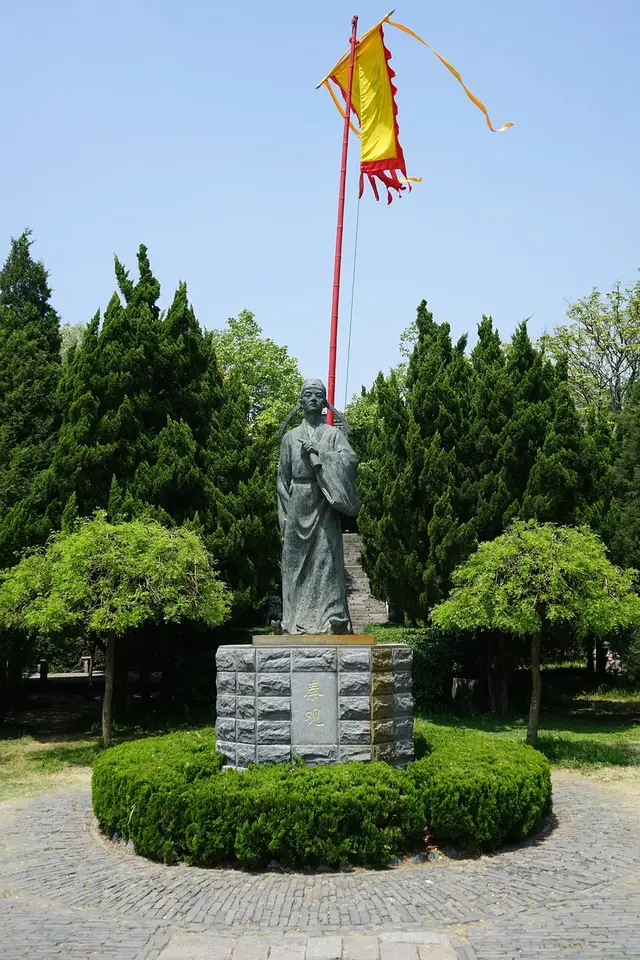
Qin Guan was born in December 1049 in Gaoyou, Yangzhou. His family had resided in Gaoyou since the Tianbao era of the Tang dynasty, maintaining a steadfast tradition of agricultural scholarship. His father, Qin Cheng, who studied at the imperial academy, named his son Guan and gave him the courtesy name Shaoyou out of admiration for distinguished scholars. From childhood, Qin Guan demonstrated an extraordinary memory and acute intellectual insight, mastering the Confucian classics at a tender age while developing a lofty and uninhibited temperament.
During the early Xining era, catastrophic inundations ravaged Gaoyou. Young Qin Guan observed the suffering of displaced refugees and penned the renowned Rhapsody on the Fushan Weir, offering trenchant critiques of dysfunctional local water management and demonstrating a profound commitment to societal governance. In 1072, Qin Guan joined the secretariat of his relative Sun Jue in Wuxing. Under Sun's tutelage, he studied classical strategists such as Sun Wu and Wu Qi, composing insightful essays on defensive preparations and troop mobilization.
In the autumn of 1077, literary giant Su Shi assumed the prefecture of Xuzhou, where he spearheaded heroic civil defenses against a catastrophic overflow of the Yellow River and erected the monumental Yellow Pavilion. Drawn by Su Shi's renown, Qin Guan journeyed to Xuzhou bearing his newly penned Rhapsody on the Yellow Pavilion. Upon reading the piece, Su Shi was astonished by its dazzling rhetoric and elevated spirit, declaring that Qin Guan possessed the extraordinary poetic genius of Qu Yuan and Song Yu. Welcomed as an esteemed student, Qin Guan earned instant national acclaim. Su Shi subsequently dispatched Qin's writings to Wang Anshi in Jiangning; Wang lavishly praised the verse for its crisp elegance, comparing it to the masters Bao Zhao and Xie Tiao of the Southern Dynasties.
Civil Examinations and Scholarly Ascent in the Yuanyou Era
Despite his sparkling literary celebrity, Qin Guan met with initial frustration in the imperial examinations. In 1078, he failed his first metropolitan examination in Bianjing. Rather than surrendering to despair, he returned to Gaoyou, establishing his study at the Wenyoutai terrace along the Grand Canal. There he engaged in intensive reading of the Zuo Zhuan, Stratagems of the Warring States, and the dynastic histories of the Han, polishing his prose and verse for years.
In the spring of 1085, following the accession of Emperor Zhezong and the regency of Grand Empress Dowager Gao, veteran conservatives led by Sima Guang revoked the New Policies. In the imperial examinations of that year, the thirty-seven-year-old Qin Guan passed with flying colors, attaining the jinshi degree alongside Huang Tingjian. He was appointed Professor of the Caizhou Prefectural School, where he reformed academic regulations, instructed local scholars, and exchanged elegant verses with Su Zhe and Chao Buzhi.
In 1088, Su Shi, then Hanlin Academician, submitted an official memorial recommending Qin Guan for statecraft and intellectual brilliance. Following rigorous palace tests, Qin Guan was appointed Erudite of the National University. In 1090, he rose to Rectifier of Characters in the Palace Library and concurrently Compiler of the National History Academy, collaborating with Huang Tingjian on the Veritable Records of Emperor Shenzong. Alongside Huang Tingjian, Chao Buzhi, and Zhang Lei, he formed the celebrated Four Scholars of Su Shi, commanding the cultural and literary life of Bianjing.
Factional Strife and Successive Demotions
The vibrant cultural life of the Yuanyou era concealed treacherous factional warfare. The court was torn not only between reformers and conservatives, but also by internal rivalries among conservative factions: the Luoyang faction led by Cheng Yi, the Shu faction headed by the Su brothers, and the Shuo faction led by Liu Zhi. As Su Shi's favorite disciple, Qin Guan became a prime target for rival censors, who repeatedly attacked him on fabricated pretexts of rhetorical frivolity.
In 1094, Grand Empress Dowager Gao died, and Emperor Zhezong assumed direct rule. Resentful of the conservative dismantlement of his father's reforms, Zhezong reinstated New Policies leaders Zhang Dun and Cai Jing, inaugurating a widespread purge. Su Shi and Su Zhe were banished to the far south. Qin Guan was stripped of his historiographical post and dispatched as Vice Prefect of Hangzhou. Before he could reach the city, hostile censors indicted him for allegedly distorting historical records in the Veritable Records of Emperor Shenzong. Imperial edicts pursued him on the road, demoting him to Supervisor of Wine Taxes in Chuzhou.
Degradation, Imprisonment, and Tropical Exile
While serving in Chuzhou, Qin Guan maintained his philosophical equanimity, wandering through scenic mountains and composing verse. Nevertheless, partisan hostility persisted. In 1096, censors denounced him for copying Buddhist sutras during sick leave, alleging dereliction of official duty and implicit criticism of the throne. Emperor Zhezong issued an edict stripping Qin Guan of all official ranks and titles, banishing him under strict administrative surveillance to Chenzhou in Hunan.
During this grueling journey into exile, Qin Guan poured his profound sorrow into the immortal lyric Tashaxing (At the Chenzhou Posthouse), capturing an overwhelming sense of cosmic solitude and human vulnerability. When Su Shi read the poignant closing lines about the Chen River flowing relentlessly toward Xiaoxiang, he wept bitterly and inscribed the couplet upon his folding fan.
In 1097, Qin Guan was relocated further southwest to Hengzhou in Guangxi. Tormented by illness and spiritual isolation, he composed the elegiac Qianqiusui, prompting Huang Tingjian to lament that its haunting sorrow foreshadowed an untimely end. In 1099, the court banished him to the tropical penal outpost of Leizhou in Guangdong. Living in a dilapidated cell of an old temple amidst sweltering humidity and malaria, Qin Guan confronted his mortality with calm serenity, composing an anticipatory funeral elegy for himself. In Leizhou, he experienced a fateful, emotional reunion with Su Shi, who was traveling across the straits from Hainan. The two aging masters wept together in the remote wilderness, exchanging parting poems in what proved to be their final earthly meeting.
Imperial Pardon and Demise at Guanghua Pavilion
In the first month of 1100, Emperor Zhezong passed away, and Emperor Huizong ascended the throne under the regency of Empress Dowager Xiang. An imperial amnesty was proclaimed to reconcile factional tensions and rehabilitate purged scholars. In the fifth month, Qin Guan received his pardon, was reinstated as Court Gentleman for Promoted Service, and was permitted to return north.
Rejoicing at his redemption, Qin Guan set out on the return journey. However, six grueling years of tropical pestilence, malnutrition, and spiritual distress had ravaged his health. While traveling through Tengzhou in Guangxi during the oppressive heat of August, he was stricken by severe fever. On September 17, 1100, while resting in the shaded breeze of Guanghua Pavilion outside Tengzhou, Qin Guan asked an attendant for a cup of fresh spring water. When the boy returned with the drink, Qin Guan had already passed away peacefully with a serene smile upon his face, at the age of fifty-two. Far away, Su Shi was devastated upon hearing the news, crying aloud that heaven was destroying his finest companions. Qin Guan's remains were transported by his son Qin Zhan back to Gaoyou and later reinterred on Mount Huishan in Wuxi.
Major Achievements
Reaching the Pinnacle of the Delicate and Restrained School of Ci Poetry
Qin Guan's foremost contribution to Chinese literature lies in his comprehensive synthesis and elevation of the lyric tradition from the Five Dynasties to the Northern Song, establishing the consummate aesthetic model for the Delicate and Restrained School.
Prior to Qin Guan, Liu Yong had expanded the slow tune (manci) into urban settings, but his diction occasionally verged on colloquial vulgarity; Su Shi had inaugurated heroic and philosophical verse, yet his style sometimes transcended the intrinsic musicality and delicate nuances of the song lyric. Qin Guan masterfully combined Liu Yong's elaborate structural exposition with Su Shi's sublime scholarly elegance. He infused refined literati sensibilities into musical forms, employing exceptionally graceful diction, immaculate rhythm, and subtle emotional cadence. By utilizing delicate natural imagery such as faint clouds, flowing water, fading twilights, and drifting blossoms, he evoked an ethereal landscape of poignant human pathos. Later literary critics acclaimed his works as the pure orthodox fountainhead of ci lyricism.
Composing the Immortal Queqiaoxian and Redefining Romantic Ethics
Among Qin Guan's vast poetic legacy, his masterpiece Queqiaoxian (Immortals at the Magpie Bridge) represents the definitive philosophical elevation of the Cowherd and Weaver Maiden myth, standing as an unexcelled monument of classical romantic literature.
Rejecting conventional laments over the tragic annual separation of the stellar lovers, Qin Guan infused the myth with transcendent philosophical conviction, concluding with the immortal lines: "If mutual devotion endures across eternity, what need is there for physical presence morning and evening?" Through this elevated moral vision, Qin Guan liberated romantic literature from the narrow confines of continuous physical cohabitation, elevating love into an everlasting spiritual bond that transcends temporal and spatial limitations. The piece is celebrated worldwide as a supreme masterwork of oriental romanticism.
Compiling the Veritable Records of Emperor Shenzong as a Faithful Historiographer
Beyond his poetic renown, Qin Guan was an astute historian and conscientious official. During his service at the imperial court in the Yuanyou era, he played a central role in compiling the Veritable Records of Emperor Shenzong.
In the National History Academy, Qin Guan meticulously reviewed imperial diaries, court memoranda, and palace archives from the Xining and Yuanfeng eras. He adhered strictly to the Confucian ideal of courageous and truthful historiography, documenting both the grand aspirations and the societal costs of Wang Anshi's socio-economic reforms, including the Green Sprouts Measure and the Hired Service System. Although this work later became a target for partisan recrimination during subsequent political purges, Qin Guan's unyielding scholarly integrity demonstrated the high intellectual standards of Northern Song official historiography.
Authoring Canshu as a Scientific Landmark of Classical Sericulture
In addition to his literary achievements, Qin Guan made monumental contributions to Chinese agricultural and mechanical sciences through his treatise Canshu (Book of Sericulture), composed during his tenure in Caizhou.
Canshu is China's earliest extant comprehensive monograph devoted entirely to the scientific techniques of sericulture and silk reeling. The book provides systematic operational guidelines covering mulberry cultivation, silkworm breeding, larval pathology, cocoon gathering, and mechanical processing. Most notably, Qin Guan provided meticulous technical illustrations and descriptions of the foot-treadle silk reeling machine, explaining the operational mechanics of the eccentric connecting rod and yarn-distributing mechanism. This extraordinary work documented advanced machinery centuries before similar descriptions appeared in Western engineering literature, earning international recognition in the history of science and technology.
Formulating Pragmatic Statecraft Treatises
Although posterity often celebrates Qin Guan exclusively for his lyrical delicacy, he was a dedicated Confucian reformer who authored profound policy essays addressing urgent imperial dilemmas.
In treatises such as Memorials on State Affairs and Essays on Financial Administration, Qin Guan analyzed border defense crises, bureaucratic inflation, and fiscal depletion. He advocated streamlining military recruitment to cultivate elite forces while curtailing wasteful mercenary expenditures, and called for light taxation and wealth accumulation among the agrarian populace. His political writings exhibited lucid reasoning, robust argumentation, and realistic economic acumen, demonstrating that he possessed the strategic vision of a true Confucian statesman.
Cultivating an Elegant and Natural Poetic Voice
In the realm of traditional shi poetry, Qin Guan forged a distinctive style that provided a delightful counterpoint to the rugged, intellectually demanding style of Huang Tingjian's Jiangxi Poetic School.
Su Shi famously characterized Qin Guan's poetry as possessing the fresh, lucid elegance of Southern Dynasties masters Bao Zhao and Xie Tiao. Qin Guan inherited the serene clarity of Tang poets such as Wang Wei and Wei Yingwu. His quatrains, exemplified by Spring Day and Autumn Day, employed delicate descriptive sketches to portray scenic nature and quiet contemplation with crystalline grace. In an era when Song poetry was increasingly turning into dry intellectual debate, Qin Guan preserved the evocative lyrical charm of classical Chinese verse.