Birth in Huzhou
Born into a cultured literati family in Wuxing, Huzhou, dedicating his youth to classical literature, calligraphy, and painting.
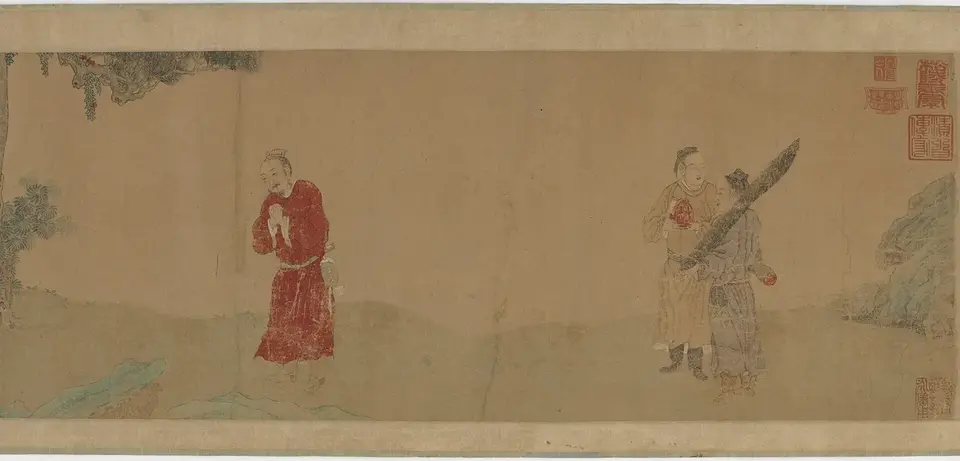
钱选
Qian Xuan (钱选), courtesy name Shunju, styled Yutan, also known as Xunfeng, Zhachuan Weng, Qingqu Laoren, and in his late years Zhaxi Weng, was a native of Huzhou (present-day Wuxing District, Huzhou City, Zhejiang Province). He was an illustrious painter, literary theorist, and poet during the transition from the Southern Song to the Yuan Dynasty. In 1262, he passed the Southern Song civil service examinations as a…
Qian Xuan (钱选), courtesy name Shunju, styled Yutan, also known as Xunfeng, Zhachuan Weng, Qingqu Laoren, and in his late years Zhaxi Weng, was a native of Huzhou (present-day Wuxing District, Huzhou City, Zhejiang Province). He was an illustrious painter, literary theorist, and poet during the transition from the Southern Song to the Yuan Dynasty. In 1262, he passed the Southern Song civil service examinations as a Tribute Jinshi. Following the fall of the Southern Song, Qian adamantly refused to serve the Mongol Yuan dynasty, living as a loyalist recluse along the rivers and streams of Huzhou. Alongside Zhao Mengfu, Wang Zizhong, and Mou Yinglong, he was celebrated across the realm as the foremost figure among the Eight Talents of Wuxing. Qian Xuan was a pivotal transitional figure who dismantled the formulas of Southern Song court painting to inaugurate the vibrant literati painting movement of the Yuan Dynasty. A versatile master, he excelled in landscapes, birds and flowers, figures, and horses, achieving unrivaled acclaim in detached branch compositions and subtle blue-and-green landscapes. In painting theory, Qian was the first to champion the concept of "antique conception" (guyi) and the "scholarly spirit" (shiqi), advocating the ethos of "amateur literati painting" (lijiahua) to counter the rigid, superficial realism of professional academy artisans. Furthermore, he pioneered the practice of inscribing lengthy original poems and commentaries in prominent areas of his hanging scrolls and handscrolls, harmonizing poetry, calligraphy, painting, and seal carving into a unified fourfold aesthetic paradigm. His surviving masterpieces, including Eight Flowers (Bahua Tu), Pear Blossoms (Lihua Tu), White Lotus (Bailian Tu), Dwelling in the Floating Jade Mountains (Fuyu Shanju Tu), and Mountain Dwelling (Shanju Tu), exerted an enduring foundational influence upon Zhao Mengfu, Huang Gongwang, and the literati traditions of the Ming and Qing dynasties.
Born into a cultured literati family in Wuxing, Huzhou, dedicating his youth to classical literature, calligraphy, and painting.
Passed the civil service examinations as a Tribute Jinshi in western Zhejiang, winning renown for classical scholarship.
The Song court surrendered Lin'an; Qian abandoned civil examination ambitions, burned his manuscripts, and retired into recluse life.
Imperial censor Cheng Jufu traveled south to recruit scholars among the Eight Talents of Wuxing; while Zhao Mengfu went north, Qian firmly refused.
Resided along the Zha Stream in his studio, debating aesthetic theory with Zhao Mengfu and establishing the doctrines of scholarly spirit and amateur painting.
Executed masterpieces including Dwelling in the Floating Jade Mountains and White Lotus, inscribing verses reflecting his loyalist solitude.
As forgeries of his paintings flooded Jiangnan art markets, adopted the late sobriquet Zhaxi Weng, composing colophons on authentic works.
Passed away peacefully at his retreat in Huzhou; his surviving verses were posthumously gathered into Drafts from the Studio of Practicing Indolence.
Qian Xuan was born in 1239 in Wuxing, Huzhou, within the scenic canal waterways of western Zhejiang. Huzhou had been a celebrated cultural capital since the Tang and Northern Song periods, renowned for deep traditions of painting, poetry, and book collecting. Blessed with an acute intellect and contemplative temperament, Qian applied himself diligently to classical Confucian learning, ancient rhapsodies, and classical histories. Concurrently, he exhibited an extraordinary natural affinity for visual art, studying and copying ancient calligraphy and Tang and Song paintings in local private collections.
In 1262, at twenty-four, Qian sat for the civil examinations in western Zhejiang, successfully earning his credential as a Tribute Jinshi. In his artistic endeavors, Qian developed an extraordinarily broad stylistic foundation: in landscapes, he studied Zhao Lingrang and Zhao Boju while absorbing the antique mistiness of Dong Yuan and Juran; in figure painting, he mastered the austere monochrome line drawing (baimiao) of Tang master Yan Liben and Northern Song genius Li Gonglin; in flower-and-bird painting, he assimilated the naturalism of Zhao Chang and the ink wash innovations of Yang Wujiu. Uniting deep scholarly literacy with versatile brushwork, the young scholar emerged as an acclaimed cultural figure across Huzhou.
In addition to original creations, Qian possessed uncanny skill in replicating ancient paintings. A celebrated local anecdote records that he once borrowed an imperial Northern Song court painting, White Falcon, from a local connoisseur. Enamored of its brushwork, Qian spent the night copying the scroll and mounting the duplicate, returning the copy the next morning with such precision that the original owner failed to discern the substitution for months. Younger aspiring artists throughout Huzhou eagerly sought his instruction, and those who received his direct guidance developed into prominent painters of the era.
In 1276, Yuan armies crossed the Yangtze and accepted the surrender of the Southern Song court in Lin'an. Confronted with the traumatic subjugation of their civilization, southern literati were plunged into existential despair. In Huzhou, where elite intellectual circles remained dense, Qian Xuan, Zhao Mengfu, Wang Zizhong, Mou Yinglong, Xiao Zizhong, Chen Wuyi, Chen Zhongxin, and Yao Shi were celebrated collectively as the Eight Talents of Wuxing, with Qian standing as the senior elder among them.
In 1286, Emperor Shizu (Kublai Khan) dispatched Censor Cheng Jufu to the south to scout for talented Song loyalists to legitimize the Mongol court. The Eight Talents of Wuxing were singled out for imperial recruitment. Confronted with high honors and official careers in Dadu, the group diverged: Zhao Mengfu and several others accepted the imperial call and traveled north, embarking on illustrious official careers. In contrast, Qian Xuan held fast to uncompromising loyalist integrity. Rejecting bureaucratic glory, he incinerated his examination drafts, donned rustic commoner garb, and withdrew into hermitic seclusion along the Zha Stream in Huzhou, vowing never to serve the northern regime.
Qian built a modest thatched studio which he named the Studio of Practicing Indolence (Xilan Zhai), adopting sobriquets such as Yutan, Xunfeng, Qingqu Laoren, and Chuanweng. Despite enduring grinding poverty, he found solace in poetry, wine, and painting. When Zhao Mengfu returned to Huzhou on official leave, he visited Qian's studio with profound deference. Although Qian lamented Zhao's decision to serve the Yuan, he received his younger friend with courteous hospitality, discussing brushwork and classical aesthetics. Their distinct paths formed a poignant historical mirror reflecting the diverging choices of Song loyalist intellectuals.
Characterized by an austere, unbending personality, Qian Xuan was deeply fond of wine, developing a romantic creative habit. He maintained that he could not paint when completely sober, nor could he paint when intoxicated; only in the state of mild inebriation, when mind and hand were in perfect spiritual harmony, could he capture the cosmic essence of nature. In such moments of inspired ease, his brush moved with fluent grace, producing landscapes and blossoming branches of ethereal beauty. Once a work was completed, he cared little for monetary recompense, often allowing friends and visitors to carry it away freely.
As his scrolls circulated through Jiangnan, Qian's fame spread far and wide. Connoisseurs, gentry scholars, and Yuan officials competed to acquire works signed by Qian Shunju. However, when wealthy grandees approached him with gold, Qian invariably shuttered his doors in refusal, reserving his finest works for destitute soulmates and hermit scholars. Renowned calligrapher Xianyu Shu, Confucian scholar Ao Jiweng, bamboo master Li Kan, and scholar Xu Yan visited Qian whenever their travels brought them through Zhejiang.
Owing to his soaring fame, counterfeiters across Jiangnan began churning out forged scrolls bearing his seals and accompanied by clumsy verses. To distinguish his genuine creations, Qian abandoned his earlier pseudonyms in his late years, adopting the sobriquet Zhaxi Weng. He inscribed a lengthy explanatory colophon on his late masterpiece White Lotus, warning future connoisseurs against deceptive market imitations.
In his twilight years, Qian concentrated his intellectual energy on systematizing the fundamental principles of Chinese literati painting. In regular dialogues with younger contemporaries, including Zhao Mengfu, he rigorously delineated the boundary between the work of cultivated scholar-gentlemen and the mechanical exercises of professional artisans. He articulated the revolutionary concepts of "scholarly spirit" (shiqi) and "amateur painting" (lijiahua), arguing that painting should renounce the pursuit of literal verisimilitude to convey inner moral character and classical reserve through calligraphic brushstrokes.
In his final years, Qian's hair turned snow-white and his circumstances grew ever more frugal, yet his artistic vision reached serene transcendence. In his inscribed poem on Mountain Dwelling, he wrote: "In mountain dwelling I love solitude alone, shutting my wicker gate against the bright sun. Alien to worldly crowds, men harbor doubts; seeking nothing, the Way sustains my dignity."
Around 1301, the master passed away peacefully in his retreat along the Zha Stream at about sixty-two. His scattered verses were later gathered into Drafts from the Studio of Practicing Indolence (Xilan Zhai Gao), anthologized in Second Collection of Yuan Poetry. Though he held no official titles under the Yuan, Qian's intellectual vision served as an enduring beacon, shaping Chinese literati aesthetics for centuries to come.
Qian Xuan's paramount theoretical contribution to Chinese art history was his systematic articulation of the "scholarly spirit" (shiqi), which redefined the philosophical foundation of literati painting.
Following the Northern Song insights of Su Dongpo, literati art had largely remained an informal mode of expressive recreation. By the late Southern Song, however, imperial academy styles had hardened into rigid, pedantic craftsmanship focused on superficial verisimilitude. Qian incisively criticized this trend, warning that paintings grew "ever more distant as they grew more meticulously worked." He argued that the supreme value of painting lay not in craft, but in the moral integrity, classical scholarship, and inner nobility of the artist. Advocating "amateur literati painting" (lijiahua), he championed incorporating the antique vigor of seal and clerical script into painting. Qian's doctrine, harmonizing with Zhao Mengfu's theory of the shared origin of calligraphy and painting, dismantled the aesthetic supremacy of the Song academy, establishing the dominant paradigm of Yuan, Ming, and Qing art.
Qian Xuan was the foundational master who integrated visual painting with literary poetry, expressive calligraphy, and seal connoisseurship into a seamless fourfold unity.
Prior to Qian, court painters and professional craftsmen concealed signatures within foliage or rock crevices to avoid disrupting visual realism. Qian overturned this convention by inscribing substantial original poems and critical commentaries directly onto open areas of the composition. He applied balanced regular and running scripts to harmonize with visual elements, stamping his works with personalized seals such as "Qian Shunju" and "Zhaxi Weng." Master Huang Gongwang observed: "Only those who understand his poetry truly understand his painting." Through Qian's pioneering practice, the fourfold synthesis of poetry, calligraphy, painting, and seal carving became the defining standard of classical Chinese painting.
In flower-and-bird painting, Qian served as the pivotal catalyst shifting Chinese traditions from meticulous court realism to expressive literati ink wash.
Qian's flower paintings evolved from early structural precision toward late ethereal simplicity. Early works such as Eight Flowers drew upon the naturalism of Northern Song court painters, yet replaced heavy mineral colors with serene, subdued washes. In his late masterpieces, such as White Lotus and Pear Blossoms, Qian synthesized Yang Wujiu's ink wash techniques with gossamer iron-wire line drawings, transforming detached botanical branches into allegories of moral purity and loyalist reclusion. He liberated flower painting from opulent decorative display, inspiring subsequent masters including Shen Zhou, Wen Zhengming, Chen Chun, and Xu Wei.
In landscape painting, Qian decisively rejected the dramatic "one-corner" diagonal compositions popularized by Southern Song masters Ma Yuan and Xia Gui, revitalizing the panoramic classical models of the Tang and Northern Song into the literati "lesser blue-and-green" (xiao qinglü) mode.
In masterworks such as Dwelling in the Floating Jade Mountains, Mountain Dwelling, and Waiting for the Ferry on an Autumn River, Qian replaced towering, intimidating mountain massifs with tranquil, horizontal planes of rolling hills. He outlined geological structures using fine, dry brushstrokes reminiscent of clerical script, applying light layers of malachite green, azurite blue, and gold dust. Balancing decorative mineral color with scholarly understatement, Qian stripped blue-and-green landscape painting of vulgar courtly ostentation, providing a structural template for Zhao Mengfu, Sheng Mou, and the Ming Wu School.
As the elder statesman among the Eight Talents of Wuxing, Qian played a decisive role in shaping the artistic development of Zhao Mengfu.
During his formative youth in Huzhou, Zhao frequently visited Qian's studio, studying ancient methods of figure drawing, archaic landscape washes, and botanical brushwork. Zhao's celebrated aesthetic dictums—such as "painting must possess an antique conception" and "calligraphy and painting share a common origin"—drew directly from Qian's pioneering practice and oral instruction. Although Zhao later referred to Qian as a "friend" to accommodate bureaucratic rank, art historians recognize Qian as Zhao's foundational aesthetic mentor. Through Zhao, Huang Gongwang, Ni Zan, and Wang Meng, Qian's artistic lineage became the bedrock of the golden age of Yuan literati painting.
FIGURES ASSOCIATED WITH THIS DYNASTY