Born in Qiantang
Born into the royal house of Wuyue, son of King Qian Chu.
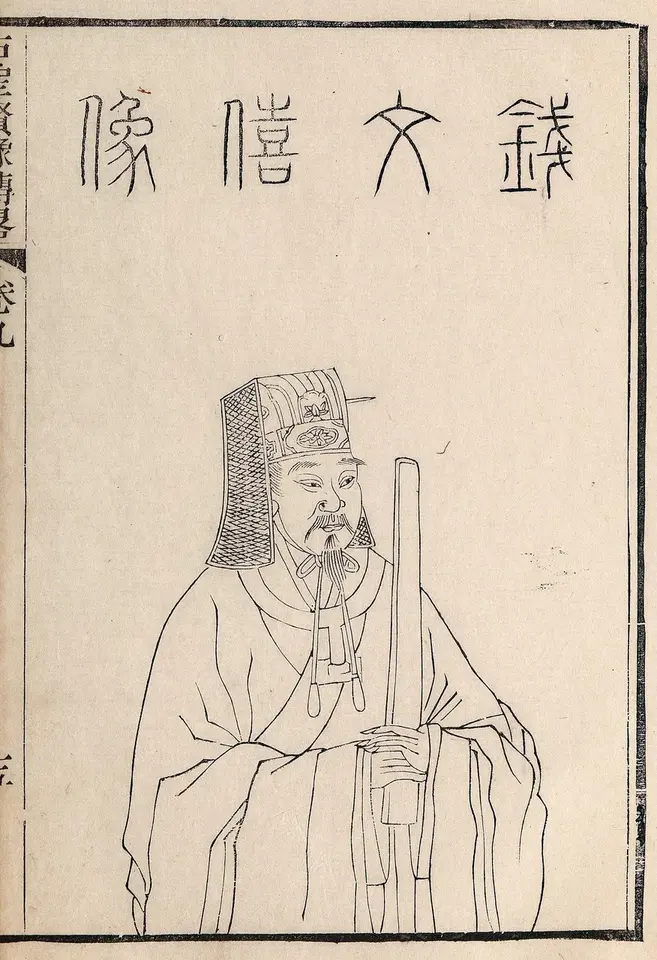
钱惟演
Qian Weiyan (钱惟演, 977–1034) was an eminent Northern Song statesman, leading literatus, and key architect of the early Song literary renaissance. Born in Qiantang as the son of Qian Chu (King Zhongyi), the last sovereign of the Wuyue Kingdom, Qian moved to the imperial capital Kaifeng at the age of two when his father surrendered Wuyue territory to the Song court. Renowned for his prodigious intellect and insatiable…
Qian Weiyan (钱惟演, 977–1034) was an eminent Northern Song statesman, leading literatus, and key architect of the early Song literary renaissance. Born in Qiantang as the son of Qian Chu (King Zhongyi), the last sovereign of the Wuyue Kingdom, Qian moved to the imperial capital Kaifeng at the age of two when his father surrendered Wuyue territory to the Song court. Renowned for his prodigious intellect and insatiable passion for books, Qian entered the imperial bureaucracy through special imperial testing under Emperor Zhenzong, rising rapidly through prestigious literary postings including Hanlin Academician, Minister of Works, and eventually Commissioner of Military Affairs. As the primary founder and chief exponent of the opulent Xikun literary style, Qian co-authored the Xikun chouchang ji and directed the compilation of monumental imperial anthologies, most notably the thousand-volume Cefu Yuangui. During his tenure as Prefect of Henan presiding over Luoyang in his later years, he served as a benevolent patron to a rising generation of intellectual giants, actively nurturing Ouyang Xiu, Mei Yaochen, Xie Jiang, and Yin Zhu, thereby laying the institutional and literary foundations for the Northern Song Prose Reform. He died at his provincial posting in Sui Prefecture in 1034, and was posthumously honored as Grand Preceptor and granted the posthumous name Wenxi.
Born into the royal house of Wuyue, son of King Qian Chu.
Accompanied his father in submitting to Song; granted palace guard title and devoted himself to books.
Tested at the Secretariat Academy, appointed Court Gentleman and Directing Scholar of the Secret Archives.
Composed poetry alongside Yang Yi and Liu Yun, compiling the renowned Xikun chouchang ji.
Elevated to Hanlin Academician, supervising the compilation of the massive encyclopedia Cefu Yuangui.
Appointed Commissioner of Military Affairs shortly before Emperor Zhenzong's death, overseeing supreme military administration.
Removed from the Privy Council amidst court factional struggles, dispatched to govern Heyang and Anzhou.
Appointed Prefect of Henan (Luoyang), recruiting Ouyang Xiu and Mei Yaochen to mentor younger literati.
Passed away in office at Suizhou at age fifty-eight; posthumously named Grand Preceptor with the posthumous title Wenxi.
Qian Weiyan was born in the Qiantang royal palace of the Wuyue Kingdom. His father was Qian Chu, the final ruler of Wuyue who held regional sway over thirteen prefectures during the Five Dynasties and Ten Kingdoms period. In 978, Qian Chu peacefully surrendered his kingdom and pledged allegiance to the Song dynasty. Qian Weiyan, then barely two years old, relocated with the entire royal lineage to Kaifeng. In recognition of his princely heritage, the Song court bestowed upon him honorary military titles, including General of the Right Garrison Guard and later General of the Right Militant Guard.
Blessed with extraordinary intellectual gifts, Qian Weiyan dedicated his youth in Kaifeng to rigorous classical scholarship, amassing a private library of tens of thousands of volumes. He was so devoted to reading that he was never seen without a book in hand: reading classical histories while seated, browsing miscellaneous records and fiction while reclining, and reciting wooden tablets even during visits to the privy.
Upon the accession of Emperor Zhenzong, who placed tremendous emphasis on civilian culture and sought to recruit talented men among the former princely lineages, Qian Weiyan was summoned to the Secretariat Academy for a rigorous testing of literary composition. Qian composed his policy essays effortlessly, displaying profound classical erudition and dazzling rhetorical elegance. Deeply impressed, Emperor Zhenzong immediately conferred upon him the posts of Erudite of the Court of Imperial Sacrifices, Auxiliary in the Secret Pavilion, and soon thereafter Vice Director of the Court of the Imperial Stud, formally inducting him into the elite ranks of court literati.
Over the succeeding years, Qian Weiyan served successively as Director of the Bureau of Hereditary Privileges in the Ministry of Personnel, Drafter of Edicts, Grand Policy Critic, and Administrator of the Bureau of Personnel Evaluation, where he took charge of civil and military bureaucratic appraisals. His administrative rulings were celebrated for their analytical clarity, procedural fairness, and meticulous precision, earning praise from both the emperor and senior court statesmen.
During the Dazhong Xiangfu era, Emperor Zhenzong ordered the establishment of an editorial bureau in the Secret Pavilion to compile a comprehensive imperial administrative encyclopedia, the thousand-volume Cefu Yuangui, as well as the Xu Tongdian. Qian Weiyan was selected to join eminent scholars including Wang Qinruo, Yang Yi, Liu Yun, and Li Zong'e in collating and analyzing millennia of dynastic records, biographies, and institutional histories. Throughout the project, Qian demonstrated encyclopedic mastery of canonical precedents and administrative evolution, drafting hundreds of foundational scrolls.
In their leisure hours away from rigorous archival labors, the Secret Pavilion scholars engaged in lively poetic exchanges. Drawing aesthetic inspiration from late Tang masters Li Shangyin and Wen Tingyun, they cultivated a poetic register marked by exquisite diction, intricate metrical harmony, and dense historical allusions, evoking the opulent grandeur of the imperial court. Between 1005 and 1006, Qian Weiyan, Yang Yi, and Liu Yun compiled over two hundred of their finest poems into the celebrated anthology Xikun chouchang ji. The work took the capital by storm, establishing the dominant poetic aesthetic of early Northern Song court literature known as the Xikun Style. Among his contemporaries, Qian was noted not only for his prolific output, but also for the poised aristocratic dignity and emotional resonance of his verse.
On the strength of his literary achievements and editorial contributions, Qian advanced through high court offices, serving as Hanlin Academician, Vice Minister of Works, Co-Administrator of the Metropolitan Examinations, and Grand Policy Critic, before being elevated to Minister of Works and Vice Commissioner of Military Affairs.
During the closing years of Emperor Zhenzong's reign, when the sovereign was incapacitated by chronic illness, Empress Liu began exercising executive authority. Astutely navigating court politics, Qian Weiyan formed close marital alliances with the empress's family: his younger sister was married to Empress Liu's brother Liu Mei, while his son Qian Ai wedded the empress's cousin.
In 1022, as Emperor Zhenzong lay dying, Qian allied with Ding Wei to sideline Chancellor Kou Zhun and was appointed Commissioner of Military Affairs, reaching the pinnacle of national military and political policymaking.
Following the accession of Emperor Renzong and the formal establishment of Empress Dowager Liu's regency, Qian Weiyan was elevated to Joint Manager of Affairs with the Secretariat-Chancellery and granted the prestigious military governorship of the Zhenguo Army. However, his intimate ties to the regency provoked persistent accusations from imperial censors, who condemned him for political opportunism and overreaching ambitions. In 1025, Qian was removed from the Military Affairs Commission and dispatched to serve in provincial posts, governing Heyang, Anzhou, and Chenzhou.
In 1031, Qian Weiyan was recalled to senior administrative rank and appointed Prefect of Henan, placing him at the helm of the Western Capital, Luoyang. Renowned for its storied gardens and rich cultural heritage, Luoyang offered a relaxed political atmosphere far removed from capital intrigue. As a high-ranking regional magistrate and former premier, Qian conducted himself with graceful warmth, displaying an insatiable appetite for discovering young literary talent.
Upon arriving in Luoyang, Qian brought exceptional young men into his administrative staff. He appointed the twenty-four-year-old Ouyang Xiu as Judicial Investigator of the Western Capital Defense Command, named Mei Yaochen as Henan Administrative Assistant, appointed Xie Jiang as Vice Prefect, and welcomed the young classical scholar Yin Zhu to his circle. Disdaining bureaucratic arrogance, Qian treated these young scholars with paternal benevolence, deliberately exempting them from tedious administrative routines so they could freely compose poetry, tour historical ruins, and discuss philosophy.
Whenever the famed Luoyang peonies were in full bloom, Qian opened his private estates, arranged lavish banquets funded by public dispensations, and provided carriages for Ouyang Xiu, Mei Yaochen, and Xie Jiang to visit Longmen Mountain, Xiangshan Temple, and the Luo River. Under Qian's generous protection, the young scholars boldly departed from the ornate, allusion-laden confines of the Xikun style, exploring rugged classical prose styles championed by Yin Zhu. This blossoming of the Luoyang Literary Group laid the indispensable creative groundwork for Ouyang Xiu's subsequent leadership of the Northern Song Guwen Prose Movement. In later life, Ouyang Xiu recorded touching reminiscences in his Guitian lu, praising Qian as an incomparable patron who recognized and cherished true literary genius.
Following the death of Empress Dowager Liu in 1033 and Emperor Renzong's assumption of direct personal rule, the imperial court purged prominent figures associated with the former regency. Subjected to fresh impeachment by censors, Qian was stripped of his gubernatorial honors and demoted to govern Sui Prefecture. In the autumn of 1034, Qian passed away in his official residence in Sui Prefecture at the age of fifty-eight. Recognizing his monumental cultural contributions, Emperor Renzong posthumously granted him the rank of Grand Preceptor and conferred upon him the esteemed posthumous name Wenxi.
As the principal architect and leading practitioner of the Xikun poetic style, Qian Weiyan shaped the aesthetics of early Northern Song court literature with his impeccable prosody, elegant diction, and learned allusiveness. Furthermore, his central role in compiling hundreds of scrolls for the Cefu Yuangui and compiling the Xu Tongdian constituted an enduring scholarly contribution that preserved crucial Tang and Song administrative documents for posterity.
Qian Weiyan's most lasting legacy lies in his extraordinary mentorship of young scholars in Luoyang. By providing generous patronage, administrative protection, and artistic freedom to Ouyang Xiu, Mei Yaochen, and Yin Zhu, he fostered the intellectual vanguard that overthrew the decorative excesses of the Xikun style itself and inaugurated the Northern Song Prose Reform, ushering in the golden age of classical Chinese literature.
Beyond his mastery of formal regulated verse, Qian achieved high distinction in the development of Song lyric poetry (ci). His lyrics, characterized by refined emotional subtlety, harmonic elegance, and vivid imagery of spring scenes, were highly acclaimed by later critics. His celebrated composition to the tune Mulan hua was celebrated in classical anthologies as an early Song masterpiece of the delicate and graceful style.
FIGURES ASSOCIATED WITH THIS DYNASTY