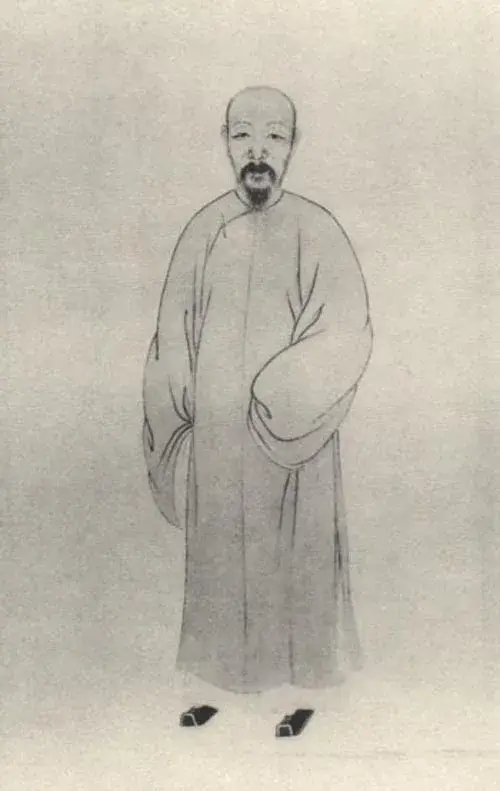
Biography
Illustrious Heritage and Maternal Nocturnal Weaving
In 1686, Qian Chenqun was born into an established gentry lineage in Jiaxing County, Jiaxing Prefecture, Zhejiang Province, tracing ancestry to the prominent Qian clan of Haiyan. His father, Qian Luanguang, was an erudite scholar who unfortunately passed away when Qian Chenqun was only a toddler, leaving behind a destitute young widow and small children.
Faced with sudden penury, Qian Chenqun and his younger siblings were nurtured entirely by their mother, Chen Shu. Daughter of the distinguished Chen family of Haiyan, she was well-versed in the classics and poetry and gained lasting renown as one of the most prominent female painters of the Qing period. To feed the household, Lady Chen painted, sold calligraphy, and performed fine needlework by day; by night, she sat before the spinning wheel, guiding young Qian Chenqun to memorize the Four Books and Five Classics and transcribe dynastic chronicles under the dim flicker of a rapeseed oil lamp. In freezing winters, mother and son read and spun together until the break of dawn, creating the touching story of maternal virtue known as "teaching the classics while spinning by night," which was later formally recorded in the Biographies of Exemplary Women of the Draft History of Qing.
Under his mother's rigorous tutelage, Qian Chenqun developed an exceptional foundation in classical scholarship. By age twenty in 1705, when the Kangxi Emperor embarked on his fifth southern inspection tour, Qian Chenqun greeted the imperial retinue at Wujiang, Jiangsu, presenting newly composed rhapsodies and eulogies. Kangxi was highly pleased and ordered him to report to the capital for an imperial examination upon the court's return. However, as his mother fell gravely ill, Qian Chenqun prioritized filial piety over official advancement, declining the palace call to nurse her at her bedside for years, earning widespread renown for his devotion.
Imperial Examination and Repute for Frank Memorials
In 1721, after his mother's recovery, the thirty-six-year-old Qian Chenqun traveled north to participate in the metropolitan examinations, earning the jinshi degree. During the imperial audience at the Hall of Preserving Harmony, the elderly Kangxi Emperor recognized Qian Chenqun, warmly recalling the poem presentation at Wujiang sixteen years earlier. Praising his filial conduct, Kangxi assigned him directly as a bachelor in the Hanlin Academy and subsequently made him a compiler.
Following the accession of Emperor Yongzheng, who sought to purge administrative corruption and cultivate social morality, Qian Chenqun was selected in 1729 alongside Shi Yizhi and Hang Yilu to serve as Imperial Commissioner for Moral Edification in Shaanxi. Their mission was to propagate the Sacred Edict and orthodox Confucian virtues among the regional populace.
Qian Chenqun traveled extensively across Shaanxi's prefectures and counties with minimal entourage. Foregoing bureaucratic pretension, he gathered local gentry, examination students, and village elders in public halls, elucidating filial piety, brotherly affection, and civic duty through clear and accessible vernacular language. His genuine empathy and lucid explanations moved many scholars to tears. Upon returning to Beijing, Emperor Yongzheng lauded him as a sincere, sensible, and dutiful scholar, rapidly promoting him to Reader of the Hanlin Academy, Diarist of Imperial Activities, and Education Commissioner of Shuntian.
High Imperial Service and Judicial Prudence
In 1736, the Qianlong Emperor ascended the throne. Qian Chenqun, then directing examinations in Shuntian, retired to observe the required three-year mourning period after the passing of his venerable mother. During this interval, he submitted to the palace his mother's hand-painted artwork, "Teaching the Classics while Spinning by Night." The young emperor was deeply moved by Lady Chen's moral perseverance, inscribing several seven-character quatrains upon the painting and bestowing fine brocades and antique treasures upon the family.
Once the mourning period concluded, Emperor Qianlong reappointed Qian Chenqun as Education Commissioner of Shuntian and elevated him through the posts of Academician of the Grand Secretariat, Right Vice Minister of Revenue, and Left Vice Minister of Justice.
During his multi-year tenure in the Ministry of Justice, Qian Chenqun oversaw national death penalty reviews and the annual Autumn Assizes. Embracing the Confucian imperative of judicial mercy, he prohibited torturous confessions and actively campaigned to exonerate those wrongly condemned. Confronting systemic local malpractices such as abusive corporal punishments, concealment of famines, and illegal meltage surcharges, he submitted notable memorials urging the suppression of anonymous denunciations, widespread tree planting, tiered disaster relief based on wealth, and the regulation of fiscal surcharges. Most of his proposals received imperial endorsement and implementation.
Retirement and Southern Inspection Meetings
In 1752, at age sixty-seven, Qian Chenqun requested permission to retire due to deteriorating eyesight and chronic leg ailments. Reluctant to part with his loyal servant, Qianlong granted him the honorary title of Grand Tutor to the Crown Prince, brevet Minister of Justice, full official pension for life, and the rare privilege of riding a horse within the Forbidden City.
In his retirement years in Jiaxing, Qian Chenqun enjoyed classical research, tutoring descendants, and exchanging poetry. Emperor Qianlong kept his former minister constantly in mind; whenever the monarch composed an exceptional poem, an imperial courier carried a copy to Jiaxing, where Qian Chenqun dutifully composed responding verses. At this time, Shen Deqian was likewise residing in retirement in Suzhou, and Qianlong frequently celebrated the two masters as the "Two Elders of the Southeast."
During Qianlong's four southern tours in 1751, 1757, 1762, and 1765, the emperor repeatedly summoned Qian Chenqun to his imperial boat to share private banquets and reminisce over past decades, addressing him warmly as a friend of many years. In imperial verses, Qianlong wrote: "The Old Man of Xiangshu is truly my friend, upon whom the literary cultivation of the Southeast relies."
In the spring of 1774, Qian Chenqun passed away peacefully at his Nanhu residence in Jiaxing at the age of eighty-eight. The Qianlong Emperor was deeply grieved upon hearing the news, providing generous imperial burial funds, posthumously conferring the office of Grand Tutor, admitting him to the capital's Temple of Worthies, and granting him the posthumous title Wenduan.
Major Achievements
High Tang Poetics and Leadership of the Southeast
Within the poetic landscape of the mid-Qing Qianlong era, Qian Chenqun held a commanding position as a foremost literary leader. Alongside Shen Deqian, who spearheaded the Form and Tone School (Gediao Pai) advocating imitation of High Tang balance and elegance, Qian Chenqun received the strongest imperial patronage from Qianlong.
Qian Chenqun maintained close affinity with Shen Deqian, forming the dual pillars of Tang-style poetics in the Jiangnan region. He argued that poetry should ground its moral vitality in Han, Wei, and Six Dynasties literature while adopting Li Bai, Du Fu, Gao Shi, and Cen Shen as orthodox stylistic paragons. He strongly opposed the Song dynasty tendency toward prose-like discursive argumentation, insisting that true poetry must preserve resonant cadence, transcendent elegance, and solemn Confucian moral intent.
His writings were assembled in the thirty-volume Xiangshuzhai Wenji and fifteen-volume Xiangshuzhai Shiji. His verse depicted Jiangnan scenery, pastoral agriculture, and imperial banquet compositions with poise, warmth, and classical restraint, devoid of superficial ornament. Emperor Qianlong personally contributed an imperial preface praising his verse as peaceful and pure, carrying the living legacy of the Kaiyuan and Tianbao eras, establishing his work as a textbook standard for mid-Qing court literature.
Judicial Clemency and Institutional Legal Reforms
In the imperial administrative apparatus, the Ministry of Justice held jurisdiction over statutory penalties, directly impacting countless lives. Operating as a Neo-Confucian scholar-official in charge of judicial verdicts, Qian Chenqun demonstrated profound humanitarian concern and legal rationality while serving as Left Vice Minister of Justice.
To counter the chronic habit of local magistrate courts employing torture to extract confessions for rapid career promotion, Qian Chenqun advocated on the imperial floor that penal administration must stress verified evidence over extracted testimony. Whenever confessions conflicted with material circumstances, he insisted on extensive re-examination rather than summary sentencing. During the annual Autumn Assizes, he pored through delayed capital execution dossiers through the night, commuting dozens of death sentences to exile or forced labor.
Equally remarkable were his policy memorials on governance. In his memorial on differentiating tax remissions during local disasters by household wealth, he noted that across-the-board tax relief benefited wealthy landowners disproportionately while leaving destitute tenant farmers impoverished. He proposed that destitute victims receive complete exemptions, introducing the concept of stratified relief into Qing famine administration. In his memorial urging tree planting, he devised an evaluation mechanism rewarding officials and commoners for afforestation, which modern scholars recognize as an early precursor to watershed management and soil conservation.
Confidential Literary Companionship with Emperor Qianlong
Throughout imperial history, relations between monarchs and courtiers were predominantly characterized by strict hierarchical subordination and chronic suspicion. However, the five-decade relationship between Emperor Qianlong and Qian Chenqun displayed an uncommon warmth of scholarly friendship.
Ever since Qian Chenqun presented the painting of his mother in 1736, the emperor admired his filial integrity and regarded him as an elder confidant. Within inner court chambers, Qianlong regularly invited Qian Chenqun to polish his drafts and discuss poetic meter; Qian Chenqun responded with modest grace, offering subtle remonstrance through respectful critique.
Even after Qian Chenqun spent more than two decades in retirement in Jiangnan, imperial poems and rhyming responses traveled constantly along courier routes, numbering in the hundreds. When Qianlong inspected Suzhou and Hangzhou, he repeatedly seated the octogenarian scholar beside the imperial throne, bestowing palace tea and medicinal ginseng. This lifelong imperial favor and literary kinship not only granted Qian Chenqun unmatched political security in Jiangnan but also enriched Qing cultural history with the enduring lore of the Two Elders serving Gaozong.