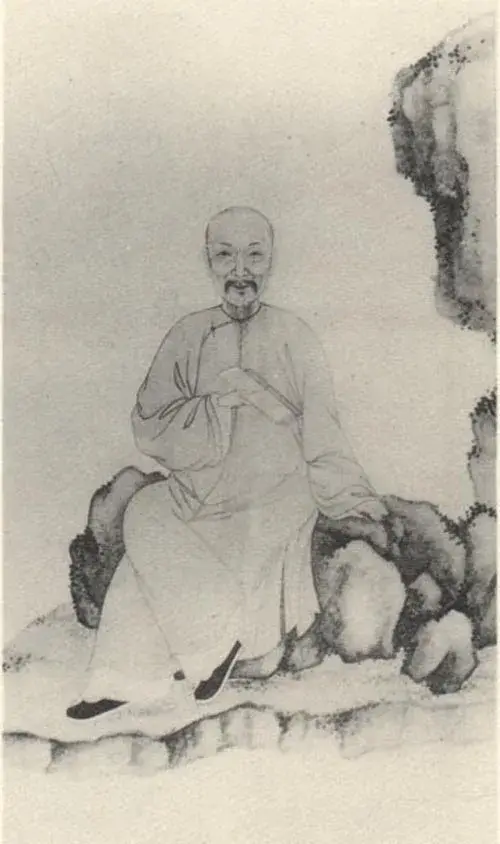
PROFILE
Qi Zhaonan (1703–1768), courtesy name Cifeng, art name Qiongtai, later styled Xiyuan, was a native of Tiantai County, Taizhou Prefecture, Zhejiang Province (present-day Tiantai County, Taizhou City, Zhejiang). He was a distinguished historical geographer, historian, classicist, and statesman of the mid-Qing dynasty, recognized as a pioneer of Chinese hydrographic geography, rising to Right Vice Minister of Rites and Academician of the Grand Secretariat. Celebrated from childhood as a prodigy endowed with photographic memory, he mastered dynastic chronicles, astronomical calendars, and topography. In 1733, he was recommended for the special imperial examination for men of vast erudition (boxue hongci), placing tenth in the second class during the 1736 palace examination under the Qianlong Emperor, and was inducted into the Hanlin Academy as a compiler. He participated in compiling the Da Qing Yitong Zhi (Comprehensive Gazetteer of the Great Qing) and served as Associate Grand Custodian of the Xu Wenxian Tongkao (Continued Comprehensive Examination of Literature). Consistently placing first in palace tests, he rose to Vice Minister of Rites and served as tutor to the imperial princes in the Imperial Study. In 1749, he fell from his horse upon leaving the palace, fracturing his cranium, and retired due to injury despite medical care sent by Emperor Qianlong. In retirement, he directed the Fuwen Academy in Hangzhou and the Jishan Academy in Shaoxing. In 1768, he was implicated in the literary inquisition case of his clan cousin Qi Zhouhua, stripped of his honors, and passed away that winter at age sixty-six. His twenty-eight-volume masterwork Shuidao Tigang (Compendium of Waterways) established a peak of classical hydrography, complemented by Hanshu Kaozheng and Lidai Diwang Nianbiao.
- Courtesy Name
- Cifeng
- Literary Name
- Qiongtai, Xiyuan
- Ancestral Home
- Tiantai County, Taizhou Prefecture, Zhejiang Province (present-day Tiantai County, Taizhou City, Zhejiang)
- Date of Birth
- 1703 (Kangxi 42)
- Date of Death
- 1768 (Qianlong 33)
- Age at Death
- 66
- Highest Office
- Right Vice Minister of Rites, Academician of the Grand Secretariat, Reader of the Imperial Study
- Historical Identity
- Historical geographer, historian, Confucian classics scholar, high court minister
BIOGRAPHY
Chronology
- 1703 (Kangxi 42) | Birth in Tiantai | Born into an established literati family in Tiantai, Zhejiang; exhibited extraordinary memory and was praised as a prodigy.
- 1729 (Yongzheng 7) | Provincial Examination | Placed on the supplementary list (fubang) in the Zhejiang provincial civil service examination.
- 1736 (Qianlong 1) | Boxue Hongci Examination | Passed the special imperial examination for vast learning; appointed Hanlin compiler.
- 1737 (Qianlong 2) | Compiling the Imperial Gazetteer | Inducted into the bureau of Da Qing Yitong Zhi, authoring volumes for Henan, Shandong, Jiangsu, and foreign lands.
- 1747 (Qianlong 12) | Associate Grand Custodian | Appointed Reader of the Hanlin Academy and Associate Director for the Xu Wenxian Tongkao compendium.
- 1748 (Qianlong 13) | Vice Minister of Rites | Placed first in internal palace examinations; promoted to Vice Minister of Rites and Imperial Study tutor.
- 1749 (Qianlong 14) | Severe Equestrian Accident | Fell from his horse outside the palace, suffering a fractured skull; retired after receiving imperial medical treatment.
- 1756 (Qianlong 21) | Finalizing the Shuidao Tigang | Completed the twenty-eight-volume hydrographic masterpiece Shuidao Tigang after decades of research.
- 1761 (Qianlong 26) | Directing Fuwen Academy | Appointed director of the Fuwen Academy in Hangzhou and Jishan Academy in Shaoxing, training regional scholars.
- 1768 (Qianlong 33) | Literary Inquisition and Death | Stripped of rank following the sedition case of his clan cousin Qi Zhouhua; died at his Tiantai home at age sixty-six.
Biography
Tiantai Child Prodigy and Encyclopedic Erudition
In 1703 (the 42nd year of the Kangxi reign), Qi Zhaonan was born outside the West Gate of Tiantai County, Taizhou Prefecture, Zhejiang Province. The Qi family had flourished in Tiantai for generations as an esteemed scholarly household. From earliest boyhood, Qi Zhaonan demonstrated intellectual talents and an extraordinary photographic memory.
Contemporary records noted that he never forgot a text once read, whether classical canons, dynastic chronicles, astronomical calendars, or topographical maps. Furthermore, his eyesight was unusually sharp; he was reputed to discern distant banner inscriptions and subtle color distinctions miles away in broad daylight. Scholars and provincial officials revered him as the "Tiantai Prodigy."
Unlike scholars focused solely on eight-legged examination prose, young Qi directed his intellect toward practical statecraft and historical geography. He collected imperial maps, local gazetteers, and border chronicles, recording the origins and junctions of mountains, rivers, strategic passes, and frontier tributary kingdoms. In 1729, Qi Zhaonan sat for the Zhejiang provincial civil service examination, earning a place as a tribute student on the supplementary list (fubang gong sheng).
Palace Examination and Service at Court
In 1733, the Yongzheng court commanded provincial governors to recommend candidates of profound erudition for the prestigious Boxue Hongci examination. Due to his reputation in classical geography and textual research, Zhejiang Governor-General Li Wei recommended Qi Zhaonan to the capital.
In the autumn of 1736, newly enthroned Emperor Qianlong personally presided over the examination at the Hall of Preserving Harmony. The examination questions probed obscure historical institutions, yet Qi Zhaonan drafted classical responses without error, placing tenth in the second class. He was inducted into the Hanlin Academy as a bachelor and subsequently appointed a compiler.
In the early Qianlong reign, major court compilation projects commenced. In 1737, Qi Zhaonan joined the bureau of the Da Qing Yitong Zhi (Comprehensive Gazetteer of the Great Qing). He assumed responsibility for drafting the provinces of Henan, Shandong, Jiangsu, Anhui, Fujian, and Yunnan, alongside foreign frontier domains. In 1741, he presented the Waifan Shu (Treatise on Outer Tributary Kingdoms), earning the emperor's praise as an authority on frontier affairs.
In internal court examinations convened by Emperor Qianlong in 1743 and 1748, Qi Zhaonan placed first among Hanlin academicians. In 1748, at age forty-six, he was elevated to Academician of the Grand Secretariat and Right Vice Minister of Rites, concurrently serving as Reader in the Imperial Study, delivering classical lectures to the imperial princes. During an archery contest in the Western Garden, the emperor struck the bullseye nineteen consecutive times and ordered attendant ministers to compose verse; Qi Zhaonan presented a poem that received an imperial responding verse.
Equestrian Accident and Early Retirement
In the summer of 1749, at the height of his administrative career, an unexpected accident interrupted Qi Zhaonan's public service.
While riding home from duty outside the Forbidden City, his horse took fright, stumbled, and bolted. Qi Zhaonan was thrown from his saddle, his head striking a granite boulder along the road. The impact fractured his skull, leaving him unconscious.
Informed of the accident, Emperor Qianlong dispatched bone-setting physicians from the imperial household and supplied precious palace medicines. Although the physicians saved his life, the trauma caused severe neurological concussion, leaving him with chronic dizziness, impaired memory, and physical frailty that prevented him from carrying out demanding administrative duties.
In the winter of 1749, Qi Zhaonan offered formal gratitude to the throne and petitioned for retirement. Regretting the loss of his minister, the emperor granted him retirement with his ministerial rank and permitted him to retain his full official pension for life.
Directing Academies and the Clan Inquisition
Returning to Tiantai, Qi spent years recovering, adopting the art name Xiyuan Laoren (Old Man of the Resting Garden). He dedicated his remaining energy to geographic research and classical pedagogy.
In 1756, after decades of collation, he completed his twenty-eight-volume geographical masterpiece Shuidao Tigang, clarifying China's hydrographic network. Beginning in 1761, supported by regional gentry, Qi served as director of the Fuwen Academy in Hangzhou and the Jishan Academy in Shaoxing for seven years. He emphasized practical statecraft alongside textual research, discouraging empty metaphysical speculation and training generations of eastern Zhejiang scholars.
However, the literary inquisitions of the mid-Qing period reached the aging scholar. In 1768, his clan cousin Qi Zhouhua was arrested for sedition regarding commentary on Lv Liuliang's banned works in his Baihetang Ji. During the treason trial, imperial authorities ordered an investigation into Qi's clan. Although retired and careful in his writing, Qi Zhaonan was arrested and transported to Beijing for interrogation.
The Ministry of Justice concluded that Qi Zhaonan had no connection to treason, yet cited his failure as a clan senior to report his cousin. The throne stripped Qi of his vice-ministerial rank and honors, banishing him back to his native county under strict surveillance. Shattered by this ordeal and the arduous journey, Qi Zhaonan passed away in his Tiantai home in the winter of 1768 at the age of sixty-six.
Major Achievements
Compiling the Shuidao Tigang and Peak of Hydrography
In the history of Chinese historical geography, Qi Zhaonan's foremost contribution was the twenty-eight-volume Shuidao Tigang (Compendium of Waterways).
Since Li Daoyuan's Commentary on the Water Classic in the Northern Wei, Chinese river geography had suffered from factual gaps and confused courses, especially regarding inland river basins in the northwest and frontier territories. Beginning with his work on the imperial gazetteer, Qi spent thirty years cross-referencing pre-Qin texts, dynastic records, Qing imperial surveys, and local gazetteers.
The Shuidao Tigang systematically documented major river systems—including the Yellow River, Yangtze, Huai River, Hai River, and Pearl River—alongside waterways across Manchuria, Mongolia, Xinjiang, Qinghai, Tibet, and neighboring tributary regions. Qi traced each river's source, tributaries, navigational channels, and terminal outlets into the sea, correcting hundreds of geographical errors in the History of Ming. Imperial editors of the Siku Quanshu praised the work as the most comprehensive hydrographic treatise since the Commentary on the Water Classic.
Directing Imperial Gazetteers and the Xu Wenxian Tongkao
During his service in the Hanlin Academy and Grand Secretariat, Qi Zhaonan directed and contributed to major imperial compilations.
In compiling the Da Qing Yitong Zhi, he completed historical documentation for multiple central provinces and conducted research on the frontiers. His monograph Waifan Shu gathered Manchu, Mongolian, and Chinese records to map borders, mountain passes, and tribute routes, providing historical evidence for the Qing Empire's territorial integration.
Appointed Associate Director of the Xu Wenxian Tongkao in 1747, Qi supervised geography, taxation, and military sections. Rejecting hearsay, he incorporated archival documentation from the late Ming and early Qing periods, enhancing the institutional reliability of the encyclopedia.
Textual Collation of the History of Former Han and Imperial Chronology
Beyond geography, Qi Zhaonan achieved distinction in Qianlong-era evidential scholarship (kaojuxue).
He devoted years to authoring the 120-volume Hanshu Kaozheng (Evidential Analysis of the History of Former Han). Scrutinizing Ban Gu's text, he synthesized ancient phonology, paleography, and stone rubbings, rectifying over a thousand transmission errors accumulated since Yan Shigu's Tang dynasty commentary. The work remains an authoritative reference for studying the Western Han.
Furthermore, he compiled the thirteen-volume Lidai Diwang Nianbiao (Chronological Tables of Dynastic Emperors) and the five-volume Shiji Gongchenhou Nianbiao Kaozheng. Employing rigorous chronological methodology, he verified the accession dates and era names of Chinese monarchs from antiquity through the Ming dynasty, establishing an empirical foundation for dynastic history.
Educational Reforms in Eastern Zhejiang Academies
In his later years, Qi Zhaonan dedicated himself to higher education, leaving an enduring mark on the development of the Eastern Zhejiang School.
While directing the Fuwen and Jishan academies, he countered the trend of students focusing solely on eight-legged essays. He restructured the curriculum to require classical textual research, institutional history, astronomy, and geography, leading students on field inspections of river dikes and water conservancy projects across the Hangzhou-Jiaxing-Huzhou and Shaoxing plains.
Hundreds of scholars attended his lectures, developing into practical administrators and scholars who preserved the Eastern Zhejiang tradition of integrating classical study with statecraft during the High Qing era.
Relationships
- Examination Peer: Hang Shijun (1696–1773), courtesy name Dazong, passed the 1736 Boxue Hongci examination in the same class, prominent Qing historian.
- Court Colleague: Jiang Pu (1708–1761), courtesy name Zhifu, Grand Secretary of the Wenhua Palace and Minister of Revenue, who composed poetry alongside Qi before the emperor.
- Clan Cousin: Qi Zhouhua (1698–1768), courtesy name Jutai, clan cousin executed during a literary inquisition, which led to Qi Zhaonan's dismissal.
- Patron: Li Wei (1687–1738), courtesy name Youjie, Yongzheng-era Governor-General of Zhili and Zhejiang, who recognized Qi's talents and recommended him for the Boxue Hongci examination.
Historical Evaluations
- Qianlong Emperor: "Qi Zhaonan possesses vast erudition and understands all branches of learning. His analysis of ancient bronze mirrors proves his scholarly reputation is entirely genuine."
- Ji Yun, Siku Quanshu Zongmu Tiyao: "Qi Zhaonan read exhaustively and was an expert in geography. The Shuidao Tigang displays rigorous research and clear organization; since Li Daoyuan's Commentary on the Water Classic, no hydrographic author across a thousand years has surpassed him."
- Quan Zuwang, Jiqiting Ji: "Master Qiongtai was knowledgeable in all branches of learning, from astronomy and the calendar to mountains, rivers, and frontier passes, handling them as if looking at his own palm; he was truly a giant of our era."
- Draft History of Qing, Volume 305: "Qi Zhaonan received office through the Boxue Hongci examination, rising to Vice Minister. Endowed with an extraordinary memory, he was skilled in geography. His Shuidao Tigang analyzed river sources with precision, standing as the foremost geographical treatise of recent times."
Related Entries
- Shuidao Tigang
- Boxue Hongci Examination
- Da Qing Yitong Zhi
- Xu Wenxian Tongkao
- Hanshu Kaozheng
- Hang Shijun