Birth in Southern India
Born as a prince of the Kshatriya royal lineage in Southern India, studying dhyana contemplation under Prajnatara.
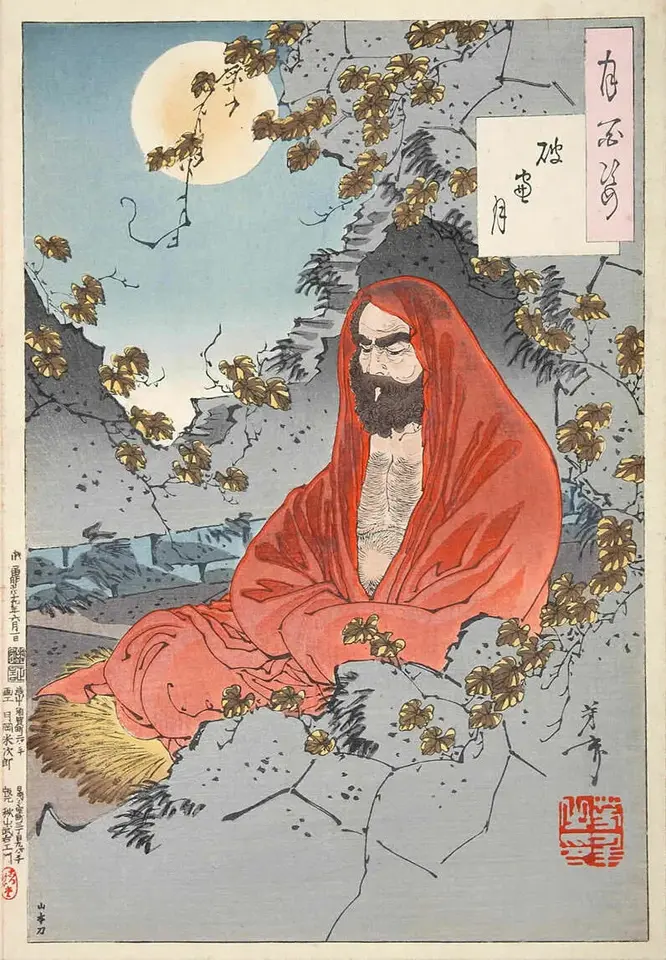
菩提达摩
Bodhidharma (菩提达摩, c. 480–c. 536) was a semi-legendary Buddhist monk originating from Southern India. He is revered throughout East Asia as the First Patriarch of Chinese Chan (Zen) Buddhism and the legendary transmitter of meditation traditions from India to China. According to historical records and early hagiographies, Bodhidharma was born the third prince of a Brahmin or royal family in South India. After attaining…
Bodhidharma (菩提达摩, c. 480–c. 536) was a semi-legendary Buddhist monk originating from Southern India. He is revered throughout East Asia as the First Patriarch of Chinese Chan (Zen) Buddhism and the legendary transmitter of meditation traditions from India to China. According to historical records and early hagiographies, Bodhidharma was born the third prince of a Brahmin or royal family in South India. After attaining enlightenment under Master Prajnatara, he traveled by sea to Guangzhou during the Liang dynasty. His famous encounter with Emperor Wu of Liang, in which he proclaimed that outward temple-building produced "no holy merit whatsoever," highlighted his radical departure from conventional scholastic Buddhism. Moving north across the Yangtze River into the Northern Wei dynasty, he settled at the Shaolin Monastery on Mount Song in Luoyang. There, he practiced his renowned "wall-gazing" (Biguan) meditation for nine years and transmitted the Lankavatara Sutra to his principal Chinese disciple, Huike (Dazu Huike). Bodhidharma's teachings—emphasizing a special transmission outside the scriptures, direct pointing to the human mind, and seeing into one's nature to attain Buddhahood—revolutionized Chinese Buddhist thought and laid the foundational cornerstone for Zen traditions globally.
Born as a prince of the Kshatriya royal lineage in Southern India, studying dhyana contemplation under Prajnatara.
Arrived by sea in Guangzhou after three years of oceanic travel; Inspector Xiao Ang sent an official memorial and Emperor Wu invited him to the capital.
Debated the true nature of karmic merit with Emperor Wu in Jiankang; finding their understanding unaligned, departed northward across the Yangtze.
Reached the Northern Wei capital Luoyang, marveling at the divine beauty and golden pagoda of Yongning Temple.
Took up residence at Shaolin Monastery on Mount Song, spending nine years in silent wall-gazing meditation in a cave on Wuru Peak.
Monk Shenguang stood in snow and severed his arm to seek the Dharma; Bodhidharma transmitted the Lankavatara Sutra and granted him the Dharma name Huike.
Passed away peacefully at Qiansheng Temple in Luoyang, interred at Dinglin Temple on Mount Xiong'er; gave rise to the legend of returning west with a single sandal.
Posthumously honored by Emperor Daizong of Tang with the title Master Yuanjue (Master of Perfect Enlightenment) and tower named Kongguan, revered as the First Patriarch of Chan Buddhism.
Bodhidharma was born in Southern India, generally identified as the Pallava kingdom centered at Kanchipuram. As the third son of a local king, he received elite classical education before renouncing worldly luxuries to become a Buddhist monk. He studied under the venerable master Prajnatara, who instructed him to carry the pure lamp of meditation to the eastern lands of China after his master's demise.
Braving severe oceanic hazards, piracy, and equatorial tempests, Bodhidharma embarked on a maritime voyage across the Indian Ocean and the South China Sea. After a voyage lasting nearly three years, he arrived at the southern port of Panyu (modern Guangzhou) during the late Tianjian or early Putong era of the Southern Liang dynasty.
The Governor of Guangzhou reported his arrival to Emperor Wu of Liang (Xiao Yan), an exceptionally devout patron of Buddhism who styled himself an imperial Bodhisattva. Emperor Wu invited the foreign master to the imperial capital of Jiankang.
During their celebrated audience in the palace, Emperor Wu inquired: "Since ascending the throne, I have constructed innumerable temples, copied holy sutras, and supported countless monks. What vast merit have I accrued?" Bodhidharma curtly replied: "No merit whatsoever." When the astonished emperor asked why, Bodhidharma explained that such deeds were merely worldly causes producing transient karmic rewards, whereas ultimate spiritual merit resides in immaculate wisdom and realizing emptiness. When the emperor asked: "What is the ultimate meaning of the holy truth?" Bodhidharma responded: "Vast emptiness, nothing holy." When Emperor Wu finally asked: "Who is standing before me?" the master answered: "I know not." Finding that his spiritual message found no resonance in the court, Bodhidharma quietly left Jiankang.
Bodhidharma crossed the Yangtze River and traveled north into the territory of the Northern Wei dynasty. Reaching the ancient capital of Luoyang, he took up residence at the Shaolin Monastery situated on the slopes of Mount Song.
At Shaolin, Bodhidharma engaged in rigorous contemplative practice known as "wall-gazing" (Biguan). For nine years, he sat facing the stone wall of a mountain cave, training his mind to remain as immobile and unshakeable as a cliff face, unswayed by external desires, conceptual distinctions, or physical hardships. Early texts like Daoxuan's Continued Biographies of Eminent Monks document his method as "pacifying the mind through wall-gazing" (Bi Guan Han Rong), synthesizing direct experiential insight with scriptural grounding.
During his stay at Mount Song, a former Confucian scholar named Shenguang sought out Bodhidharma, seeking profound spiritual liberation. Demonstrating his supreme sincerity during a freezing winter night—symbolized in later tradition by cutting off his left arm in the snow—Shenguang was accepted as his primary disciple and renamed Dazu Huike.
Bodhidharma transmitted to Huike four fascicles of the Lankavatara Sutra, stating that this text alone was essential for clarifying the fundamental nature of mind in the lands of China. Along with the sutra, he passed on his monastic robe and bowl as symbols of patriarchal succession.
Before his departure, Bodhidharma tested his disciples' realization; while others offered verbal formulations, Huike simply bowed and stood in silence, receiving the master's profound approval.
Around 536, Bodhidharma passed away near the Luo River. Disciples and local devotees interred his remains at Mount Xiong'er (in modern Yiyang County, Henan). Later folklore related that three years after his burial, an imperial envoy named Songyun encountered Bodhidharma walking barefoot through Central Asia carrying a single shoe; when his disciples opened his tomb, only an empty coffin containing the companion sandal remained.
Bodhidharma braved years of perilous sea travel across the Indian Ocean and South China Sea to transmit the pure contemplative lineage of Mahayana Buddhism to China, establishing a revolutionary new chapter in Asian spiritual history.
During his famous encounter with Emperor Wu of Liang, Bodhidharma boldly declared that imperial temple-building and sutra-copying accrued no genuine transcendent merit, sweeping away empty ritualistic attachments and directing attention straight to the intrinsic awakening of mind.
During his nine years of silent contemplation at Shaolin Monastery, Bodhidharma authored The Two Entrances and Four Practices, synthesizing transcendent meditative realization with practical moral conduct and laying the structural bedrock for the Chan school.
By conferring the four fascicles of the Lankavatara Sutra alongside the patriarchal robe and bowl upon Huike, Bodhidharma established an unbroken lineage of dharma transmission that flourished into the premier tradition of East Asian Buddhist thought.
FIGURES ASSOCIATED WITH THIS DYNASTY