Birth
Born into the eminent historiographical Pei clan of Hedong; lost his mother in infancy and was raised by his grandmother.
裴子野
Pei Ziye (裴子野, 469–530 CE), styled Jiyuan, was an eminent historian, classicist, and statesman of the Southern Dynasties during the Liang dynasty. A native of Wenxi in Hedong Commandery (modern-day Wenxi, Shanxi), he belonged to the illustrious Pei clan of Hedong, a family famed across generations for historical scholarship. He was the great-grandson of Pei Songzhi, who annotated Records of the Three Kingdoms, and son of…
Pei Ziye (裴子野, 469–530 CE), styled Jiyuan, was an eminent historian, classicist, and statesman of the Southern Dynasties during the Liang dynasty. A native of Wenxi in Hedong Commandery (modern-day Wenxi, Shanxi), he belonged to the illustrious Pei clan of Hedong, a family famed across generations for historical scholarship. He was the great-grandson of Pei Songzhi, who annotated Records of the Three Kingdoms, and son of Pei Zhaoming, a senior officer in the Southern Qi administration. Demonstrating profound filial piety and intellectual distinction from youth, he served in the Southern Qi and later rose to high esteem under Emperor Wu of Liang (Xiao Yan). During his tenure as Magistrate of Zhuji, he instituted benevolent rule and abolished corporal floggings, bringing an end to litigation throughout the county. In the imperial capital, he served for over a decade in confidential secretarial positions, concurrently superintending dynastic historiography, composing imperial decrees, and holding the office of Chamberlain for Diplomatic Reception. In the realm of historiography, Pei Ziye achieved enduring fame by authoring Song Lue (Summary of Song), a twenty-volume chronological history of the Liu Song dynasty designed to prune the redundancies and moral ambiguities of Shen Yue's Book of Song. Upon reading the work, Shen Yue humbly confessed his inferiority, and the Tang dynasty critic Liu Zhiji hailed it as superior to Shen's official compilation. Furthermore, Pei Ziye championed literary archaism, composing Diao Chong Lun (On Petty Literary Craft) to denounce the frivolous, ornament-laden parallel prose then prevailing across Jiangnan. Emperor Wu famously remarked of his rapid draftsmanship: "His physical frame is slender, yet his literary vigor is mighty!" Living in Spartan poverty in a thatched cottage on leased state land, he gave his salary to impoverished relatives and died at sixty-two, honored with the rare posthumous name Zhenzi.
Born into the eminent historiographical Pei clan of Hedong; lost his mother in infancy and was raised by his grandmother.
Deeply grieved the death of his grandmother Yin at age nine, astonishing his kin with his extreme filial tears.
Observed ritual mourning for his father Pei Zhaoming; white rabbits and doves gathered by the weeping grave.
The scholar-philosopher Fan Zhen petitioned the throne to yield his post as Erudite of the National Academy to Pei Ziye.
Completed the monumental twenty-volume Song Lue, earning the deep admiration of elder statesman Shen Yue.
Recommended by Xu Mian to serve as Editorial Director and Clerk of the Secretariat, directing court archives and decrees.
Composed the famous declaration of war against Northern Wei at Shouguang Hall, stunning the Liang court with its robust eloquence.
Elevated to Chamberlain for Diplomatic Reception while retaining supervisory roles over state histories and palace drafting.
Succumbed to illness at age sixty-two; posthumously awarded Cavalier Attendant-in-Ordinary and granted the prestigious posthumous name Zhenzi.
Pei Ziye was born in 469 CE into one of the most intellectually distinguished families in Chinese historiography. His great-grandfather Pei Songzhi had won immortal fame by annotating Chen Shou's Records of the Three Kingdoms and was commissioned by Emperor Wen of Song to complete the official history of the dynasty; his grand-uncle Pei Yin compiled Collected Explanations of the Records of the Grand Historian, while his father Pei Zhaoming was celebrated for administrative integrity in the Southern Qi dynasty. Having lost his birth mother, Lady Wei, soon after birth, Pei Ziye was nurtured by his grandmother, Lady Yin, an erudite woman versed in classical poetry and history who taught him the fundamentals of classical scholarship. When Lady Yin passed away when he was nine, Pei Ziye mourned so intensely that he wept blood, startling his relatives with his natural filial devotion.
Throughout his youth, Pei Ziye devoted himself tirelessly to ancient manuscripts, mastering the Confucian classics and developing extraordinary skill in composition. He embarked on his official career under the Southern Qi dynasty, serving as Left Companion to Prince of Wuling Xiao Ye and subsequently as Adjutant to Prince of Jiangxia Xiao Baoxuan. In 502 CE, during the second year of Zhongxing under Emperor He of Qi, his father fell gravely ill for over a year. Pei Ziye prayed fervently to Heaven day and night, weeping bitterly. His father dreamed of his haggard countenance in prayer and, summoning him the next morning, found him exactly as seen in the vision. The father's brief recovery was attributed by contemporaries to Pei's filial devotion. When his father eventually died, Pei Ziye retired from office and observed mourning with meticulous rigor. At the grave site, vegetation withered where he wept, and wild white rabbits and doves hovered placidly beside him. When the court invited him to compile a treatise on filial devotion, he modestly refused.
At the dawn of Emperor Wu's reign in 502 CE, Right Vice Director of the Department of State Affairs Fan Yun admired Pei's spotless character and prepared to present a memorial recommending him for high promotion. However, Fan Yun died suddenly of illness before the petition could be formalized. At that time, Ren Fang of Le'an enjoyed immense literary fame, surrounded by ambitious junior scholars seeking career advancement. Although Pei Ziye was related to Ren Fang by marriage, his reserved and upright temperament prevented him from courting patronage. Ren Fang deeply resented this independence and refused to speak on his behalf at court.
After an extended period, Pei Ziye was appointed Adjutant to Prince of Ancheng Xiao Xiu and soon concurrently served as Assistant Director of the Court of Judicature (Tingwei Zheng). Under administrative procedure, judicial rulings required the concurrent signatures of three magistrates. On one occasion when Pei was away from the ministry, a colleague forged his signature on a judicial verdict. When higher imperial authorities rejected the verdict as legally flawed, Pei Ziye was dismissed alongside his associates. Friends urged him to petition the crown to clear his record, but Pei smiled and replied: "I often feel ashamed that I cannot match the rectitude of Liuxia Hui; how could I stoop to administrative litigation merely to preserve an official cap?" He remained in retirement for years without the slightest trace of bitterness.
In 503 CE, Xiao Jing, Marquis of Wuping, assumed regional governorship over Southern Yan Province and recruited Pei Ziye as Adjutant in his military headquarters, a post that dissolved when the military command was transferred. Around this time, the famed thinker and Palace Gentleman Fan Zhen, though having never met Pei in person, had long revered his integrity. When Fan Zhen was slated to become Professor of the National University, he submitted a celebrated memorial requesting that the imperial appointment be transferred to Pei Ziye, praising him as a master classicist who had produced the twenty-volume Song Lue. Although bureaucratic regulations blocked the petition, Pei's moral stature became widely recognized throughout Jiankang. He was subsequently appointed Gentleman of the Section of Apportionment and then Magistrate of Zhuji. In Zhuji, he instituted enlightened civil administration, abolishing judicial beating and resolving local grievances through ethical persuasion, resulting in a litigation-free county.
From early youth, Pei Ziye had felt an obligation to complete the historical enterprise left unfinished by his great-grandfather Pei Songzhi. In the late Yongming era, Shen Yue's official Book of Song had become standard, though it was marred by extensive verbiage, moralizing digressions, and a dismissive passing remark that "nothing notable was heard of the Pei descendants after Songzhi." In response, Pei Ziye meticulously compiled Song Lue (Summary of Song) in twenty volumes, combining annalistic structure with incisive biographies and critiques.
The Song Lue was distinguished by its balanced, concise, and unsparing narrative. In recording the factional violence of the Southern Song, Pei Ziye explicitly wrote: "The court executed Shen Pu, Prefect of Huainan, precisely because he refused to yield to the rebel expeditionary armies." Shen Yue, who had been politically complicit in Shen Pu's execution decades earlier, was so mortified and terrified upon reading the sentence that he walked barefoot to Pei Ziye's gate to apologize, begging to dissolve their past enmity. Shen Yue sighed: "In clarity of narrative and depth of critique, I cannot equal Pei Ziye." Lanling scholar Xiao Chen likewise declared that Pei's historical essays ranked alongside Jia Yi's Faults of Qin.
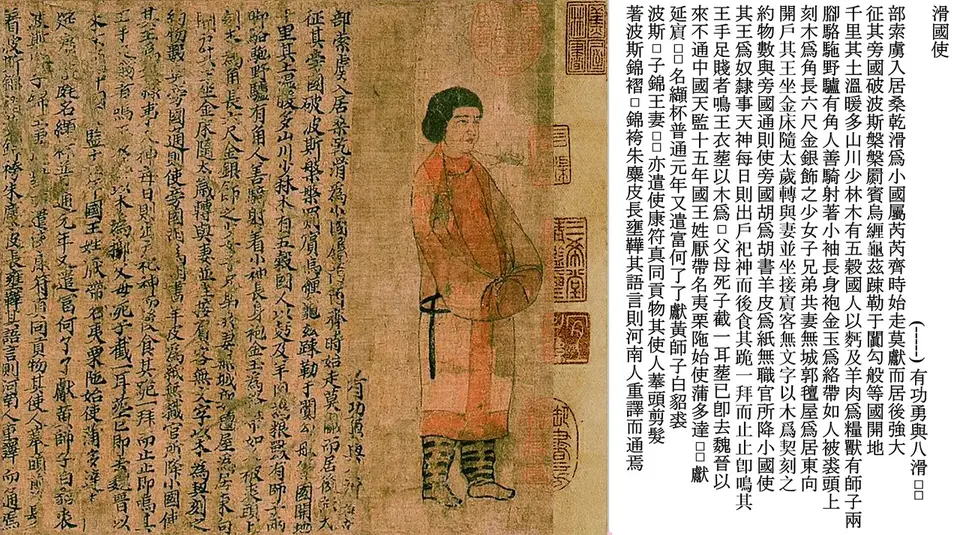
In 516 CE, Minister of Personnel Xu Mian urged Emperor Wu to recruit Pei Ziye to manage state historiography. Emperor Wu appointed him Editorial Director (Zhuzuo Lang) and concurrent Clerk of the Secretariat (Zhongshu Tongshi Sheren). He held these dual posts for over a decade, drafting imperial rescripts and chronicling imperial deeds. When envoys from the remote western lands of Baiti and Hua crossed the Min Mountains to present tribute, none of the court scholars knew their origins. Pei Ziye recalled: "In the Han dynasty, Guan Ying slew a cavalry commander of the Baiti; Fu Qian noted that Baiti was a tribal designation. Furthermore, when Ban Chao campaigned in the Western Regions, eight Hua tribes submitted. These tributary states are likely their descendants." Astounded by his breadth of knowledge, Emperor Wu commissioned him to compose Fangguo Shitu (Illustrated Records of Tributary Domains), detailing the customs, topography, and tributary goods of twenty neighboring realms.
During the northern campaign of 526 CE against the Northern Wei, Emperor Wu commanded Pei Ziye to compose an imperial declaration of war (Yi Wei Wen). Pei completed the declaration spontaneously before the throne. Recognizing the political gravity of the text, Emperor Wu summoned chief ministers Xu Mian, Zhou She, Liu Zhilin, and Zhu Yi to Shouguang Hall to inspect it. All were awed by its stately vigor. Gazing at Pei Ziye, Emperor Wu remarked: "His physical stature may appear frail, but his writing is exceptionally robust!" Shortly thereafter, Pei was tasked with drafting a diplomatic letter to the Northern Wei chancellor Yuan Cha; receiving the order late at night, he arose before dawn and finished it in one breath. From that moment forward, major war manifestos, diplomatic letters, and strategic imperial decrees were drafted exclusively by Pei Ziye.
Pei Ziye steadfastly rejected the florid, ornamental parallel prose (pianwen) then fashionable across the southern courts. He favored a clear, archaic syntax modeled on the Han dynasty, arguing in Diao Chong Lun (On Petty Literary Craft) that true literature must convey ethical governance rather than trivial verbal pyrotechnics. When contemporaries inquired how he composed with such extraordinary speed, Pei replied: "Others formulate their thoughts with their hands upon paper; I form my arguments entirely within my mind before touching the brush."
In 527 CE, Pei Ziye was elevated to Chamberlain for Diplomatic Reception (Honglu Qing) while continuing his secretarial and historiographical duties. Throughout his long service in the imperial palace, he maintained total detachment from personal gain, never soliciting favors for family members. He distributed his modest stipend among impoverished kin, possessing no private mansion and living in a thatched hut on two mu of leased government ground. In his final years, he embraced Buddhist precepts, eating plain grains and vegetables. In 530 CE, having foreseen his impending death, he informed his colleague Liu Zhiheng that his time had come, leaving instructions for an austere funeral. He died in office at sixty-two. Deeply moved, Emperor Wu wept and issued a decree praising his spotless scholarship and integrity, conferring posthumous honors of Cavalier Attendant-in-Ordinary and the prestigious posthumous name Zhenzi.
Addressing the defects of Shen Yue's voluminous official history, Pei Ziye compiled the twenty-volume Song Lue, establishing a concise and objective model for dynastic history. His insightful historical critiques were later praised by Tang dynasty historian Liu Zhiji as superior to Shen Yue's work, and ten of his essays were incorporated into Sima Guang's Zizhi Tongjian.
Through his famous treatise Diao Chong Lun and magnificent state papers such as Yi Wei Wen, Pei Ziye led an early archaic revival against the overly stylized, decadent parallel prose of the Southern Dynasties, advocating an unvarnished, substantive classical style rooted in moral governance.
Pei Ziye deciphered the complex ethnological origins of the western Hua and Baiti tribes using rare Han classical sources. His subsequent compilation of Fangguo Shitu documented twenty foreign polities, providing an invaluable primary source for foreign relations and geographic knowledge in sixth-century China.
Beyond the twenty volumes of Song Lue and the explanatory texts for the Tribute Illustrations of Foreign Lands, Pei Ziye maintained an extraordinary scholarly output throughout his life. In his early years, he composed Collected Annotations on Mourning Apparel (Jizhu Sangfu, two volumes) and Sequel to the Pei Clan Genealogies (Xu Peishi Jiachuan, two volumes), while compiling over forty volumes of surviving writings from the Eastern Han dynasty. Following his recruitment into central service, he authored by imperial decree the twenty-volume Biographies of Eminent Monks (Zhouseng Zhuan), the two-volume Nine Ranks of Imperial Officials (Baiguan Jiupin), and the single-volume Supplementary Rules for Posthumous Titles (Fuyi Shifa). His collected literary works, Pei Ziye Wenji, circulated in twenty volumes. Though much of his celebrated poetry was lost, surviving stanzas preserved in Yiwen Leiju and Chuxue Ji bear witness to his restrained aesthetic. In his later years, he initiated an ambitious annalistic masterpiece titled Annals of Qi and Liang (Qi Liang Chunqiu); its abandonment upon his sudden demise remained an enduring loss to southern dynastic historiography.
During his tenure as Magistrate of Zhuji, Pei Ziye governed through benevolence, moral suasion, and profound restraint. He dismantled the entrenched reliance on severe corporal punishment characteristic of the southern dynasties, forbidding the use of whips and cudgels in open court. Whenever disputes arose among the populace, he patiently illuminated ethical principles and familial duty, resolving grievances so thoroughly that his county achieved an unblemished state of zero litigation. Throughout his subsequent decade in key metropolitan secretarial offices, Pei lived in voluntary poverty, residing in a humble thatched cottage built on borrowed public land. Even as his household endured cold and hunger, he remained steadfast in scholarly contentment, becoming a living beacon of uncompromised moral rectitude for Southern Dynasties literati.
FIGURES ASSOCIATED WITH THIS DYNASTY