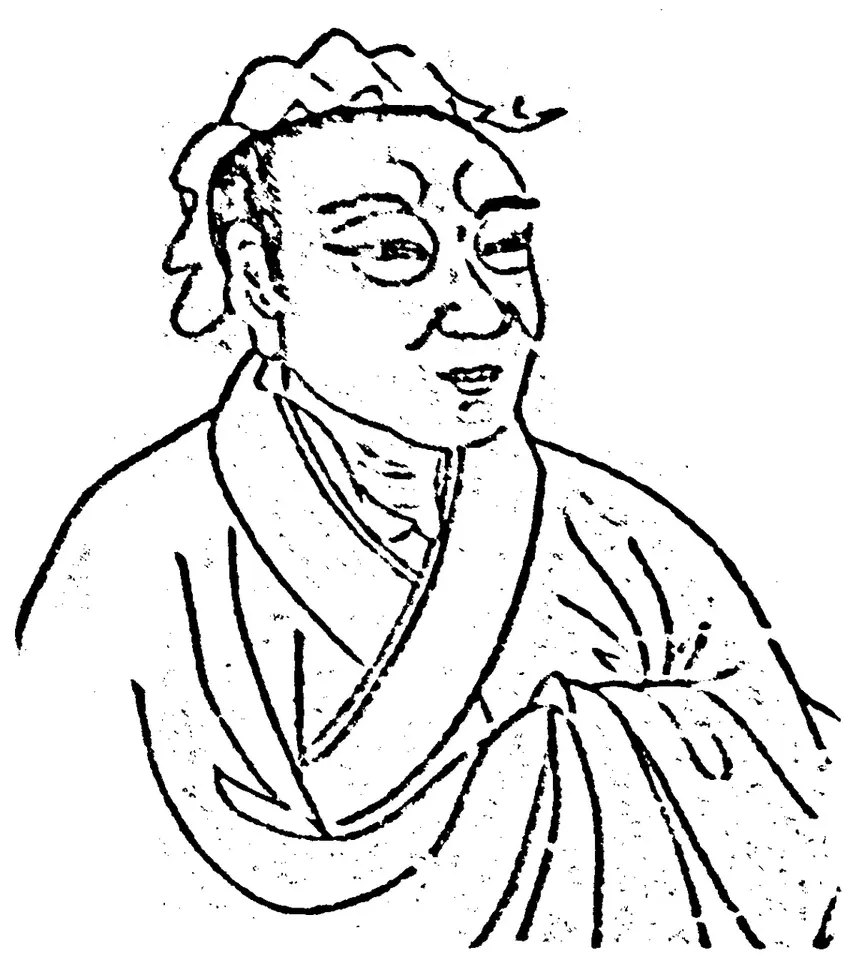
Life
Aristocratic Lineage and Historiographical Heritage
Pei Yin was born into the Western Chamber of the Hedong Pei clan, one of the most prominent aristocratic lineages in medieval China. His ancestor Pei Xiu had formulated the foundational "Six Principles of Cartography" during the Western Jin dynasty, his grandfather Pei Mei was renowned for erudition in classical learning, and his father Pei Songzhi was a celebrated scholar of the Northern and Southern Dynasties.
In the sixth year of Yuanjia (429 CE) under Emperor Wen of Liu Song, because Chen Shou's Records of the Three Kingdoms was deemed too terse in its historical details, Pei Songzhi was commissioned by imperial decree to compile annotations. Drawing citations from more than one hundred and forty historical works, Pei Songzhi created a pioneering method of critical historiography that supplemented omissions, corrected errors, and preserved conflicting records. Emperor Wen praised it as an immortal contribution to historical learning.
Nurtured in this refined intellectual atmosphere, Pei Yin displayed a quiet, modest, and scholarly temperament from childhood. Deeply shaped by his father's academic rigor, he achieved mastery of ancient institutions, phonology, and historical geography, gaining broad respect among southern scholars for his vast erudition and upright character.
Admiration for Authentic History and Literary Mission
Throughout his extensive reading, Pei Yin developed an exalted admiration for Sima Qian's Records of the Grand Historian. In his preface to the Shiji Jijie, he praised the masterwork with passionate reverence, commending Sima Qian's ability to arrange cause and consequence lucidly, arguing with persuasion without superficial floridness, maintaining an unpolished directness without vulgarity, presenting facts with strict accuracy, and refusing to invent praise or conceal misconduct. To Pei Yin, this constituted the supreme embodiment of authentic historical recording.
However, Pei Yin observed that throughout the centuries following the Han and Jin dynasties, while scholars studied Sima Qian's text intently, existing commentaries were deeply flawed. Authors such as Ban Gu and Yang Xiong offered fragmented observations, while Xu Guang's Pronunciation and Meaning of the Shiji, Zou Dansheng's Collected Notes on the Shiji, and Jin Zhuo's Collected Notes on the Book of Han focused narrowly on isolated phonetic glosses or specific anecdotes. These works frequently contradicted one another, harbored factual errors, and suffered from fragmented transmission, leaving later students without reliable guidance.
Pei Yin concluded that for the premier historical work of Chinese antiquity to lack a comprehensive, synthesized commentary was an immense scholarly tragedy. He resolved to inherit his father's critical standards and devote his life to creating an authoritative compilation that would synthesize diverse interpretations into an integrated whole.
Broad Synthesis and Rigorous Critical Method
During the Yuanjia era, Pei Yin withdrew from social engagements to dedicate himself entirely to the monumental labor of commenting on the Shiji.
To ensure comprehensive authority, Pei Yin assembled classical commentaries and ancient texts from across the realm. His textual sources encompassed the foundational Confucian scriptures—the Classic of Changes, Classic of Documents, Classic of Poetry, Rites of Zhou, Ceremonial Rites, Book of Rites, Zuo Commentary, and Discourses of the States—alongside pre-Qin philosophical masters such as Guanzi, Mencius, Zhuangzi, Xunzi, Han Feizi, and the Spring and Autumn of Master Lü, as well as ancient lexicons including the Erya, Shuowen Jiezi, Fangyan, and Shiming.
In executing his annotations, Pei Yin established four uncompromising methodological rules:
First, in selecting citations, he rigorously excised superfluous rhetoric to preserve only essential philological and factual insights, avoiding the uncritical copying of bloated earlier notes.
Second, he preserved competing scholarly opinions with total impartiality. Whenever geographic identifications or historical dates differed among predecessors such as Xu Guang, Zou Dansheng, Ying Shao, or Fu Qian, Pei Yin cited their conflicting views side by side, allowing posterity to examine diverse traditions rather than imposing arbitrary personal choices.
Third, whenever confronted with missing text, fragmented titles, or irrecoverable dates, he deliberately preserved the textual gap rather than fabricating speculative hypotheses, maintaining strict scholarly integrity.
Fourth, he employed Confucian canonical scriptures to verify historical narratives, creating an exemplary model of mutual cross-verification between classical hermeneutics and historical inquiry.
Completion of the Masterpiece and Serene Later Years
Through more than a decade of uninterrupted labor, Pei Yin completed the eighty chapters of the Collected Explanations of the Records of the Grand Historian in the late Yuanjia era.
The extensive annotations, spanning hundreds of thousands of characters, systematically clarified every ancient institutional regulation, imperial genealogy, bureaucratic transition, mountain and river location, and archaic phonetic variant throughout Sima Qian's one hundred and thirty original chapters. Upon its dissemination, scholars across the Southern Dynasties acclaimed its precision and circulated copies widely.
Possessing a tranquil temperament unconcerned with political advancement, Pei Yin led an unassuming official life. In his later years, he accepted an appointment as Consulting Officer of the Outer Military Staff under the Southern General of the Palace Gentlemen in the Liu Song government, managing military registers and clerical documentation with conscientious dedication.
Pei Yin passed away in his official residence. The academic lineage of the Hedong Pei clan flourished through his son Pei Zhaoming, who served as Director of Ceremonies under the Southern Qi, and his grandson Pei Ziye, who rose to Libationer of the National University and author of the acclaimed twenty-chapter Summary History of Song, establishing the family as medieval China's most celebrated dynasty of historians.
Major Accomplishments
Authorship of the Eighty-Chapter Shiji Jijie
Pei Yin's paramount accomplishment in Chinese historiography was his solitary compilation of the Collected Explanations of the Records of the Grand Historian in eighty chapters, the earliest surviving complete commentary on Sima Qian's work.
In the centuries following Sima Qian, earlier annotations by scholars like Xu Guang had survived only in fragmented excerpts. Pei Yin was the first scholar to annotate all one hundred and thirty chapters of the Shiji in a continuous edition. Breaking free from the narrow factional dogmatism of Han dynasty exegetes, he synthesized phonetic glosses, institutional histories, and historical geography, setting the normative template for subsequent commentaries on dynastic histories.
Establishing the Principles of Critical Historiography
The philological principles practiced by Pei Yin in his Shiji Jijie exerted a profound influence on the Qianlong-Jiaqing evidential scholarship of the Qing dynasty and modern historical methodology.
Confronted with the chaotic, superstition-laden commentaries of the Six Dynasties, Pei Yin demonstrated exceptional critical acumen in separating fact from fancy. By preserving rival hypotheses while strictly withholding judgment on unverified traditions, he ensured that the authentic factual texture of Sima Qian's masterwork survived intact despite centuries of manuscript transmission and wartime destruction.
Bridging the Historiographical Legacy of the Pei Family
Pei Yin occupied a pivotal transitional position within the illustrious Pei historiographical lineage.
Building upon the expansive, inclusive annotation style pioneered by his father Pei Songzhi in the Annotations to the Records of the Three Kingdoms, and inspiring the concise, rigorous historical prose of his grandson Pei Ziye in the Summary History of Song, Pei Yin elevated the Hedong Pei clan to the apex of academic prestige. Later historians placed the three generations of the Pei family on par with Sima Tan and Sima Qian of the Western Han and the Ban family of the Eastern Han as China's greatest historical lineages.