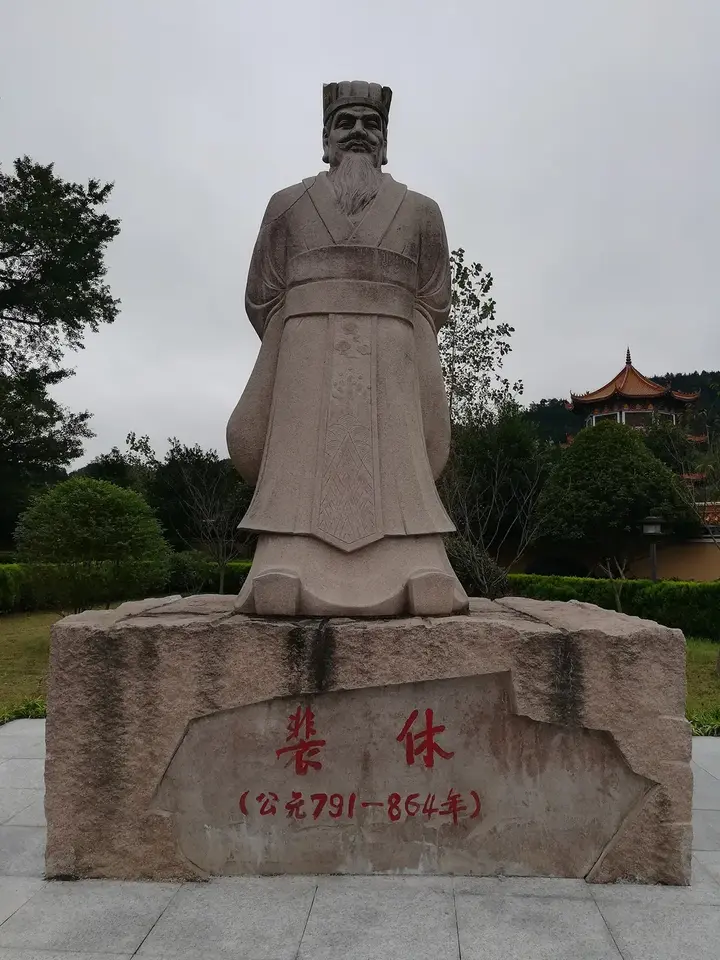
Life and Career
Classical Mastery and Moral Discipline
Pei Xiu belonged to the Eastern Branch of the Hedong Pei clan, one of the most prominent aristocratic lineages in medieval China. His father, Pei Su, served as Regional Surveillance Commissioner of Eastern Zhejiang under Emperor Dezong, renowned for frugality and incorruptible governance. Inheriting strict family precepts, Pei Xiu exhibited extraordinary self-discipline and scholarly devotion from early youth. Living with his brothers in their rural retreat in Jiyuan, he dedicated his days to the Confucian Five Classics and his nights to poetry, refusing all frivolous society.
During their student years, when an acquaintance sent a wild deer to his elder brother, his brothers cooked the meat and invited Pei Xiu to partake. Pei Xiu politely declined, explaining that as poor scholars who could barely afford coarse greens, indulging in rich meats today would make tomorrow's simple fare intolerable, noting that a gentleman should never alter his austere habits for transient pleasure. Entering the civil service examinations during the Changqing era, he passed the Jinshi examination. In 828, he passed Emperor Wenzong's special palace decree examination, earning appointment as Investigating Censor, Right Reminder, and Historiographer.
Courageous Protest and Provincial Administration
In 831, Emperor Wenzong sought to eliminate the overweening power of the court eunuchs and held secret consultations with Chancellor Song Shenxi. When the eunuch commander Wang Shoucheng discovered the plot, he fabricated charges that Song Shenxi was conspiring to overthrow the emperor in favor of Prince Li Cou. In a fury, Emperor Wenzong intended to execute the chancellor immediately. While senior courtiers remained silent in terror, Pei Xiu stepped forward. Leading his fellow remonstrators, he prostrated himself before the Yanying Palace gates, pleading that Song Shenxi's upright character precluded treason and imploring a formal joint judicial review. His impassioned defense calmed Emperor Wenzong, averting Song Shenxi's execution and commuting his sentence to exile as Marshal of Kaizhou.
During the factional struggles of the Huichang era under Emperor Wuzong, Pei Xiu avoided partisan alignment with dominant ministers such as Li Deyu. He was assigned to provincial governorships, serving as Prefect in multiple regions. Throughout his provincial tenure, he eliminated arbitrary surcharges, pacified displaced refugees, and established an administration renowned for fair taxation and humane governance.
Financial Overhaul and the Economic Foundations of Dazhong
In 847, Emperor Xuanzong ascended the throne and recalled Pei Xiu to the central administration as Vice Minister of Revenue. In February 851, Xuanzong appointed him Commissioner for Salt and Iron Transport, entrusting him with the empire's fiscal lifeline. Since the late Dahe era, the national canal transport system had collapsed. Grain shipments from Jiangnan rarely exceeded 400,000 bushels annually, and rampant embezzlement by transport clerks alongside intentional sinkings reduced deliveries to the capital's Wei Granary to under 200,000 bushels, leaving metropolitan reserves dangerously depleted.
Studying the financial reforms of mid-Tang statesman Liu Yan, Pei Xiu recognized that transport failures stemmed from misaligned incentives and undefined administrative liability. He formulated the Ten Rules of Canal Transport, establishing clear operational boundaries between prefectural officials and canal staff while guaranteeing that transport commission funds were distributed directly to the laborers and boatmen. Under his management, annual grain deliveries to Chang'an rose to 1.2 million bushels without loss, setting historical records. Simultaneously, he promulgated the Eight Regulations on Salt and the Twelve Articles of the Tea Code, forbidding regional warlords from erecting unauthorized toll barriers, which protected merchants while providing overflowing tax revenues that funded the peace and prosperity of the Dazhong era.
The Chancellery and the Daily Record of Current Affairs
In August 852, Emperor Xuanzong elevated Pei Xiu to Grand Councilor of the Secretariat-Chancellery (Chancellor) in recognition of his fiscal achievements, permitting him to continue directing salt and iron transport. Serving as Chancellor for four years, Pei Xiu governed with strict fairness and integrity. To reform the laxity of imperial historical documentation, he submitted a memorial recommending that all policy deliberations between the emperor and chancellors, along with ministerial replies, be documented verbatim daily to produce the Shizheng Ji (Daily Record of Current Affairs). This ensured that imperial historians could record court governance truthfully and without omission, establishing a lasting institutional precedent for Chinese dynastic historiography.
In 856, Emperor Xuanzong held audience with Pei Xiu, inviting candid advice on statecraft. Observing that the sovereign was aging while the heir-apparent remained undesignated, Pei Xiu urged the emperor to name a Crown Prince to stabilize dynastic succession. Suspicious of sharing authority, Xuanzong replied coldly: "If I designate a Crown Prince, shall I become a man of leisure?" Realizing the emperor's distrust, Pei Xiu refrained from pressing the matter further. In February 856, he petitioned to resign on health grounds. Emperor Xuanzong relieved him of the chancellery, appointing him Minister of Revenue, Prefect of Bianzhou, and Military Commissioner of Xuanwu Circuit.
Frontier Leadership and Peaceful Departure
Between 857 and 860, Pei Xiu governed vital northern garrisons as Military Commissioner of Zhaoyi, Military Commissioner of Hedong and Mayor of Taiyuan, and Military Commissioner of Fengxiang. In these postings, he repaired armaments, drilled troops, and patronized Confucian academies and Buddhist temples, securing peace and stability along the northern borders.
In 860, following the accession of Emperor Yizong, Pei Xiu was recalled to Chang'an, serving successively as Minister of Revenue, Minister of Personnel, and Junior Preceptor of the Crown Prince. In his final years, despite holding supreme bureaucratic honors, he lived in austere simplicity, wearing cotton robes, eating vegetarian food, and studying Buddhist scriptures. In 864, he passed away peacefully in office at the age of seventy-four. Emperor Yizong suspended court sessions in mourning and granted him the posthumous rank of Minister of Education.
Major Achievements
Overhauling the Canal System and Fiscal Restructuring
Pei Xiu was one of the most effective economic administrators in imperial Chinese history. Confronting the complete breakdown of the southeastern canal transport network, he enacted the Ten Rules of Canal Transport, the Eight Regulations on Salt, and the Twelve Articles of the Tea Code. By aligning operational liability with direct monetary incentives for transport crews, he achieved an unprecedented annual delivery of 1.2 million bushels of grain to the capital without loss. His fiscal measures curbed warlord exactions while shielding merchants and farmers, averting the financial collapse of the late Tang.
Imperial Remonstrance and Upholding Bureaucratic Integrity
During the political crisis of 831, when eunuch commanders framed Chancellor Song Shenxi, Pei Xiu led the court remonstrators in prostrating themselves at the palace gates to protest the injustice. His moral courage in confronting the palace eunuchs saved Song Shenxi's life and affirmed the ethical duty of the Confucian scholar-official to resist tyranny.
Authorship of Transmission of Mind and Buddhist Epigraphy
Pei Xiu was a preeminent lay patron and philosophical chronicler of medieval Chinese Buddhism. He studied under the Fifth Patriarch of the Huayan School, Guifeng Zongmi, composing his stele inscription. Later, he hosted Chan master Huangbo Xiyun, recording his discourses and compiling the foundational Chan classic Essential Teaching of the Transmission of Mind (Chuanxin Fayao). A distinguished calligrapher who synthesized the styles of Ouyang Xun and Liu Gongquan, he composed and inscribed monumental works such as the Epitaph for Daming Master Yuanmi, celebrated across art history as a master who fused Buddhist learning with calligraphic excellence.
Institutionalization of the Daily Record of Current Affairs
Pei Xiu spent decades in high office without accumulating personal wealth, praised by Ming thinker Wang Fuzhi as one of the few clean statesmen across three centuries of Tang rule. Furthermore, his institution of the Daily Record of Current Affairs (Shizheng Ji) ensured that day-to-day imperial deliberations were transcribed directly for historiographers, permanently transforming the methodology of official Chinese dynastic record-keeping.