Biography
Liangzhou Warrior and Slaying Guo Yuan
Pang De was born into a prominent martial family in Huandao of Nan'an Commandery in Liangzhou. Fierce, resolute, and daring from his youth, he initially served as an administrative clerk in Nan'an. During the Zhongping era, when Qiang rebellions and banditry erupted across Liangzhou, regional warlord Ma Teng raised volunteer forces. Pang De enlisted under Ma Teng, campaigning across Longxi and repeatedly repelling Qiang incursions, earning promotion to a military commandant (xiaowei).
In 202 CE (the 7th Year of the Jian'an Era), following Yuan Shao's death, his son Yuan Shang allied with Bingzhou Inspector Gao Gan and Southern Xiongnu Chanyu Luan-ti Hu-chu-quan to attack Pingyang, sending his nephew Guo Yuan with tens of thousands of elite troops into Hedong. Cao Cao's Colonel Director of Retainers, Zhong Yao, persuaded Ma Teng to form an alliance. Ma Teng appointed his eldest son Ma Chao as commander-in-chief, with Pang De serving as vanguard to march on Pingyang.
Pang De donned heavy armor and led the frontal assault, charging directly into Guo Yuan's command camp. In the chaotic melee of tens of thousands of combatants, Pang De cut down the enemy commander Guo Yuan with his own blade and hung the severed head from his saddle. After the battle, the Han commanders were unaware of Guo Yuan's fate until Pang De produced the head from his sack. Seeing the severed head of his nephew, Zhong Yao wept bitterly; Pang De bowed to apologize, but Zhong Yao wiped his tears and said: "Guo Yuan was indeed my nephew, yet he was a rebel against the state; why should the general apologize?" For his extraordinary exploit at Pingyang, Pang De was appointed Leader of Court Gentlemen (zhonglangjiang) and Marquis of Duting.
In 208 CE (the 13th Year of the Jian'an Era), Ma Teng was summoned to the capital as Commandant of the Guards, leaving Ma Chao to govern Liangzhou, while Pang De continued as commander of Ma Chao's household retinue.
Campaigns in Guanzhong and Allegiance to Cao Cao
In 211 CE (the 16th Year of the Jian'an Era), fearing Cao Cao's western advance into Hanzhong, Ma Chao and Han Sui launched a major rebellion with ten regional warlords, sparking the Battle of Weinan. Pang De fought as Ma Chao's vanguard across Tong Pass and Huayin, earning renown as the fiercest warrior in the western armies. After Cao Cao deployed Jia Xu's alienation strategy to break the coalition, Ma Chao fled back to Liangzhou with Pang De.
In 214 CE (the 19th Year of the Jian'an Era), after suffering further defeats in Liangzhou, Ma Chao fled south into Hanzhong to join Zhang Lu. Soon after, Ma Chao defected to Liu Bei in Sichuan, but Pang De, confined to his bed by illness in Hanzhong, was unable to join him.
In 215 CE (the 20th Year of the Jian'an Era), Cao Cao conquered Hanzhong. Having long admired Pang De's bravery at Pingyang and Weinan, Cao Cao summoned him to his presence. Deeply moved by Cao Cao's magnanimity, Pang De pledged his loyalty. Delighted, Cao Cao draped his own robe over Pang De, appointing him General of Establishing Righteousness (liyi jiangjun) and Marquis of Guanmen Pavilion with three hundred households.
The White Horse General and Parading the Coffin
In late 218 CE (the 23rd Year of the Jian'an Era), Hou Yin and Wei Kai rebelled in Wan, communicating secretly with Guan Yu. Cao Cao dispatched Cao Ren and Pang De to besiege Wan, where Pang De personally beheaded Hou Yin, pacifying the city. They subsequently moved to Fancheng to defend against Guan Yu's anticipated northern offensive.
In the autumn of 219 CE (the 24th Year of the Jian'an Era), Guan Yu launched the Battle of Fancheng. Because Pang De's elder brother Pang Rou held office under Liu Bei and Ma Chao served as Senior General of the Left in Shu, several Wei commanders questioned Pang De's loyalty.
Enraged by the suspicion, Pang De declared to his officers: "I have received grand favors from the King of Wei and swear to repay him with my life! This year, either I slay Guan Yu or Guan Yu slays me!" He commissioned a heavy wooden coffin painted in bright red lacquer, parading it through the camp to demonstrate his determination to die in battle.
During engagements outside Fancheng, Pang De donned white armor and rode a white warhorse, darting across the front lines and firing heavy bows with deadly accuracy. Guan Yu's soldiers dreaded his presence, referring to him as the "White Horse General." In one clash, Pang De engaged Guan Yu, feigned a retreat, and suddenly spun around to loose an arrow that pierced Guan Yu's helmet visor, striking his forehead and forcing the Shu commander to withdraw.
Flood of the Seven Armies and Heroic Martyrdom
In the eighth month of 219 CE, torrential rains inundated the region for over ten days, causing the Han River to overflow its banks. Yu Jin's seven relief divisions, encamped on low ground, were submerged by floodwaters several yards deep, and thirty thousand troops surrendered to Guan Yu.
Pang De led his surviving officers, Dong Heng, Dong Chao, and several hundred archers onto a narrow earthen embankment above the floodwaters. Guan Yu deployed heavy warships to encircle the position, raining arrows down on the defenders. Undaunted, Pang De drew his bow, dropping enemy soldiers with every shot.
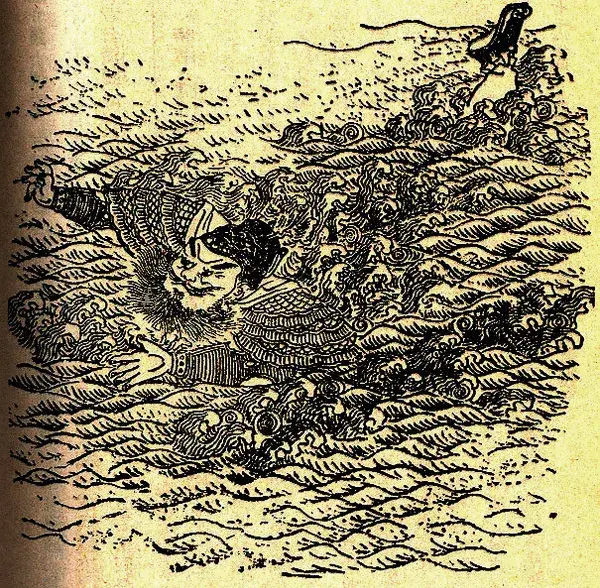
The combat raged from dawn until afternoon. When ammunition was exhausted, Dong Heng and Dong Chao suggested surrendering. Enraged, Pang De drew his blade and executed both men on the spot to maintain discipline. Drawing his short sword, he leaped into the water to engage the enemy hand-to-hand until his small skiff overturned in the rushing current, and he was captured by Guan Yu's naval troops.
Guan Yu attempted to persuade him: "Your brother serves in Hanzhong, and I would gladly make you a general; why not surrender?" Pang De glared with fury, standing upright and shouting curses: "You wretch! What talk of surrender! The King of Wei commands a million soldiers and shakes the realm, while your master Liu Bei is a mere mediocrity! I would rather be a ghost of the state than a general of bandits!"
Recognizing that Pang De would never bend, Guan Yu ordered his execution. Pang De died a martyr in his forties.
Royal Tears and Lasting Honor
When news of Yu Jin's surrender and Pang De's martyrdom reached Luoyang, Cao Cao wept bitterly for several days, lamenting: "I have known Yu Jin for thirty years, yet in the face of crisis, he proved inferior to Pang De!"
Cao Cao conferred upon Pang De the posthumous title Marquis Zhuang (Zhuang hou) and enfeoffed his two sons as marquises. When Cao Pi ascended the throne, he dispatched emissaries to sacrifice at Pang De's tomb, praising him as a peerless model of loyalty and promoting his eldest son, Pang Hui, to General of Courageous Guards (yongwei jiangjun). In 263 CE, when Zhong Hui and Deng Ai conquered Shu, Pang Hui marched into Chengdu and wiped out the surviving members of Guan Yu's clan, avenging his father in an enduring episode of Three Kingdoms history.
Renown at Pingyang and Slaying Guo Yuan
During the pivotal Battle of Pingyang in 202 CE, facing formidable Bingzhou battle lines commanded by Yuan Shang's nephew Guo Yuan, Pang De was entrusted to spearhead the heavy cavalry vanguard. Addressing his troops before battle, Pang De swore: "A true warrior slaughtering the enemy on the battlefield must be wrapped in horsehide upon death; what is there to begrudge of this mortal body!" Vaulting onto his warhorse, Pang De wielded his heavy steel blade and smashed through three defensive shield lines of the enemy host.
Amidst the swirling melee of tens of thousands of charging cavalry, Pang De caught sight of Guo Yuan brandishing his whip beneath the enemy command canopy. Charging alone straight into the hostile center, Pang De felled Guo Yuan with a single sweeping blow and severed his head, stowing it securely in his saddlebag. The Han forces won a crushing victory, taking over ten thousand heads. When Pang De withdrew Guo Yuan's severed head from his leather bag before Zhong Yao in the commander's pavilion, the assembled dignitaries and commanders of Cao Wei gasped in astonishment, voicing unanimous awe at Pang De's peerless martial valor.
Shooting Guan Yu at Fancheng and Stand on the Embankment
When Fancheng was besieged in 219 CE and the Han River flooded the surrounding plains, Pang De led his elite survivors in retreating to a narrow earthen embankment, where floodwaters already reached the soldiers' chests. Clad in heavy armor and wielding a massive recurve iron bow, Pang De unleashed arrows with unruffled composure, dropping Guan Yu's naval warriors whenever their vessels approached within range.
From early morning until late afternoon, Pang De's detachment fought on until their ammunition was completely exhausted. When his officers Dong Heng and Dong Chao knelt in the mud weeping and pleading to surrender to save their lives, Pang De roared in fury: "I have received immense favor from the King of Wei; how could I bend my knee to bandits!" With two swift strokes of his blade, he decapitated Dong Chao and Dong Heng on the frontline, leaving the entire unit trembling in awe and daring not whisper of surrender. Drawing his short sidearms, Pang De leaped into the rushing waters to engage in hand-to-hand combat, fighting fiercely even after his blade had curled and notched, until his small skiff capsized and he was dragged down by sheer exhaustion. His heroic defiance reverberated with awe across the entire Jingxiang theater.