Lineage Birth
Born into the prominent Pan clan of Zhongmu; celebrated as an intellectual prodigy and legendary beauty.
潘岳
Pan Yue (247–300), courtesy name Anren and widely known in folklore as Pan An, was a native of Zhongmu County, Xingyang Commandery (modern Zhongmu County, Henan Province). He was the grandson of Cao Wei Administrator of Anping Pan Jin, the son of Internal Clerk of Langya Pan Bi, and the clan uncle of celebrated literatus Pan Ni. A paramount literatus, politician, and aesthetic titan of the Western Jin dynasty, Pan Yue stood…
Pan Yue (247–300), courtesy name Anren and widely known in folklore as Pan An, was a native of Zhongmu County, Xingyang Commandery (modern Zhongmu County, Henan Province). He was the grandson of Cao Wei Administrator of Anping Pan Jin, the son of Internal Clerk of Langya Pan Bi, and the clan uncle of celebrated literatus Pan Ni. A paramount literatus, politician, and aesthetic titan of the Western Jin dynasty, Pan Yue stood as the undisputed leader of Taikang literature. Endowed with precocious intellect and celebrated from youth as a child prodigy, his peerless physical beauty captivated the capital, inspiring the enduring idiom "tossing fruit to fill his chariot" (zhi guo ying che), which established him as the archetypal male beauty throughout Chinese history. Pan Yue commenced his career on the staff of paramount statesman Jia Chong. During the early Taishi era, he composed the majestic Rhapsody on Plowing the Sacred Field (Jitian Fu) celebrating Emperor Wu's imperial agrarian rites. However, his extraordinary eloquence provoked jealousy among established aristocrats, resulting in his decennial exile as Magistrate of Heyang. In local governance, he ordered the planting of peach and plum orchards throughout the district, earning acclaim as "the County of Flowers." Under Emperor Hui, he was recruited as Chief Clerk to regent Yang Jun. When Yang Jun fell in an armed coup in 291, Pan Yue narrowly escaped execution through the intervention of colleagues, retiring into private life to care for his aging mother and authoring masterpieces including Rhapsody on the Western Expedition and Rhapsody on Living in Retirement. During the Yuankang era, Pan Yue returned to the central court by aligning himself with the powerful consort favorite Jia Mi, serving as the cultural doyen of the Twenty-Four Friends of Jingu salon, though his deference toward power drew contemporary derision for "bowing before dusty carriages." In 299, at the instigation of Empress Jia Nanfeng, Pan Yue coerced the drunken Crown Prince Sima Yu into transcribing an incriminating draft, directly causing the heir's deposition and murder. In 300, Prince of Zhao Sima Lun launched a military counter-coup, and his vengeful confidant Sun Xiu framed Pan Yue for treason. Pan Yue was executed in the eastern market of Luoyang alongside his entire three-generation lineage at the age of fifty-four. Renowned alongside Lu Ji under the adage "Pan's talent is like a river, Lu's like an ocean," his poetic elegies and fu rhapsodies represent the peak of early medieval literary brilliance.
Born into the prominent Pan clan of Zhongmu; celebrated as an intellectual prodigy and legendary beauty.
Entered public office on the staff of Minister of Education Jia Chong, gaining capital renown.
Authored Rhapsody on Plowing the Sacred Field; ostracized by envious courtiers and banished as Magistrate of Heyang.
Reassigned as Magistrate of Huai County; promoted to Court Gentleman in State Affairs before being dismissed.
Appointed Chief Clerk to regent Yang Jun, participating in confidential administrative affairs.
Narrowly survived Yang Jun's purge; retired to attend his mother and composed Rhapsody on the Western Expedition.
Returned to court as Attendant Gentleman of the Yellow Gates; led the Twenty-Four Friends of Jingu under Jia Mi.
Sima Lun seized power; framed by Sun Xiu and executed with his three-generation lineage at age fifty-four.
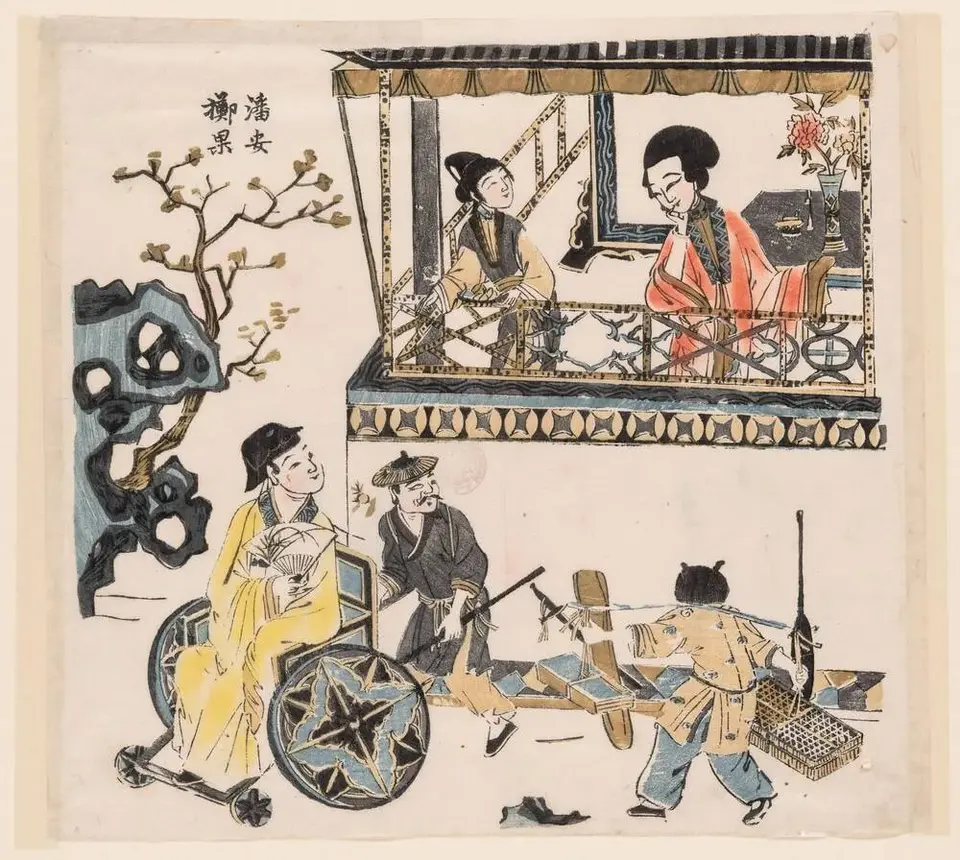
Pan Yue hailed from an illustrious lineage of Zhongmu; his grandfather Pan Jin served as Administrator of Anping, and his father Pan Bi was Internal Clerk of Langya. Endowed with penetrating intellect, Pan Yue mastered classical canonical literature in early childhood, earning acclaim across the Central Plains as a divine prodigy. Beyond intellectual gifts, his physical beauty was celebrated throughout the realm. Endowed with graceful posture and radiant features, legend recorded that whenever young Pan Yue strolled through the streets of Luoyang with a catapult in hand, women gathered in crowds and tossed fresh fruit into his carriage until it overflowed, giving rise to the famous historical idiom "tossing fruit to fill his chariot."
During the early Taishi era, Minister of Education Jia Chong recruited Pan Yue to his staff. Handling official documentation with effortless elegance, Pan Yue's reputation surged among capital literati.
In 268, Emperor Wu performed the sacred spring plowing ritual at the eastern suburbs of Luoyang. Pan Yue composed Rhapsody on Plowing the Sacred Field, synthesizing rhythmic balance with majestic encomium. However, established aristocratic ministers were jealous of his youth and literary genius, conspiring to block his promotion and consigning him to subordinate administrative obscurity for over a decade.
In 278, frustrated by central stagnation, Pan Yue was appointed Magistrate of Heyang. Rather than despairing, he adapted administrative governance to local geography, encouraging households to plant flowering peach and plum orchards across all roads and dikes. Every spring, the county bloomed into a sea of blossoms, earning Heyang the celebrated title of "the County of Flowers."
Promoted to Magistrate of Huai County on account of superior administration, Pan Yue was summoned back to Luoyang as Court Gentleman in the Department of State Affairs. However, his fiery temperament and unbending pride alienated entrenched courtiers, resulting in his rapid dismissal from office.
In 290, Emperor Wu died, and imperial relative Yang Jun assumed regency. Recognizing Pan Yue's literary fame, Yang Jun recruited him as Chief Clerk to the Grand Tutor. In 291, Empress Jia orchestrated an armed coup that exterminated Yang Jun and his faction. Pan Yue was cast into death row, surviving only because colleague Gongsun Hong pleaded that Pan Yue had harbored no conspiratorial intent. Stripped of official titles, Pan Yue retired to care for his elderly mother, authoring Rhapsody on the Western Expedition and Rhapsody on Living in Retirement to express his longing for rustic tranquility.
However, Pan Yue's passion for worldly recognition remained unextinguished. By the mid-Yuankang era, Empress Jia's nephew, Duke of Lu Jia Mi, dominated court patronage. Cultivating literati prestige, Jia Mi gathered the Twenty-Four Friends of Jingu, an elite cultural salon including Pan Yue, Shi Chong, Lu Ji, and Liu Kun.
Eager to restore his career, Pan Yue abandoned philosophical detachment, becoming the intellectual leader of the salon and composing official stelae for the Jia family. His deference toward the regent drew sharp ridicule from principled scholars, who observed that whenever Jia Mi's carriage passed, Pan Yue and Shi Chong prostrated themselves by the road, inspiring the satirical phrase "bowing before dusty carriages."
Through Jia Mi's patronage, Pan Yue was elevated to Attendant Gentleman of the Yellow Gates, serving inside the palace and reaching the apex of his worldly power.
In 299, Empress Jia resolved to eliminate Crown Prince Sima Yu. Getting the young prince intoxicated within palace chambers, Empress Jia delivered a draft of a treasonous oath to Pan Yue, commanding him to revise it to resemble the heir's handwriting.
Blinded by power, Pan Yue altered the text into an explicit treasonous proclamation, entrapping the intoxicated prince into copying it. This forged document was used by Empress Jia to depose Sima Yu, who was murdered in exile the following year, provoking empire-wide outrage.
In April 300, Prince of Zhao Sima Lun and his confidant Sun Xiu staged a coup, exterminating the Jia faction. Sun Xiu had once served as a petty clerk under Pan Yue's father, where his devious conduct had earned repeated floggings from Pan Yue. Nursing bitter hatred, Sun Xiu seized power and immediately arrested Pan Yue and Shi Chong on trumped-up charges of treason.
When Pan Yue and Shi Chong met within prisoner carts on the road to the execution ground, Pan Yue sighed: "Anren shares the same doomed fate as you!" Shi Chong replied: "They merely covet my family's wealth." Pan Yue smiled bitterly: "What Sun Xiu covets is vengeance for past beatings!"
In the autumn of 300, Pan Yue was executed at the eastern market of Luoyang, and his three-generation family—including his elderly mother, brothers, and sons—were slaughtered alongside him. The premier literary master of his age perished at the age of fifty-four.
Pan Yue stood as the preeminent master of Western Jin Taikang literature. Literary theorist Zhong Rong ranked his poetry in the Superior Grade of Poetry Gradings, declaring: "Anren's prose is exquisitely refined, his incisive talent flowing with boundless melody, lucid, soaring, and filled with poignant gravity." Celebrated alongside Lu Ji under the legendary idiom "Pan's talent is like a river, Lu's like an ocean" (Pan Jiang Lu Hai), his descriptive rhapsodies harmonized the grandeur of Han court rhapsodies with the emotional intimacy of early medieval lyrical verse, accelerating the aesthetic maturation of Chinese parallel literature.
Pan Yue's most enduring and singular innovation in Chinese poetic history was his creation of daowang shi (mourning poems for a deceased wife). Following the death of his beloved wife Lady Yang in 298, he composed his canonical cycle of three mourning poems. Prior to Pan Yue, mourning verse was applied generically to deceased friends or sovereigns; through Pan Yue's masterpieces, the genre became permanently defined as lyrical grief for a departed spouse. Lines such as "turning to gaze upon the pillow and mat, the long bamboo mat lies empty across the bed" captured genuine personal sorrow with unadorned intimacy, establishing the supreme aesthetic standard for marital mourning throughout Chinese literature.
Pan Yue's tragic life serves as a quintessential historical archetype of the intellectual fractures within early medieval aristocratic politics. Gifted with towering literary genius, filial devotion, and functional administrative benevolence in Heyang, he nonetheless lacked moral steadfastness amidst court turmoil. Succumbing to the allure of worldly prestige, he became an accessory to Empress Jia's judicial murder of the crown prince, sealing his family's doom. Historian Fang Xuanling remarked in the Book of Jin that Pan Yue's tragic demise remains an enduring historical lesson on the perils of compromising moral integrity for transient political power.
Another pinnacle of Pan Yue's rhapsodic genius was his immortal Rhapsody on Autumn Sentiments (Qiuxing Fu). At age thirty-two, stranded in minor provincial office, he observed the arrival of autumn winds and discovered gray hairs at his temples, prompting him to compose a poignant meditation on mortality. Opening with the famous lines contrasting sorrow for autumn foliage with joy for spring shoots, the rhapsody blended seasonal melancholy with the anxieties of an ambitious scholar-official. By shifting the fu from external dynastic spectacle to internal existential vulnerability, Pan Yue transformed premature graying (Pan Lang bai fa) into one of the most enduring aesthetic tropes of early medieval Chinese literature.
Despite relentless historical criticism of his political opportunism, Pan Yue's filial devotion toward his mother was universally acknowledged by Wei-Jin contemporaries. During his tenures as magistrate in Heyang and Huai, he personally tended his mother's bedside during illnesses. Following his dismissal after Yang Jun's fall, he abandoned court ambitions to care for her in the southern suburbs of Luoyang, documenting his domestic devotion in Rhapsody on Living in Retirement. Even on the execution ground in 300, his final tears were shed for his doomed elderly mother, earning reluctant praise from later historians for his authentic familial tenderness.
FIGURES ASSOCIATED WITH THIS DYNASTY