Birth in Jiankang
Born into the household of merchant Yu Baoqing in Jiankang; showed early musical and dancing talents.
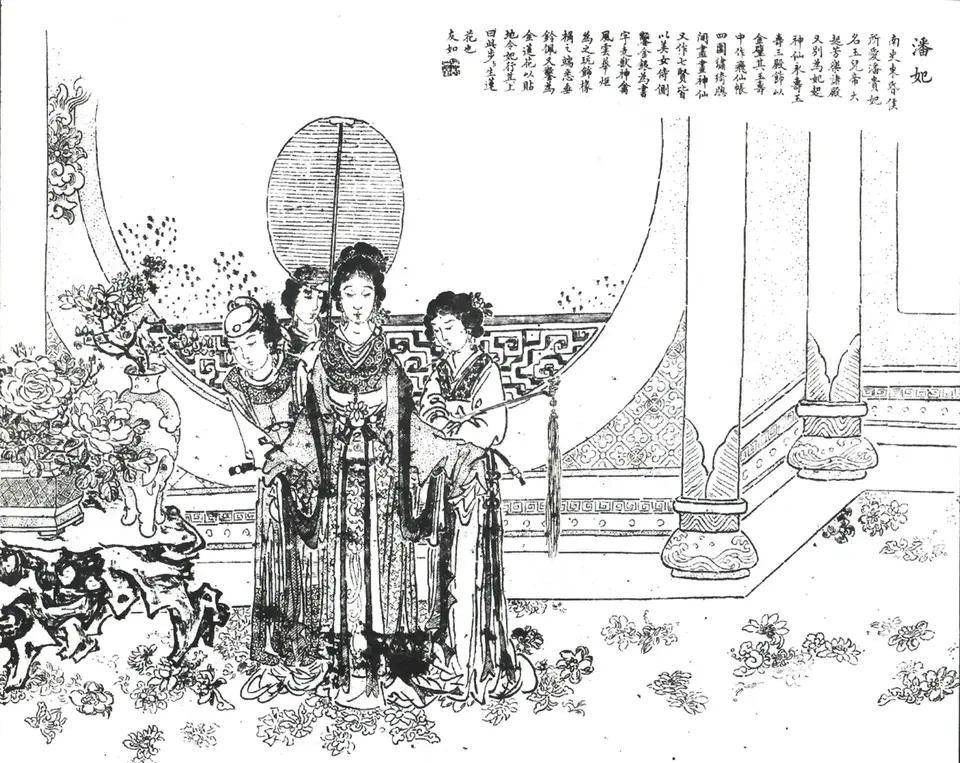
潘玉儿
Pan Yu'er (died 501), originally named Yu Nizi and also known as Pan Yunu, was a native of the Southern Qi dynasty and the daughter of merchant Yu Baoqing. She was the imperial consort of Xiao Baojuan (the Marquess of Donghun, deposed emperor of Southern Qi), remembered in Chinese cultural history as an imperial beauty and the historical inspiration behind the cultural idiom "lotus blossoms with every step" (bubu sheng…
Pan Yu'er (died 501), originally named Yu Nizi and also known as Pan Yunu, was a native of the Southern Qi dynasty and the daughter of merchant Yu Baoqing. She was the imperial consort of Xiao Baojuan (the Marquess of Donghun, deposed emperor of Southern Qi), remembered in Chinese cultural history as an imperial beauty and the historical inspiration behind the cultural idiom "lotus blossoms with every step" (bubu sheng lianhua). In her early youth, she was a musical performer in the household of Grand Commander Wang Jingze, before being selected into the Eastern Palace to attend Crown Prince Xiao Baojuan. Following his accession to the imperial throne, Xiao Baojuan elevated her above all palace ladies. Recalling that Emperor Wen of Song had enjoyed a thirty-year reign allegedly linked to the auspicious presence of a Consort Pan, Xiao Baojuan formally conferred the surname Pan upon her and her father, elevating her to Noble Consort and appointing her adoptive mother to Crown Prince Xiao Song. Pan Yu'er possessed striking beauty, noted for her delicate complexion and petite, graceful feet. Xiao Baojuan's infatuation led him to melt down treasury gold into thousands of lotus plaques inlaid into marble floors, exclaiming as she walked barefoot upon them: "This is lotus blossoms springing forth with every step!" He erected the lavish Shenxian, Yongshou, and Yushou palace pavilions for her, dismantling historic Buddhist temples to repurpose jade carvings and gold ornaments for her chambers. To fund their expenditures, Xiao Baojuan levied heavy exactions upon the populace, appropriating wine tax revenues and converting dikes, bridges, and labor drafts across Yang and Nanxu provinces into direct cash levies, which caused the regional irrigation system to fall into ruin. Her father Pan Baoqing conspired with corrupt courtiers to frame wealthy families and seize their estates. Inside the palace grounds at the Fangle Garden, Xiao Baojuan created an artificial bazaar where Pan Yu'er acted as Market Magistrate over palace attendants, while the emperor served as her clerk, submitting to her chastisement and giving rise to the popular ballad "the Emperor carves meat, Consort Pan serves wine." In 501 (the third year of the Yongyuan era), Xiao Yan besieged Jiankang, and Xiao Baojuan was slain during an internal palace coup. Though Xiao Yan initially contemplated taking her as a concubine, he was dissuaded by General Wang Mao. When subordinate commander Tian An requested her hand, Pan wept, declaring she would rather die than be wed to a common soldier, and hanged herself in her cell, concluding a tragic chapter of Southern Dynasties history.
Born into the household of merchant Yu Baoqing in Jiankang; showed early musical and dancing talents.
Entered the household of Grand Commander Wang Jingze as a performer; presented to Crown Prince Xiao Baojuan.
Xiao Baojuan ascended the throne, granted her the surname Pan, and appointed her adoptive guardian to Crown Prince Xiao Song.
The emperor erected the Yushou Palaces, inlaying golden lotuses into the floors, and established the mock market in the imperial park.
Xiao Yan besieged the capital; palace guards assassinated Xiao Baojuan, and Pan was imprisoned within the palace citadel.
Refused marriage to subordinate officer Tian An, declaring she would never submit to a commoner, and hanged herself at approximately age twenty.
Pan Yu'er, originally named Yu Nizi, was born into a merchant family in the capital city of Jiankang during the late Song or early Qi dynasties. Her father, Yu Baoqing, engaged in commerce throughout the metropolitan markets. From early youth, Yu Nizi displayed striking beauty and graceful deportment, possessing a melodious singing voice, mastery of string and wind music, and a delicate complexion, accentuated by petite, well-proportioned feet.
During the reign of Emperor Ming of Southern Qi, the senior general and Grand Commander Wang Jingze possessed vast wealth and maintained an extensive troupe of dancing and singing performers within his mansion. Yu Nizi was recruited into Wang's residence to train in refined performance arts. When Crown Prince Xiao Baojuan came of age in the Eastern Palace, Wang Jingze, seeking to secure royal favor, presented Yu Nizi to the heir apparent. Xiao Baojuan was captivated by her beauty, granting her his exclusive affection over all other consorts.
In 498 (the first year of the Yongtai era), Emperor Ming passed away, and Xiao Baojuan ascended the throne. He brought Yu Nizi into the inner palace. In contemporary southern lore, Emperor Wen of Song had enjoyed a prosperous thirty-year reign associated with his beloved Consort Pan. Desiring an equally durable reign, Xiao Baojuan officially bestowed the surname Pan upon Yu Nizi and her father Yu Baoqing. He elevated her to Noble Consort (Guifei), positioning her at the head of the imperial harem. As Crown Prince Xiao Song's biological mother, Yellow Noble Lady, had died early, Xiao Baojuan appointed Pan as the crown prince's adoptive mother, concentrating court influence within her quarters.
Xiao Baojuan possessed an erratic and tyrannical disposition, harboring deep suspicion toward senior state ministers while indulging Pan's every whim. To please her, he undertook extravagant architectural projects within the Forbidden City.
Fascinated by her delicate, pale feet, Xiao Baojuan went to extreme lengths to display them. He depleted imperial gold reserves, commanding court goldsmiths to cast thousands of intricate multi-petaled golden lotuses that were inlaid into the marble floors of the bedchambers. Whenever Pan Yu'er walked barefoot across the golden flowers, her skirts trailing, the emperor knelt in admiration, remarking: "This is lotus blossoms springing forth with every step!" This display popularized the poetic association of the "golden lotus" with feminine beauty in classical Chinese literature.
In 500 (the second year of the Yongyuan era), a fire destroyed over a dozen palatial complexes, including the Xuanyi and Yaoling halls. Unconcerned by the disaster, Xiao Baojuan treated it as an opportunity to construct fresh residences for Pan. Mobilizing hundreds of thousands of artisans and conscripts, he erected the Shenxian, Yongshou, and Yushou palace halls. The Yushou Hall featured pillars carved from aromatic aloeswood and walls overlaid with beaten gold leaf and studded with jade, pearls, and lapis lazuli. To decorate her chambers, the emperor ordered imperial officers to dismantle ancient Buddhist monasteries around Jiankang, seizing relief carvings, glazed tiles, and jeweled statues to embellish her palace doorways and interior screens.
To sustain this expenditure, Xiao Baojuan dispatched court eunuchs to extract revenue from the populace. He commuted bridge and dike construction corvée drafts across Yang and Nanxu provinces into direct cash exactions, causing regional irrigation canals to breach and waterworks to collapse. Furthermore, he mandated levies of rare avian plumage, including pheasant crests, crane plumes, and egret feathers, across hundreds of arbitrary categories. Pan wielded unchecked influence within the inner palace, while her father Pan Baoqing conspired with corrupt officials to fabricate treason charges against wealthy landowners, seizing their estates and ruining prosperous households.
Beyond palatial construction, Xiao Baojuan and Pan performed an inversion of royal hierarchy within the palace grounds. Bored with court routine, the emperor excavated canals and earthen dikes inside the imperial Fangle Garden, constructing a mock street market replicating the commercial quarters of Jiankang.
Within this mock bazaar, palace maidens, eunuchs, and imperial relatives acted as butchers, merchants, innkeepers, and peddlers, while Pan sat in the administrative pavilion as the Market Magistrate overseeing prices and public order. Xiao Baojuan dressed in plain commoner robes, serving as her subordinate clerk, running errands and keeping market records. Whenever commercial squabbles arose or courtiers made bookkeeping errors, Pan ordered palace guards to cane the offenders. Even when the emperor made minor computational errors in his ledgers, Pan struck his back with a staff. Xiao Baojuan tolerated these beatings, ordering his guards to avoid solid wooden batons in favor of hollow reed canes.
Whenever the emperor ventured beyond the palace, Pan rode in a sedan chair adorned with pearls and kingfisher feathers, accompanied by palace ladies wearing green silk shoes and embroidered trousers. Meanwhile, the Son of Heaven rode on horseback in military uniform behind her litter, acting as her bodyguard. Along the garden canal, Xiao Baojuan waded into the water to haul boat towlines for her, operating a butcher's stall along the riverbank while Pan sold wine next door, prompting commoners to sing: "At the Yuewu Hall where willows grow, the Emperor carves meat, and Consort Pan serves wine."
This misrule destabilized the Southern Qi dynasty. Between 500 and 501, Xiao Baojuan executed prominent founding ministers, including Grand Commandant Chen Xianda and General of the Disciplinary Army Liu Xuan, causing fear among regional governors. In late 500, Xiao Yan, Governor of Yong Province, launched a military rebellion in Xiangyang. His armies advanced east along the Yangtze, laying siege to the palace citadel of Jiankang in the winter of 501.
Even as enemy forces encircled the walls, Xiao Baojuan remained in the Yushou Hall, drinking and reveling with Pan. On the night of January 1, 502 (the Bingyin day of the twelfth month of the third year of Yongyuan), palace commanders Wang Zhenguo and Zhang Ji launched a coup within the citadel, leading imperial guards into the private apartments, where they assassinated the emperor.
Following the citadel's fall, Pan was captured and imprisoned. When Xiao Yan entered the palace, struck by her beauty despite her disheveled state in captivity, he contemplated taking her into his household. However, his senior advisor, General Wang Mao, interceded, cautioning: "Your Excellency raised troops to deliver the realm from tyranny; the ruin of the Qi dynasty was brought about by the allure of this woman! If you retain her, how will you display moral probity to the empire? The world will say you campaigned merely to possess her!" Xiao Yan heeded the warning, abandoning his intention.
Shortly thereafter, a subordinate commander named Tian An requested Pan's hand as a reward for his military service. Informed of the request by the prison guard, Pan wept with indignation, refusing: "Having received the grace of an imperial sovereign, how could I submit to be the wife of a common soldier! I would rather die than suffer humiliation at the hands of servants!" She hanged herself in her cell, passing away at approximately twenty years of age.
Following her death, her body remained radiant and unmarred. When prison attendants transported her remains out of the imperial precinct on an open cart, onlookers and soldiers gathered along the road, awed by her appearance, leaving a haunting final image of the tragic excesses of the Southern Dynasties.
Pan Yu'er's foremost legacy in Chinese aesthetic culture is her association with the poetic phrase "lotus blossoms with every step" (bubu sheng lianhua). Inspired by her barefoot steps across the golden lotus tiles commissioned by Xiao Baojuan, this image became an enduring classical metaphor for feminine grace in traditional poetry, drama, and painting.
From Tang poets Wen Tingyun, Li Shangyin, and Sun Yuan'an to Song literati Su Shi and Xin Qiji, writers utilized the imagery of the "golden lotus" to evoke elegance, melancholy beauty, and imperial vanity. While reflecting the architectural extravagance of late Southern Qi, the image introduced a lasting aesthetic motif into the lexicon of classical Chinese literature.
Pan's tenure as Market Magistrate in the Fangle Garden, directing the emperor as her clerk and inflicting corporal punishment upon him, stands as a rare historical example of the inversion of imperial decorum. This dynamic reflected Xiao Baojuan's psychological eccentricities and marked a departure from orthodox palace ritual.
The popular ballad "the Emperor carves meat, Consort Pan serves wine" captured contemporary popular disaffection toward the court. This historical episode provided moralist chroniclers and essayists with a vivid historical cautionary tale illustrating the breakdown of Confucian governance in the twilight of an imperial regime.
Amid the collapse of Southern Qi, Pan Yu'er demonstrated resolve when confronted by captivity. Refusing to become a concubine to the victorious rebel leader Xiao Yan or be wed to a common soldier, she chose suicide over submission.
Her declaration that "having received the grace of an imperial sovereign, how could I submit to be the wife of a common soldier" broke through traditional historical conventions that reduced fallen consorts to passive schemers. Her decision to take her own life to preserve her dignity adds a complex, tragic dimension to her historical memory.
FIGURES ASSOCIATED WITH THIS DYNASTY