Birth in Liuyang
Born in Liuyang, Tanzhou Route; demonstrated exceptional photographic memory and literary talent.
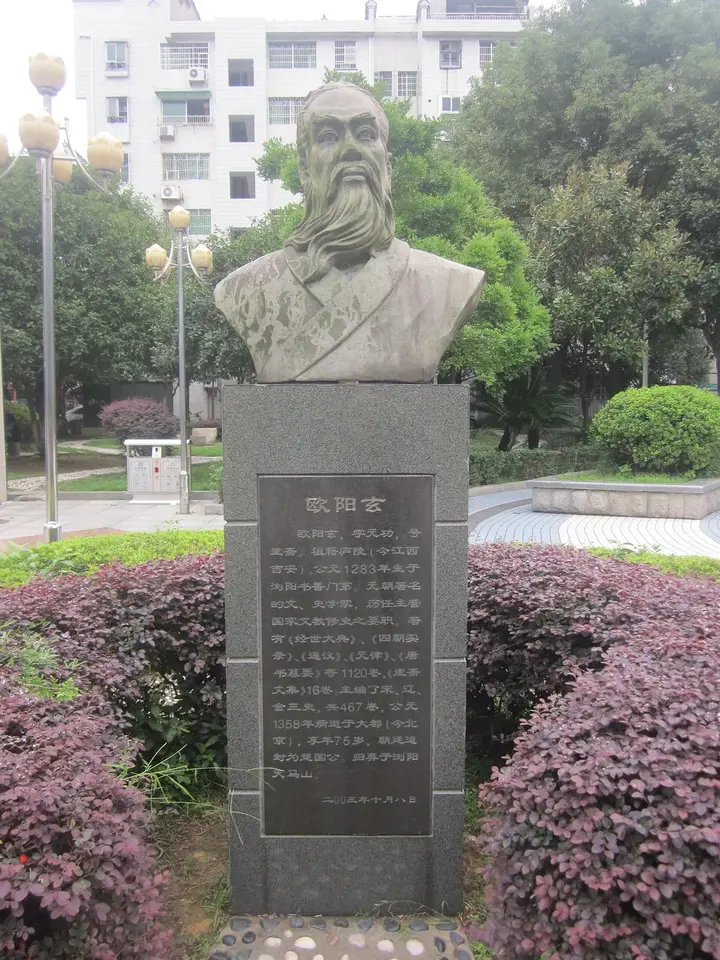
欧阳玄
Ouyang Xuan (欧阳玄, 1283–February 7, 1358 CE), courtesy name Yuangong (原功), art name Guizhai (圭斋), later styling himself Shuanghua Shanren (霜华山人) and Pingxin Laoren (平心老人), traced his ancestral roots to Luling, Jizhou (modern Ji'an, Jiangxi), before his family relocated to Liuyang in Tanzhou Route (modern Liuyang, Hunan). Posthumously honored with the private posthumous title Wen and celebrated by…
Ouyang Xuan (欧阳玄, 1283–February 7, 1358 CE), courtesy name Yuangong (原功), art name Guizhai (圭斋), later styling himself Shuanghua Shanren (霜华山人) and Pingxin Laoren (平心老人), traced his ancestral roots to Luling, Jizhou (modern Ji'an, Jiangxi), before his family relocated to Liuyang in Tanzhou Route (modern Liuyang, Hunan). Posthumously honored with the private posthumous title Wen and celebrated by posterity as Duke Ouyang Wen or Master Guizhai, he was the preeminent historian, scholar-official, literary leader, and calligrapher of the middle-to-late Yuan dynasty, revered as the literary chancellor of an entire era. Claiming kinship with the illustrious Northern Song statesman Ouyang Xiu, Ouyang Xuan displayed photographic recall and literary brilliance from childhood. When the imperial civil examinations were restored under Emperor Renzong in 1314 CE (the first year of the Yanyou era), Ouyang Xuan ranked first overall (jieyuan) in the Huguang provincial examinations, subsequently placing third (tanhua) in the metropolitan palace examinations of 1315 CE. Appointed vice-prefect of Pingjiang and magistrate of Wuhu and Wugang, he established an exemplary administrative reputation by clearing backlog litigation, suppressing local aristocratic tyranny, and pacifying southwest ethnic border feuds through moral persuasion rather than military violence. Summoned to the central government, Ouyang Xuan served six successive Yuan emperors over four decades, spending three-quarters of his career in the capital. He was celebrated for his unique record: "three times appointed to the Imperial University, twice serving as Director of the Imperial University; six times entering the Hanlin Academy, and thrice appointed Chief Academician of the Hanlin Academy." During the Two Capitals War that brought Emperor Wenzong to power, and throughout subsequent reigns, virtually all major imperial rescripts, ancestral temple declarations, enthronement proclamations, and general amnesties were drafted by his brush, renowned for their majestic classical cadence. Ouyang Xuan's crowning historical achievement was directing the official compilation of the History of Song (Song Shi), History of Liao (Liao Shi), and History of Jin (Jin Shi). Commissioned by Emperor Shundi in 1343 CE with Chancellor Toghto as chancellor-director, Ouyang Xuan served as the operational Chief Compiler. He resolved decades of ideological deadlock by establishing the monumental precedent that Song, Liao, and Jin each possessed legitimate dynastic orthodoxy (ge yu zhengtong), drafting the historiographical guidelines, tables, and prefaces. Through his indefatigable leadership, the immense 747-volume compilation was completed in just three years, preserving an irreplaceable ocean of medieval historical archives. He died in Dadu at age seventy-six, posthumously ennobled as Duke of Chu and awarded the highest ministerial honors.
Born in Liuyang, Tanzhou Route; demonstrated exceptional photographic memory and literary talent.
At age ten, mastered classical histories and composition; traveling Daoists praised him as a pillar of statecraft.
Placed first overall in the Huguang provincial civil examinations, celebrated across central and southern China.
Achieved third place (tanhua) in the imperial palace examinations; appointed Vice-Prefect of Pingjiang.
Transferred to Magistrate of Wuhu; reformed predatory feudal servitude and cleared long-pending judicial backlogs.
Appointed Magistrate of Wugang; personally rode unarmed into southwest tribal conflicts, pacifying centuries-old feuds.
Summoned to Dadu as Doctor of the Imperial University, instructing imperial elite youth in Neo-Confucian classics.
Appointed Hanlin Standby Academician; drafted the accession proclamations for Emperor Wenzong during the Two Capitals War.
Appointed Director of the Imperial University; revitalized academic regulations and promoted practical Confucian learning.
Appointed Chief Compiler of the Song, Liao, and Jin official histories under Chancellor Toghto.
Successfully completed and submitted the History of Liao, History of Jin, and History of Song, authoring the imperial prefaces.
Passed away on February 7 in Dadu at age seventy-six; posthumously ennobled as Duke of Chu.
Ouyang Xuan traced his ancestry to Luling, Jizhou (modern Ji'an, Jiangxi), deriving from the same clan as Northern Song literary titan Ouyang Xiu. During the chaotic transition at the end of the Song dynasty, his great-grandfather Ouyang An migrated to Liuyang in Tanzhou Route, becoming the founding ancestor of the Liuyang branch. In May 1283 CE (the twentieth year of the Zhiyuan era under Kublai Khan), Ouyang Xuan was born in Ouyangfang beneath Mount Daowu in Liuyang.
From infancy, Ouyang Xuan exhibited piercing intellectual brilliance. According to historical lore, an itinerant Daoist master saw the young boy studying calmly and remarked in awe: "This child possesses serene and distant spiritual energy, with eyes that pierce like beams; in the future he will certainly crown the world with his literary genius, standing as a pillar of the imperial halls!" His mother, Lady Li, hailing from an educated lineage, personally instructed him in the Classic of Filial Piety, the Analects, the Great Learning, the Doctrine of the Mean, and elementary primers; by age eight, he had committed all of them to memory.
Subsequently, he was placed under the tutelage of local scholar Zhang Guanzhi. Under Zhang's rigorous instruction, Ouyang Xuan memorized thousands of words daily without effort. By age ten, he had thoroughly mastered the Classic of Documents, the Zuo Zhuan, and major philosophical treatises, drafting mature literary essays at a single sitting. In 1293 CE, he traveled throughout the Xiang-Chu region with his elders, absorbing the academic heritage of the Yuelu Academy and earning widespread acclaim as a child prodigy.
Following the Mongol conquest, the imperial examination system remained suspended for decades. It was not until the reign of Emperor Renzong, following energetic advocacy by Hanlin scholars such as Wang Yue, that the civil examinations were formally re-established in 1314 CE (the first year of the Yanyou era).
Entering the Huguang provincial examinations as a specialist in the Classic of Documents, thirty-two-year-old Ouyang Xuan captured first place (jieyuan). In 1315 CE, he journeyed to Dadu for the metropolitan examinations. Emperor Renzong personally reviewed his palace examination paper, admiring his profound statecraft, and elevated him to third place overall (tanhua), granting him the title of Jinshi and appointing him Vice-Prefect of Pingjiang in Yuezhou Route. In Pingjiang, Ouyang Xuan adjudicated cases with scrupulous fairness and assisted in flood control.
In 1317 CE, he was reassigned as Magistrate of Wuhu in Taiping Route. Wuhu was a bustling commercial nexus along the Yangtze River plagued by accumulated judicial corruption and entrenched rural gentry. Ouyang Xuan scrutinized every backlog case, overturning numerous wrongful convictions. When wealthy clans illegally enslaved tenant farmers and abused their households, Ouyang Xuan enforced the law strictly, emancipating hundreds of coerced bondservants. He levied taxes strictly according to the calendar without extra exactions, encouraging agrarian cultivation and expanding the county academy. A popular legend recorded that during a catastrophic regional locust plague that devastated neighboring counties, swarms spared Wuhu entirely, which local populations attributed to his benevolent governance. During his tenure, he also repaired local heritage sites and composed verses defining the famed "Eight Views of Wuhu."
In 1320 CE, Ouyang Xuan was transferred to Magistrate of Wugang. Wugang occupied a strategic frontier adjacent to southwest tribal territories, characterized by steep gorges and multi-ethnic populations. Soon after his arrival, longstanding disputes over water rights and land exploded between the Chishui and Taiqing tribal settlements, escalating into open warfare that left dead and wounded across the highways. While other officials panicked and urged military suppression, Ouyang Xuan took only two attendants and rode unarmed directly into the remote gorges. Surrounding his horse with raised spears, the tribal fighters recognized his reputation, cast down their weapons, and knelt before his stirrup, weeping: "We do not fear the law; rather, corrupt officials extorted us and refused to hear our pleas, driving us to fight. We never imagined our honest magistrate would come in person!" Ouyang Xuan elucidated legal reconciliation and resolved their suits fairly, pacifying the frontier for decades without shedding a drop of blood.
In 1323 CE, Emperor Yingzong summoned Ouyang Xuan to the capital, appointing him Doctor of the Imperial University (Guozi Boshi) and subsequently Director of Studies. He instructed imperial Mongol, Semu, and Han students in Cheng-Zhu Neo-Confucian orthodoxy with exceptional pedagogical clarity.
In the summer of 1328 CE, the sudden death of the Taiding Emperor triggered the Two Capitals War. Prince Tugh Temür (Emperor Wenzong) was enthroned in Dadu by loyalist ministers. With the Hanlin Academy scattered, Ouyang Xuan, then serving as Standby Academician, was entrusted with the seal of the Hanlin Academy. Working day and night in the inner palace, he drafted the military proclamations against Shangdu, the enthronement edicts, ancestral temple declarations, and nationwide amnesties. His diction was majestic, classical, and forceful, solidifying the political legitimacy of the new regime.
Throughout Emperor Wenzong's reign and into the Zhizheng era under Emperor Shundi, whenever the court executed solemn imperial ceremonies—such as imperial ancestral sacrifices, investing empresses, appointing crown princes, or issuing imperial edicts—Ouyang Xuan was exclusively selected to draft the official texts. Furthermore, he submitted numerous confidential policy memorials addressing administrative efficiency, grain granary inspections, and judicial integrity, most of which were adopted.
Ouyang Xuan served twice as Director of the Imperial University (Guozi Jiye), reforming academic curricula and examining classical exegesis. Emperor Shundi granted him extraordinary court privileges, exempting him from daily dawn audiences due to his chronic rheumatism and directing that important imperial state documents be conveyed directly to his private residence for drafting.
In March 1343 CE, Emperor Shundi issued an imperial edict commanding the compilation of the dynastic histories of the Song, Liao, and Jin dynasties. The court established an imperial history office, naming Grand Chancellor Toghto as chancellor-director and appointing Ouyang Xuan as the chief operational compiler (zongcaiguan).
For over five decades since the founding of the Yuan dynasty, efforts to compile the three histories had remained paralyzed over the acrimonious debate regarding dynastic legitimacy (zhengtong). Southern Han literati insisted that the Song alone held legitimate succession, treating Liao and Jin as barbarian usurpers, while northern scholars insisted on honoring Liao and Jin. Ouyang Xuan boldly broke this deadlock. In consultation with Toghto, he formulated the revolutionary principle that "each of the three states shall be granted legitimate orthodoxy, each recorded under its own dynastic calendar." This profound historical judgment rejected narrow ethnic chauvinism, recognizing the pluralistic foundations of Chinese imperial history.
Ouyang Xuan personally formulated the historiographical guidelines (fapan juli), disciplining partisan squabbles among his subordinate compilers. Working with astonishing velocity, the bureau completed the 116-volume History of Liao in March 1344 CE, the 135-volume History of Jin in November 1344 CE, and the massive 496-volume History of Song in October 1345 CE. Totalling 747 volumes, the entire project was completed in just under three years. Ouyang Xuan personally finalized every section and penned the formal submission memorials and prefaces, rescuing centuries of irreplaceable records from oblivion.
In the winter of 1345 CE, Ouyang Xuan was elevated to Chief Academician of the Hanlin Academy (Hanlin Xueshi Chengshi). In 1348 CE, he served as chief examiner for the metropolitan civil service examinations.
In 1351 CE, following catastrophic breaches of the Yellow River that inundated vast stretches of Shandong, Henan, and Hebei, Chancellor Jia Lu was commissioned to mobilize 150,000 civilian laborers and 20,000 garrison troops to restore the river's ancient course. Despite his advanced age of sixty-nine, Ouyang Xuan was dispatched to inspect the monumental engineering project. He walked the dusty embankments, consulted engineers, and examined logistical ledgers, documenting dredging methods, dam construction, and supply chains. Following the completion of the project, he authored the two-volume Record of River Conservancy in the Zhizheng Era (Zhizheng Hefang Ji), which stands as the foremost empirical monograph on hydraulic engineering produced in the Yuan dynasty.
In 1355 CE, at age seventy-three, Ouyang Xuan formally retired to his private residence in Dadu. Living in austere simplicity amidst thousands of scrolls, he styled himself "The Old Man of Equanimity" (Pingxin Laoren). On February 7, 1358 CE, he passed away peacefully at the age of seventy-six. Emperor Shundi posthumously ennobled him as Duke of Chu and conferred the title Grand Preceptor.
Ouyang Xuan's crowning achievement was resolving the dynastic legitimacy dispute that had paralyzed Yuan historiography for half a century, successfully directing the compilation of the History of Song, History of Liao, and History of Jin.
By establishing the principle of "granting orthodoxy to all three states" (ge yu zhengtong), Ouyang Xuan transcended traditional Han-centric chauvinism. He recognized that the Khitan Liao, Jurchen Jin, and Chinese Song all exercised sovereign governance over legitimate territories and populations under heaven. This conceptual breakthrough established a pluralistic historiographical framework that shaped all subsequent Chinese historical consciousness. His administrative mastery enabled the compilation bureau to publish 747 volumes of official history in just thirty months, preserving the political, economic, institutional, and literary heritage of five centuries.
Ouyang Xuan stood as the undisputed literary chancellor of the middle and late Yuan dynasty, serving as the voice of the imperial throne across six reigns.
Serving in the Hanlin Academy and the Imperial University for decades, he personally drafted every critical dynastic proclamation, treaty, enthronement rescript, and ancestral elegy. His prose, collected in the sixteen-volume Collected Works of Guizhai (Guizhai Wenji), was praised for its grand architectural balance, combining Han dynasty political rhetoric with Tang-Song classical elegance. Foreign envoys from Korea, Japan, and Central Asian kingdoms eagerly sought his manuscripts, considering them supreme treasures of Chinese civilization.
In addition to the Three Histories, Ouyang Xuan contributed immensely to contemporary Yuan documentation. He served as chief editor for the Veritable Records of Emperors Wuzong, Renzong, Yingzong, and Ningzong (Sichao Shilu), and directed the compilation of the massive imperial institutional encyclopaedia Great Compendium of Statecraft (Jingshi Dadian) in 880 volumes, ensuring that primary administrative documents from the Mongol-Yuan era were preserved for posterity.
Ouyang Xuan authored Record of River Conservancy in the Zhizheng Era (Zhizheng Hefang Ji), a seminal work in the history of Chinese science and technology.
Based upon his firsthand field investigations of Chancellor Jia Lu's Yellow River restoration in 1351 CE, the work systematically analyzed hydraulic topography, sediment dredging techniques, earthwork logistics, and riverbed embankment architectures. It provided early modern Chinese hydraulic engineers with an authoritative scientific reference, remaining a core text for river management throughout the Ming and Qing dynasties.
FIGURES ASSOCIATED WITH THIS DYNASTY