Life
Ascension Amidst Turmoil
Nuohebo was the eldest son of Murong Shun. In 635, Emperor Taizong dispatched Li Jing and Hou Junji to crush Tuyuhun ruler Fuyun, installing Prince Murong Shun as ruler. However, within months, Murong Shun was assassinated by anti-Tang tribal elders. Amidst the chaos, Tang generals Hou Junji and Li Daozong intervened, restoring order and installing the young Nuohebo as Qaghan.
In 636, Emperor Taizong dispatched envoys to confirm Nuohebo as Commandery Prince of Heyuan and Wudi Yebaledou Qaghan, garrisoning troops at the capital Fusicheng on Qinghai Lake to deter rebellious Qiang factions. Dependent on Tang arms, Nuohebo remained steadfast in his devotion to Chang'an.
Dynastic Marriage and Xi Junmai's Rescue
In 639, Nuohebo traveled across mountains to Chang'an to request an imperial marriage. Delighted by his fidelity, Emperor Taizong bestowed Princess Honghua upon him in 640, appointing Nuohebo Imperial Prince Consort (Fuma Douwei). Princess Honghua became the first authentic Tang imperial princess bestowed upon a non-Han monarch, stimulating trade across the Silk Road.
However, anti-Tang ministers resented the alliance. In 641, Chancellor Prince Xuan conspired to detain Nuohebo and kidnap Princess Honghua to surrender them to Tibetan ruler Songtsen Gampo. Informed of the plot, Nuohebo fled with the princess to Shanshan. Hearing of the coup, Tang envoy Xi Junmai led 120 cavalry in a daring midnight assault on Fusicheng, beheading three rebel commanders and executing Prince Xuan. Emperor Taizong dispatched Minister Tang Jian to pacify the tribes, consolidating Nuohebo's authority.
Tibetan Expansion and Flight to Liangzhou
Under Emperor Gaozong, the Tibetan Empire expanded aggressively under Grand Minister Gar Tongtsen, targeting the pasturelands around Qinghai Lake. From 656 onward, Gar Tongtsen overran surrounding tribes, ravaging Tuyuhun settlements. Nuohebo dispatched desperate appeals to Chang'an, but Tang armies were committed to campaigns against the Western Turks and Goguryeo.
In 663, corrupt Tuyuhun minister Suhe Gui defected to Tibet, providing Gar Tongtsen with strategic intelligence regarding border defenses. Gar Tongtsen mobilized 200,000 cavalry, shattering Tuyuhun resistance on the shores of Qinghai Lake. Recognizing all was lost, Nuohebo fled with Princess Honghua and several thousand retainers to Liangzhou. Emperor Gaozong welcomed the exiled king, granting him estates and appointing him General of the Left Militant Guard and King of Qinghai.
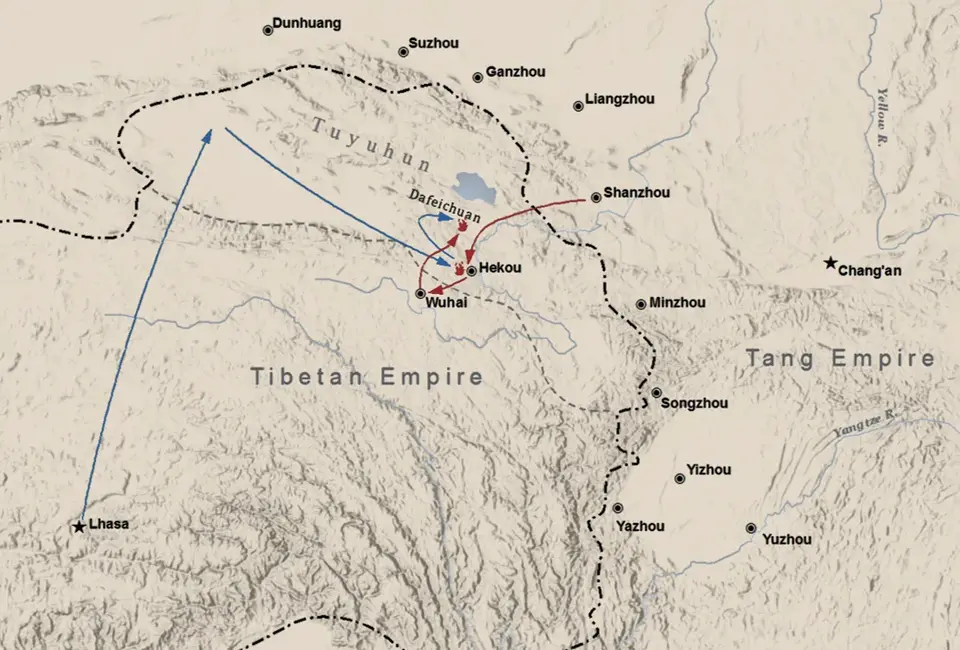
In 670, Emperor Gaozong dispatched General Xue Rengui with one hundred thousand troops to reclaim Tuyuhun territory. However, Xue's vanguard was annihilated at the Battle of Dafeichuan, extinguishing Nuohebo's hopes of returning to his homeland.
Resettlement at Anlezhou and Death
Following the catastrophe at Dafeichuan, the Hexi Corridor lay exposed to Tibetan cavalry. In 672, seeking a secure sanctuary, the Tang court relocated several tens of thousands of Tuyuhun refugees to Mingsha County in Lingzhou (modern Zhongning, Ningxia). The court established a prefecture named Anlezhou ("Peaceful Happiness"), appointing Nuohebo as its Area Commander.
For sixteen years, Nuohebo governed Anlezhou diligently, constructing fortifications and digging canals from the Yellow River to irrigate farmlands. His people transitioned from nomadic pastoralism to settled agriculture, maintaining stability on the northern frontier. In 688, Nuohebo passed away in Anlezhou at age sixty-five. Empress Wu Zetian mourned his passing, posthumously elevating him to General of the Right Guard and reburying his remains beside ancestral tombs in Liangzhou.
Major Achievements
Unwavering Fidelity Against Tibetan Imperialism
Throughout decades of existential warfare against the formidable Tibetan Empire, Nuohebo maintained absolute loyalty to the Tang dynasty. Resisting Tibetan coercion, he defended the strategic buffer around Qinghai Lake, blunting Tibetan drives toward the Hexi Corridor during critical decades of Tang imperial consolidation.
Establishing the Precedent of Tang Imperial Marriages
Nuohebo's marriage to Princess Honghua inaugurated the celebrated Tang institution of imperial peace marriages (heqin). The union facilitated the transfer of agricultural techniques, silk weaving, and administrative literacy to frontier nationalities, establishing a lasting template for regional integration.
Resettling the Tuyuhun at Anlezhou
Following the fall of his realm, Nuohebo preserved the lineage and identity of tens of thousands of Tuyuhun refugees in Lingzhou. By developing irrigation canals along the Yellow River, he contributed to the agricultural development of the Ningxia plain, enabling his descendants to serve as loyal frontier cavalry officers throughout the High Tang.