Birth of Ni Yuanlu
Born in Shangyu, Shaoxing, Zhejiang, demonstrating extraordinary precocity and eloquence in classical letters from childhood.
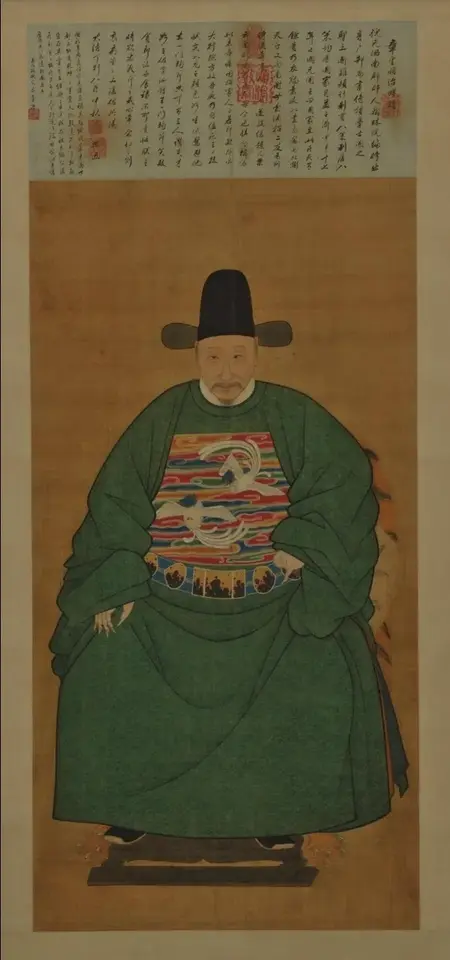
倪元璐
Ni Yuanlu (January 7, 1594 – April 25, 1644), courtesy names Ruyu and Yuru, art name Hongbao, native of Shangyu, Zhejiang, was an eminent late Ming dynasty statesman, fiscal administrator, calligraphic master, and loyalist martyr. Passing the metropolitan examination in 1622 as a jinshi, he served as Hanlin compiler. Upon the accession of the Chongzhen Emperor in 1628, Ni demonstrated unbending moral fortitude by submitting…
Ni Yuanlu (January 7, 1594 – April 25, 1644), courtesy names Ruyu and Yuru, art name Hongbao, native of Shangyu, Zhejiang, was an eminent late Ming dynasty statesman, fiscal administrator, calligraphic master, and loyalist martyr. Passing the metropolitan examination in 1622 as a jinshi, he served as Hanlin compiler. Upon the accession of the Chongzhen Emperor in 1628, Ni demonstrated unbending moral fortitude by submitting famous memorials impeaching the remnant partisans of the eunuch Wei Zhongxian and successfully petitioning the throne to incinerate the notorious factional propaganda work Sanchao Yaodian. Appointed Chancellor of the Directorate of Education (Guozijian Jijiu) and subsequently Vice Minister of War, he was elevated in 1643 to Minister of Revenue (Hubu Shangshu) and Hanlin Academician, concurrent with acting duties over the Ministry of Personnel, exhausting his energies to reorganize state finance and military grain supplies. When Beijing fell to the rebel forces of Li Zicheng on April 25, 1644, Ni dressed in formal court attire and committed suicide by hanging to remain faithful to the fallen sovereign. Posthumously granted the name Wenzheng by the Southern Ming and Wenzhen by the Qing, his calligraphic mastery earned him lasting acclaim alongside Huang Daozhou and Wang Duo as one of the "Three Great Trees of the Late Ming Calligraphic World."
Born in Shangyu, Shaoxing, Zhejiang, demonstrating extraordinary precocity and eloquence in classical letters from childhood.
Passed the metropolitan examination alongside Huang Daozhou and Wang Duo, studying under Yuan Keli and Sun Chengzong.
Submitted fiery memorials denouncing remnants of Wei Zhongxian's faction and petitioned successfully to incinerate the Sanchao Yaodian.
Promoted to Junior Mentor and Imperial Daily Lecturer, delivering candid advice to Chongzhen regarding popular destitution.
Appointed Chancellor of the Directorate of Education, implementing strict disciplinary reforms before being impeached by political rivals.
Recalled as Vice Minister of War and Hanlin Reader-in-Waiting, supervising capital defense garrisons and emergency troop logistics.
Appointed Minister of Revenue and concurrently acting Minister of Personnel, formulating plans to clear land registers and curb corruption.
Proposed preparing the Southern Capital at Nanjing; when Beijing was breached on April 25, he hanged himself in his mansion.
Posthumously named Junior Protector and Minister of Personnel with the posthumous title Wenzheng by the Southern Ming court.
Ni Yuanlu displayed exceptional literary talent from his youth in Shaoxing. In 1622, he achieved the jinshi degree in the same cohort as Huang Daozhou and Wang Duo, gaining the mentorship of senior statesmen Yuan Keli and Sun Chengzong. Inducted into the Hanlin Academy as a Bachelor and subsequent Compiler, Ni earned a formidable reputation for his classical essays and unbending moral integrity. During the mid-1620s, as the eunuch dictator Wei Zhongxian consolidated despotic control over the imperial court, Ni steadfastly refused to ingratiate himself with the sycophantic cabal, claiming illness to retire to Zhejiang.
Upon the enthronement of the Chongzhen Emperor in 1628, Wei Zhongxian committed suicide, yet his surviving henchmen, headed by Yang Weiyuan, sought to confuse public morality by attacking the upright Donglin scholars alongside the eunuch faction. While the majority of court officials remained silent out of caution, Ni submitted two landmark memorials. He systematically dismantled Yang's self-serving sophistry, vindicating the righteous martyrs Yang Lian and Zuo Guangdou. He boldly asserted that those who erected shrines and chanted praises to the eunuch could never excuse their cowardice as unavoidable. Chongzhen praised Ni's integrity, initiating a broad rehabilitation of persecuted officials.
Shortly thereafter, Ni petitioned the throne to incinerate the Sanchao Yaodian (Essential Documents of the Three Reigns), the slanderous history fabricated by Wei Zhongxian and Cui Chengxiu to justify the purge of their opponents. Ni demonstrated that while the factional debates of the previous reigns reflected legitimate court deliberation, the Yaodian was merely an instrument of political terror designed to murder upright scholars. Persuaded by Ni's reasoning, Chongzhen ordered the printing blocks burned outside the Meridian Gate, provoking the weeping panic of reactionary sycophants like Sun Zhixie.
Following his defense of court integrity, Ni was appointed Hanlin Academician, serving as Junior Mentor and Imperial Lecturer. During the daily lectures before the young monarch, Ni frequently utilized passages from the Classic of History and Analects to caution the emperor against fiscal exhaustion, excessive penal cruelty, and the catastrophic social consequences of relentless military surtaxes. Although Chongzhen possessed a suspicious and impatient nature, he respected Ni's upright learning.
In 1635, Ni was elevated to Chancellor of the Directorate of Education (Guozijian Jijiu), the empire's highest academic office. Finding the national university crippled by absenteeism, bribery, and the purchase of degrees by wealthy merchant families, Ni enforced rigorous examinations, expelled unqualified students, and restored canonical academic rituals. However, these unyielding reforms antagonized influential court cliques. Exploiting minor procedural ambiguities in Ni's household honors, political enemies launched concerted factional attacks, prompting Chongzhen to dismiss him. Ni retired to his ancestral estate in Shangyu for seven productive years, dedicating himself to commenting on the Book of Changes, writing poetry, and perfecting his distinctive calligraphic aesthetic.
In 1642, following the disastrous defeat of imperial forces at the Battle of Songjin, the northern frontier collapsed while peasant rebellions led by Li Zicheng and Zhang Xianzhong swept across Central China. Recognizing the desperate need for experienced and untainted statesmen, Chongzhen issued an urgent decree recalling Ni as Vice Minister of War and Hanlin Reader-in-Waiting. Ni inspected the dilapidated capital ramparts, drafted emergency mobilization plans, and urged the redeployment of reliable regional commanders to guard the imperial heartland.
In May 1643, as the state treasury was completely emptied by escalating military campaigns, Chongzhen appointed Ni as Minister of Revenue (Hubu Shangshu), concurrently assigning him to supervise the Ministry of Personnel. Facing an unprecedented deficit where grain revenues failed to meet one-tenth of frontier expenditures, Ni worked tirelessly within the ministry, sleeping on office benches. He drafted bold fiscal measures: auditing tax registers, surveying the untaxed estates of imperial nobility and eunuchs, and curbing fraudulent supply requisitions by border commanders. He even sold his personal family property to contribute directly to army rations. Yet with imperial power crumbling and the aristocracy refusing to contribute, these systemic reforms could not reverse the empire's fiscal collapse.
In early 1644, with Li Zicheng's Dashun armies overrunning Shanxi and breaching the Juyong Pass, Ni presciently recognized that Beijing was indefensible. He secretly petitioned Chongzhen to renovate the secondary palaces in Nanjing, recommending that the Crown Prince be dispatched south to mobilize the resources of the Yangtze provinces to safeguard the dynastic succession. The emperor delayed decision, missing the final strategic window.
On the morning of April 25, 1644 (the nineteenth day of the third lunar month), Dashun troops breached the gates of Beijing, and Chongzhen hanged himself on Jingshan Hill. While numerous officials rushed to surrender or fled in disguise, Ni declared: "The dynasty has nurtured scholars for three centuries; how can it lack a single minister willing to die for its honor!" Gathering his household, he burned incense, bowed nine times toward the imperial palace, and wrote his farewell testament. Donning his full ceremonial court robes, Ni hanged himself in his ancestral hall at the age of fifty-one. Even rebel commanders who entered his home were awestruck by his serene martyrdom. The Southern Ming bestowed the posthumous name Wenzheng, and the Qing dynasty later awarded him the posthumous title Wenzhen, inscribing him at the head of the loyalist biographies in the History of Ming.
Ni Yuanlu's principled opposition to the eunuch cabal during the early Chongzhen period played a crucial role in rehabilitating the moral authority of the late Ming scholar-gentry. By directly confronting Yang Weiyuan's evasive political tactics, Ni restored the clear boundary between principled dissent and corrupt treason, providing intellectual and legal cover for surviving Donglin scholars.
His successful campaign to burn the Sanchao Yaodian eradicated a lethal instrument of ideological persecution that had terrorized court officials for a decade. Ni demonstrated that truth in governance cannot be sustained when state historiography is subverted by totalitarian cliques, setting an enduring benchmark for scholarly courage and historical accountability.
As the final Minister of Revenue of the Ming capital, Ni Yuanlu left behind a sophisticated body of administrative statecraft. Unlike conventional literati who retreated into moral platitudes, Ni mastered the logistics of grain transit, silver minting, and land taxation.
His reform programs targeted the systematic evasion of taxes by aristocratic estates and monastic foundations. His compilation of the Hubu Zouyi (Memorials of the Ministry of Revenue) and Duchu Yaolüe (Compendium of State Expenditures) detailed pragmatic methods for eliminating intermediary graft and enforcing accurate land registration. These documents remain fundamental historical sources for modern economic historians examining late Ming fiscal policy.
Ni Yuanlu stands as one of the most innovative figures in the history of late imperial Chinese calligraphy. Breaking decisively with the pervasive, delicate sweetness that dominated the Dong Qichang school, Ni developed an intensely dramatic, idiosyncratic aesthetic that reflected his turbulent political era.
He infused the structural framework of Wang Xizhi and Yan Zhenqing with the expressive angularity of Su Shi and Huang Tingjian. His running-cursive script utilized dynamic dry-brush strokes (kebi) alongside saturated ink blots, generating stark visual tensions, soaring vertical rhythms, and sharp, cliff-like contours. Art historians celebrated his achievements as the "Three Curiosities" (San Qi: singular brushwork, singular character structure, and singular aesthetic spirit) and the "Three Plethoras" (San Zu: overflowing dynamic momentum, overflowing conceptual depth, and overflowing rhythmic resonance). Alongside Huang Daozhou and Wang Duo, he formed the "Three Great Trees of the Late Ming Calligraphic World," profoundly shaping the late Qing stele-school revival led by Kang Youwei and Sha Menghai.
FIGURES ASSOCIATED WITH THIS DYNASTY