Seeking Refuge in Qin
Escaped from Ye to Former Qin with Murong Chui following court conspiracies by Murong Ping and Empress Dowager Kezuhun.
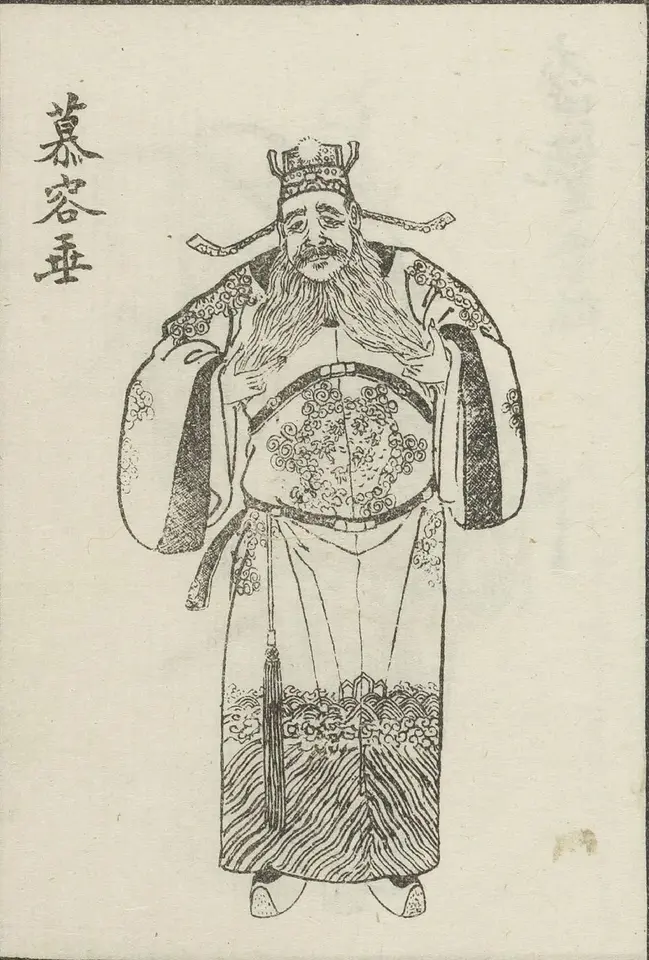
慕容隆
Murong Long (d. May 18, 397), courtesy name Daoxing, was a native of Daji City, Changli Commandery (present-day Yi County, Liaoning Province). He belonged to the Xianbei ethnic group and served as an eminent royal general and pivotal military pillar of the Later Yan regime during the Sixteen Kingdoms period. He was a grandson of Emperor Wenming (Murong Huang) and a son of Emperor Chengwu (Murong Chui), enfeoffed as Prince of…
Murong Long (d. May 18, 397), courtesy name Daoxing, was a native of Daji City, Changli Commandery (present-day Yi County, Liaoning Province). He belonged to the Xianbei ethnic group and served as an eminent royal general and pivotal military pillar of the Later Yan regime during the Sixteen Kingdoms period. He was a grandson of Emperor Wenming (Murong Huang) and a son of Emperor Chengwu (Murong Chui), enfeoffed as Prince of Gaoyang. Celebrated from his youth for unyielding fortitude, tactical acumen, and mastery of warfare, Murong Long accompanied his father through decades of peril and campaign victories. In 369, when Murong Chui's triumphs at Fangtou provoked mortal jealousy from Grand Tutor Murong Ping and Empress Dowager Kezuhun, Murong Long fled with his father to seek refuge under Fu Jian of Former Qin. Following Former Qin's defeat at the Battle of Fei River in 384, Murong Chui raised righteous armies to restore the Yan state. Murong Long assisted in executing Fu Feilong in Henan, broke through enemy ranks to rescue his father during an ambush at Hualin Garden in Ye, and systematically crushed rebel forces led by Zhai Zhen, Shao Xing, Zhao Su, Cai Kuang, Wen Xiang, Zhang Yuan, and Wang Zu, pacifying Jizhou and eastern Shandong. In 389, Murong Long was appointed Commander-in-Chief of Military Affairs in You and Ping Provinces, stationed at Longcheng (Dragon City) to govern the northeast, where he promoted agriculture, preserved stability, and crushed local rebellions. In 396, he spearheaded the royal punitive strike against Northern Wei, personally slaying Tuoba Qian, Duke of Chenliu, at Pingcheng. Following Murong Chui's death, when Tuoba Gui of Northern Wei besieged the capital city of Zhongshan, Murong Long repeatedly rallied troops to break the siege, only to be obstructed by Prince of Zhao Murong Lin. In 397, escorting Emperor Huimin (Murong Bao) in a fighting retreat toward Longcheng, Murong Long was assassinated at Huangyugu in Guangdu by Qiu Nigui, an agent of the treacherous Prince of Qinghe Murong Hui. He was posthumously honored as Grand Minister of Works with the posthumous title King Kang.
Escaped from Ye to Former Qin with Murong Chui following court conspiracies by Murong Ping and Empress Dowager Kezuhun.
Coordinated the execution of Fu Feilong in Henan; rescued Murong Chui from a surprise encirclement at Hualin Garden in Ye.
Smashed Dingling chieftain Zhai Zhen at Handan; annihilated Shao Xing and Zhao Su at Xiangguo, recovering Jizhou commanderies.
Ambushed Eastern Jin general Liu Laozhi at Wuqiaoze and Wuzhang Bridge, forcing Liu to leap his warhorse across the chasm.
Created Prince of Gaoyang upon Murong Chui's imperial accession; suppressed rebel leader Cai Kuang at Yimu.
Forced Wen Xiang into flight by crossing the Yellow River; shattered Zhang Yuan at Wengkou, pacifying Qing, Yan, and Xu provinces.
Besieged Zhang Shen at Hekou; mounted an audacious nocturnal pursuit to crush Wang Zu, completely calming the eastern seaboard.
Appointed Senior General Conquering the North and Pastor of Youzhou; administered the old capital, pacifying Wu Zhu's uprising.
Led elite Longcheng cavalry as vanguard against Northern Wei; stormed Pingcheng and slew Duke of Chenliu Tuoba Qian.
Promoted to Right Supervisor of the Masters of Writing; repelled massive assaults by Tuoba Gui at the southern wall of Zhongshan.
Prepared four times to lead counterstrikes against the exhausted Wei army, but was repeatedly thwarted by Murong Lin's jealousy.
Guarded Murong Bao's retreat to Jicheng and routed Wei pursuers; murdered at Huangyugu by conspirators loyal to Murong Hui.
Murong Long was a legitimate son of Murong Chui, the founding sovereign of Later Yan, born to one of his favored consorts. Endowed from youth with exceptional composure and strategic vision, he possessed profound mastery of military strategy alongside archery and horsemanship, distinguishing himself among Murong Chui's sons as a leader of both intellect and martial prowess.
In the fourth year of the Taihe era (369), Former Yan was invaded by Eastern Jin Grand Commander Huan Wen. Murong Chui turned the tide of war, crushing the Jin armies at the Battle of Fangtou. However, Regent Murong Ping and Empress Dowager Kezuhun deeply envied his rising prestige and plotted his execution. Learning of the conspiracy, Murong Chui declined advice to stage a palace coup, choosing instead to seek refuge abroad. Murong Long accompanied his father, along with his brothers Murong Bao and Murong Nong and cousin Murong Kai, fleeing Ye under cover of a hunting party. At Handan, their younger brother Murong Lin betrayed their itinerary to Murong Ping. Evading pursuers, Murong Chui led his family westward to submit to Former Qin. Emperor Xuanzhao (Fu Jian) of Former Qin, who had long admired Murong Chui, rejected Wang Meng's warning that the Murong family resembled untamable dragons and tigers, treating them with exceptional generosity. Murong Long resided in Guanzhong with his father for more than a decade.
Following Former Qin's collapse at the Battle of Fei River in 383, Murong Chui requested permission to appease northern populations and pay homage to his ancestral tombs, arriving in Ye. Regional Inspector Fu Pi deeply suspected his loyalty and placed him under surveillance. When Dingling leader Zhai Bin rebelled near Luoyang, Fu Pi detached Murong Chui to suppress the revolt, providing only two thousand decrepit soldiers alongside one thousand elite Di horsemen under General Fu Feilong, secretly instructing Fu Feilong to assassinate Murong Chui en route.
At Tangchi in Anyang, loyal aides Min Liang and Li Pi alerted Murong Chui to the plot. Murong Chui halted at Henan to recruit fresh troops, enlisting eight thousand volunteers within ten days. At night, Murong Chui dispatched Murong Bao to lead the vanguard while Murong Long commanded elite personal guards to protect his father, interspersing Di soldiers among his ranks. At midnight, upon hearing the signal drums, Murong Long and Murong Bao launched a coordinated simultaneous assault from front and rear, completely annihilating Fu Feilong and his Di cavalry, formally inaugurating the restoration of the Yan kingdom.
In January 384, Murong Chui arrived outside Ye, changing the era to the first year of Yan. He summoned armies led by Murong Nong, Murong Kai, and other Xianbei chieftains to lay siege to Ye. In February, more than two hundred thousand Yan troops employed siege towers and tunnels against the city, but met fierce resistance from Fu Pi. In April, while the siege dragged on, Murong Chui held a military hunt and banquet in Hualin Garden outside the walls. Garrison troops inside Ye staged a surprise raid from concealed sally ports. Arrows fell like rain, decimating the royal bodyguards and trapping Murong Chui in mortal peril. In this desperate crisis, Murong Long, then serving as Senior General of the Vanguard, rode fearlessly into the melee at the head of a hundred cavalrymen, cutting down enemy vanguards and carving an escape path to rescue his father from encirclement.
In July, Zhai Bin, who had initially surrendered to Murong Chui, grew arrogant and conspired with Fu Pi to breach dikes and flood the Yan encampment. Murong Chui executed Zhai Bin, prompting Zhai Bin's nephew Zhai Zhen to flee to Handan and ally with Former Qin commanders Guang Zuo and Gongsun Xi. Murong Long and Heir Apparent Murong Bao were dispatched to intercept the insurgents, executing a rapid cavalry ambush outside Handan that routed Zhai Zhen's forces.
In August, Zhai Zhen retreated to Chengying, linking up with Former Qin Administrator Shao Xing. Shao Xing mobilized thousands of cavalry to rally imperial loyalists across Jizhou, while Zhao Su of Zhao Commandery took up arms in sympathy. Murong Chui ordered Murong Long and General Zhang Chong to crush Shao Xing, coordinating with Murong Nong advancing from Qinghe. Murong Long marched day and night to Xiangguo, engaging Shao Xing in a pitched cavalry battle. Charging into the enemy vanguard, Murong Long shattered Shao Xing's formation and chased him toward Guang'a, where Shao Xing was captured by Murong Nong. Hearing of the defeat, Guang Zuo hastily withdrew to Ye. Murong Long then swept across Zhao Commandery, capturing Zhao Su and pacifying all insurgent bastions, restoring Jizhou commanderies to Yan rule.
In April 385, Eastern Jin general Xie Xuan dispatched Liu Laozhi with twenty thousand elite Northern Fleet troops to relieve Ye. Facing battle fatigue, Murong Chui feigned retreat to Xincheng and Wuqiaoze. Liu Laozhi advanced rapidly over two hundred li to seize Yan supply trains, stumbling directly into Murong Chui's prepared trap. The Yan army launched a devastating counteroffensive, slaying thousands of Jin soldiers. Murong Long and Prince of Fanyang Murong De held the strategic bottleneck at Wuzhang Bridge to cut off retreat. Confronted by Murong Long's formidable battle line, Liu Laozhi spurred his warhorse across a wide mountain chasm, barely escaping capture on a solitary mount.
In August, Fu Pi abandoned Ye for Jinyang, allowing Later Yan to secure the regional capital. In November, local magnate Cai Kuang rebelled at Yimu, while Administrator Ren Tai of Taishan marched with several thousand troops to relieve him, halting eight li south of Cai Kuang's stockade. As Yan commanders voiced anxiety over the approaching relief column, Murong Long calmly analyzed the situation: "Cai Kuang resists stubbornly solely because he relies on external relief. Ren Tai commands fewer than several thousand men, and their forces have not yet joined. If we strike Ren Tai while his troops are exhausted from marching, he will break easily; once Ren Tai is routed, Cai Kuang will surrender without battle!" Murong Chui approved the strategy. Murong Long led cavalry to assault Ren Tai's camp, killing over a thousand men. Witnessing the destruction of his relief column, Cai Kuang opened the stockade gates and surrendered.
In January 386, Murong Chui formally assumed the imperial title in Zhongshan, establishing the Jianxing era and enfeoffing Murong Long as Prince of Gaoyang to participate in supreme military councils. In January 387, Eastern Jin Administrator Wen Xiang gathered forces at Dong'e, deploying his cousin Wen Pan on the southern bank of the Yellow River and his son Wen Kai at the strategic crossing of Que'ao. Murong Long advised: "Wen Xiang and his associates are mere Confucian pedants leading an undisciplined rabble, relying entirely on the river barrier. Once our army crosses, they will collapse at the sight of our banners without giving battle!" Following his counsel, the Yan army forced a crossing forty li west of Que'ao. Panicked, Wen Pan and Wen Kai fled, while Wen Xiang escaped by night to Pengcheng. Murong Long occupied the strongholds and accepted the surrender of over thirty thousand households.
In February, rebel general Zhang Yuan mobilized ten thousand refugees at Wengkou, allying with Qi She of Anci. Murong Chui ordered Murong Long and Murong De to lead twenty thousand infantry and cavalry against them. Arriving at Doucheng to rest horses, the Yan camp was suddenly ambushed by Zhang Yuan's vanguard. As Murong De retreated to regroup, Murong Long held his ground with iron discipline. When Zhang Yuan's son Zhang Gui spearheaded a charge against his perimeter, Murong Long directed officer Wang Mo to counterattack, beheading Zhang Gui on the field.
Seizing the opening, Murong Long launched a sweeping countercharge that broke Zhang Yuan's front. As Murong De returned and suggested delaying pursuit because the enemy remained numerous, Murong Long countered that an ambushing force whose surprise failed was already morally broken and must be relentlessly pursued. Joining forces, they pursued the enemy to Wengkou, annihilating over 7,800 troops and driving Zhang Yuan into solitary flight. Soon after, Qi She was delivered in chains by local citizens, and fortified settlements across Qing, Yan, and Xu provinces surrendered in rapid succession. In December 388, Murong Long joined forces with Murong Kai and Murong Lin at Hekou to besiege Zhang Shen; when rebel general Wang Zu launched a midnight raid on the camps, Murong Long led an aggressive night counter-pursuit that wiped out Wang Zu's command, compelling both Zhang Shen and Wang Zu to surrender.
In January 389, Prince of Liaoxi Murong Nong completed five years of administration at Longcheng and petitioned to return to court. Murong Chui appointed Murong Long as Commander-in-Chief of Military Affairs in You and Ping Provinces, Senior General Conquering the North, and Regional Pastor of Youzhou, establishing a Branch Department of State Affairs at Longcheng to direct the northeastern marches. During his tenure, Murong Long faithfully maintained Murong Nong's benevolent administrative policies, promoting farming, silk production, military readiness, and judicial fairness, securing tranquility across Liaodong and Mount Jieshi.
In September, while Murong Long was conducting funeral rites for his deceased princess, local malcontent Wu Zhu gathered a thousand insurgents in Beiping, proclaiming the monk Fachang as emperor and capturing Bailang City. Subordinates urged Murong Long to abort the funeral and mobilize the garrison. Murong Long assured his officers: "The common people are content in their livelihoods and abhor warfare. Wu Zhu has merely deceived ignorant peasants with sorcery; such a mob can accomplish nothing." Once the funeral was completed with dignity, he dispatched Marquis Murong Jin with only a hundred elite horsemen to Bailang City. Upon beholding Murong Long's royal standards, the rebel followers dispersed without fighting, and Wu Zhu was captured and beheaded.
In 395, Crown Prince Murong Bao suffered a catastrophic defeat against Tuoba Gui of Northern Wei at Canhebei, where tens of thousands of Yan soldiers were captured and buried alive. Desperate to avenge the disaster, Murong Bao petitioned for a second expedition. Murong Chui resolved to campaign in person, urgently recalling Murong Long and his Longcheng elite to Zhongshan. In January 396, Murong Long arrived at the capital with impeccably disciplined regiments, rekindling hope and martial spirit throughout the demoralized court.
In March, the ailing seventy-one-year-old Murong Chui launched his final expedition, assigning Murong Long and Murong Nong as the vanguard to traverse the Tianmen Mountains and strike Yunzhong. Tuoba Qian, Duke of Chenliu, guarded Pingcheng with over thirty thousand tribal households. While most Yan soldiers trembled at Northern Wei's reputation, Murong Long's Longcheng veterans charged forward with unyielding ferocity. Caught completely unprepared, Tuoba Qian hastily marshaled his forces outside Pingcheng. Murong Long galloped at the head of his heavy cavalry, smashing the Wei line and cutting down the renowned warrior Tuoba Qian in personal combat, routing the Wei host and capturing Pingcheng. Terrified by Tuoba Qian's death, northern tribal confederacies wavered, and Tuoba Gui prepared to flee north. However, when Murong Chui passed Canhebei and witnessed mountains of bones, he vomited blood in grief and fell fatally ill. The expedition retreated, and Murong Chui died at Juyang in April. Murong Bao succeeded to the throne, appointing Murong Long as Right Supervisor of the Masters of Writing. In June, when rebel general Ping Gui seized Gaotang, Murong Long marched to the Yellow River and dispatched Murong Jin to hunt down and behead Ping Gui in Jibei.
In August 396, Tuoba Gui mobilized four hundred thousand troops to invade Later Yan, capturing Bingzhou and advancing directly toward Zhongshan. As frontier garrisons surrendered, only Zhongshan, Ye, and Xindu held out. In November, Tuoba Gui launched furious assaults against Zhongshan. Murong Long was charged with defending the southern walls, where he fought in the front ranks alongside soldiers and citizens, repeatedly repelling scaling ladders and killing thousands of elite Wei warriors, compelling Tuoba Gui to withdraw to Boling.
In February 397, Northern Wei resumed the siege of Zhongshan. Murong Bao launched a reckless sortie at Baisi and was soundly defeated, retreating behind the city walls. By March, Zhongshan had been besieged for over six months, yet tens of thousands of garrison soldiers remained eager to fight. Murong Long urged Murong Bao: "Tuoba Gui has stalled beneath our walls for a year. His men and horses are depleted, his tribal confederates desire to return home, and internal divisions are rampant. This is the ideal moment to strike! If we harness the desperate courage of our garrison to attack his exhausted lines, victory is assured; if we sit idly, our morale will wither into ruin!" Murong Bao agreed, and Murong Long donned armor and mounted his warhorse.
However, Prince of Zhao Murong Lin, motivated by jealousy of Murong Long's military reputation, repeatedly sabotaged the plan, forcing the deployment to be called off four consecutive times. Weeping bitter tears of frustration, Murong Long had to dismount and stand down. Shortly afterward, palace conspiracies erupted: Minister Murong Hao attempted regicide before defecting to Wei, and Murong Lin assassinated Prince of Beidi Murong Jing before fleeing to join the Dingling. Paralyzed by panic, Murong Bao resolved to abandon Zhongshan and flee to the ancestral base at Longcheng. When diviner Gao Fu urged Murong Long to remain in the central plains to achieve independent glory, Murong Long rebuked him: "Our sovereign faces catastrophe and my aged mother resides in the north. If I die facing north, I have no regrets!"
Escorting Murong Bao on a harrowing night breakout, the royal party reached Jicheng with only hundreds of Murong Long's loyal cavalry surviving. Prince of Qinghe Murong Hui met the emperor with twenty thousand horsemen, but exhibited sullen insubordination. Murong Long urged Murong Bao to exercise forbearance while personally leading his cavalry to repulse pursuing Northern Wei vanguards, chasing them for tens of li while weeping over the wasted armies trapped in Zhongshan. Murong Hui, harboring fierce ambitions for the crown prince position, intensely resented Murong Long and Murong Nong for repeatedly reprimanding his arrogance and advising Murong Bao to designate Murong Ce as heir.
On May 18, 397 (the tenth day of the fourth month of the second year of the Yongkang era), Murong Bao's entourage encamped at Huangyugu in Guangdu. Murong Hui dispatched trusted assassins Qiu Nigui and Wuti Rangan with twenty armed warriors to infiltrate the camp. Murong Long was brutally murdered in his sleeping tent, while Murong Nong suffered grievous wounds. After reaching Longcheng and crushing Murong Hui's subsequent mutiny, Murong Bao wept in profound remorse, issuing an imperial decree posthumously appointing Murong Long Grand Minister of Works and granting him the posthumous title King Kang.
Throughout the turbulent decades of Later Yan's foundation, Murong Long stood as Murong Chui's most dependable field commander, participating in nearly every campaign that decided the fate of the dynasty. From the initial strike that annihilated Fu Feilong in Henan to the siege of Ye, he fought continuously in the front ranks. During the critical crisis at Hualin Garden, when Murong Chui was pinned down under a deluge of enemy archery, Murong Long's daring cavalry counter-charge saved the founding monarch from certain death.
In operations against Dingling warlord Zhai Zhen, Former Qin commanders Shao Xing and Zhao Su, and Eastern Jin general Liu Laozhi, Murong Long demonstrated unmatched tactical mobility. He excelled at identifying operational turning points, mounting rapid deep thrusts, and utilizing terrain traps. His field victories restored imperial control over the vast Yellow River basin, establishing him as one of the preeminent generals of the Sixteen Kingdoms period.
Following the proclamation of the Later Yan empire, regional warlords and fortified local clans contested imperial authority across the central plains. Murong Long's campaigns against Wen Xiang and Zhang Yuan in 387 showcased his operational brilliance in large-scale multi-corps warfare. Recognizing that Wen Xiang's river defense was manned by disorganized militias, he advocated an immediate river-crossing assault that triggered a bloodless surrender of thirty thousand households.
At the subsequent Battle of Wengkou, Murong Long maintained unshakable composure when his flanks recoiled under a surprise ambush, holding his formation until his officers slew the enemy vanguard commander Zhang Gui. Realizing that the enemy's failed charge had exhausted their morale, he pressed a relentless pursuit that crushed Zhang Yuan's ten thousand troops, bringing permanent pacification to Shandong and opening the southern approaches for Later Yan expansion.
Longcheng served as the historic cradle and strategic sanctuary of the Xianbei Murong people. In 389, Murong Long assumed command of the northeastern region as Senior General Conquering the North, Pastor of Youzhou, and Director of the Branch Secretariat. Over his years of northeastern governance, he displayed mature statesmanship.
Rather than imposing disruptive new decrees, he expanded the agricultural policies initiated by Murong Nong, establishing irrigation canals, settling refugees, and encouraging silk cultivation. When the demagogue Wu Zhu exploited his princess's funeral to stage an uprising, Murong Long accurately discerned that the populace was peaceful and refused to panick. Dispatching only a hundred cavalry to capture the ringleader, he snuffed out the revolt without collateral bloodshed. The agricultural wealth and military reserves accumulated under Murong Long at Longcheng provided the vital logistical lifeline that enabled Later Yan to survive the catastrophic defeats inflicted by Northern Wei.
During Later Yan's terminal struggle against Northern Wei, Murong Long stood as the rare royal commander who retained tactical clarity and unyielding offensive spirit. In the spring of 396, when the entire Yan military trembled following the slaughter at Canhebei, Murong Long's Longcheng corps spearheaded the offensive, storming Pingcheng and beheading Northern Wei's legendary champion Tuoba Qian.
During the defense of Zhongshan, Murong Long held the southern walls against overwhelming odds and repeatedly identified windows of vulnerability in Tuoba Gui's lines, four times assembling his strike corps to launch a decisive sally. Although these opportunities were sabotaged by Murong Lin's petty jealousy, Murong Long remained devoted to duty, refusing to carve out an independent satrapy in the central plains and giving his life to shield his sovereign during the northern retreat.
FIGURES ASSOCIATED WITH THIS DYNASTY