Birth in Princely Estate
Born on September 16 at the Xing princely estate in Anlu State, Huguang, displaying precocious intellect.
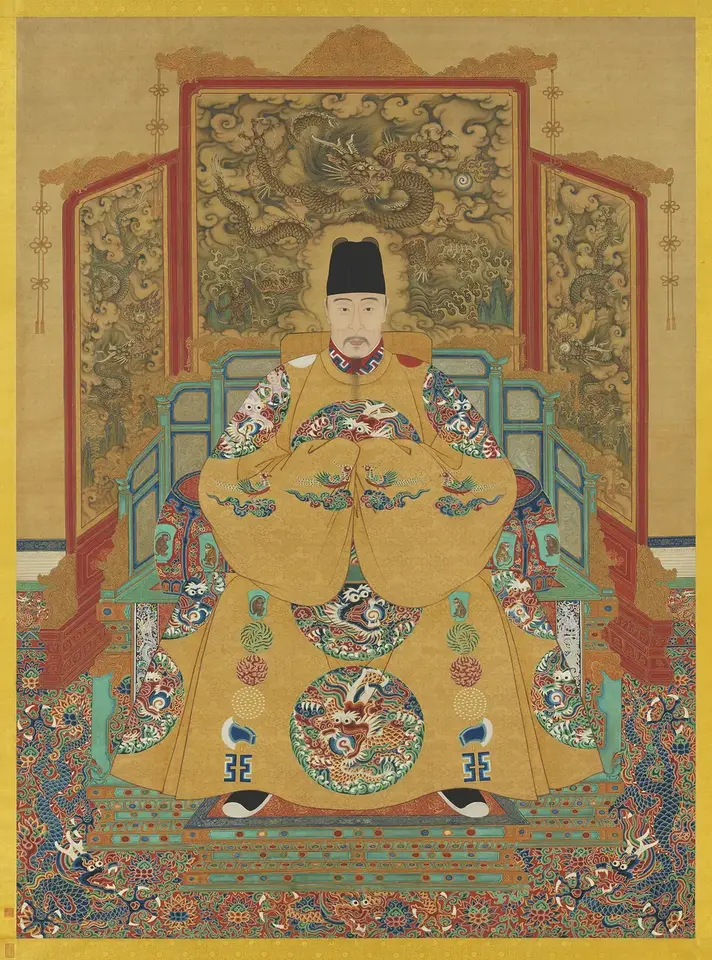
明世宗朱厚熜
Emperor Shizong of Ming, personal name Zhu Houcong (朱厚熜, September 16, 1507 – January 23, 1567), was the grandson of Emperor Xianzong (Zhu Jianshen), the second son of Prince Xian of Xing (Zhu Youyuan), and the cousin of Emperor Wuzong (Zhu Houzhao). He was the eleventh emperor of the Ming Dynasty, reigning under the era name Jiajing. Ruling for forty-five years (1521–1566), his reign was the second longest in Ming history,…
Emperor Shizong of Ming, personal name Zhu Houcong (朱厚熜, September 16, 1507 – January 23, 1567), was the grandson of Emperor Xianzong (Zhu Jianshen), the second son of Prince Xian of Xing (Zhu Youyuan), and the cousin of Emperor Wuzong (Zhu Houzhao). He was the eleventh emperor of the Ming Dynasty, reigning under the era name Jiajing. Ruling for forty-five years (1521–1566), his reign was the second longest in Ming history, exceeded only by that of his grandson, Emperor Shenzong (Wanli). In 1521, Emperor Wuzong died without an heir. Grand Secretary Yang Tinghe, following the dynastic ancestral injunctions, summoned fourteen-year-old Zhu Houcong from his princely estate in Anlu to succeed to the imperial throne. Immediately following his ascension, Zhu Houcong waged the bitter three-year Great Rites Controversy against conservative cabinet ministers, successfully elevating his biological father to posthumous imperial status and consolidating absolute personal autocratic authority. In his early reign, he energetically overhauled Zhengde abuses: abolishing provincial eunuch commissioners, executing corrupt military favorites Jiang Bin and Qian Ning, surveying and reclaiming private imperial estates, pruning redundant bureaucratic expenses, piloting the single whip tax reforms, and recodifying the imperial administrative code, a period acclaimed as the Jiajing Reforms or the Resurgence of Jiajing. In his middle and late reign, Shizong succumbed to Daoist alchemy, seeking physical immortality through endless sacrificial rites and consuming chemical elixirs. This obsession provoked the unprecedented Renyin Palace Plot of 1542, wherein sixteen palace maidens attempted to strangle him. Surviving the ordeal, he withdrew to the West Park for twenty-four years, refusing to attend formal palace morning audiences while continuing to rule the empire through confidential red-ink rescripts and autocratic surveillance. In foreign affairs, the empire faced the dual crises of northern Tartar raids under Altan Khan—culminating in the Gengxu Incident of 1550—and rampant wokou piracy along the southeastern seaboard. Shizong fortified Beijing with an outer wall and appointed Hu Zongxian, Yu Dayou, and Qi Jiguang to pacify the maritime frontier. Politically, Grand Secretary Yan Song dominated the cabinet for two decades until overthrown by Xu Jie. Passing away in 1567 from mercury and lead poisoning caused by Daoist elixirs at age sixty, he was enshrined as Shizong and buried in the Yongling Mausoleum of the Ming Tombs.
Born on September 16 at the Xing princely estate in Anlu State, Huguang, displaying precocious intellect.
Succeeded as Prince of Xing upon the death of his father Zhu Youyuan, managing princely affairs with strict protocol.
Ascended the imperial throne on May 27 following Emperor Wuzong's death, proclaiming the reign title Jiajing.
Vehemently rejected cabinet demands to adopt Emperor Xiaozong as father, initiating the Great Rites Controversy.
Crushed bureaucratic demonstrations at the Left Shun Gate with severe palace floggings, establishing imperial autocracy.
Promulgated the Comprehensive Code on Human Relationships, concluding the Great Rites Controversy.
Abolished combined sacrifices, establishing separate suburban altars: Temple of Heaven, Earth, Sun, and Moon.
Survived an assassination attempt by palace maidens in the tenth month; subsequently withdrew to the West Park.
Besieged in Beijing by Mongol cavalry under Altan Khan; ordered the construction of Beijing's outer wall.
Wokou raiders penetrated the southern heartland toward Nanjing; commissioned Hu Zongxian to direct maritime defense.
Qi Jiguang's army achieved nine consecutive victories in Taizhou, decimating the primary forces of the coastal pirates.
Dismissed Senior Grand Secretary Yan Song after twenty years of cabinet dominance, elevating Xu Jie to chief minister.
Hai Rui submitted his fearless Memorial on Security, directly castigating the emperor's Daoist neglect of state affairs.
Passed away on January 23 at the Qianqing Palace at age sixty, buried in the Yongling Mausoleum.
Zhu Houcong was born on September 16, 1507, in the princely mansion of Anlu State, Huguang Province. His father was Zhu Youyuan, Prince Xian of Xing, the fourth son of Emperor Xianzong; his mother was Consort Jiang. Precociously intelligent, Zhu Houcong memorized classical poetry from early childhood and demonstrated profound interest in imperial statecraft and history. His father personally supervised his classical education in the Thirteen Classics, imbuing the young prince with deep reverence for Confucian ancestral ethics and imperial protocol.
In 1519, Prince Xian of Xing passed away. Thirteen-year-old Zhu Houcong assumed management of the princely estate, maintaining strict administrative discipline. On April 20, 1521, Emperor Wuzong died suddenly in the Leopard House at age thirty-one without issue or designated successor. Senior Grand Secretary Yang Tinghe, consulting the dynastic founder's ancestral admonitions regarding brotherly succession, conferred with Empress Dowager Zhang to summon Emperor Wuzong's cousin, Prince of Xing Zhu Houcong, to inherit the imperial throne.
A delegation of high civil officials and imperial dukes arrived in Anlu on May 7, 1521, to convey the imperial decree. Zhu Houcong accepted the mandate and journeyed to Beijing. On May 27, when the imperial retinue reached Liangxiang outside the capital, a sharp constitutional confrontation erupted. Senior Grand Secretary Yang Tinghe insisted that the young prince should enter the capital through the East Peace Gate as imperial crown prince, lodge in the Wenhua Hall, and undergo formal coming-of-age ceremonies before taking the throne.
Fourteen-year-old Zhu Houcong refused adamantly, declaring: "The imperial edict summoned me to inherit the imperial throne as emperor, not to become an adopted son!" He insisted upon entering through the Daming Gate—the central southern gate reserved exclusively for reigning sovereigns—and proceeding directly to the Fengtian Hall. Faced with the prince's resolute refusal to compromise, the cabinet capitulated. Zhu Houcong processed through the Daming Gate, ascended the throne at the Fengtian Hall, and proclaimed the era name Jiajing for the following year.
Upon his accession, the young monarch immediately confronted the most severe ideological and factional conflict of the mid-Ming Dynasty: the Great Rites Controversy. Grand Secretary Yang Tinghe and Minister of Rites Mao Cheng, citing classical ritual precedents, insisted that Zhu Houcong must posthumously adopt his uncle, Emperor Xiaozong (Zhu Yougtang), as his imperial father, while demoting his biological father to Imperial Uncle Prince of Xing and his mother to Imperial Aunt.
Deeply attached to his biological parents, Zhu Houcong rejected this demand, arguing that filial piety forbade altering biological lineage. Newly minted scholar-officials Zhang Cong and Gui E provided doctrinal support by submitting memorials arguing that Zhu Houcong had inherited the imperial line without severing his biological ancestral ties, proposing that Emperor Xiaozong be honored as Imperial Uncle and Zhu Youyuan as Imperial Father.
The court fractured into two irreconcilable factions: conservative senior ministers under Yang Tinghe versus reformist scholars aligned with Zhang Cong. The struggle raged for over three years. In July 1524, Shizong formally bestowed imperial ancestral titles upon his biological parents. Yang Tinghe resigned in protest, while his son Yang Shen mobilized more than two hundred and twenty high officials to kneel and wail in protest outside the Left Shun Gate of the Forbidden City.
Confronting this open bureaucratic defiance, the seventeen-year-old emperor responded with draconian severity. He ordered the imperial guard to arrest more than one hundred leading demonstrators, subjecting them to public floggings on the palace flagstones. Sixteen officials died of their wounds, and dozens more were exiled to distant frontier garrisons. This bloody purge shattered bureaucratic resistance. In 1528, Shizong promulgated the Comprehensive Code on Human Relationships, establishing his biological father in the Imperial Ancestral Temple as Emperor Ruizong, cementing absolute monarchical autocracy.
Following his victory in the ritual controversy, Shizong launched comprehensive administrative reforms during his first decade of rule, known as the Jiajing Reforms. Addressing the corruption, military decay, and fiscal depletion left by Emperor Wuzong's regime, Shizong implemented vigorous administrative cleanups.
He ordered the execution of Wuzong's favored military commanders, Jiang Bin and Qian Ning, while purging over one hundred corrupt favorites. Crucially, Shizong permanently abolished the post of provincial eunuch commissioner across more than one hundred and sixty regional garrisons, eliminating a century-old abuse of eunuch extortion and restoring civil administrative authority to provincial governors and censors.
In fiscal administration, Shizong carried out rigorous investigations into private estates usurped by imperial relatives and nobles, which had exceeded thirty thousand qing around Beijing during the Zhengde era. He dispatched investigating censors to survey land registers, returning seized farmlands to common cultivators and remitting long-standing tax arrears across the provinces. Over his forty-five-year reign, he issued tax remissions and famine relief decrees over one hundred times, personally plowing imperial agricultural fields to encourage farming. In the southern provinces, he encouraged early experiments in consolidating labor service dues into silver payments, paving the way for the later Single Whip Law.
Shizong elevated capable administrators including Zhang Cong, Gui E, and Xia Yan to high office. Addressing aristocratic nepotism, in 1529 he adopted Minister of Personnel Fang Xianfu's proposal to permanently abolish the hereditary succession of imperial in-law titles, decreeing that noble titles granted to maternal relatives could be held only for life. In the imperial examinations, he eradicated ornate rhetorical trivia, dispatching censors in 1528 to supervise regional examinations in Zhejiang, Shanxi, Guangdong, and Shaanxi to ensure the recruitment of practical talent, revitalizing dynastic governance.
Having established his imperial lineage, Shizong extended his ritual philosophy into the physical architecture of the capital. Breaking with Ming Taizu's tradition of combined sacrifices to Heaven and Earth in Nanjing, Shizong studied the Rites of Zhou and the Book of Han, concluding that Heaven and Earth represented complementary cosmic forces that required separate suburban altars.
Beginning in 1530, Shizong directed the architectural transformation of Beijing. South of the Meridian Gate, he expanded the original altar into the circular Temple of Heaven; north of the city at Andingmen, he constructed the square Temple of Earth; east of Chaoyangmen, he built the Temple of the Sun; and west of Fuchengmen, he erected the Temple of the Moon. This system of four suburban altars aligned the capital's geography with the eight trigrams and ancient cosmology, creating the iconic imperial architectural framework that survives today.
He also constructed the Altar of Agriculture and Altar of the Year God, while reorganizing the Imperial Ancestral Temple. Furthermore, he stripped Confucius of the hereditary kingly title bestowed during the Tang and Song dynasties, restoring his designation to Ultimate Sage and Ancient Teacher, replacing anthropomorphic statues with wooden ancestral tablets to conform to classical antiquity. In 1557, when a palace fire endangered the imperial archives, Shizong ordered a duplicate transcription of the monumental Yongle Dadian, employing hundreds of scribes over years to safeguard the encyclopedic treasure for posterity. In bureaucratic legislation, he directed the comprehensive re-compilation of the Collected Statutes of the Ming Dynasty, synthesizing dynastic laws into fifty-three authoritative volumes.
As his autocratic authority became absolute, Shizong grew increasingly alienated from conventional governance, exacerbated by lifelong frailty and illness. He fell under the sway of Daoist alchemists and sorcerers such as Shao Yuanjie and Tao Zhongwen, transforming the palace into a Daoist sanctuary where he wore priestly vestments and chanted liturgy day and night.
Daoist masters received unprecedented imperial favors: Shao Yuanjie was elevated to Minister of Rites, while Tao Zhongwen was granted the supreme titles of Junior Preceptor, Junior Tutor, and Junior Guardian. Official court memorials were categorized into civilian submissions and Daoist communications. The imperial treasury expended millions of silver taels on Daoist rites, grinding thousands of ounces of pure gold into dust for cinnabar inscriptions and commissioning over thirty thousand porcelain vessels from Jingdezhen for alchemical altars. The cabinet ministers spent their primary energies composing ornate green-paper prayers for the emperor's spiritual favor.
To formulate elixirs of immortality, Shizong selected hundreds of young maidens for his palace. In 1542, believing that drinking dawn dew promoted longevity, he forced palace maids to collect dew from the imperial gardens before dawn in freezing weather, punishing minor infractions with brutal beatings that crippled over one hundred palace attendants.
This torment provoked the historic Renyin Palace Plot. On the night of November 27, 1542, while Shizong was asleep in the palace of Consort Duan, sixteen palace maidens led by Yang Jinying slipped into the bedchamber. They looped a silk cord around the emperor's neck, pulling with all their strength to strangle him. In their haste, the maidens tied a knot that failed to tighten, leaving Shizong unconscious but alive.
Palace maid Zhang Jinlian panicked and alerted Empress Fang, who rushed in with imperial guards to rescue the monarch. Shizong remained comatose for days, revived by physician Xu Shen through emetic treatments. Empress Fang ordered the execution of the sixteen maidens and Consort Duan by lingchi (death by a thousand cuts). The traumatic attack shattered Shizong's psychological stability, leaving him with an enduring paranoia regarding the inner palace.
Following the assassination attempt, Shizong abandoned the Forbidden City in December 1542, moving his permanent residence to the Wanshou Palace in the West Park (modern Zhongnanhai and Beihai). Over the remaining twenty-four years of his reign, he never set foot inside the Qianqing Palace or presided over a single imperial morning audience.
Shizong was deeply superstitious and paranoid, abhorring words connected to death. When physician Xu Wei hesitated to approach because the imperial robe lay on the floor, Shizong rewarded his discretion, remarking: "Upon the earth dwell the living; beneath the earth lie ghosts." Because of constant Mongol border raids, he developed an aversion to the characters for barbarian, writing them in miniature script on memorials.
Yet, his retirement was an exercise in remote autocratic surveillance rather than political abandonment. Retaining absolute control through confidential channels, he spent nights reviewing memorials from across the empire, issuing confidential directives written on red paper slips. Grand secretaries lived in terror of his unpredictable moods.
In 1548, Senior Grand Secretary Xia Yan, an outspoken opponent of Daoist excesses, was implicated in Shaanxi Governor-General Zeng Xian's proposal to recover the Ordos Loop from the Mongols. Manipulated by rival Yan Song, Shizong ordered the execution of both Xia Yan and Zeng Xian in the Ordos Case. Following Xia Yan's fall, Yan Song assumed cabinet leadership alongside his corrupt son Yan Shifan, dominating civil administration for twenty years while catering to Shizong's Daoist obsessions.
During Shizong's seclusion in the West Park, the northern frontier suffered its worst military crisis since the Tumu Crisis of 1449. Altan Khan, leader of the Tumed Mongols, unified the southern steppe tribes and repeatedly requested imperial permission for border trade, seeking to exchange horses and hides for grain and textiles.
Bound by traditional tributary dogma, Shizong viewed these requests as barbarian blackmail, executing Mongol trade envoys and prohibiting border commerce. In response, Altan Khan launched devastating incursions across the Great Wall. In September 1550, Altan Khan led tens of thousands of cavalry through the Gubeikou pass, sweeping into Tongzhou and encircling Beijing in the Gengxu Incident.
Enemy horsemen torched suburbs surrounding the capital, filling the sky with smoke while imperial forces huddled within the city walls. In the West Park, Shizong mobilized regional armies under Minister of War Ding Rukui, but Grand Secretary Yan Song advised passive defense, declaring that the invaders would retreat once their plunder was complete. After looting the surrounding counties for days, the Mongol forces withdrew unhindered.
To pacify public fury, Shizong executed Minister of War Ding Rukui. Recognizing the vulnerability of the capital, Shizong ordered the construction of Beijing's outer wall in 1553. Although original plans called for a complete circuit of seventy li, financial constraints forced builders to concentrate on enclosing the southern suburbs, completing gates including Yongdingmen and Guangqumen, creating Beijing's distinctive indented double-walled configuration. Along the northern frontier, Shizong deployed commanders Zhou Shangwen and Ma Fang to stabilize defenses.
Simultaneously, the southeastern coast experienced devastating maritime raiding. Ming maritime bans had driven private overseas merchants into outlaw networks. When Shizong closed commercial offices in Zhejiang and Fujian, Chinese merchant leaders such as Wang Zhi and Xu Hai formed armed alliances with Japanese ronin warriors, launching extensive coastal smuggling and raiding operations.
From 1552 onwards, pirate fleets raided coastal counties across Zhejiang, Jiangsu, Fujian, and Guangdong, looting and burning villages. In 1555, a raid of several dozen pirates advanced deep inland to the gates of Nanjing, killing thousands of garrison troops and exposing the decay of the coastal military system.
Shizong took decisive measures to reclaim the coastline. After dismissing generals who failed in battle, he appointed the capable strategist Hu Zongxian as Supreme Commander of Southeastern Coastal Defense. He reorganized coastal logistics, establishing naval vice-commissioners at Nantou and creating a general headquarters at Chaozhou under Wu Guifang, deploying local Lang troops to secure vital maritime channels.
Hu Zongxian pursued a strategy of divide-and-conquer, neutralizing pirate chiefs Wang Zhi and Xu Hai, while promoting battle-hardened commanders Yu Dayou, Qi Jiguang, and Tang Kekuan. Qi Jiguang recruited miners and farmers in Yiwu, inventing the tactical Mandarin Duck Formation to forge the disciplined Qi Family Army. In 1561, Qi's forces achieved nine consecutive victories in Taizhou, destroying the primary pirate hosts. Subsequent campaigns cleared pirate fortresses in Fujian and Guangdong, extinguishing the coastal piracy crisis and laying the foundation for the reopening of maritime trade under Emperor Muzong.
With the pacification of the maritime frontier, court politics reached a turning point. Senior Grand Secretary Yan Song and his son Yan Shifan had monopolized administrative appointments for two decades, amassing illicit fortunes.
In 1555, Vice Director of War Yang Jisheng submitted an indictment charging Yan Song with ten capital crimes and five acts of treachery. Enraged by the attack on his chief minister, Shizong subjected Yang Jisheng to severe flogging and executed him after three years of imprisonment. Yang Jisheng's martyrdom solidified resistance against the Yan clique.
Junior Grand Secretary Xu Jie bided his time, cultivating ties with Daoist master Lan Daohang, who was trusted by the emperor. During a divination session, Lan Daohang produced an oracle declaring that national harmony was blocked by treacherous ministers, identifying Xu Jie as loyal and Yan Song as corrupt.
In 1562, weary of Yan Song's senility and moved by Censor Zou Yinglong's exposure of Yan Shifan's extortion, Shizong stripped eighty-two-year-old Yan Song of office and arrested his son. In 1565, Xu Jie secured proof that Yan Shifan was colluding with maritime outlaws and plotting rebellion. Shizong ordered Yan Shifan's execution and the confiscation of the family's immense wealth. Yan Song died in disgrace, ending two decades of factional misrule.
As Senior Grand Secretary, Xu Jie worked to reverse wrongful convictions and stabilize administration. However, the aging monarch's health deteriorated rapidly as his consumption of toxic mercury and lead elixirs intensified, producing violent mood swings and paranoid outbursts.
In February 1566, Hai Rui, a junior official in the Ministry of Revenue, purchased a coffin, bade farewell to his family, and submitted his historic Memorial on Security. Hai Rui delivered an unsparing indictment of Shizong's forty-five-year reign, condemning his twenty-year absence from court, his wasteful Daoist expenditures, and the suffering of the populace: "Your Majesty has long indulged in delusions of immortality, wasting public revenues and leaving the state in peril! The officials are corrupt, the soldiers weak, and the people destitute. All under Heaven have long found Your Majesty deficient! The populace observes that the characters for your reign, Jia-Jing, truly mean that every household has been cleansed bare!"
Shizong was seized with fury, throwing the memorial to the floor and shouting for the author's arrest. Eunuch Huang Jin knelt and said: "Your Majesty need not fear his escape. Hai Rui bought a coffin, dismissed his servants, and awaits death in the ministry." Hearing this, Shizong fell silent, sighing deeply. He spared Hai Rui's life, ordering him imprisoned in the imperial guard dungeons for interrogation.
Months later, Shizong's condition deteriorated as toxic heavy metals ravaged his organs. In December 1566, sensing his impending demise, he returned to the Qianqing Palace inside the Forbidden City. On January 23, 1567, Emperor Shizong passed away at the age of sixty.
Grand Secretary Xu Jie drafted the imperial final testament, abolishing all Daoist rituals, releasing imprisoned remonstrators such as Hai Rui, and posthumously rehabilitating martyrs including Yang Jisheng and Zeng Xian. Shizong was granted the posthumous title Emperor Su and buried in the Yongling Mausoleum of the Ming Tombs, succeeded by his third son, Prince of Yu Zhu Zaiji (Emperor Muzong).
During his early reign, Shizong demonstrated remarkable political resolve in eliminating the systemic abuses inherited from Emperor Wuzong. He permanently abolished the office of provincial eunuch commissioners across the empire, dismantling the century-old practice of eunuchs commanding regional garrisons and extorting local populations, and restoring administrative authority to civilian governors.
He enforced discipline within the palace, executing eunuchs who violated regulations. Trusted attendants such as Huang Jin (Director of the Directorate of Ceremonial), Sun Hong, and Bi Yun were kept under close supervision. Economically, he reclaimed over thirty thousand qing of farmlands seized by imperial favorites, returning them to common peasants and remitting delinquent taxes, stabilizing the realm after the Zhengde upheavals.
Shizong reshaped the ritual architecture of the Chinese imperial state. Rejecting Ming Taizu's combined sacrifices to Heaven and Earth, he instituted the system of four separate suburban altars in 1530, based on his reading of classical cosmological texts.
He expanded the Temple of Heaven in the south, built the Temple of Earth in the north, the Temple of the Sun in the east, and the Temple of the Moon in the west, while adding altars dedicated to Agriculture and Planetary Deities, creating the iconic "Nine Altars and Eight Temples" layout of Beijing. Furthermore, he stripped Confucius of kingly aristocratic titles, designating him Ultimate Sage and Ancient Teacher, and replacing statues with classical wooden tablets to align imperial ritual with orthodox Confucian antiquity.
Confronting the piracy crisis along the southeastern seaboard, Shizong remained steadfast in his determination to pacify the maritime frontier. Promoting talent over bureaucratic seniority, he entrusted Supreme Commander Hu Zongxian with expansive military authority to coordinate coastal defense.
Under his sponsorship, commanders Hu Zongxian, Yu Dayou, Qi Jiguang, Tan Lun, and Tang Kekuan devised tactical innovations including the Mandarin Duck Formation, destroying pirate bases at Taizhou, Cengang, and Hengyu. This successful campaign ended a decade of devastation across the southern provinces and created the military conditions that enabled the formal reopening of maritime foreign trade under Emperor Muzong.
Shizong placed paramount emphasis on compiling legal codes and ideological texts. Recognizing that the Zhengde edition of the Collected Statutes of the Ming Dynasty was riddled with errors, he commissioned cabinet ministers to re-compile the work in 1529, laboring across two decades to produce a fifty-three-volume legal compendium that governed Ming administration for the remainder of the dynasty.
Following his triumph in the Great Rites Controversy, Shizong directed the compilation of the twenty-four-volume Comprehensive Code on Human Relationships (Minglun Dadian), distributing it to academies and yamens across the empire as mandatory ideological curriculum for the scholar-gentry, using imperial authority to codify his interpretation of filial piety and ancestral legitimacy.
Shizong represented the apex of monarchical autocracy in the Ming Dynasty. Despite living in seclusion at the West Park for twenty-four years without holding formal court audiences, the administrative apparatus of the empire operated under his vigilant personal command.
He reviewed mountains of memorials daily, issuing imperial rescripts and granting senior ministers the privilege of submitting confidential memorials directly to his desk. By adroitly balancing cabinet rivals—Yang Tinghe, Zhang Cong, Xia Yan, Yan Song, and Xu Jie—he ensured that while ministers competed for influence, the supreme power of life and death remained exclusively in his hands, establishing an enduring pattern of autocratic rule from behind palace walls.
FIGURES ASSOCIATED WITH THIS DYNASTY