Birth in Beijing
On March 4, Zhu Zaiji was born in the Forbidden City, Beijing, as the third son of the Jiajing Emperor and Consort Kang Du.
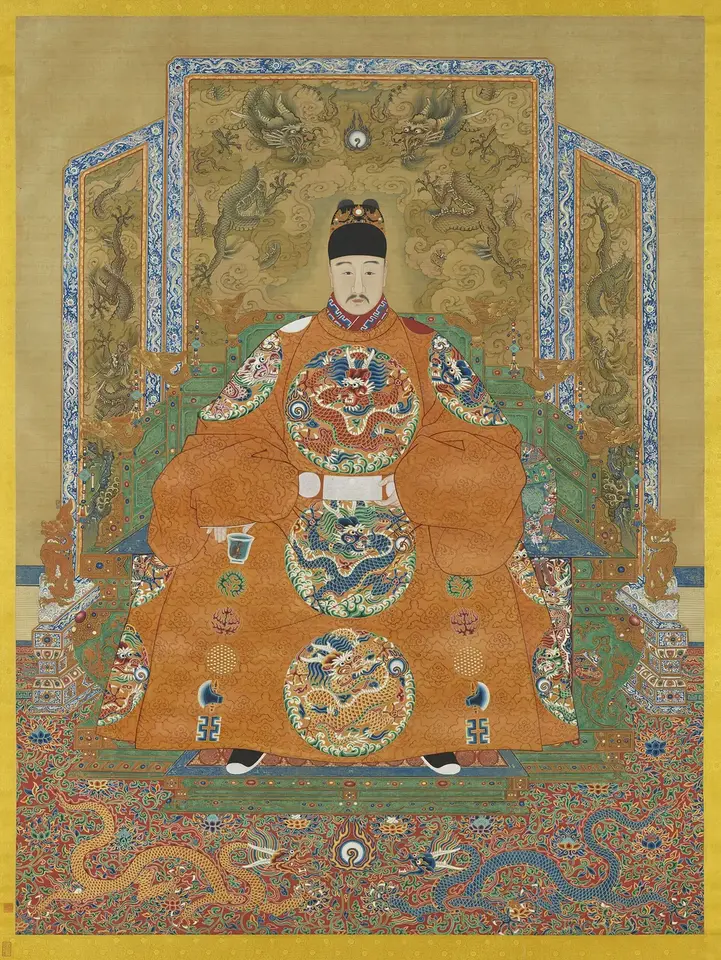
隆庆皇帝
The Longqing Emperor (隆庆皇帝, March 4, 1537 – July 5, 1572), personal name Zhu Zaiji (朱载坖), also rendered as Zhu Zaihou (朱载垕), was the twelfth emperor of the Ming dynasty, reigning from 1567 to 1572 under the era name Longqing. The third son of the Jiajing Emperor (Emperor Shizong), he was initially created Prince of Yu. Because his father adhered fanatically to the Daoist prophecy that two dragons must not meet, Zhu Zaiji was…
The Longqing Emperor (隆庆皇帝, March 4, 1537 – July 5, 1572), personal name Zhu Zaiji (朱载坖), also rendered as Zhu Zaihou (朱载垕), was the twelfth emperor of the Ming dynasty, reigning from 1567 to 1572 under the era name Longqing. The third son of the Jiajing Emperor (Emperor Shizong), he was initially created Prince of Yu. Because his father adhered fanatically to the Daoist prophecy that two dragons must not meet, Zhu Zaiji was alienated from the inner imperial palace for decades and became embroiled in a precarious political succession rivalry against his younger half-brother Zhu Zaizhen, Prince of Jing. Living cautiously within his princely mansion, he was tutored by renowned Hanlin scholar-officials including Xu Jie, Gao Gong, Zhang Juzheng, and Chen Yiqin, cultivating a restrained and prudent temperament. Following the death of the Jiajing Emperor in the twelfth lunar month of 1566, Zhu Zaiji ascended the throne. He swiftly dismantled the harsh excesses of his father's reign, abolished Daoist sacrificial rituals, freed wrongfully imprisoned officials such as Hai Rui, and rehabilitated upright remonstrators including Yang Jisheng. Entrusting state governance to capable Grand Secretaries, the Longqing Emperor presided over an era of remarkable institutional renewal historically termed the Longqing Resturation. In military affairs, he mobilized Tan Lun, Qi Jiguang, and Wang Chonggu to strengthen border fortifications, successfully resolved the surrender of Baahanagi, and concluded the historic Altan Khan's Investiture and Tribute Agreement, conferring upon the Mongol leader the title Prince of Shunyi and establishing bilateral trade fairs that ended two centuries of armed conflict along the northern frontier. Economically, he lifted the long-standing maritime embargo by opening Moon Harbor in Zhangzhou, Fujian to lawful private overseas commerce—a landmark policy known as the Longqing Switch—which stimulated global silver inflows and international commerce. Domestically, he endorsed local pilots of the Single Whip Law and supported sweeping bureaucratic evaluations directed by Gao Gong. In his later years, Zhu Zaiji retreated into the inner palace, indulging in sensory pleasures and bestowing excessive favors upon court eunuchs, which undermined his health. In 1572, he fell critically ill, summoned Gao Gong, Zhang Juzheng, and Gao Yi to receive his deathbed bequest to guide the young crown prince Zhu Yijun (the Wanli Emperor), and passed away at age thirty-five. He was buried in the Zhaoling Mausoleum and bestowed the temple name Muzong.
On March 4, Zhu Zaiji was born in the Forbidden City, Beijing, as the third son of the Jiajing Emperor and Consort Kang Du.
On March 23, the Jiajing Emperor designated his second son Zhu Zairui as Crown Prince, while ennobling Zhu Zaiji as Prince of Yu and fourth son Zhu Zaizhen as Prince of Jing.
Crown Prince Zhu Zairui passed away. Fearing the Daoist prophecy that two dragons must not meet, the Jiajing Emperor refused to designate a new heir.
Celebrated capping and wedding ceremonies, moving out of the palace into the Prince of Yu mansion, where Gao Gong and Zhang Juzheng became his lecturers.
Prince of Jing Zhu Zaizhen died of illness in his fiefdom of De'an, leaving Zhu Zaiji as the sole surviving imperial son and undisputed successor.
On January 23, 1567 (12th month of the 45th year), the Jiajing Emperor died. Senior Grand Secretary Xu Jie drafted the posthumous edict transmitting the throne to Zhu Zaiji.
Formally ascended the throne, proclaimed the era name Longqing, released Hai Rui, ended Daoist rituals, and opened Moon Harbor in Fujian to maritime trade.
Baahanagi, grandson of the Mongol right-wing leader Altan Khan, defected to Datong, providing Ming diplomats with strategic leverage for peace talks.
In March, conferred the noble title Prince of Shunyi upon Altan Khan and established border trading posts under the Longqing Peace Agreement.
In May, fell critically ill, summoned Gao Gong, Zhang Juzheng, and Gao Yi to receive his deathbed testamentary bequest, and passed away on July 5 at age thirty-five.
Zhu Zaiji was born on March 4, 1537, in the Forbidden City of Beijing, the third son of the Jiajing Emperor and Consort Kang Du. His eldest brother Zhu Zaiji died within two months of birth, while his second brother Zhu Zairui was born a year earlier. In February 1539, the Jiajing Emperor designated Zhu Zairui as crown prince, simultaneously enfeoffing Zhu Zaiji as Prince of Yu and his fourth son Zhu Zaizhen as Prince of Jing. However, in March 1549, the fourteen-year-old crown prince Zhu Zairui died suddenly following his capping ceremony. By dynastic succession customs, Zhu Zaiji should have been immediately invested as heir apparent. Nonetheless, the Jiajing Emperor was heavily swayed by Daoist occultism. His favored Daoist master Tao Zhongwen warned that two dragons must not meet. Consequently, the emperor attributed his son's early demise to premature investiture, adamantly refusing to name a new successor and intentionally avoiding contact with his surviving sons.
In February 1553, Zhu Zaiji celebrated his capping and wedding rites, subsequently departing the imperial palace to reside in the Prince of Yu mansion in Beijing. Esteemed Hanlin scholars including Gao Gong, Chen Yiqin, Yin Shidan, and Zhang Juzheng were appointed as his princely tutors, guiding him in Confucian classics and dynastic history. In 1554, his birth mother Consort Kang Du passed away. Having lacked imperial favor in life, her funeral was stripped of high honors by imperial decree, and Zhu Zaiji was forbidden from wearing deep mourning robes. In sharp contrast, Prince of Jing Zhu Zaizhen was supported by his favored mother Consort Jing Lu. Possessing an articulate and flattering demeanor, the younger prince found favor with the emperor, sparking an intense subterranean succession struggle across the civil and military bureaucracy.
Throughout over a decade in his princely manor, Zhu Zaiji lived under extreme financial austerity and political dread. While the Prince of Jing received generous maternal subsidies and courting gifts from ambitious courtiers, Zhu Zaiji struggled to maintain his household solely on standard stipend grain, often having to negotiate loans from royal provisioning stores and cultivate favor with Yan Shifan, son of Senior Grand Secretary Yan Song. Fully aware of his father's paranoid suspicion, Zhu Zaiji practiced extreme caution. When his eldest son was born during his mother's mourning period, the emperor expressed severe displeasure; thereafter, Zhu avoided reporting new offspring, leaving his third son Zhu Yijun (the future Wanli Emperor) without an official name or the customary first-month hair-cutting ceremony for years.
In 1560, former junior compiler Guo Xiyan attempted to manipulate succession rumors and petitioned the emperor to dispatch the Prince of Jing to his fief and officially designate the Prince of Yu as crown prince. The enraged emperor executed Guo, yet growing public controversy compelled him to order the Prince of Jing to take up residence at De'an in Huguang in October of that year. Following Yan Song's downfall in 1562, Xu Jie became Senior Grand Secretary. In the winter of 1564, the emperor still voiced dissatisfaction regarding the Prince of Yu. The Prince of Jing attempted to return to court under the pretext of praying at Mount Wudang, but fell ill and died in January 1565. With Zhu Zaizhen's death, Zhu Zaiji became the emperor's sole surviving son, finally securing his succession.
In the winter of 1566, the Jiajing Emperor's health declined precipitously. On January 23, 1567, he was carried from the Western Park to the Palace of Heavenly Purity and died before granting an audience to Zhu Zaiji. Senior Grand Secretary Xu Jie reacted swiftly, escorting Zhu Zaiji into the palace to assume charge of mourning rituals and drafting the imperial testament overnight. Promulgated the next day, the posthumous edict halted all wasteful court Daoist sacrifices, palace construction projects, luxury procurements, and textile levies, while granting general amnesty to officials victimized during earlier political purges. After the civil and military officials submitted three formal petitions urging his accession, Zhu Zaiji ascended the throne at the Hall of Imperial Supreme on February 4, 1567, declaring that the following year would initiate the Longqing era.
On the day of his accession, Zhu Zaiji ordered the immediate release of Hai Rui, an official who had been sentenced to death for directly rebuking the late emperor. He posthumously rehabilitated renowned upright remonstrators including Yang Jisheng and Yang Zui, granting honorable posthumous titles and pensions to their families while restoring cashiered officials to public office. Simultaneously, the new monarch initiated a decisive reckoning against the corrupt cliques that had dominated the previous reign. He punished tyrannical imperial clansmen such as Zhu Xianjie, Prince of Liao, abolished Daoist altars, rescinded religious titles granted to Daoist figures like Tao Zhongwen and Shao Yuanjie, and cast fraudulent occultists like Wang Jin into prison.
To relieve civilian distress caused by exorbitant exactions under his father, Zhu Zaiji implemented benevolent economic measures. He remitted taxes for famine-stricken prefectures, eliminated unauthorized local levies, and curtailed expenditures within the imperial household and eunuch directorates. Furthermore, he discontinued the contentious practice of having his grandfather Zhu Youyuan's spirit tablet participate in imperial celestial sacrifices. When Director Wang Zhi petitioned to remove Zhu Youyuan's ancestral tablet entirely from the Imperial Ancestral Temple, the emperor refrained from adopting the proposal but merely shelved the memorial without punishing the remonstrator, reflecting his tolerant approach toward civil dissent.
Possessing an introverted and gentle demeanor, Zhu Zaiji seldom spoke sharply during morning audiences, maintaining an air of silent composure while delegating major state affairs to his Grand Secretaries. During the Longqing reign, the Grand Secretariat brought together extraordinary statesmen, including Xu Jie, Li Chunfang, Gao Gong, Guo Pu, Chen Yiqin, Zhang Juzheng, Yin Shidan, Zhao Zhenji, and Gao Yi. Nevertheless, intense factional rivalry accompanied their administrative brilliance. In 1567, friction between Senior Grand Secretary Xu Jie and junior colleague Gao Gong reached a climax when Xu orchestrated attacks by supervising censors, compelling Gao Gong and Guo Pu to resign. However, Xu Jie subsequently alienated palace eunuchs by opposing royal expenditures. In 1568, Zhang Juzheng and Gao Gong cooperated with Eunuch Li Fang to force Xu Jie into retirement, leaving Li Chunfang as Senior Grand Secretary.
In December 1569, Zhu Zaiji recalled his beloved teacher Gao Gong to court, placing him concurrently in charge of the Grand Secretariat and the Ministry of Personnel. Seeking retribution against Xu Jie, Gao Gong directed censors to expose massive unlawful landholdings and predatory moneylending by Xu's family in Jiangnan. Gao Gong subsequently submitted two scathing memorials, accusing Xu Jie of slandering the late emperor in the posthumous edict and seeking capital punishment for his former rival. Confronted with this bitter feud, Zhu Zaiji demonstrated moderate balancing skill. While praising Gao Gong's loyalty, he tactfully declined to execute Xu Jie, shielding his former minister from complete destruction and permitting him to live out his retirement in peace.
In May 1571, following Li Chunfang's retirement, Gao Gong became Senior Grand Secretary and collaborated closely with Zhang Juzheng to execute sweeping governance reforms. Backed by the emperor, they overhauled the bureaucratic evaluation apparatus, revised assessment guidelines, cashiered redundant functionaries, prosecuted venal officials, and promoted capable figures such as Tan Lun, Qi Jiguang, Wang Chonggu, and Hai Rui. Throughout contentious court debates, Zhu Zaiji consistently maintained courteous treatment toward his ministers and adopted measured compromises, creating a stable political environment that enabled key administrative breakthroughs.
Despite the administrative vitality of the Longqing era, Zhu Zaiji gradually succumbed to self-indulgence within the palace. After enduring years of intense anxiety during his youth, he retreated into sensory amusements soon after ascending the throne. Over his five-year reign, he invested more than a dozen concubines and repeatedly dispatched court agents to recruit young maidens from Beijing and Jiangnan, causing widespread public distress. To finance inner-court expenditures and theatrical displays, he repeatedly extracted substantial silver sums from the Ministry of Revenue's Taicang Granary against ministerial objections and stationed eunuchs such as Li You in Suzhou and Hangzhou to supervise massive weaving quotas for imperial robes, heavily straining regional resources.
Simultaneously, Zhu Zaiji showed excessive leniency toward palace eunuchs. Leading figures in the Directorate of Ceremonial, including Teng Xiang, Meng Chong, and Chen Hong, catered to his whims by presenting exotic toys, aphrodisiacs, and elaborate lantern displays to encourage nocturnal carousels. The emperor assigned eunuchs to supervise the capital training camps, defended inner-court officials against fiscal audits by investigating censors, and demoted or flogged censors such as Li Xuedao and Yang Song who attempted to punish arrogant eunuchs. This prolonged physical indulgence severely undermined his constitution, and by the autumn of 1571, chronic illness frequently prevented him from presiding over court assemblies.
In the leap second month of 1572, Zhu Zaiji briefly recovered and attempted to attend an imperial audience. Upon reaching the Gate of Meeting Extremes, he suddenly descended from his palanquin in visible distress. Clasping Gao Gong's robes, he tearfully declared that he would not return to the inner palace, lamenting: "Our dynastic ancestors have preserved the realm for two hundred years down to this day; having a mature monarch is a blessing for the state, yet alas, the Crown Prince is so young! People are mistreating me." He sighed deeply, asking: "What matter has not been ruined by the palace eunuchs? How could you know, Master?" Gao Gong and Zhang Juzheng escorted him back to the Palace of Heavenly Purity and remained on vigil outside for days. By late May, the emperor was terminally ill. On June 5, he summoned Gao Gong, Zhang Juzheng, and Gao Yi to his bedside to receive his final bequest to aid the ten-year-old crown prince Zhu Yijun. Zhu Zaiji passed away on July 5, 1572, at the age of thirty-five, and was interred at the Zhaoling Mausoleum.
Following the founding of the Ming dynasty, relations with the northern Mongol tribes remained locked in intense confrontation for two centuries. During the Jiajing reign, Altan Khan, chieftain of the Tümed Mongols, repeatedly led cavalry raids across the Great Wall, culminating in the Gengxu Crisis of 1550 that besieged Beijing. In September 1567, Altan Khan's forces once again breached the frontiers at Shizhou in Shanxi, plundering over ten administrative districts and revealing severe military deficiencies. Recognizing the immediate threat to the capital, Zhu Zaiji resolved to reorganize the northern defenses. Acting on Zhang Juzheng's recommendations, he attended annual military reviews, appointed Tan Lun as Minister of War, and stationed General Qi Jiguang at Jizhou and Changping. Qi constructed over one thousand hollow watchtowers, drilled combined infantry-cavalry-wagon units, and fortified the eastern defensive perimeter against Tumen Khan. Concurrently, Wang Chonggu was appointed Supreme Commander of Xuanfu, Datong, and Shanxi to stabilize the western frontier.
Under Gao Gong and Wang Chonggu's coordination, the Ming court rigorously executed the Eight Tasks of northern frontier administration: accumulating food supplies, fortifying strategic passes, drilling troops, renovating weaponry, developing military colonies, managing salt distributions, acquiring cavalry horses, and dispersing enemy alliances. By the summer of 1570, Ming forces had reversed their defensive disadvantage, launching successful counter-offensives under Generals Lei Long, Niu Bingzhong, and Lü Jing. In October 1570, an unexpected opportunity arose when Altan Khan's grandson Baahanagi defected to Datong following a domestic dispute. Demonstrating profound strategic foresight, Wang Chonggu treated the defecting prince with high honor, recognizing that Baahanagi represented invaluable diplomatic leverage to negotiate lasting peace. Gao Gong and Zhang Juzheng fully supported this strategy against conservative domestic opposition.
Zhu Zaiji endorsed the plan, conferring the military rank of Commandery Commander upon Baahanagi alongside rich imperial gifts. Overwhelmed with gratitude and relief upon learning of his grandson's safety, Altan Khan agreed to repatriate captured Han subjects, surrender the White Lotus rebel leaders Zhao Quan and Li Zixin who had orchestrated cross-border incursions, and pledge eternal loyalty. In March 1571, Zhu Zaiji issued an imperial decree enfeoffing Altan Khan as the Prince of Shunyi and bestowing military commissions upon over sixty subordinate tribal leaders, an agreement celebrated as Altan Khan's Investiture and Tribute Agreement. The court opened official border trading markets at Desheng Fort, Zhangjiakou, and Shuiquan Camp, permitting free commerce in livestock, textiles, cauldrons, and tea under the thirteen articles of the Longqing Peace Agreement. This landmark settlement saved millions of taels in annual military expenditures, ended decades of warfare, fostered economic exchange across the Great Wall, and established a durable northern peace.
At the beginning of the Ming dynasty, the Hongwu Emperor instituted strict maritime bans, restricting foreign commerce exclusively to tributary missions. During the Jiajing era, rigorous anti-trade enforcement drove coastal merchants into armed defiance, coalescing with regional pirates to trigger decades of devastating raids along the southeastern seaboard. Upon Zhu Zaiji's accession, Fujian Governor Tu Zemin submitted a pivotal memorial urging the court to abandon the failed ban and permit private merchant vessels to trade abroad lawfully. Demonstrating remarkable economic insight, Zhu Zaiji approved the petition in 1567, authorizing private merchant ships from Moon Harbor in Haicheng, Zhangzhou, to sail to Eastern and Western maritime destinations, an initiative celebrated as the Longqing Switch.
To administer this newly legalized commerce, the Ming court established Maritime Defense and Revenue Inspection offices at Moon Harbor. Approximately one hundred official sailing permits were issued annually, while returning vessels were assessed port duties based on cargo value and hull displacement. Strategic war materiel such as copper, iron, and sulfur was strictly barred from export, and direct voyages to Japan remained prohibited. The Longqing Switch marked the first formal opening of Ming maritime boundaries, unleashing vibrant transoceanic commerce that connected China to major international entrepôts including Manila, Luzon, and Batavia. Chinese raw silk, textiles, porcelain, and tea were exchanged for massive influxes of silver mined in the Americas and Japan, generating annual trade turnover exceeding sixteen million taels of silver. This historic policy eliminated coastal piracy, invigorated the southern market economy, and facilitated the nationwide monetization of silver that underpinned late Ming public finance.
Simultaneously, Zhu Zaiji adopted proposals from Supervising Censor Song Liangzuo and Grand Secretary Gao Gong to revive the long-abandoned coastal sea transport system. The provisioning of the capital and northern garrisons had long depended solely on the Grand Canal, which was prone to severe silting and disruption. Zhu Zaiji authorized the construction of oceangoing transport vessels and the recruitment of experienced maritime crews, initially restoring the coastal route from Zheyangzong to Jizhou before establishing a regular direct sea route from Huai'an to Tianjin and Tongzhou. By operating both inland canals and open sea lanes, the Longqing administration established a reliable dual-supply network safeguarding grain and logistical deliveries to northern frontiers throughout the late Ming period.
By the middle of the Ming dynasty, the fiscal tax and corvée structure had become extraordinarily convoluted and inequitable, burdened by miscellaneous levies, local corruption, and severe evasion that bankrupted smallholder farmers. Zhu Zaiji actively supported fiscal restructuring across key economic regions. Beginning in 1567, the Ministry of Revenue surveyed agricultural acreage across the affluent southern prefectures of Suzhou, Songjiang, Changzhou, and Zhenjiang to equalize tax obligations. In 1568, Jiangxi Governor Liu Guangji instituted regional trials of the Single Whip Law. In 1569, upright official Hai Rui was appointed Governor of Yingtian, where he systematically enforced the Single Whip reform by consolidating disparate corvée duties and auxiliary charges into uniform silver levies assessed directly upon land acreage, utilizing public treasury funds to hire labor.
The expansion of the Single Whip Law effectively dismantled the systemic extortion long practiced by local clerks under traditional labor service obligations. By simplifying tax categories, liberating peasants from cumbersome personal corvée, and monetizing land rents, the reform significantly enhanced agricultural productivity and stimulated regional markets. These successful administrative pilots during the Longqing reign furnished the indispensable practical foundation for Zhang Juzheng's nationwide implementation of the Single Whip Law during the subsequent Wanli period. Concurrently, Hai Rui directed extensive hydraulic engineering along the Wusong River and Baimao Canal to drain floodwaters into the sea, intertwining famine relief with water conservancy to stabilize the agricultural economy of the Lower Yangtze.
In bureaucratic governance, Zhu Zaiji placed full trust in Grand Secretary Gao Gong, who assumed concurrent leadership of the Ministry of Personnel in 1569. Gao instituted rigorous personnel audits under the revised Regulations on Bureaucratic Evaluation, enforcing strict procedural deadlines and detailed documentation. The administration broke with traditional seniority rules, prioritizing practical administrative efficacy over examination ranking and removing incompetent or venal officials without hesitation. Under these reforms, the court even abolished the hereditary privilege whereby descendants of Confucius automatically held the magistracy of Qufu. This energetic campaign eradicated the institutional lethargy of the late Jiajing era and revitalized the central administrative apparatus.
Endowed with a naturally compassionate temperament, Zhu Zaiji remained acutely wary of the frequent and bloody political persecutions that had characterized his father's reign. Early in his rule, he faithfully executed the Jiajing Emperor's valedictory decree by executing the most comprehensive political rehabilitation campaign of the mid-Ming dynasty. On the day of his accession, he issued an imperial decree releasing Hai Rui from the death row of the Ministry of Justice and elevating him to Secretary in the Ministry of War. He extended broad pardons to scholar-officials who had been executed, exiled, or degraded for submitting remonstrances during the Great Rites Controversy or opposing Yan Song. Martyred loyalists such as Yang Jisheng received posthumous appointments, state-sponsored funerals, and hereditary honors for their descendants, while upright officials such as Yang Zui and Zhou Tianzuo were fully cleared of treasonous charges.
In criminal jurisprudence, Zhu Zaiji instructed the Ministry of Justice and the Court of Judicial Review to review backlogged prison cases, prohibiting judicial torture and unauthorized arrests by imperial secret police agencies while granting wide clemency to non-violent offenders. Furthermore, he exhibited exceptional forbearance toward outspoken court remonstrators. Although his retreat from daily audiences and fondness for inner-court revelry prompted fierce criticism from supervising censors such as Shi Xing, Zhan Yangbi, and Li Yi, the emperor never executed a single remonstrator or initiated factional show trials throughout his six-year reign. This atmosphere of judicial clemency encouraged civil officials to discharge their duties with professional integrity, providing essential institutional stability during a critical period of dynastic recovery.
FIGURES ASSOCIATED WITH THIS DYNASTY