Detailed Biography
Family Pedigree and Youthful Renown
Mi Youren was born in 1074 during the Xining era of Emperor Shenzong into a family celebrated for high artistic taste. His father, Mi Fu, was one of the four great calligraphers of the Song dynasty (Song Si Jia), legendary for his eccentric connoisseurship and brush mastery. Receiving personal instruction from his father from infancy, Mi Youren was immersed in masterworks of the Jin and Tang dynasties, exhibiting remarkable aesthetic sensitivity and calligraphic talent from an early age.
In 1091, the seventeen-year-old Mi Youren traveled with his father to the Northern Song capital of Kaifeng. Huang Tingjian, leader of the Jiangxi poetry school and renowned calligrapher, was astonished by Mi Youren's powerful brush strokes, remarking that "his brush power is capable of lifting a bronze tripod." Huang presented him with an ancient bronze seal bearing the characters "Yuanhui" and advised him to adopt it as his adult courtesy name. Two years later, in 1093, the twenty-year-old Mi Youren submitted his calligraphy to Su Shi, who effusively praised it for inheriting the unrestrained vitality of his father's hand.
At age nineteen, his father presented Mi Youren's landscape painting Morning Sun over Chu Mountains (Chushan Qingxiao Tu) to Emperor Huizong, who marveled at its atmospheric beauty and rewarded him generously. In 1122, during Emperor Huizong's institutional expansion of court academies, Mi Youren passed the imperial examination to direct the Calligraphy School (Shuxue), establishing his artistic reputation across the northern capital.
Southern Migration and Imperial Favor
The Jingkang incident of 1127 precipitated the collapse of Northern Song and the Jurchen sack of Kaifeng. Mi Youren gathered his family's invaluable manuscripts and fled south amidst refugee chaos. After establishing residence in Jiangnan, he reinterred his father's coffin in 1134 from Shili Changshan in Zhenjiang to Mount Huanghe, ensuring perpetual familial veneration.
Following the foundation of the Southern Song dynasty in Lin'an, Emperor Gaozong sought to reconstitute the lost imperial art collection. Recognizing Mi Youren's unparalleled connoisseurship, Gaozong retained him as the preeminent palace authenticator. Whenever ancient rubbings, paintings, and calligraphic scrolls were submitted to the throne, Gaozong ordered Mi Youren to authenticate their provenance and compose imperial colophons. This role granted Mi intimate access to the finest surviving works of antiquity, refining his artistic vision. Contemporaries noted that in his court duties, Mi occasionally deferred to imperial tastes (fuhui shangyi), reflecting pragmatic adaptability within palace politics.
Anecdotes recorded in Qingbo Zazhi and other Song miscellanies illustrate his obsession with ancient art. Mi was known to borrow Tang and Jin paintings to produce deceptive replicas, sometimes substituting his copies for the originals, an artifice contemporaries referred to as "clever theft and forceful seizure" (qiaotou haoduo), the origin of the common idiom qiaoqu haoduo. On one occasion, upon viewing a genuine Wang Xizhi manuscript aboard a riverboat, he offered his finest painting in trade; when the owner refused, Mi frantically grabbed the ship's railing and threatened to leap into the river, being restrained just in time.
In 1141, at the invitation of Liang Rujia, Prefect of Pingjiang, Mi Youren brushed the monumental stele Record of the Reconstruction of Dacheng Hall in Wujun in dynamic semi-cursive script (xingshu). Measuring 182 centimeters in height and 96 centimeters in width, with 22 columns and 788 characters, the stele remains preserved in the Suzhou Inscription Museum as a rare monument of Southern Song epigraphy.
Late Splendor and Detached Old Age
In his final decade, Mi Youren rose to high official rank, serving as Vice Minister of Works, Vice Minister of War, and Direct Academician of Fuwen Pavilion. Despite his ministerial status, he remained thoroughly devoted to literati painting and ink-play, adopting the moniker "Lazy and Clumsy Old Man" (Lanzhuo Laoren).
His artistic creation was thoroughly spontaneous; when inspiration struck, he would reach for lotus seedpods or scraps of paper to splash ink across the silk. Describing his late creative state, he wrote: "In the aged boundary of my painting, I am entirely detached from the dust of the mundane world; seated cross-legged like a monk in a quiet chamber, casting off ten thousand cares, my spirit flows with the vast blue void." The aesthetician Zong Baihua compared this serene detachment to an Apollonian artistic spirit reflecting cosmic harmony. In 1153, Mi Youren passed away peacefully at his Lin'an residence at the age of eighty.
Major Achievements
Consolidation of the "Mi-family Clouded Mountains"
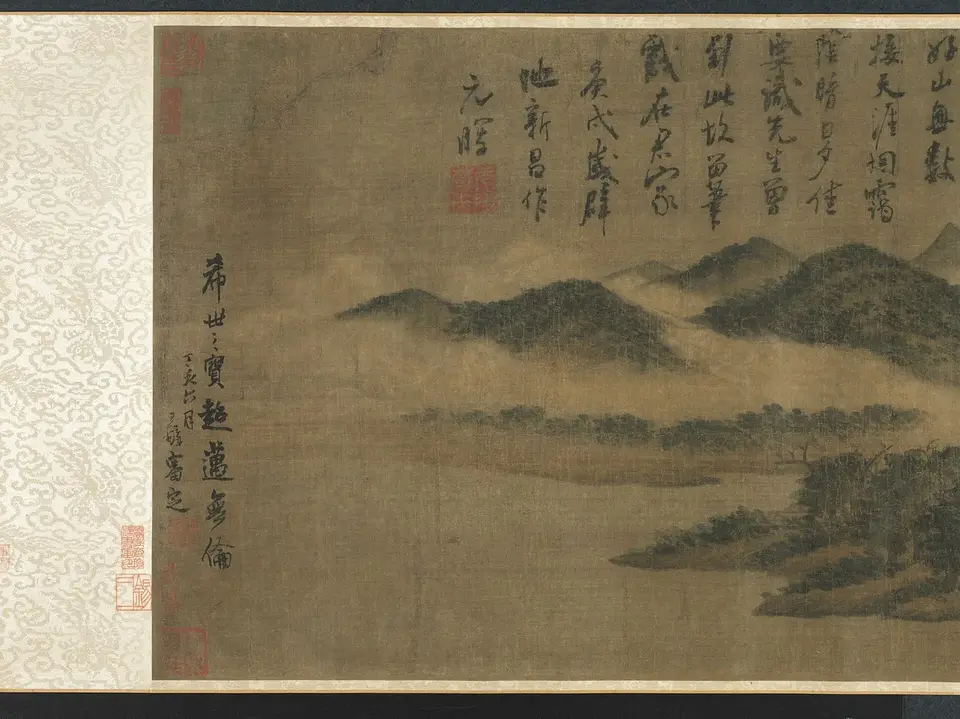
Mi Youren's most transformative legacy was his structural formulation of the "Mi-family Clouded Mountains" (Mi-shi Yunshan) school:
- *Mastery of Eggplant Dots (Luoqie Cun): He dismantled the traditional Northern Song tradition of dense, linear mountain contours (mi), substituting layers of horizontal wet ink dabs (luoqie cun* or Mi dots) washed with subtle gray tones. This technique miraculously captured the moisture-laden atmosphere, drifting fog, and dissolving silhouettes of Jiangnan landscapes. Yuan dynasty critic Wu Shidao praised his innovation: "He replaced density with simplicity, yet in simplicity he did not sacrifice refinement."
- *Aesthetic of Ink-play (Moxi) and Self-Amusement: Rejecting mimetic representation for patrons, Mi championed painting as an act of inner cultivation, entitling his works moxi (ink-play). By prioritizing personal expression (jie wu xie xin) and natural ease (pingdan tianzhen), he laid the philosophical foundations for the Yuan, Ming, and Qing literati painting traditions (wenren hua*).
Pioneering Use of Goat-Hair Brushes
In calligraphy, Mi Youren inherited the expressive vigor of the Northern Song masters while introducing a pivotal technical innovation: he was the first master calligrapher in Chinese history to successfully employ soft goat-hair brushes (yanghao). Unlike stiff weasel-hair or rabbit-hair brushes, goat hair provided resilient flexibility and rich ink retention, endowing his strokes with supple flesh and sinewy bone (qing er jian gu). His expansive characters broke through the fragile, delicate mannerisms common in the early Southern Song academy.
Integration of Poetry, Calligraphy, and Painting
Mi Youren was a crucial innovator in uniting poetry, painting, and calligraphic colophons on a single scroll. As the Qing theorist Fang Xun observed in Shanjingju Hualun: "Inscribing poems on paintings originated with Su Shi and Mi Fu, but reaching perfection in combining painting and commentary began with Mi Yuanhui."
His masterpiece Wondrous Sights of Xiao and Xiang (Xiaoxiang Qiguan Tu, Palace Museum, Beijing) exemplifies this fusion, featuring an expressive ink landscape followed by an extensive self-composed colophon describing his aesthetic intent. His Yunshan Moxi Tu and Yunshan Deyi Tu similarly stand as touchstones of literati landscape art. His poetic works, characterized by lucid imagery, are collected in Yangchun Ci (Spring Songs).