Birth into Commercial Nobility
Born in Qu County, Donghai; her family possessed vast landholdings and ten thousand retainers, renowned across Jianghuai.
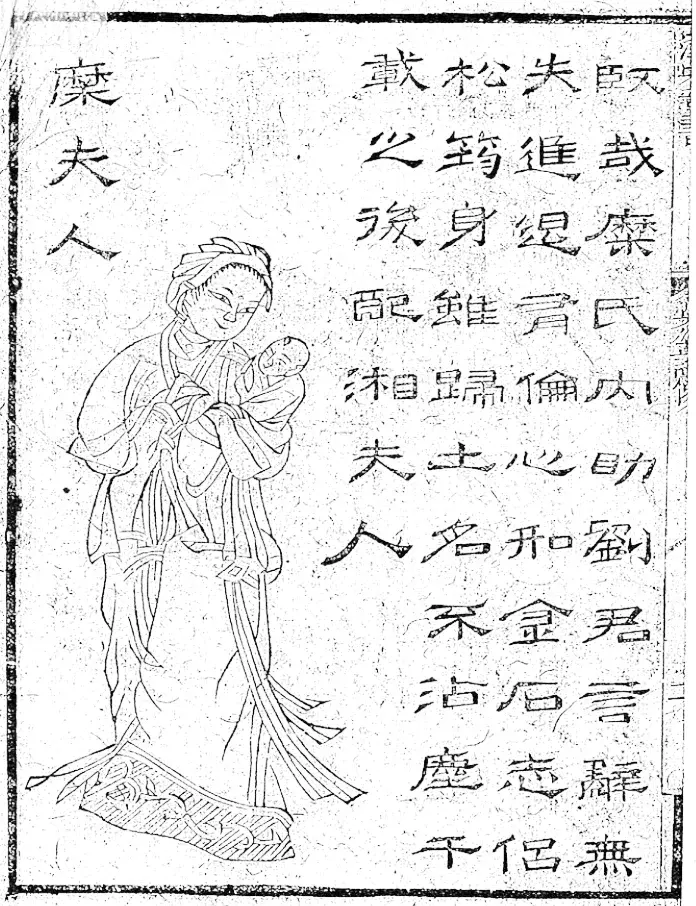
糜夫人
Lady Mi (糜夫人, birth and death dates unrecorded in standard histories) was a native of Qu County in Donghai Commandery (present-day Lianyungang, Jiangsu). She was a principal consort of Liu Bei (Emperor Zhaolie, First Ruler of Shu Han) and the younger sister of founding Shu Han statesmen Mi Zhu (General Pacifying Han) and Mi Fang (Grand Administrator of Nanjun). The Donghai Mi clan was the preeminent merchant aristocracy in…
Lady Mi (糜夫人, birth and death dates unrecorded in standard histories) was a native of Qu County in Donghai Commandery (present-day Lianyungang, Jiangsu). She was a principal consort of Liu Bei (Emperor Zhaolie, First Ruler of Shu Han) and the younger sister of founding Shu Han statesmen Mi Zhu (General Pacifying Han) and Mi Fang (Grand Administrator of Nanjun). The Donghai Mi clan was the preeminent merchant aristocracy in Xuzhou, maintaining extensive trade operations and possessing vast estates, thousands of retainers, and enormous fortunes. In 196 (Jian'an 1), while Liu Bei marched against Yuan Shu, warlord Lu Bu launched a surprise raid on Xiapi, capturing Liu Bei's base and seizing his wives and children. Retreating in disarray to Haixi in Guangling Commandery, Liu Bei's forces were on the brink of starvation and collapse. In this dire crisis, Assistant Officer Mi Zhu pledged his family's fortunes to Liu Bei, offering his sister Lady Mi in marriage alongside two thousand household servants and vast quantities of gold, silver, and currency, enabling Liu Bei's army to regroup and survive. Over subsequent years, Lady Mi endured intense turmoil and military peril alongside Liu Bei. In 198 (Jian'an 3), Lu Bu seized Liu Bei's headquarters at Xiaopei, capturing Lady Mi a second time before Cao Cao's conquest of Xiapi secured her release. In 200 (Jian'an 5), following the exposure of the Secret Girdle Decree conspiracy, Cao Cao crushed Liu Bei in Xuzhou; Lady Mi was captured alongside General Guan Yu, who temporarily surrendered to protect his lord's household before escorting the consorts on his legendary thousand-li journey to rejoin Liu Bei. Following Liu Bei's relocation to Jingzhou, references to Lady Mi disappear from official dynastic records, and domestic management was assumed by Lady Gan. In Chinese popular drama and Luo Guanzhong's classic novel Romance of the Three Kingdoms, Lady Mi's legacy was immortalized with profound heroic tragedy. During the Battle of Changban in 208 (Jian'an 13), Liu Bei was routed by Cao Cao's elite cavalry, and Lady Mi was wounded and separated from the main column while protecting Liu Bei's infant heir, Liu Shan (A'dou). When General Zhao Yun returned alone through enemy lines to rescue them, Lady Mi realized that her leg injury would hinder Zhao Yun's ability to protect the child. Entrusting infant Liu Shan to Zhao Yun, she cast herself into an abandoned dry well to eliminate any hindrance to their escape. Zhao Yun pushed down a mud wall to conceal her remains and fought his way through the encirclement. Lady Mi's pivotal alliance at Haixi and her literary sacrifice established her as an enduring exemplar of female nobility and self-sacrifice in Chinese history.
Born in Qu County, Donghai; her family possessed vast landholdings and ten thousand retainers, renowned across Jianghuai.
Lu Bu captured Xiapi; brother Mi Zhu offered Lady Mi in marriage to Liu Bei with two thousand servants and massive funds, reviving his forces.
Captured when Lu Bu took Xiaopei; liberated after Cao Cao drowned Xiapi and executed Lu Bu, proceeding to Xu.
Cao Cao defeated Liu Bei; Lady Mi was captured with Guan Yu, who shielded her before riding a thousand li to rejoin Liu Bei.
Accompanied Liu Bei to seek refuge with Liu Biao in Jingzhou; historical records cease, with domestic management assumed by Lady Gan.
In literary tradition, sacrificed herself by jumping into a dry well at Changban to preserve infant Liu Shan, allowing Zhao Yun to break through.
Lady Mi was born into the prominent Mi merchant clan of Qu County in Donghai Commandery (present-day southwest of Lianyungang, Jiangsu) during the late Eastern Han dynasty. The Donghai Mi family was the wealthiest and most influential commercial lineage in the Jianghuai region. Standard historical records document that the Mi clan had accumulated wealth through commerce and agriculture for generations, maintaining over ten thousand household retainers, private militia, and servants, alongside vast reserves of gold, silver, silk, and grain.
In 194 (Xingping 1), Tao Qian, the dying Governor of Xuzhou, recognized Liu Bei as the only virtuous leader capable of shielding the province from northern warlords, petitioning the court to install Liu Bei as Governor of Xuzhou. Mi Zhu, serving as Assistant Officer of the province, pledged his full loyalty to Liu Bei.
However, in 196 (Jian'an 1), the political landscape in Xuzhou turned catastrophic. While Liu Bei led the main provincial army south to Huaiyin to resist an invasion by warlord Yuan Shu, fighting an exhausting standoff at Xuyi and Huaiyin, the treacherous warlord Lu Bu conspired with local commander Cao Bao to stage a surprise nocturnal assault on the provincial capital Xiapi. Lu Bu's cavalry seized Xiapi, capturing Liu Bei's wives, children, and the families of his generals.
Deprived of provisions and rear bases, Liu Bei's army disintegrated in panic. Liu Bei was forced to retreat south into Haixi County in Guangling Commandery (present-day Guannan, Jiangsu). There, Liu Bei's enterprise reached its darkest nadir: his territory was lost, his family was held hostage, food ran out completely, and starving soldiers were reduced to desperation.
At this critical juncture, Mi Zhu displayed remarkable strategic foresight and courage. Deeply convinced of Liu Bei's supreme virtue and destiny, Mi Zhu resolved to link the entire fortunes of his lineage to Liu Bei. Returning to Donghai, Mi Zhu, acting as clan patriarch, presented his beautiful and cultured sister, Lady Mi, in formal marriage to Liu Bei as his lawful principal consort. Furthermore, Mi Zhu selected two thousand strong household servants to reinforce Liu Bei's army, delivering millions in gold, silver, and coin to replenish empty military coffers.
This alliance transformed the fortunes of the destitute warlord. With the immense capital, human reinforcements, and supplies brought by Lady Mi's marriage, Liu Bei reorganized his forces, recruited thousands of soldiers, and revitalized his army: "In a time of dire extremity, he relied upon this to revive." Liu Bei regained the military capacity to negotiate with Lu Bu and contest the realm.
Following her marriage to Liu Bei, Lady Mi enjoyed no life of sheltered luxury; instead, she embarked upon years of constant displacement, privation, and exposure to lethal warfare.
In the autumn of 196, having regained military footing, Liu Bei reached a temporary truce with Lu Bu, who returned Liu Bei's former family members. Liu Bei garrisoned Xiaopei (present-day Pei County, Jiangsu), rapidly enlisting over ten thousand soldiers. However, Liu Bei's resurgence alarmed Lu Bu. In 198 (Jian'an 3), Lu Bu dispatched generals Gao Shun and Zhang Liao to launch an assault on Xiaopei. Liu Bei was routed, fleeing alone on horseback to seek assistance from Cao Cao. Once again, Xiaopei fell, and Lady Mi was captured by Lu Bu's forces alongside Liu Bei's dependents.
In the winter of that year, Cao Cao led a massive army east to besiege Xiapi, diverting the Si and Yi rivers to flood the fortress. Lu Bu was captured at White Gate Tower and executed. Following the fall of Xiapi, Lady Mi and Liu Bei's family were safely liberated from enemy hands and reunited with Liu Bei, accompanying him to the imperial capital of Xu.
Yet peace was fleeting. In 199 (Jian'an 4), Emperor Xian issued the Secret Girdle Decree to Dong Cheng to assassinate Cao Cao, with Liu Bei signing the pact. In the winter of that year, Liu Bei executed Che Zhou, Inspector of Xuzhou, seizing Xiapi in open rebellion against Cao Cao. In the spring of 200 (Jian'an 5), before his decisive clash with Yuan Shao at Guandu, Cao Cao personally led elite forces east to eliminate the threat posed by Liu Bei.
Cao Cao's forces struck Xiaopei and Xiapi with overwhelming speed. Liu Bei was routed and fled north to join Yuan Shao. Guan Yu, tasked with defending Xiapi and guarding Liu Bei's family, was encircled. To protect Lady Mi and the imperial dependents, Guan Yu accepted a conditional surrender to Cao Cao, stipulating that he surrendered to the Han emperor rather than to Cao Cao, and that he would depart the moment he learned Liu Bei's whereabouts. During their months in the Cao camp at Xu and during the Battle of Baima, Guan Yu observed scrupulous propriety, safeguarding Lady Mi and Lady Gan with reverent honor.
In the autumn of 200, having slain Yan Liang and Wen Chou to repay Cao Cao's hospitality, Guan Yu learned that Liu Bei was in Runan with Yuan Shao's forces. Guan Yu immediately sealed up Cao Cao's gifts, resigned his rank, and escorted carriages carrying Lady Mi and Lady Gan through thousands of li, crossing enemy borders to safely reunite with Liu Bei.
Having endured captivity twice under Lu Bu and once under Cao Cao, Lady Mi's physical and mental health had suffered immense strain. Following Liu Bei's retreat from Runan in 201 (Jian'an 6) to seek refuge under Liu Biao in Jingzhou, historical mentions of Lady Mi cease in Chen Shou's Records of the Three Kingdoms.
According to the Biographies of Two Sovereigns' Consorts in the Records of the Three Kingdoms, during Liu Bei's years in Xinye, because Liu Bei had lost several previous wives, "Lady Gan frequently managed household affairs." In classical ritual codes, "managing household affairs" indicated acting in the capacity of principal mistress. Historians infer that Lady Mi likely succumbed to illness from wartime trauma shortly after rejoining Liu Bei in Runan or upon arriving in Jingzhou, or that having borne no sons, she quietly stepped back from public domestic governance. However, the extraordinary prestige enjoyed by her brother Mi Zhu—whose administrative rank in Shu Han consistently surpassed that of Chancellor Zhuge Liang—was directly rooted in the sacrificial alliance forged by Lady Mi and Mi Zhu at Haixi.
While dynastic histories left her final moments unrecorded, Lady Mi's legacy was immortalized in popular folklore, Yuan drama, and Luo Guanzhong's epic masterpiece Romance of the Three Kingdoms with tragic grandeur.
In Chapter 41 of Romance of the Three Kingdoms, in the autumn of 208 (Jian'an 13), Cao Cao's army advanced south into Jingzhou. Liu Bei led over one hundred thousand civilians in retreat toward Jiangling, only to be overtaken at Changban slope in Dangyang by five thousand elite iron cavalry under Cao Cao. In the ensuing panic, Liu Bei's entourage was scattered, and Lady Mi, carrying the two-year-old infant Liu Shan (A'dou) in her arms, was separated from the main force amid enemy arrows.
Determined to save his lord's family, the Shu general Zhao Yun (Zilong) rode alone through the battlefield, scouring smoking ruins and debris. He eventually located Lady Mi leaning against an earthen wall beside an abandoned dry well, weeping while holding infant A'dou. Lady Mi had been struck in the leg by a stray arrow, bleeding profusely and unable to walk.
Overjoyed, Zhao Yun dismounted and knelt: "Lady, you have suffered! Zhao Yun has come to your rescue! Please mount my horse immediately; I shall fight on foot with spear in hand to escort you through the encirclement!" Yet Lady Mi displayed supreme courage. Recognizing that Cao Cao's cavalry surrounded them and that Zhao Yun could barely break through on a single warhorse, she realized that attempting to carry both a wounded woman and an infant would guarantee destruction for all three.
Tearfully holding infant A'dou, Lady Mi placed the child into Zhao Yun's arms, delivering her dying charge: "I am fortunate to meet you today, General; this child may now live! I beg you to pity his father, who has drifted for half his life and possesses only this sole flesh and blood! If you can protect this infant and deliver him to his father's sight, I shall die without regret!"
Zhao Yun desperately pleaded with her to mount his steed, but Lady Mi remained resolute. To eliminate Zhao Yun's hesitation and ensure the child's survival, she turned and threw herself into the deep, dry well.
Grief-stricken, and fearing that enemy soldiers would desecrate her remains, Zhao Yun used his immense strength to push down the crumbling mud wall, burying the well beneath earth and rubble. He then bound infant Liu Shan securely against his breastplate, mounted his horse, and charged into the enemy host, cutting down dozens of officers and breaking through the encirclement.
Luo Guanzhong commemorated her deed with a famous poetic tribute: "The fighting general won fame on his white steed, leaving the heroic woman dead amid wild thorns. Entrusting the orphan was as weighty as a mountain; casting herself into the well preserved life and exalted honor." Lady Mi's sacrifice stands as a supreme monument of female valor and devotion in the cultural memory of the Three Kingdoms.
Wed Liu Bei in 196 when his army was encircled at Haixi following Lu Bu's capture of Xiapi.
Her marriage brought two thousand household servants and immense wealth in gold and silver, resurrecting Liu Bei's shattered military forces.
Endured repeated captivity when Xiaopei fell to Lu Bu in 198 and when Xuzhou collapsed before Cao Cao in 200.
Maintained steadfast loyalty alongside Lady Gan, protected by Guan Yu through perilous journeys across northern battlefields.
Her marriage cemented the lifelong alliance between Liu Bei and the merchant aristocracy of Xuzhou.
Elevated her elder brother Mi Zhu to the paramount rank of General Pacifying Han, seated above Zhuge Liang in Shu Han court hierarchy.
In cultural and literary history, shielded the young heir Liu Shan amid the chaos of the Battle of Changban in 208.
Cast herself into a dry well to ensure that Zhao Yun could break through the enemy encirclement with infant Liu Shan, immortalizing her heroic devotion.
FIGURES ASSOCIATED WITH THIS DYNASTY