Biography
Fleeing Famine and Joining Liu Bei
Meng Da was born into a prominent family in Mei County, Fufeng of the Sanfu region. His father, Meng Tuo, had served as Regional Inspector of Liangzhou during the reign of Emperor Ling of the Eastern Han. From a young age, Meng Da was noted for his sharp intelligence, commanding height, handsome features, and gift for eloquent debate, combined with mastery of classical histories and military tactics.
During the Xingping era of the late Eastern Han, the Guanzhong plain was devastated by consecutive years of drought, famine, and chaotic warfare among warlords Li Jue and Guo Si. After consulting with his fellow countyman Fa Zheng, Meng Da abandoned his family estates, crossed the Qinling Mountains into Sichuan, and offered his allegiance to Liu Zhang, the Governor of Yizhou. During his years in Shu, because Liu Zhang was irresolute and indecisive, Meng Da received only modest appointments as a secondary commander.
In 211 CE (the 16th Year of the Jian'an Era), threatened by Cao Cao's designs on Zhang Lu in Hanzhong, Liu Zhang took Zhang Song's advice to invite Liu Bei into Sichuan. Liu Zhang dispatched Meng Da and Fa Zheng with four thousand elite infantry to Jingzhou to welcome Liu Bei. Upon meeting Liu Bei and witnessing his magnificent heroic vision, Meng Da was thoroughly impressed and formed a secret compact alongside Fa Zheng to submit to Liu Bei. Liu Bei stationed Meng Da to garrison Jiangling, and after conquering Chengdu, promoted him to Grand Administrator of Jiangyang and later transferred him to Yidu.
Conquest of the Three Commanderies and the Fall of Guan Yu
In 219 CE (the 24th Year of the Jian'an Era), after Liu Bei defeated Xiahou Yuan at Mount Dingjun and declared himself King of Hanzhong, he ordered Meng Da to lead elite troops north from Zigui to capture Fangling Commandery. Meng Da marched with swift momentum, storming Fangling and slaying the Wei administrator Kuai Qi.
Concerned that Meng Da's force was isolated, Liu Bei ordered his adopted son, Vice Army Leader of Court Gentlemen Liu Feng, to lead river flotillas down the Han River to join Meng Da in assaulting Shangyong Commandery. Overwhelmed by their combined strength, Shangyong Administrator Shen Dan and Xicheng Administrator Shen Yi surrendered. Liu Bei consolidated Fangling, Shangyong, and Xicheng into the Three Eastern Commanderies, placing Liu Feng and Meng Da in shared command.
That autumn, Guan Yu launched the Battle of Fancheng, routing Yu Jin's seven armies and shaking the realm. However, Sun Quan's forces launched a surprise attack on Jingzhou, severing Guan Yu's retreat and trapping him at Maicheng. Guan Yu sent urgent messages to Shangyong demanding relief. Meng Da and Liu Feng conferred, concluding that their newly conquered mountain districts were politically unstable, and refused to send troops on the grounds that the newly annexed region could not be destabilized. Guan Yu was subsequently captured and executed, costing Shu Han the entire Jingzhou region and earning Liu Bei's bitter fury.
Defection to Cao Wei and the Favor of Cao Pi
Following Guan Yu's death, Liu Feng acted with increasing arrogance, confiscating Meng Da's ceremonial drum and bugle corps. With his close friend Fa Zheng recently deceased and fearing execution for failing to aid Guan Yu, Meng Da decided to defect to Cao Wei in 220 CE with over four thousand households.
Before departing, Meng Da sent a farewell letter to Liu Bei, explaining that he was fleeing to preserve his life rather than out of malice, citing ancient proverbs that great merit invites suspicion and that a wise man averts disaster.
Upon reaching Luoyang, Meng Da made an immediate impression on Emperor Wen of Wei, Cao Pi, who admired his refined elegance and military talent. Cao Pi appointed him Cavalier Attendant-in-Ordinary (sanqi changshi), General of Establishing Might (jianwu jiangjun), and Marquis of Jiangling. Cao Pi combined Fangling, Shangyong, and Xicheng into Xincheng Commandery, appointing Meng Da as Grand Administrator to guard the southern frontier. Cao Pi showered him with lavish gifts, frequently riding in the same carriage with him. Meng Da then guided Xiahou Shang and Xu Huang to reclaim the Three Commanderies, driving Liu Feng back to Chengdu, where he was ordered to commit suicide.
Zhuge Liang's Strategy and Sima Yi's Forced March
In 226 CE (the 7th Year of the Huangchu Era), Cao Pi passed away, and his close friends Xiahou Shang and Jia Xu had already died. Senior ministers in Luoyang, including Sima Yi and Chen Qun, harbored deep distrust of Meng Da's repeated vacillations, repeatedly warning Emperor Ming that Meng Da held vast armies in an isolated border region and would surely rebel.
In 227 CE (the 5th Year of the Jianxing Era), as Chancellor Zhuge Liang prepared for his northern expeditions from Hanzhong, he recognized that Xincheng was a vital water corridor connecting Jingxiang to Hanzhong. If Meng Da could be persuaded to defect back to Shu, Han armies could sweep down the Han River directly into the central plains. Zhuge Liang sent secret letters to Meng Da, urging him to return to the Han fold and attributing his earlier departure entirely to Liu Feng's provocations.
Tempted by the offer, Meng Da agreed to rebel. He wrote back to Zhuge Liang, expressing confidence that Sima Yi, then stationed in Wan, would have to seek imperial approval from Luoyang before marching, giving him at least a month to fortify his mountain bastion.
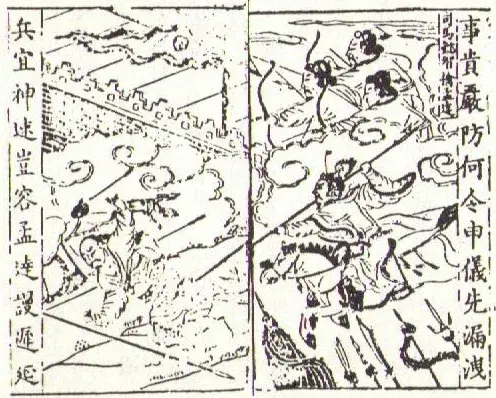
However, Shen Yi discovered the conspiracy and alerted Sima Yi. Recognizing that speed was essential, Sima Yi sent a reassuring letter to lull Meng Da into complacency while ordering his infantry and cavalry to march day and night without waiting for imperial sanction. In the dead of winter, through heavy snow and mud, Sima Yi covered 1,200 li in eight days, appearing outside Shangyong before Meng Da had even assembled his garrison.
The Fall of Shangyong and Execution
In the first month of 228 CE (the 2nd Year of the Taihe Era), Sima Yi's army encircled Shangyong. Surprised by the rapid arrival of the Wei forces, Meng Da retreated behind the city walls and sent urgent appeals to Zhuge Liang. However, Sima Yi deployed units to block the relief routes.
For sixteen days, Sima Yi launched relentless assaults on the city. As food supplies dwindled, Meng Da's nephew Deng Xian and his general Li Fu opened the gates to admit the Wei army. Shangyong fell, and Meng Da was captured and executed on the spot.
Sima Yi placed Meng Da's head in a lacquered box and sent it to Luoyang, deporting ten thousand surviving inhabitants to Youzhou. Though exceptionally talented and versatile, Meng Da's opportunistic vacillations led to his tragic downfall, marking him as one of the most complex figures of the Three Kingdoms era.
Farewell Letter to Liu Bei and Cao Pi's Lavish Reception
When Meng Da resolved to sever ties with Shu Han and defect to Wei, he took up his brush to compose an eloquent, closely reasoned memorial addressed to Liu Bei. In this farewell letter, Meng Da explained: "Your servant, possessing meager and common talents, was blessed with Your Majesty's gracious elevation to garrison Jincheng and govern Shangyong. Yet when Guan Yu met defeat in Jingxiang, I judged that because these mountain commanderies were newly annexed and the populace harbored doubts, it was perilous to mobilize troops rashly, which regrettably caused us to miss the opportunity for relief. The ancients observed: 'A loyal minister dies for his principles; a wise man averts disaster.' With Liu Feng humiliating me at the front and court factions harboring resentment behind, I feared falling into the hands of petty prison wardens and becoming a laughingstock under Heaven; therefore, I flee to distant realms to preserve my life and integrity." Reading this letter, Liu Bei sighed with profound sorrow.
After Cao Pi ascended the throne as King of Wei and heard of Meng Da's surrender with his host, he held a grand imperial audience in the main palace hall of Luoyang to receive him. Gazing upon Meng Da's handsome countenance, aristocratic poise, and refined demeanor, Cao Pi was thoroughly captivated, exclaiming that he possessed the aura of "a man among the immortals." Cao Pi presented him with an imperial carriage, ceremonial robes, and lavish regalia on the spot, smiling as he asked: "General, do you truly hold no lingering longing for the mountains and rivers of Sichuan?" Meng Da calmly replied: "Though the roads of Shu are perilous, they cannot preserve a state. The King of Wei possesses sage benevolence that accords with Heaven and men; my submission today is but obeying Heaven's mandate." Overjoyed, Cao Pi immediately consolidated the three commanderies into Xincheng Commandery, entrusting Meng Da with its sole administration.
Sima Yi's Forced March and Betrayal within the Walls
When Zhuge Liang established contact with Meng Da to coordinate a rebellion against Wei, Meng Da sent a reply assuring Zhuge Liang that if Sima Yi at Wan wished to mobilize an expedition against Xincheng, Cao Wei statutory law required him to dispatch an urgent memorial to Emperor Ming in Luoyang first; awaiting the imperial rescript would take at least a month. Furthermore, Xincheng was barricaded by precipitous mountain passes and watchtowers lined the Han River, allowing abundant time to entrench his garrison.
However, Sima Yi was a master of unexpected tactical flexibility. Upon receiving Shen Yi's confidential intelligence, Sima Yi made an instantaneous decision: without awaiting the imperial response from Luoyang, he ordered his infantry and cavalry from Wan to advance day and night. Despite severe winter blizzards, freezing mud, and treacherous mountain trails, Sima Yi's army forced a march of 1,200 li in eight days, surging along both banks of the Han River. When the banners of Wei suddenly appeared before Shangyong, Meng Da was paralyzed with shock, realizing that his strategic window had evaporated.
During the sixteen days of relentless Wei assaults, supplies within the walls dwindled and the defenders' resolve shattered. Convinced that relief was impossible, Meng Da's trusted officer Li Fu and his nephew Deng Xian plotted secretly to surrender the city in order to preserve their families. Under cover of night, they severed the drawbridge cables and threw open the city gates to admit the Wei host. Trapped before he could execute a breakout, Meng Da was seized by Wei heavy cavalry and executed on the spot.