Birth in Dadu
Born into a literate, comfortable family in Dadu; acquired classical erudition and musical skill in youth.
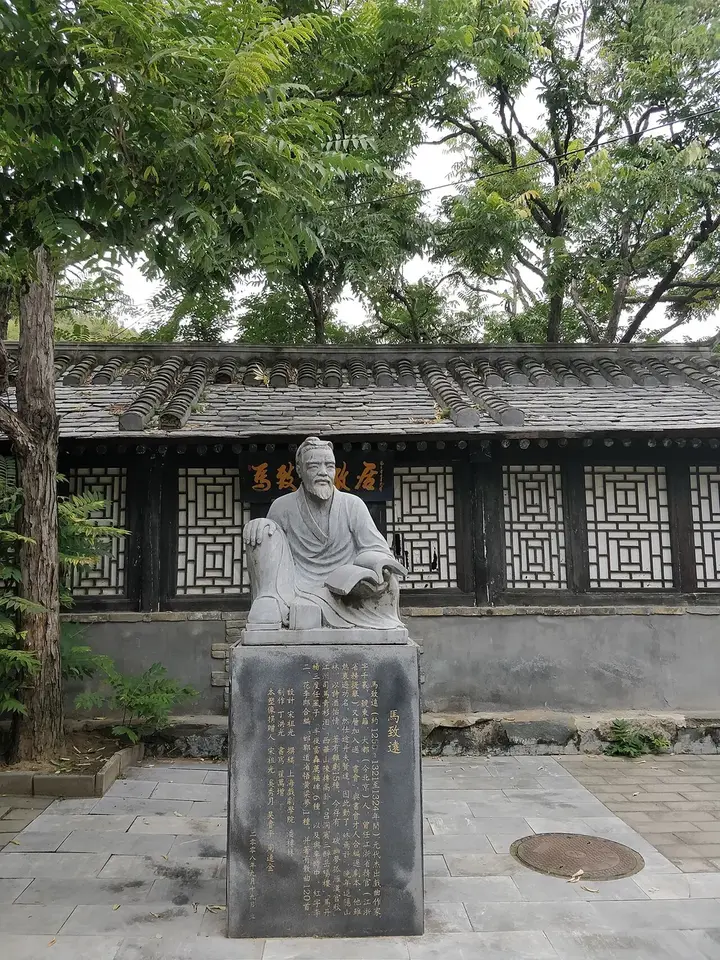
马致远
Ma Zhiyuan (马致远, c. 1250–c. 1321), courtesy name Qianli, literary name Dongli (derived from Tao Yuanming's line "picking chrysanthemums beneath the eastern fence"), was a native of Dadu (modern Beijing). He was a foremost dramatist and lyric poet of the early Yuan dynasty, ranked alongside Guan Hanqing, Bai Pu, and Zheng Guangzu as one of the "Four Great Yuan Dramatists." In his early youth, Ma harbored high political…
Ma Zhiyuan (马致远, c. 1250–c. 1321), courtesy name Qianli, literary name Dongli (derived from Tao Yuanming's line "picking chrysanthemums beneath the eastern fence"), was a native of Dadu (modern Beijing). He was a foremost dramatist and lyric poet of the early Yuan dynasty, ranked alongside Guan Hanqing, Bai Pu, and Zheng Guangzu as one of the "Four Great Yuan Dramatists." In his early youth, Ma harbored high political aspirations and sought imperial employment. However, because the imperial civil examination system remained suspended during the early decades of Mongol rule, he remained stalled in subordinate clerical posts, serving briefly as a clerk in the Jiangzhe Branch Secretariat. Disillusioned by bureaucratic corruption and arbitrary Mongol aristocratic privilege, Ma resigned his position around the age of forty. Assuming the recluse sobriquet "Dongli," he withdrew into mountains and lakes, subsequently establishing the famous Zhenyuan Literary Society in Hangzhou alongside northern playwrights Hua Lilang and Li Er to dedicate himself to northern opera and lyric song. Ma Zhiyuan occupies a monumental position in Chinese literary history, having achieved preeminence in both dramatic zaju and lyrical sanqu. His sanqu lyrics synthesize heroic vigor with transcendent ethereal serenity. His immortal twenty-eight-character lyric Tian Jin Sha: Autumn Thoughts ("Withered vines, old trees, crows at dusk; small bridge, flowing water, a cottage home; ancient road, west wind, a lean horse. The sun sinks in the west; the heartbroken wanderer stands at the edge of the world") was extolled by Ming theorist Zhou Deqing as the "Ancestor of Autumn Thoughts." His dramatic plays, noted for architectural grandeur and literary eloquence, survive in six titles, most famously Autumn in the Han Palace, which shattered conventional melodramatic adaptations of Wang Zhaojun to produce a profound national historical tragedy.
Born into a literate, comfortable family in Dadu; acquired classical erudition and musical skill in youth.
Sought patrons among metropolitan officials; faced insurmountable obstacles due to the suspension of civil exams.
Appointed minor clerk in the Jiangzhe Branch Secretariat, observing administrative graft and popular distress.
Severed ties with the bureaucracy, took the name Dongli, and retired to Hangzhou to pursue dramatic writing.
Founded the Zhenyuan Literary Society in Hangzhou, reigning as the intellectual leader of southern theater guilds.
Died peacefully near West Lake in Hangzhou; listed by Zhong Sicheng in A Register of Ghosts among deceased masters.
Ma Zhiyuan was born into an affluent household in Dadu during the formative period of the Yuan empire. He was thoroughly trained in the Confucian classics, dynastic histories, classical poetry, and popular northern narrative music.
During his twenties and thirties, Ma burned with political ambition to serve the state. Following Kublai's establishment of the capital at Dadu, Ma composed verses voicing his eager yearning for statecraft: "A heart to aid the realm, hands to seize the clouds, yet stranded by cruel fate and adversity." He sought patrons among prominent Mongol and Han ministers, presenting memorials and poetry. However, with the imperial examinations suspended, the civil bureaucracy favored hereditary Mongol and Central Asian aristocracy (Semu). Lacking family connections, Ma languished in obscurity, enduring bitter social neglect.
In the middle Zhiyuan era, Ma obtained a minor civil posting as an administrative clerk in the Jiangzhe Branch Secretariat, relocating south to Hangzhou.
During his tenure in the lower Yangtze provinces, Ma witnessed firsthand the extortion of local officials, the disenfranchisement of Jiangnan literati, and the suffering of the peasantry. Recognizing that an imperial clerk possessed neither the authority to reform society nor the stature to preserve personal integrity, his disillusionment became absolute. In the late 1280s, Ma resigned his commission. Emulating the Jin dynasty hermit poet Tao Yuanming, who famously plucked chrysanthemums beneath his eastern fence, Ma adopted the literary moniker "Dongli" and severed all ties with political life.
Following his retirement, Ma settled permanently in Hangzhou. With its flourishing entertainment quarters and thriving merchant economy, Hangzhou served as the haven for displaced northern playwrights. Ma joined forces with northern masters such as Hua Lilang and Li Er to organize the Zhenyuan Literary Society (Zhenyuan Shuhui), an elite guild of drama authors and musical composers.
Drawing upon deep historical learning and mastery of northern musical modes, Ma became the foremost playwright of his generation. According to Zhong Sicheng's A Register of Ghosts, Ma composed fifteen full-length zaju plays, six of which survive intact: Autumn in the Han Palace, Yellow Millet Dream, Ma Danyang Thrice Converts Ren Fengzi, Lü Dongbin Thrice Drunk at Yueyang Tower, Tears on the Blue Gown, and Dream of Western Shu.
In his theatrical output, Ma pioneered two distinct genres. The first was the serious historical tragedy, exemplified by Autumn in the Han Palace, which reimagined the Han emperor's surrender of his concubine Wang Zhaojun to the Xiongnu chanyu, lamenting that court scholars and ministers could not defend the realm without sacrificing women to barbarians. The second was the Daoist conversion play (shenxian daohua ju), including Yueyang Tower and Ren Fengzi, which utilized the wandering immortals of the Quanzhen Daoist school to articulate literati yearnings for spiritual detachment and moral liberation.
Beyond his theatrical triumphs, Ma was celebrated as the greatest sanqu lyricist of the Yuan dynasty, earning the popular titles "Champion of Qu" (Qu Zhuangyuan) and "The Immortal of Song" (Ma Shenxian). Ming prince Zhu Quan declared in the Score of Supreme Harmony and Correct Sounds that Ma's poetry resembled an immortal roaming through luxuriant gardens.
Ma's surviving lyrical corpus consists of 115 individual song poems (xiaoling) and 22 multi-modal song suites (taoshu), compiled under the title Dongli Yuefu. His verses seamlessly harmonize sweeping heroic vigor with delicate, evocative melancholy. His most famous short lyric, Tian Jin Sha: Autumn Thoughts, reads: "Withered vines, old trees, crows at dusk; small bridge, flowing water, a cottage home; ancient road, west wind, a lean horse. The sun sinks in the west; the heartbroken wanderer stands at the edge of the world." Composed entirely of nine juxtapositioned concrete images without a single connective verb, the poem captures the universal pathos of exile, universally revered as the supreme masterpiece of classical Chinese song poetry.
Ma passed away in Hangzhou around 1321. In 1330, when Zhong Sicheng compiled A Register of Ghosts, he placed Ma at the pinnacle of departed literary masters.
Ma Zhiyuan stands with Guan Hanqing as one of the twin summits of Yuan Dynasty classical literature.
Ming prince Zhu Quan wrote in the Score of Supreme Harmony and Correct Sounds: "The poetry of Ma Dongli is like an immortal amidst myriad blooming flowers; his phrasing transcends the mundane dust, drifting effortlessly like celestial banquet melodies across jade terraces—truly the sovereign leader of the dramatic realm."
Ming literary critic Wang Shizhen observed in Evaluation of Songs: "Ma Zhiyuan's Autumn in the Han Palace exhibits sublime musical cadence and austere, mournful grandeur; every phrase resounds with dignified sorrow, unmatched by any rival among Yuan dramatists."
Modern literary historians universally emphasize that Ma elevated popular urban lyricism into a canonized high art form equivalent to Tang poetry and Song ci poetry, establishing an enduring aesthetic monument of melancholy heroism in Chinese literary culture.
FIGURES ASSOCIATED WITH THIS DYNASTY