马武
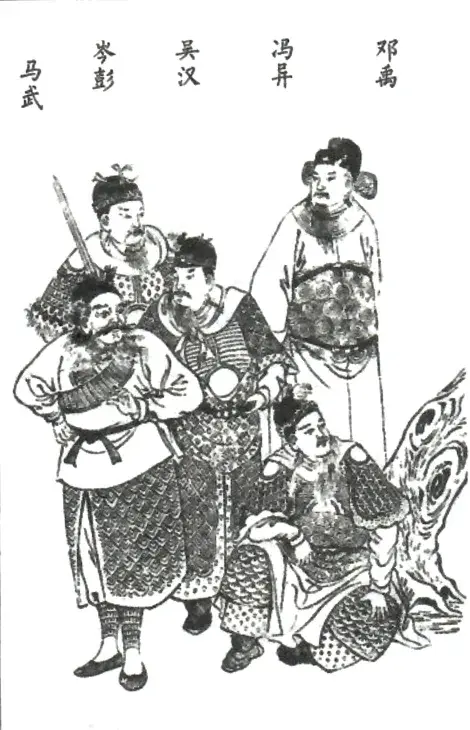
Historical portrait of Ma Wu
Image credits蔡東藩(Cai Dongfan、1877-1945) · Public domainImage source

Founding general of Eastern Hanleader of the Lvlin insurgent armyranked 26th among the 28 Generals of Yuntai

Ma Wu (马武)

马武

Ma Wu (马武, d. 61), courtesy name Zizhang (子张), was a native of Huyang County in Nanyang Commandery (modern Tanghe County, Henan Province). He was an illustrious founding general of the Eastern Han dynasty, ranked 26th among the 28 Generals of Yuntai. During the late Xin dynasty, Ma Wu fled into the Lvlin Mountains to escape a blood feud and joined the Lvlin insurgent army. Later serving the Gengshi Emperor as General of…

Era not stated

PROFILE

Ma Wu (马武, d. 61), courtesy name Zizhang (子张), was a native of Huyang County in Nanyang Commandery (modern Tanghe County, Henan Province). He was an illustrious founding general of the Eastern Han dynasty, ranked 26th among the 28 Generals of Yuntai. During the late Xin dynasty, Ma Wu fled into the Lvlin Mountains to escape a blood feud and joined the Lvlin insurgent army. Later serving the Gengshi Emperor as General of Inspiring Might, he fought alongside Liu Xiu in the Battle of Kunyang, helping crush Wang Mang's grand army. Disillusioned with internal factional strife in the Gengshi regime, he defected to Liu Xiu at Lincheng in Hebei. Following Liu Xiu's ascension to the throne, Ma Wu served as Cavalier Attendant-in-Ordinary, Commandant of Cavalry, and General Who Captures Bandits, receiving the titles Marquis of Shandu, Marquis of Qu, and Marquis of Yangxu. Renowned for horsemanship, archery, and magnanimous character, he was known for personally covering rearguard retreats. He suppressed the Tongma and Chimei insurgent forces and defeated Liu Yong and Pang Meng across the central plains. In 58, during the reign of Emperor Ming, the septuagenarian general campaigned against the Western Qiang, slaying over four thousand rebels and pacifying Longyou. He passed away in 61 and was granted the posthumous title Marquis Jie.

Courtesy Name
Zizhang (子张)
Native Place
Huyang County, Nanyang Commandery (南阳郡湖阳县, modern Tanghe, Henan)
Date of Death
61 (4th year of Yongping)
Highest and Major Offices
General Who Captures Bandits (捕虏将军), Cavalier Attendant-in-Ordinary (侍中), Commandant of Cavalry (骑都尉)
Noble Titles
Marquis of Shandu (山都侯), Marquis of Qu (鄡侯), Marquis of Yangxu (杨虚侯)
Posthumous Title
Marquis Jie of Yangxu (杨虚节侯)
Identity
Founding general of Eastern Han, leader of the Lvlin insurgent army, ranked 26th among the 28 Generals of Yuntai

LIFE TIMELINE

Relationship graph

BIOGRAPHY

Chronology

  • 22 (3rd year of Dihuang) | Joining the Lvlin Army | Fled blood feuds to join the Lvlin insurgent forces, gaining renown for martial valor.
  • 23 (1st year of Gengshi) | Triumph at Kunyang | Appointed General of Inspiring Might; accompanied Liu Xiu in defeating Wang Mang's 420,000-strong army at Kunyang.
  • 24 (2nd year of Gengshi) | Allegiance to Liu Xiu | Stationed in Hebei under Xie Gong; recognized Liu Xiu's leadership and pledged loyalty to him at Lincheng.
  • 25 (1st year of Jianwu) | Enfeoffment as Marquis | Accompanied Liu Xiu in pacifying Hebei; appointed Cavalier Attendant-in-Ordinary and Commandant of Cavalry, enfeoffed as Marquis of Shandu.
  • 28 (4th year of Jianwu) | Defeating Pang Meng | Appointed General Who Captures Bandits; campaigned in Suiyang, crushing the rebel forces of Liu Yong and Pang Meng.
  • 58 (1st year of Yongping) | Campaign Against the Qiang | Led expedition against Western Qiang insurgents at age over seventy, slaying four thousand rebels; promoted to Marquis of Yangxu.
  • 61 (4th year of Yongping) | Death and Honor | Passed away in Luoyang; Emperor Ming conferred the posthumous title Marquis Jie of Yangxu.

Biography

Lvlin Outlaw and the Battle of Kunyang

Ma Wu was born in the countryside of Huyang, Nanyang. Endowed with tremendous physical strength and an open-hearted personality, he placed high value on honor and chivalry. During the chaotic late Xin dynasty, Ma Wu became entangled in a violent clan vendetta. After slaying his adversaries, he fled government arrest and joined the Lvlin insurgent army in the mountains. His exceptional bravery in combat quickly elevated him to a prominent leadership position among the rebels.

In early 23, the Lvlin leaders proclaimed Liu Xuan as the Gengshi Emperor, and Ma Wu was appointed General of Inspiring Might. In the fifth month of 23, Wang Mang's grand army of 420,000 men besieged Kunyang. While the city's defenders numbered barely ten thousand, Liu Xiu broke through the encirclement to rally relief forces. Ma Wu served as a vanguard commander, charging Wang Mang's headquarters alongside Liu Xiu with three thousand daredevil troops. Fighting under violent storms, the Han troops threw the imperial army into total disarray, winning a legendary victory that cemented Ma Wu's deep admiration for Liu Xiu.

Choosing Loyalty at Lincheng

Following the victory at Kunyang, the Gengshi regime established its court in Chang'an, where corruption and infighting quickly surfaced. In late 23, Liu Xiu was sent to pacify Hebei, while the Gengshi Emperor dispatched Director of the Imperial Secretariat Xie Gong with an army to Yecheng to monitor him. Ma Wu was assigned to serve under Xie Gong.

During the joint campaign against Wang Lang, Ma Wu was ordered to besiege Lincheng. Stationed nearby, Liu Xiu observed that Xie Gong was narrow-minded and incapable of maintaining discipline, whereas Ma Wu was a steadfast warrior. Liu Xiu invited Ma Wu to an intimate feast. Dismissing all guards, Liu Xiu climbed a tower with Ma Wu to discuss the empire's future. Liu Xiu candidly remarked: "The empire is shattered, and the Gengshi court cannot endure. Why waste your talent under Xie Gong?" Deeply moved, Ma Wu bowed and pledged his allegiance. When Liu Xiu subsequently neutralized Xie Gong, Ma Wu formally joined Liu Xiu's army and was appointed a Major General commanding cavalry.

Campaigns in the Central Plains

In 25, massive insurgent armies roamed Jizhou. During the pursuit of the Wudao rebels, Ma Wu's unit was cut off and surrounded. Despite sustaining several wounds, Ma Wu fought fiercely with his blade, slaying dozens of enemies and keeping the command flag flying. Upon ascending the throne in 25, Emperor Guangwu appointed Ma Wu as Cavalier Attendant-in-Ordinary and Commandant of Cavalry, enfeoffing him as Marquis of Shandu.

In 28, Pang Meng rebelled in the central plains and allied with Su Mao to invade Chu Commandery and Suiyang. Emperor Guangwu appointed Ma Wu as General Who Captures Bandits. Pang Meng set ambushes in dense forests, but Ma Wu detected the trap, counter-encircling the enemy with cavalry while holding the center with heavy infantry. The Han forces routed Pang Meng's army, killing thousands. Ma Wu pursued the remnants to Xiapi, securing the coastal commanderies of Donghai. In recognition of his success, his fief was transferred to the Marquisate of Qu.

In 37, with the empire largely unified, Emperor Guangwu retired the military commands of founding generals, granting them generous stipends. Ma Wu retired to his estate, maintaining a low profile and never interfering in local governance, winning high praise from the emperor.

Subduing the Qiang in His Twilight Years

In 58, during the first year of Emperor Ming's reign, Western Qiang tribes revolted and raided Longxi, Jincheng, and Anding, killing officials and threatening border passes. Many court commanders hesitated to march against the fierce Qiang cavalry.

Despite being over seventy years old, Ma Wu volunteered to lead the expedition: "Though I am aged, my archery and horsemanship have not failed. I am ready to don armor once more for Your Majesty!" Moved by his devotion, Emperor Ming appointed Ma Wu as General Who Captures Bandits, giving him command of forty thousand troops alongside General of the Household Wang Feng.

Arriving in Jincheng, Ma Wu recognized that the Qiang lacked discipline in siege warfare. He secured key mountain passes and led his main infantry and cavalry directly against the rebel heartland. In a pitched battle outside Lintao, Ma Wu donned double armor and led the frontal assault. Inspired by their elderly commander's courage, the Han troops fought valiantly, slaying dozens of tribal chieftains, decapitating and capturing over four thousand enemy fighters. The remaining tribes surrendered, restoring peace to the Longyou frontier. Upon his return, Emperor Ming celebrated his triumph at the Southern Palace, enfeoffing him as Marquis of Yangxu.

Ma Wu passed away peacefully in Luoyang in 61. Emperor Ming mourned his passing, granted imperial burial items, and conferred the posthumous title Marquis Jie. In 60, Emperor Ming honored him among the 28 Generals of Yuntai, where he was ranked 26th.
Personal Relationships

  • Sovereigns: Emperor Guangwu of Han, who shared a friendship of mutual respect; Emperor Ming of Han, who entrusted him with the Qiang expedition.
  • Former Superiors: Gengshi Emperor Liu Xuan; Xie Gong, whom Ma Wu abandoned to serve Liu Xiu.
  • Comrades-in-Arms: Wu Han, Geng Yan, Zhu You, Yin Shi.

Historical Evaluation

  • Fan Ye, Book of the Later Han: "Ma Wu was simple, upright, resolute, and wise. Campaigning across Guanzhong and Hebei, he always placed himself in the vanguard during danger. In his old age, he crushed the Qiang with unmatched bravery, proving himself a true champion of the Han house."
  • Emperor Guangwu of Han: "Zizhang is open-hearted, courageous, and principled; in turbulent times, he is truly a champion of regional command."
  • Sima Guang, Comprehensive Mirror in Aid of Governance: "General Who Captures Bandits Ma Wu crushed the Qiang tribes, taking four thousand heads and pacifying Jincheng and Longxi."

Related Entries

  • 28 Generals of Yuntai
  • Emperor Guangwu of Han
  • Battle of Kunyang
  • Lvlin Army
  • General Who Captures Bandits

FIGURES ASSOCIATED WITH THIS DYNASTY

Bibliography

  • Book of the Later Han, Volume 22, Biographies of Zhu, Jing, Wang, Du, Ma, Liu, Fu, Jian, and Ma
  • Book of the Later Han, Volume 1, Annals of Emperor Guangwu
  • Records of the Eastern Watchhouse, Volume 10