Early Hardships
Lived in poverty, gathering timber in the mountains to sell in urban markets to support his household.
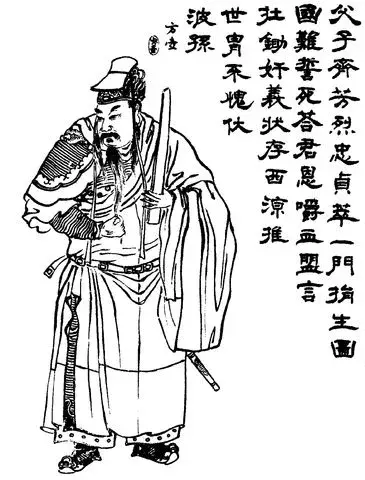
马腾
Ma Teng (马腾, ?–212), courtesy name Shoucheng (寿成), was a powerful military warlord and regional hegemon of Liang Province (Liangzhou, 凉州) during the turbulent late Eastern Han (东汉) dynasty, and the father of celebrated Shu Han general Ma Chao (马超). Descended from the famed General Who Calms the Waves Ma Yuan, his father Ma Ping had lost office and settled in Longxi among the Qiang people, marrying an indigenous woman.…
Ma Teng (马腾, ?–212), courtesy name Shoucheng (寿成), was a powerful military warlord and regional hegemon of Liang Province (Liangzhou, 凉州) during the turbulent late Eastern Han (东汉) dynasty, and the father of celebrated Shu Han general Ma Chao (马超). Descended from the famed General Who Calms the Waves Ma Yuan, his father Ma Ping had lost office and settled in Longxi among the Qiang people, marrying an indigenous woman. Blessed with a towering physique over eight chi tall, distinctive facial features, and a magnanimous character, Ma Teng earned deep reverence among both Han settlers and Qiang tribesmen. Responding to provincial levies during the Liang Province rebellion in the 180s, he rose swiftly through the ranks to General of the Household. For over two decades, he and his sworn brother Han Sui dominated the Guanzhong and Longyou regions with tens of thousands of hardened cavalrymen. In 202, he supported Cao Cao by dispatching Ma Chao and Pang De to defeat Yuan Shang's general Guo Yuan at Pingyang. Relocating his extended clan to Ye in 208 upon appointment as Minister of the Guards, he was tragically executed along with more than two hundred family members in 212 after Ma Chao took up arms against Cao Cao.
Lived in poverty, gathering timber in the mountains to sell in urban markets to support his household.
Enlisted in the provincial levies of Governor Geng Bi, appointed Army Major due to his stature and martial valor.
Allied with Han Sui and Wang Guo following Geng Bi's death, establishing an autonomous domain in Longyou.
Following Dong Zhuo's death, recognized by Li Jue as General Who Conquers the West and stationed at Mei.
Plotted with court officials Ma Yu and Liu Fan to overthrow Li Jue, withdrawing to Liangzhou after defeat at Changpingguan.
Engaged in fierce border conflicts with Han Sui, suffering the loss of his wife and sons before Zhong Yao mediated.
Dispatched Ma Chao and Pang De to relieve Pingyang, crushing Guo Yuan and stabilizing the Guanzhong flank.
Yielded regional command under persuasion from Zhang Ji, moving his clan to Ye as Minister of the Guards.
Arrested and executed alongside over two hundred family members following Ma Chao's rebellion at Tong Pass.
Ma Teng traced his lineage to General Ma Yuan, the revered early Eastern Han commander. His father, Ma Ping, served as a county magistrate in Tianshui before falling from official grace and living amongst the indigenous Qiang in Longxi. Impoverished, Ma Ping took a Qiang woman as his wife, giving birth to Ma Teng. During his youth, Ma Teng possessed no ancestral estate and eked out a living by felling timber on Mount Zhang and carrying heavy loads into city markets to feed his parents. Measuring over eight chi in height, with a broad frame, striking nose, and benevolent temperament, he earned widespread admiration among border inhabitants.
Between 184 and 187, Liang Province was convulsed by massive rebellions sparked by corrupt officials under Provincial Governor Geng Bi. When provincial authorities issued calls for martial recruits, Ma Teng reported for enlistment. Impressed by his imposing stature and combat prowess, officials commissioned him as an Army Assistant and later promoted him to Army Major. In 187, Geng Bi was murdered by mutinous troops at Didao, and the rebel army besieged Hanyang, slaying Grand Administrator Fu Xie. Perceiving the breakdown of imperial authority, Ma Teng gathered regional forces and joined Han Sui and Wang Guo in raiding the Sanfu basin.
In 189, after the rebel leader Wang Guo was routed by imperial general Huangfu Song, Ma Teng and Han Sui deposed Wang Guo and coerced the prominent scholar Yan Zhong to assume nominal leadership. Following Yan Zhong's sudden illness and death, the alliance fractured into competing factions. When warlord Dong Zhuo took control of Chang'an, he recognized the formidable cavalry strength of the Liangzhou generals and invited Ma Teng and Han Sui to join his fold.
In 192, following Dong Zhuo's assassination, his subordinates Li Jue and Guo Si seized power in Chang'an. To placate the western borders, Li Jue appointed Han Sui as General Who Calms the West and Ma Teng as General Who Conquers the West, ordering Ma Teng to garrison the key fortress of Mei. However, in 194, relations soured when Li Jue refused Ma Teng's personal requests. Court loyalists, including Palace Attendant Ma Yu, Right General of the Household Liu Fan, and Grandee Remonstrant Du Bing, conspired with Ma Teng to purge Li Jue from within. Joined by Han Sui, Ma Teng marched on Chang'an and engaged imperial forces at Changpingguan. The plot was betrayed from within, resulting in the slaughter of Ma Yu and Liu Fan, while Ma Teng and Han Sui retreated westward after exhausting their provisions. To avoid endless frontier warfare, Li Jue subsequently conciliated Ma Teng by appointing him General Who Pacifies the Di.
In 195, Ma Teng petitioned to relocate his forces to Chiyang due to grain shortages, camping at Changping Anthou. Suspecting treachery, a local commander named Wang Cheng launched a surprise raid, forcing Ma Teng to retreat back to Longyou. Over time, friction over grazing lands and livestock flared into open conflict between Ma Teng and his sworn brother Han Sui. Ma Teng launched an offensive that forced Han Sui to retreat; Han Sui then rallied his divisions, attacked Ma Teng's base, and killed Ma Teng's wife and younger sons. The two warlords waged bitter, destructive warfare across Liang Province for years.
Recognizing that the stability of the Guanzhong corridor was paramount as Cao Cao prepared for the decisive clash with Yuan Shao at Guandu, the imperial court dispatched Colonel of the Sili Province Zhong Yao and Liangzhou Governor Wei Duan to mediate. Zhong Yao appealed to their strategic self-interest, convincing Ma Teng and Han Sui to enter a formal truce and send their sons to the imperial capital as hostages. Ma Teng then moved his headquarters to Huaili.
In 202, following Yuan Shao's death, his son Yuan Shang dispatched Guo Yuan, Gao Gan, and the Southern Xiongnu Chanyu to invade Hedong, while sending emissaries to solicit Guanzhong warlords. Hesitant at first, Ma Teng was swayed by his advisor Fu Gan, who stressed that Cao Cao upheld royal order and strict justice whereas the Yuan clan relied on nomadic raiders. Persuaded, Ma Teng dispatched his eldest son Ma Chao and champion general Pang De with ten thousand cavalrymen to reinforce Zhong Yao. At the Battle of Pingyang, Ma Chao led a devastating assault despite being wounded in the foot, while Pang De personally decapitated Guo Yuan, securing victory. Cao Cao rewarded Ma Teng with the title General of the Front and elevated his noble title to Marquis of Huaili.
In 208, having consolidated northern China, Cao Cao prepared for his grand southern expedition against Jing Province. To eliminate the risk of a Guanzhong revolt against his northern bases, Cao Cao sent advisor Zhang Ji to persuade Ma Teng to surrender his command and move to court. Aware of Ma Teng's hesitation, Zhang Ji secretly instructed county magistrates along the route to prepare lavish way-stations, creating the impression that Ma Teng was already on the march. Finding himself diplomatically outmaneuvered, Ma Teng yielded and moved to Ye with his younger sons Ma Xiu and Ma Tie, along with over two hundred clan members, assuming the title Minister of the Guards. His eldest son Ma Chao remained behind in Liangzhou to govern the ancestral military retinue.
In 211, Cao Cao dispatched Zhong Yao through Guanzhong under the pretext of invading Hanzhong. Suspecting that Cao Cao intended to subjugate them, Ma Chao, Han Sui, and nine other Guanzhong generals revolted, seizing Tong Pass. In 212, after routing Ma Chao's coalition along the Wei River, Cao Cao took vengeance on the hostages held in the capital. Ma Teng, his sons Ma Xiu and Ma Tie, and over two hundred members of the extended Ma clan were arrested and executed, bringing a tragic end to the legendary Liangzhou warlord.
Rising from an impoverished woodcutter to the foremost military hegemon of Liang Province, Ma Teng maintained military autonomy across Guanzhong and Longyou for over twenty years, bridging relations between Han frontiersmen and nomadic tribes.
By resisting northern seduction and dispatching ten thousand elite cavalry under Ma Chao and Pang De to crush Guo Yuan at Pingyang, Ma Teng safeguarded Cao Cao's western rear during the post-Guandu campaigns.
FIGURES ASSOCIATED WITH THIS DYNASTY