Life and Career
Diplomatic Service and the Royal Commission
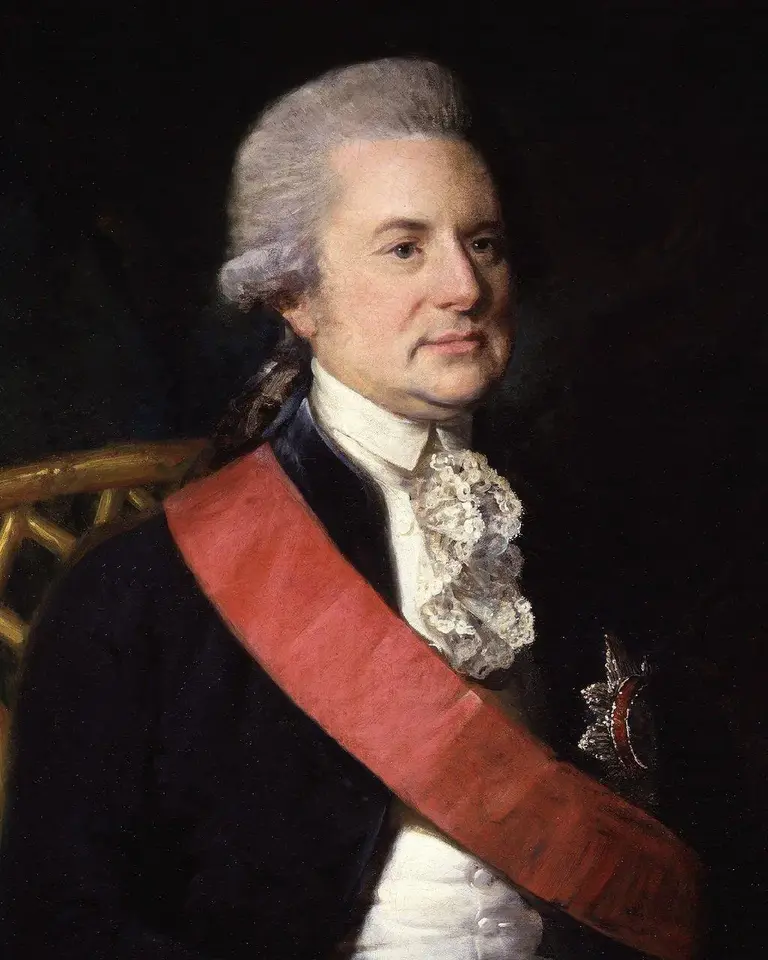
George Macartney was born in 1737 into an established Anglo-Irish aristocratic family in County Antrim. Following classical humanist studies, he attended Trinity College Dublin, graduating with a Master of Arts in 1759. In 1764, at age twenty-seven, Macartney was appointed envoy extraordinary to the court of Catherine the Great in Saint Petersburg. His poise and diplomatic acuity secured a favorable Anglo-Russian commercial treaty, earning him a knighthood from King George III. Over the subsequent two decades, he served as Chief Secretary for Ireland, Governor of the Caribbean island of Grenada, and Governor of Madras under the British East India Company, acquiring extensive administrative experience.
By the late eighteenth century, the Industrial Revolution was transforming the British economy. Mechanized textile manufacture in Lancashire and industrial metalworking in Birmingham generated unprecedented output, creating an urgent imperative to open foreign markets in Asia. However, the Qing Empire maintained the restrictive Canton System, confining all Western maritime commerce to the port of Guangzhou under the monopoly of the Cohong merchant guild. In 1792, Prime Minister William Pitt the Younger and Henry Dundas appointed Lord Macartney to lead a grand diplomatic embassy to Beijing, ostentatiously to celebrate the Qianlong Emperor eighty-third birthday while seeking formal treaties and commercial liberalization.
Journey to Beijing and the Kowtow Controversy
In September 1792, Macartney departed Portsmouth aboard the sixty-four-gun warship HMS Lion, accompanied by the Hindostan and Jackal, carrying a retinue of seventy diplomats, physicians, artists, and mechanics, alongside hundreds of seamen. The embassy transported over six hundred crates of gifts designed to showcase Britain scientific, astronomical, and military advances. These included a planetarium constructed by Herschel, refracting telescopes, Wedgwood Jasperware vases, steam engine models, and precision flintlock field artillery.
Arriving at Tianjin in July 1793, the embassy was categorized under the imperial tribute system, with Qing officials affixing banners to the river transports reading "The English Ambassador Bringing Tribute." In August, Macartney traveled to Beijing and progressed north to the Chengde Mountain Resort. Ahead of the imperial audience, a bitter protocol impasse developed. Grand Councilor Heshen and General Fuk'anggan insisted that Macartney perform the traditional kowtow (three kneelings and nine full forehead prostrations) before the Son of Heaven. Macartney refused, asserting sovereign equality between Great Britain and China, and offering to kowtow only if a senior Qing courtier performed an equivalent homage before an official portrait of King George III. Ultimately, a compromise was brokered: Macartney was permitted to kneel on one knee, following the etiquette observed before the British sovereign.
On September 14, 1793, inside the imperial tent in the Garden of Ten Thousand Trees at Chengde, Macartney knelt on one knee to present King George III letter and gift inventory directly to the elderly Qianlong Emperor.
Rupture of Negotiations and Strategic Intelligence
Though the ceremonial impasse was navigated, substantive commercial negotiations proved an absolute failure. Macartney presented six formal requests to Grand Councilor Heshen: first, the opening of Zhoushan, Ningbo, and Tianjin to British commercial shipping; second, permission for British traders to maintain permanent warehouses in Beijing; third, the cession of a small, unfortified island near Zhoushan for warehousing and ship repair; fourth, the grant of a residential site near Guangzhou for British merchants; fifth, the reduction of internal transit tariffs between Guangzhou and Macau; and sixth, freedom of religious propagation for Christian missionaries.
The Qianlong Emperor and his ministers viewed these requests as intolerable encroachments upon imperial sovereignty and dynastic ancestral statutes. The Emperor issued an imperial rescript to King George III, declaring: "Our Celestial Empire possesses all things in prolific abundance and lacks no product within its own borders. There is no need to import the manufactures of outside barbarians." All six British requests were summarily rejected, and the embassy was ordered to depart the capital immediately.
In the winter of 1793, the Macartney Embassy traversed the Grand Canal southward toward Guangzhou. Traveling through the Chinese interior, embassy scientists, cartographers, and officers meticulously recorded the operational state of Chinese waterways, grain reserves, urban markets, and Eight Banner garrisons. In his confidential memoirs, Macartney recorded his prophetic diagnosis: "The Empire of China is an old, crazy, first-rate Man of War, which a fortunate succession of able and vigilant officers has contrived to keep afloat for these hundred and fifty years past. But whenever an insufficient man happens to have command, there will be an end of discipline and safety on board. She may drift some time as a wreck, and will then be dashed to pieces on the shore."
While failing to achieve immediate commercial treaties, the Macartney Embassy stripped away European idealizations of Chinese power, providing London with firsthand intelligence regarding the technological stagnation of the Qing military that shaped imperial policy culminating in the First Opium War forty years later. Macartney passed away in Chiswick, near London, on March 31, 1806, at age sixty-nine.