Birth in Suzhou
Born into an affluent scholarly household in Suzhou, orphaned of her mother and raised with natural feet.
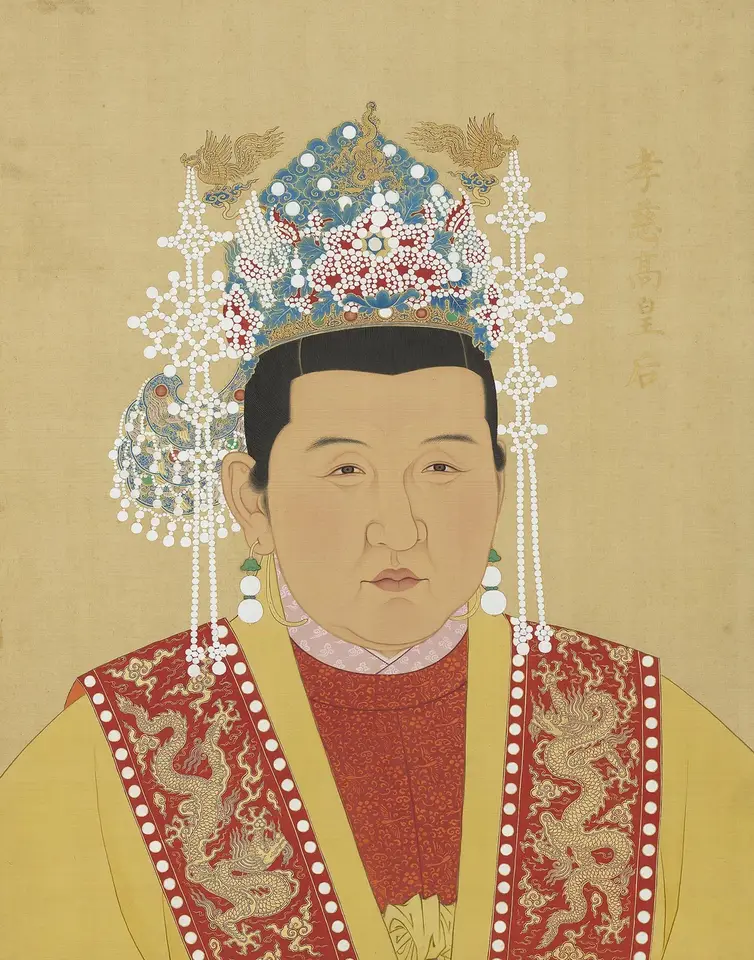
马氏(明太祖皇后)
Empress Ma (马氏(明太祖皇后)) (1332–1382), native to Xinfengli, Suzhou in Guide Prefecture (modern Suzhou, Anhui), was the principal consort and founding empress of Zhu Yuanzhang (Emperor Taizu of Ming), posthumously honored as Empress Xiaoci Gao and popularly venerated as "Empress Ma" or "Big-Footed Empress Ma." Descended from Ma Mo, Grand Protector of the Crown Prince during the Northern Song dynasty whose lineage migrated south…
Empress Ma (马氏(明太祖皇后)) (1332–1382), native to Xinfengli, Suzhou in Guide Prefecture (modern Suzhou, Anhui), was the principal consort and founding empress of Zhu Yuanzhang (Emperor Taizu of Ming), posthumously honored as Empress Xiaoci Gao and popularly venerated as "Empress Ma" or "Big-Footed Empress Ma." Descended from Ma Mo, Grand Protector of the Crown Prince during the Northern Song dynasty whose lineage migrated south after the Jingkang incident, she was orphaned of her mother in infancy. When her father, Lord Ma, fled local legal troubles, he entrusted her to his sworn friend Guo Zixing. Guo and his wife Lady Zhang adopted her, providing an education in Confucian classics, histories, and needlework, fostering her calm, compassionate, and steadfast character, while she notably resisted the common custom of foot-binding. In 1352, recognizing Zhu Yuanzhang's exceptional martial leadership within the Red Turban army at Haozhou, Guo Zixing gave his adopted daughter Lady Ma in marriage to him. Throughout the chaotic civil conflicts of the late Yuan dynasty, Lady Ma remained Zhu Yuanzhang's stalwart partner. When Zhu was falsely slandered by Guo Zixing's sons and starved in solitary confinement, Lady Ma concealed freshly baked, scalding wheat cakes in her garments to feed him, severely blistering the flesh of her chest. During the perilous defense of Nanjing against Chen Youliang, she mobilized military wives to sew uniforms and boots, donating all her private jewelry and silk to reward front-line troops. Following Zhu Yuanzhang's coronation in Nanjing in 1368, Lady Ma was invested as Empress. Despite her supreme elevation, she preserved the austere virtues of commoner life, wearing washed, plain silk, and personally supervising silk weaving and palace meals. Firmly opposing nepotism, she adamantly prevented Zhu from bestowing noble titles and high offices upon her own relatives. In state governance, she consistently urged imperial moderation and restraint in judicial executions, successfully interceding to save the renowned scholar-tutor Song Lian, the merchant Shen Wansan, and military commanders like Li Wenzhong and Guo Jingxiang, while founding the "Red Plank Granary" to maintain the households of impoverished National University students. In August 1382, falling mortally ill, she refused medication to prevent the retribution and execution of imperial physicians should she succumb. She passed away peacefully at age fifty-one. Emperor Taizu was inconsolable and swore never to install another empress for the remainder of his life, interring her in the Ming Xiaoling Mausoleum.
Born into an affluent scholarly household in Suzhou, orphaned of her mother and raised with natural feet.
Entrusted by her father to his sworn friend Guo Zixing, who educated her alongside his wife Lady Zhang.
Married Zhu Yuanzhang in Haozhou after Guo Zixing recognized his extraordinary leadership potential.
Smuggled scalding bread against her chest to feed Zhu during his solitary confinement, enduring permanent scars.
Organized army dependents to sew battle gear and donated personal wealth to reward soldiers defending Nanjing.
Invested as the founding Empress of the Ming Dynasty in Nanjing, modeling frugality and benevolence.
Firmly rejected imperial proposals to ennoble her maternal relatives, guarding against consort kin political dominance.
Persuaded Emperor Taizu to spare venerable tutor Song Lian and merchant Shen Wansan from capital punishment.
Refused medicine to protect palace doctors and died peacefully in Kunning Palace; Taizu vowed never to name another empress.
Lady Ma's lineage traced back to Ma Mo, a distinguished official and Grand Protector of the Crown Prince during the Northern Song dynasty. Originating from Chengwu, Ma Mo passed the imperial examinations under Emperor Renzong and earned fame as an upright magistrate. Following the fall of Northern Song during the Jingkang incident, his descendants migrated southward to settle in Xinfengli, Suzhou in Guide Prefecture. By the late Yuan dynasty, the Ma household was known locally for its generational wealth and philanthropic generosity.
Lady Ma's father, known as Lord Ma, was open-handed and frequently aided impoverished villagers, which gradually depleted his wealth. Her mother, Lady Zheng, died of illness shortly after giving birth to Lady Ma on August 9, 1332. Having no sons, Lord Ma doted upon Lady Ma, teaching her literacy, poetry, and classical history. Unusually for young women of elite Han Chinese families at the time, Lady Ma stubbornly refused the painful custom of foot-binding, keeping natural feet, which later earned her the affectionate popular nickname "Big-Footed Empress Ma."
During the Zhizheng era of Emperor Huizong of Yuan, local banditry surged. Lord Ma killed a man in an act of chivalric retaliation and was forced to flee the area. Before departing, he entrusted his daughter to his close friend, the wealthy local magnate Guo Zixing of Dingyuan. Lord Ma subsequently died abroad. Deeply moved by the child's plight, Guo Zixing and his wife Lady Zhang formally adopted her as their daughter, rearing her in their mansion with great tenderness. Guo taught her classical literature and strategic texts, while Lady Zhang instructed her in spinning and embroidery. Lady Ma displayed remarkable intellectual agility and poise, maintaining an unruffled demeanor regardless of crisis, which won her the respect of the entire household.
In 1352, Guo Zixing spent his family fortune raising an army in Haozhou in support of the Red Turban rebellion, establishing himself as Grand Marshal. Zhu Yuanzhang, who had previously been a novice monk at Huangjue Temple, enlisted in Guo's ranks. Possessing commanding physical presence, courage, and tactical cunning, Zhu was rapidly promoted from common infantryman to head of nine guards and placed in charge of confidential garrison communications. Recognizing Zhu's extraordinary future potential, Guo Zixing and Lady Zhang arranged the marriage between their twenty-year-old adopted daughter Lady Ma and the twenty-five-year-old Zhu Yuanzhang in war-torn Haozhou.
Throughout the fierce factional struggles of the late Yuan rebellion, Lady Ma remained Zhu Yuanzhang's steadfast companion. Within Haozhou, Guo Zixing's second son, Guo Tianxu, grew intensely jealous of Zhu's rising reputation and repeatedly slandered him before his father, alleging treasonous conspiracies. The suspicious Guo Zixing ordered Zhu disarmed and confined in a dark, isolated storehouse, forbidding guards from giving him food. Learning of her husband's mortal peril, Lady Ma slipped into the garrison kitchen, stole freshly baked wheat cakes straight from the oven, and hid them inside her tunic against her bare chest to smuggle to the detention cell.
On her way, she ran into her adoptive mother, Lady Zhang. Fearing discovery, Lady Ma pressed the scalding bread tightly against herself while bowing in greeting. Noticing her pale countenance and stammering speech, Lady Zhang detained her in conversation. Overwhelmed by agonizing pain, Lady Ma collapsed in tears. Lady Zhang led her into a private chamber, unbuttoned her tunic, and found the steaming cakes sticking to her blistered skin, which was severely burned and bleeding. Moved to tears by her devotion, Lady Zhang dressed her wounds, sent food to Zhu Yuanzhang, and urged Guo Zixing to release him immediately. The burns left permanent scars across Lady Ma's chest, and Zhu wept openly in gratitude, forging an unshakeable bond between husband and wife.
When Zhu Yuanzhang later led independent forces southward across the Yangtze River to capture Taiping and Nanjing, Lady Ma accompanied the army. In 1360, the rival warlord Chen Youliang led a massive armada down the Yangtze to assault Nanjing, causing panic throughout the city. Remaining calm, Lady Ma mobilized the wives and daughters of all officers to sew thousands of battle jackets, padded armor, and boots for defending troops. Discovering that state reserves were exhausted, she donated all her personal gold, silver, silk, and heirloom jewelry to reward the defending soldiers on the battlements, inspiring the troops to fight with fanatical courage and win the decisive Battle of Longwan.
On January 23, 1368, Zhu Yuanzhang ascended the imperial throne in Nanjing, establishing the Ming Dynasty. He invested his first wife Lady Ma as Empress and their eldest son Zhu Biao as Crown Prince. Despite reaching the pinnacle of imperial honor, Empress Ma remained utterly uncorrupted by luxury, adhering strictly to the frugality of her early years.
Residing in Kunning Palace, Empress Ma wore washed, everyday clothing made of coarse silk and homespun cloth, avoiding gold-embroidered brocades except during solemn state ceremonies. She constantly reminded palace women: "Though we enjoy supreme honor, we must never forget the hardships of commoners. A single bolt of silk requires a year of labor by farm women; we must not squander it." She established a sericulture workshop inside the palace walls, personally leading palace concubines in tending silkworms and weaving cloth. She also insisted on preparing Zhu Yuanzhang's daily meals with her own hands and oversaw the clothing and diet of her imperial sons and grandsons. When palace women became pregnant, Empress Ma treated them with special maternal kindness, and whenever concubines incurred the Emperor's displeasure, she gently intervened to restore harmony.
Mindful of dynastic history, Empress Ma was keenly aware that overbearing consort kin had ruined numerous past dynasties. After founding the empire, Zhu Yuanzhang repeatedly proposed searching across the country for her surviving relatives to confer noble titles and fertile estates upon them. Empress Ma knelt and adamantly refused: "State titles and salaries are public treasures intended to reward generals and officials who shed blood for the dynasty! My kinsmen have performed no service for the state; elevating them to nobility will only foster arrogance and bring ruin upon them, inviting public condemnation. This must never be permitted!" Due to her unbending opposition, not a single relative from the Ma clan was granted office or nobility during Zhu Yuanzhang's reign, eliminating the scourge of consort kin political dominance.
Emperor Taizu possessed a fierce, suspicious, and unforgiving temper. To consolidate his authority and eliminate corruption, he enacted harsh legal statutes and conducted broad purges that terrorized the court. Knowing his disposition intimately, Empress Ma utilized her warmth, intellect, and moral courage to gently remonstrate with him behind palace walls, saving countless loyal ministers and innocent people from execution.
In 1380, during the purge of Chancellor Hu Weiyong, the venerable scholar and former Academician Song Lian was implicated through his grandson Song Shen and arrested by imperial guards. Enraged, Zhu Yuanzhang ordered the seventy-year-old scholar to be executed the following morning. Hearing this, Empress Ma rushed to remonstrate: "Common families honor their children's teachers with lifelong respect; how much more should the imperial house! Master Song was the preceptor of the Crown Prince and codified our dynastic ceremonies. He has long lived in retirement in the mountains of Zhejiang and could not possibly have known of his grandson's misdeeds. How can Your Majesty execute an empire's teacher on charges of treason?" When Zhu refused to listen, Empress Ma removed all meat and wine from that evening's imperial dinner table, sitting in tears. Surprised, Zhu asked the reason, to which she wept: "I hear Master Song is to be executed tomorrow, and I am abstaining from meat to pray for his soul." Touched and ashamed, Zhu put down his chopsticks, and the next day commuted Song Lian's sentence to exile in Maozhou.
When the wealthy Jiangnan merchant Shen Wansan contributed vast personal funds to construct one-third of the stone walls of Nanjing and offered to fund a million taels of silver to reward the imperial army, Zhu Yuanzhang flew into a rage, condemning a commoner who dared reward the Son of Heaven's troops as a traitor and ordering his execution and confiscation of property. Empress Ma intervened calmly: "Laws exist to execute criminals, not the unblessed. That Shen Wansan, a private commoner, commands wealth rivaling a capital city is in itself an unnatural omen that Heaven will naturally diminish. Why should Your Majesty soil imperial hands and bear the reputation of killing a wealthy subject?" Awakened to reason, Zhu spared Shen's life, merely banishing him to Yunnan. Furthermore, when Commander Guo Jingxiang's son was falsely accused of attempting parricide, she prevented his execution to preserve Guo's lineage; and when adopted general Li Wenzhong was framed by Yang Xian, she dissuaded Zhu from replacing him at the frontier, allowing Li to achieve historic victories.
Empress Ma was also deeply devoted to the welfare of impoverished scholars. Learning that students of the National University (Guozijian) often lacked means to support their families in the capital, she persuaded Zhu Yuanzhang to establish the "Red Plank Granary," which distributed monthly grain rations to students' wives and children, winning the adoration of scholars across the realm.
In August 1382, exhausted by decades of devotion, Empress Ma fell gravely ill. Anxious and distraught, Zhu Yuanzhang summoned the empire's finest physicians to Nanjing and walked personally to the Imperial Ancestral Temple to pray for her recovery. However, Empress Ma knew her condition was terminal. Aware of Zhu's volatile temper, she realized that if she died after taking medicine, Zhu would execute the attending doctors and their entire households. To protect innocent physicians from imperial wrath, she closed her mouth and adamantly refused all herbal prescriptions.
Sitting beside her bed in tears, Zhu Yuanzhang grasped her hand and asked for her final words. Empress Ma whispered serenely: "I only hope Your Majesty will continue to seek virtuous talents, listen to remonstrance, and maintain constancy from beginning to end; that our descendants will be worthy and moral, and that officials and commoners alike will find peace. If this is achieved, I die without regret." On September 17, 1382, Empress Ma passed away in Kunning Palace at the age of fifty-one.
Upon her death, Emperor Taizu wept uncontrollably, suspended court sessions for three days, and swore an oath never to install another empress. In September 1382, she was buried with grand state honors in the Ming Xiaoling Mausoleum on Purple Mountain and bestowed the posthumous title Empress Xiaoci. In 1403, Emperor Yongle expanded her title to Empress Xiaoci Zhaoxian Zhiren Wende Chengtian Miansheng Gao, and in 1538 Emperor Jiajing finalized it as Empress Xiaoci Zhenhua Zheshun Renhui Chengtian Yusheng Zhide Gao. For her benevolence, frugality, profound wisdom, and exemplary moral influence, Empress Ma is celebrated by historians as one of the most virtuous founding empresses in Chinese history.
Accompanied Zhu Yuanzhang through the bloody conflicts of the late Yuan dynasty; famously endured severe burns to smuggle hot food to him during his imprisonment by Guo Zixing, and mobilized military wives while donating personal jewelry to sustain the army during the defense of Nanjing.
Maintained commoner simplicity despite her imperial station, spinning and weaving silk within the palace; adamantly refused the ennoblement of her own relatives, successfully preventing consort kin interference in state politics throughout the Hongwu era.
Used her diplomatic wisdom and moral standing to moderate Zhu Yuanzhang's harsh punishments, saving venerable imperial tutor Song Lian, merchant Shen Wansan, and key commanders Li Wenzhong and Guo Jingxiang from execution.
Demonstrated profound concern for education and common welfare by establishing the Red Plank Granary to provide grain rations for the families of National University students, nurturing the intellectual class of the early Ming Dynasty.
FIGURES ASSOCIATED WITH THIS DYNASTY