Artistic Prominence
Active in Lin'an, Ma achieved wide fame for brushwork modeled after Wu Daozi.
马和之
Ma Hezhi (马和之) was a preeminent court painter and scholar-official of the early-to-mid Southern Song Dynasty. Hailing from Qiantang, his exact dates of birth and death are unrecorded, but he was primarily active during the reigns of Emperor Gaozong and Emperor Xiaozong. Advancing through civil examinations, he obtained the jinshi degree during the Shaoxing era, rose to Vice Minister of the Ministry of Works, and presided over…
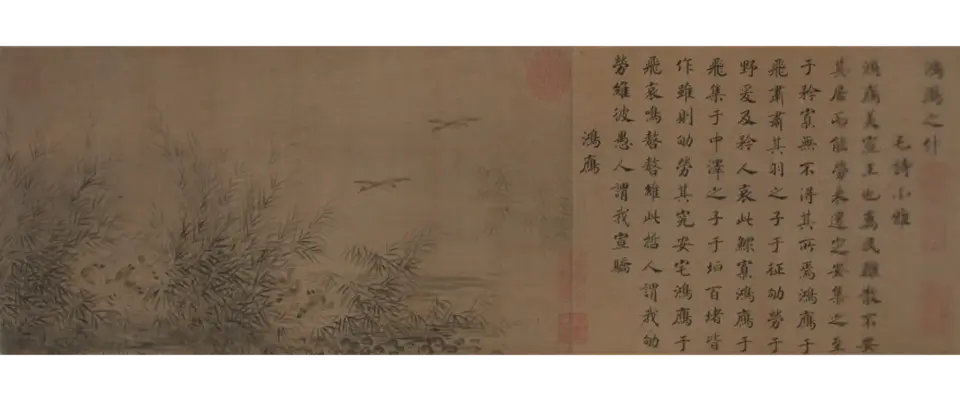
Ma Hezhi (马和之) was a preeminent court painter and scholar-official of the early-to-mid Southern Song Dynasty. Hailing from Qiantang, his exact dates of birth and death are unrecorded, but he was primarily active during the reigns of Emperor Gaozong and Emperor Xiaozong. Advancing through civil examinations, he obtained the jinshi degree during the Shaoxing era, rose to Vice Minister of the Ministry of Works, and presided over the Imperial Painting Academy as a high dignitary. Ma enjoyed exceptional imperial favor; Emperor Gaozong personally transcribed the entire 305 poems of the Classic of Poetry in imperial calligraphy, commissioning Ma to paint accompanying illustrations for every piece, creating the monumental imperial Illustrations to the Classic of Poetry. In artistic technique, Ma studied the Tang dynasty master Wu Daozi, transforming the traditional "orchid-leaf line" into the celebrated "leech-outline" (also known as willow-leaf line), characterized by sharp tips, full midsections, and dynamic cadence. His brushwork was lofty and fluid, with pale, antique coloring that combined calligraphic brush energy with painting, excelling in Buddhist icons, architectural boundaries, landscapes, and figures, earning him the title "Little Wu Sheng". Masterpieces such as Illustrations to the Odes of Bin and Illustrations to the Odes of Tang are revered as national treasures.
Active in Lin'an, Ma achieved wide fame for brushwork modeled after Wu Daozi.
He earned the jinshi degree during the Shaoxing era, entering official administration.
Emperor Gaozong personally inscribed the Classic of Poetry, commanding Ma to create illustrations.
Elevated to Vice Minister of Works, he oversaw the Imperial Painting Academy as a court dignitary.
Emperor Xiaozong continued to patronize his art, ordering further illustrations for canonical poems.
Completing hundreds of monumental scrolls, he retired with timeless acclaim in Chinese art history.
Ma Hezhi was born in Qiantang, within the Southern Song capital Lin'an. Growing up beside West Lake amid a vibrant gathering of scholars, he mastered canonical texts while nurturing a passionate devotion to painting. Following the dynastic flight southward, the imperial court re-established the Painting Academy in Lin'an to recruit talented painters. Although remarkably gifted in pictorial art, Ma differed from ordinary vocational artisans, resolving to pursue classical scholarship and a civil examination career.
In painting heritage, Ma avoided the rigid, delicate mannerisms common among contemporary academy artisans, instead emulating the grand tradition of the Tang dynasty painting master Wu Daozi. He assiduously copied Wu's murals and scrolls, absorbing the dynamic spirit of billowing draperies and wind-swept forms. Integrating calligraphic stroke discipline and literati philosophy into Wu's linear framework, Ma created an original style combining the heroic vitality of the High Tang with the lyrical elegance of the Southern Song, earning early praise as a transcendent talent.
During the Shaoxing era of Emperor Gaozong, Ma passed the metropolitan civil service examinations to attain the jinshi degree. Following his graduation, he served in administrative bureaus at court and in provincial posts, gaining promotion through administrative competence and cultural refinement until he reached the post of Vice Minister of the Ministry of Works.
Historical sources illuminate his unique status within the Southern Song art world. Zhou Mi's Old Affairs of the Martial Forest records him as chief of the Imperial Painting Academy, while Xia Wenyan's Treasury of Painting confirms his status as a Shaoxing jinshi and Vice Minister of Works. In Records of Southern Song Academy Paintings, the Qing scholar Li E resolved this dual identity, explaining that the court entrusted Ma, as an eminent scholar-official of unmatched artistic excellence, with the overall direction of the Imperial Painting Academy. This prestigious appointment enabled him to transcend artisanal limitations, elevating court aesthetics with an enlightened literati perspective.
Ma Hezhi enjoyed extraordinary imperial patronage under Emperors Gaozong and Xiaozong. Seeking to demonstrate Confucian legitimacy and promote cultural governance after relocating to Lin'an, Emperor Gaozong resolved to personally transcribe the entire 305 poems of the Classic of Poetry in standard, running, and cursive scripts, commissioning matching pictorial illustrations for every piece. Among all court painters, Gaozong favored Ma exclusively, entrusting him with the creation of the complete Classic of Poetry illustrations.
This partnership initiated one of the most illustrious imperial collaborations in Chinese art history, with the emperor transcribing texts on the left and the courtier illustrating themes on the right. When Emperor Xiaozong ascended the throne, he sustained this massive project, according Ma deep reverence. Ma dedicated decades of his life to designing and painting hundreds of scrolls spanning dynastic hymns and regional odes, achieving a monumental synthesis of classical literature and visual art.
In his later years, although holding senior ministerial office, Ma maintained a simple and contemplative life, continuing to paint daily. His late brushwork achieved concise mastery, casting aside all conventional artifices to attain effortless natural harmony.
Having completed the vast majority of the Classic of Poetry series alongside masterpieces like the Illustrations to the Classic of Filial Piety for Women, Ma retired in honor at an advanced age. His life was celebrated both in state annals as an official and in art history as a founding master. Later masters such as Zhao Mengfu praised his paintings for capturing the authentic spirit of the ancient odes, while Dong Qichang revered his works as untrammeled masterpieces of literati art.
Ma Hezhi's preeminent technical contribution was his invention of the "leech-outline" (also called willow-leaf line). Evolving from Wu Daozi's "orchid-leaf line," his strokes featured sharp, tapering tips with full, buoyant centers, vibrating with rhythmic cadences. His brushwork was agile and unconstrained, shedding the stiff mannerisms of contemporary academy styles by incorporating calligraphic brushwork into drapery folds, rocks, and trees. Contemporary literati admired his transcendent grace, honoring him with the title "Little Wu Sheng."
In illustrating the Classic of Poetry, Ma demonstrated profound literary erudition and compositional philosophy. Rather than mechanically depicting textual phrases, he explored the moral principles of the ancient prefaces, utilizing the traditional poetic modes of exposition, comparison, and affective association (fu, bi, xing). In his Odes of Bin, he depicted agrarian life and seasonal sacrifices; in Deer Cry, he captured court banquet rituals with solemn grace. His imagery was antique and restrained, serving as the supreme visual manifestation of Confucian canonical literature.
Ma Hezhi's surviving scrolls were preserved in imperial collections across the Song, Yuan, Ming, and Qing dynasties, venerated as crowns of Chinese pictorial heritage. His Illustrations to the Odes of Bin is housed in the Palace Museum in Beijing; Illustrations to the Odes of Tang and Autumn Moon and Sound reside in the Liaoning Provincial Museum; Ancient Trees and Rushing Stream in the National Palace Museum in Taipei was designated a National Treasure in 2011; while portions of the Odes of Chen are preserved in the British Museum, exhibiting the pinnacle of Southern Song painting.
Among the vast corpus of the Classic of Poetry project, Ma Hezhi created numerous celebrated masterpieces. In the Illustrations to the Odes of Lu Ming, preserved in the Palace Museum in Beijing, the painting depicts a grand imperial banquet where attendants stand in disciplined reverence while guests exchange courteous salutations with tranquil and solemn grace, vividly manifesting the harmonious Confucian ideal of sovereign and subject. The Illustrations to the Odes of Tang in the Liaoning Provincial Museum uses sequential episodic illustration to depict twelve poems including "The Cricket," "The Mountain Has Its Trees," and "The Rising Waters," characterized by austere archaic robes and washed mountain rocks that evoke the rustic purity of the pre-Qin era. In his Illustrations to the Odes of Bin, Ma depicted rural peasants engaged in silkworm rearing, weaving, seasonal ancestral sacrifices, ice harvesting, and house building, elevating rustic agricultural customs into refined and harmonious courtly art through translucent literati brushwork.
Beyond the grand format of his poetry illustrations, Ma Hezhi achieved supreme distinction in narrative figure painting and literati landscape compositions. His surviving handscroll Illustrations to the Classic of Filial Piety for Women, rendered in ink and color on silk, illustrates chapters of the Han text with vigorous, buoyant lines and elegant coloring. Court ladies move with graceful robes fluttering in the wind, their composed expressions capturing psychological vitality that seamlessly harmonizes the kinetic energy of Wu Daozi with the linear dignity of Li Gonglin. In landscape vignettes and stream scenes, his National Treasure masterpiece Ancient Trees and Rushing Stream in the National Palace Museum in Taipei employs characteristic leech-outlines to render gnarled pines and precipitous cliffs, with swirling torrents drawn like cursive calligraphy, perfectly embodying the scholarly ideal of mountain seclusion and standing as a pinnacle where academy craftsmanship and literati aesthetics merge.
In rendering landscapes and natural scenery, Ma broke through the constraints of meticulous color realism, infusing painting with the untrammeled spirit of literati poetry. In Autumn Moon and Sound, he rendered an autumn river night in pure monochrome ink, depicting an elder in a skiff gazing at the bright moon with sparse, evocative strokes. In Ode to the Red Cliff, his energetic lines captured Su Shi's nocturnal excursion with spontaneous vitality. Furthermore, the Illustrations to the Ancestral Temple Hymns of Zhou in the Palace Museum and scrolls of the Odes of Chen dispersed abroad depict temple sacrifices and ancient cityscapes with warm, antique colors. Dong Qichang noted in the Rongtai Ji that Ma's calligraphic brushwork surpassed Li Gonglin and anticipated the rise of Yuan dynasty literati landscapes.
FIGURES ASSOCIATED WITH THIS DYNASTY