Birth into Prominent Lineage
Born into an aristocratic official family in Yongle, mastering Confucian canons and poetic prosody in his youth.
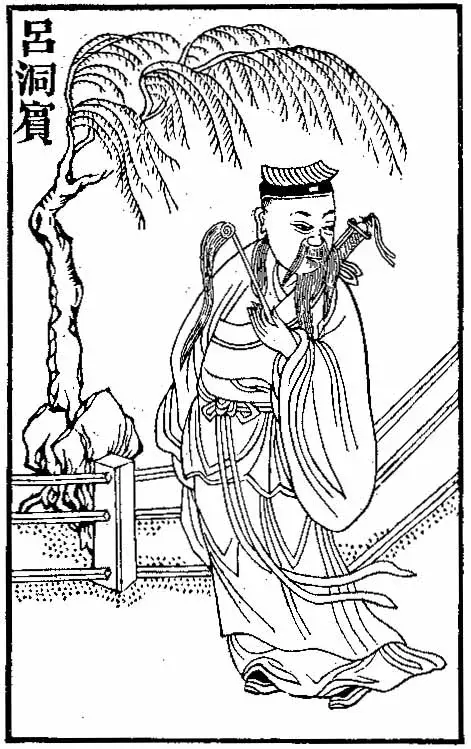
吕洞宾
Lu Dongbin (吕洞宾, personal name Lu Yan, styled Dongbin, literary name Chunyangzi), a native of Yongle in Hezhong Prefecture (modern Ruicheng, Shanxi), was an illustrious Daoist master, founder of the Internal Alchemy (Neidan) school, and one of the revered Five Northern Patriarchs of the Quanzhen tradition. Known reverently as "Patriarch Chunyang" or "Immortal Lu," he is the most celebrated and central figure among the…
Lu Dongbin (吕洞宾, personal name Lu Yan, styled Dongbin, literary name Chunyangzi), a native of Yongle in Hezhong Prefecture (modern Ruicheng, Shanxi), was an illustrious Daoist master, founder of the Internal Alchemy (Neidan) school, and one of the revered Five Northern Patriarchs of the Quanzhen tradition. Known reverently as "Patriarch Chunyang" or "Immortal Lu," he is the most celebrated and central figure among the legendary Eight Immortals of Chinese folklore. According to historical records and Daoist biographies, Lu hailed from a prominent scholar-official lineage, mastering Confucian classics and poetry from early youth. During the Xiantong reign of Emperor Yizong, he passed the imperial jinshi examination and served briefly as a local magistrate before resigning in disillusionment with late Tang political disintegration and warlord violence. During subsequent travels through Mount Lu and the Zhongnan Mountains, Lu met the transcendent master Zhongli Quan, experiencing the revelatory "Yellow Millet Dream" that shattered his illusions regarding worldly wealth and bureaucratic glory. Devoting himself to Daoist cultivation, Lu initiated a historic doctrinal revolution: he decisively rejected the toxic external alchemy of previous centuries, establishing the internal alchemy tradition based on cultivating the body's vital essence, breath, and spirit (jing, qi, shen). Synthesizing Daoist cultivation, Confucian moral duty, and Buddhist mental awakening, Lu emphasized that spiritual realization required compassion, altruism, and the severance of anger and greed. He was subsequently elevated as the spiritual progenitor of Quanzhen Dao, receiving imperial enfeoffments from Yuan Dynasty emperors as the "Sovereign Emperor of Pure Yang," leaving an imperishable mark on East Asian religious philosophy and popular culture.
Born into an aristocratic official family in Yongle, mastering Confucian canons and poetic prosody in his youth.
Achieved the jinshi degree, briefly serving as a conscientious local magistrate devoted to civilian welfare.
Met master Zhongli Quan in an inn near Chang'an, experiencing the revelatory "Yellow Millet Dream" that triggered his spiritual awakening.
Distributed his wealth and renounced worldly ambitions, wandering through Mount Zhongnan, Mount Lu, and sacred Daoist grottoes.
Systematically articulated the doctrine of internal alchemy, replacing toxic mineral ingestion with internal meditative cultivation.
Wandered across the Yangtze-Huai river valleys and Lake Dongting, providing herbal healing and resolving civil disputes.
According to sacred tradition, entered transcendent immortality beside Lake Dongting or in his ancestral home, venerated with shrines across China.
Lu Dongbin was born during the late Tang period in Yongle County, Hezhong Prefecture. According to Song epigraphic records and local gazetteers, his grandfather Lu Wei had served as Vice Minister of Rites, and his father Lu Rang was prefect of Haizhou, representing an illustrious Guanlong gentry family. Possessing exceptional intellect and noble bearing, Lu received a rigorous classical Confucian education, excelling in rapid poetic composition and historical commentary.
During the Xiantong reign, Lu sat for the imperial examinations in Chang'an and achieved the prestigious jinshi degree. He was appointed to a provincial magistracy, where he governed with integrity and sought tax relief for distressed rural communities. However, as the An Lushan fallout, Huang Chao rebellion, and militarized warlords tore the empire apart, central authority dissolved into chaos. Recognizing that individual administrative efforts were powerless against structural collapse, Lu harbored deep spiritual yearnings to renounce worldly office.
In the early Qianfu reign, while traveling through Chang'an, Lu stopped at an ordinary tavern where he encountered an eccentric ascetic named Zhongli Quan. Sensing Lu's latent spiritual capacity, Zhongli sought to awaken him. As Zhongli placed a pot of yellow millet over the hearth fire, he lent Lu a pillow of blue porcelain to rest upon.
Drifting into slumber, Lu experienced an entire lifetime in a single dream: he envisioned himself scoring first in the imperial examinations, rising through the bureaucracy to become Prime Minister, enjoying decades of imperial favor, marrying aristocratic ladies, and presiding over wealthy generations. Suddenly, jealous rivals framed him for treason; his property was confiscated, his family banished, and he found himself freezing in rags on a deserted northern mountain pass. Awaking with a start, he looked up to find the millet in the hearth was not yet cooked. Zhongli Quan smiled and said: "Before the yellow millet is cooked, you have completed a lifetime in your dream!" Trembling, Lu realized the fleeting vanity of worldly glory, bowed before Zhongli Quan, and accompanied him into the Zhongnan Mountains to cultivate the Dao.
During his discipleship at Mount Zhongnan and Mount Lu, Zhongli Quan initiated Lu into internal meditation and sacred sword doctrines. Lu subsequently carried out a profound transformation of Daoist history. Prior to the late Tang, Daoism had been dominated by external alchemy (Waidan), in which practitioners ingested elixirs formulated from cinnabar, mercury, lead, and sulfur to achieve physical immortality. This lethal practice caused the premature deaths of numerous Tang emperors and courtiers. Lu vehemently rejected this poisonous superstition, pioneering the revolutionary concept of Internal Alchemy (Neidan), which utilized the practitioner's own body as the furnace, vital essence and breath as the medicinal ingredients, and focused awareness as the refining fire.
Furthermore, correcting popular myths that depicted him using flying swords to decapitate enemies, Lu articulated his famous "Doctrine of the Three Swords." As recorded in Song author Wu Zeng's Record of the Studio for Self-Correction, Lu explained: "People say I use a flying sword to take human heads; I laugh at such nonsense. In truth, I possess three swords: the first severs unilluminated worldly grief, the second severs irrational anger, and the third severs insatiable desire." By transforming the physical blade into a spiritual instrument of moral purification, Lu anchored Daoist cultivation directly in ethical self-realization.
Having attained spiritual realization, Lu did not remain isolated in mountain caves. Instead, he embraced the Mahayana-Daoist ideal of universal salvation, traveling across the empire with a straw hat, bamboo staff, and gourd of herbal medicine. He frequented the regions of Lake Dongting, Yueyang, the Yellow Crane Tower, and the Yangtze River valleys, healing the sick, rescuing impoverished travelers, and resolving communal quarrels. His persona as an accessible, witty, and compassionate wanderer became beloved in folk culture.
Following his historical passing, his veneration grew exponentially. During the Jin and Yuan dynasties, Wang Chongyang, the founder of the Quanzhen tradition, traced his spiritual lineage directly to apparitions of Lu Dongbin, consecrating him as one of the Five Northern Patriarchs of Quanzhen. Emperor Shizu of Yuan (Kublai Khan) canonized him in 1269 as the "Illuminated Transcendent of Pure Yang," and Emperor Wuzong elevated him in 1310 to "Sovereign Emperor of Pure Yang." His ancestral birthplace in Yongle was transformed into the Yongle Palace (Yonglegong), whose surviving Yuan murals remain one of the crowning artistic and architectural achievements of Chinese religious civilization.
Lu Dongbin's greatest contribution to world religious history was the conceptualization and popularization of the Zhong-Lu Internal Alchemy system. This development dismantled the lethal legacy of toxic mineral ingestion, saving Daoism from existential crisis.
By designating the physical body as the laboratory and refining vital essence (jing), energy (qi), and spirit (shen), Lu synthesized classical Daoist naturalism with Buddhist Chan mindfulness and Confucian ethical introspection. This paradigm of "Dual Cultivation of Nature and Life" (Xingming Shuangxiu) became the universal foundation for all subsequent Daoist schools, including the Quanzhen and Longmen lineages, while profoundly influencing Neo-Confucian moral psychology from the Song dynasty onward.
Lu Dongbin achieved unmatched resonance in Chinese popular imagination as the foremost personality among the Eight Immortals. While other immortals represented extremes of age, gender, or social status, Lu represented the ideal bridge between scholarly refinement, martial righteousness, and popular compassion.
Carrying a sword not for slaughter but to vanquish internal illusions and protect the vulnerable, his folk narratives—such as the "Yellow Millet Dream," his miraculous rescues along Lake Dongting, and his witty interactions with commoners—became enduring staples of Yuan drama, Ming vernacular novels, and Daoist liturgy. He remains a universal symbol of benevolent transcendent wisdom across East Asia.
FIGURES ASSOCIATED WITH THIS DYNASTY