Born in Guangling
Born into an official family in Hailing, Guangling, studying classical texts and displaying sharp competence.
吕岱
Lu Dai (161 – October 21, 256), courtesy name Dinggong, was a native of Hailing County, Guangling Commandery, Xu Province (modern Rugao, Jiangsu Province). He was a senior minister, supreme military commander, and Grand Minister of War across two reigns of Eastern Wu during the Three Kingdoms period, celebrated as one of the most meritorious and longest-lived founding veterans in Eastern Wu history. In his early years, Lu…
Lu Dai (161 – October 21, 256), courtesy name Dinggong, was a native of Hailing County, Guangling Commandery, Xu Province (modern Rugao, Jiangsu Province). He was a senior minister, supreme military commander, and Grand Minister of War across two reigns of Eastern Wu during the Three Kingdoms period, celebrated as one of the most meritorious and longest-lived founding veterans in Eastern Wu history. In his early years, Lu Dai served as a low-ranking official in his home commandery and county. Amid the chaotic collapse of the Central Plains at the end of the Eastern Han dynasty, he fled southward across the Yangtze River. When Sun Quan assumed leadership over Jiangdong in 200, Lu Dai entered Sun Quan's headquarters. Because of his sharp administrative intellect and precise responses to imperial inquiries, he won Sun Quan's high regard, being appointed Assistant Prefect of Wu Commandery and Magistrate of Yuyao. Subsequently, he raised local troops, pacified rebel factions in Kuaiji and Dongye alongside Jiang Qin, and was promoted to Palace Commandant of Bright Trust. In 215, he joined Sun Quan and Lu Meng in taking three commanderies of Jing Province, capturing Yinshan Fortress, executing the rebel general Yuan Long, and being elevated to Administrator of Luling. In 220, Lu Dai succeeded Bu Zhi as Inspector of Jiao Province, pacifying revolts in Gaoliang and Yulin and capturing the rebel leader Wang Jin, for which he was granted the title of Marquis of Duxiang and appointed General Who Pacifies the South with acting imperial credentials. In 226, following the death of Shi Xie, Shi Xie's son Shi Hui launched an open rebellion in Lingnan. Lu Dai led three thousand elite amphibious troops in a lightning sea voyage, taking the rebels by total surprise and compelling Shi Hui and his brothers to surrender before executing them. He subsequently swept through Jiuzhen, bringing the seven southern commanderies of Lingnan under direct Eastern Wu central administration, earning promotion to General Who Suppresses the South and Marquis of Panyu. During his tenure governing Jiao Province, Lu Dai dispatched diplomatic missions across the South China Sea, inaugurating official maritime silk road links and prompting states such as Funan, Linyi, and Tangming to send tribute missions to Eastern Wu. In his later years, Lu Dai retained vigor and stamina. In 239, he took over civil and military administration of Jing Province following the death of Pan Jun, co-defending Wuchang alongside Chancellor Lu Xun and guarding the Puqi defense line. Even around eighty years of age, he personally led an army through day and night marches, taking a year to extinguish the broad inter-provincial uprising led by Liao Shi. In 246, he was promoted to Senior General-in-Chief, and upon the accession of Sun Liang in 252, he was elevated to Grand Minister of War. Throughout his long life, Lu Dai maintained strict personal integrity and frugality, leaving no private wealth. He passed away in Wuchang in 256 at the age of ninety-six and was buried with modest simplicity according to his own final wishes, enduring as a paragon of loyalty and virtue in the Southland.
Born into an official family in Hailing, Guangling, studying classical texts and displaying sharp competence.
Fled southward across the Yangtze River to escape northern warlord turmoil, serving as a minor local clerk.
Entered Sun Quan's administration, serving as Assistant Prefect of Wu Commandery, then promoted to Magistrate of Yuyao.
Appointed Military Supervisor Commandant, joined Jiang Qin to suppress Lu He and Qin Lang, promoted to Palace Commandant of Bright Trust.
Supervised forces into Changsha, seized Yinshan Fortress, and captured and executed rebel general Yuan Long at Liling.
Succeeded Bu Zhi as Inspector of Jiao Province, pacified Gaoliang and Yulin, captured Wang Jin, and received Marquisate of Duxiang.
Executed rapid maritime strike on Jiaozhi, defeated Shi Hui's secession, secured Lingnan, and was created Marquis of Panyu.
Dispatched envoys across southern seas, prompting kingdoms of Funan, Linyi, and Tangming to send tribute to Eastern Wu.
Coordinated generals to eliminate rebels Li Huan and Luo Li across three commanderies, receiving Sun Quan's glowing imperial commendation.
Handled civil and military duties after Pan Jun, co-garrisoned Wuchang with Lu Xun, and suppressed Liao Shi's southern revolt at age eighty.
Took over the right wing defense of Wuchang after Lu Xun's death, promoted to Senior General-in-Chief.
Appointed Grand Minister of War at age ninety-two upon Sun Liang's accession, reaching the pinnacle of ministerial rank.
Passed away in Wuchang at age ninety-six, buried in plain attire and unlacquered coffin per his strict testament.
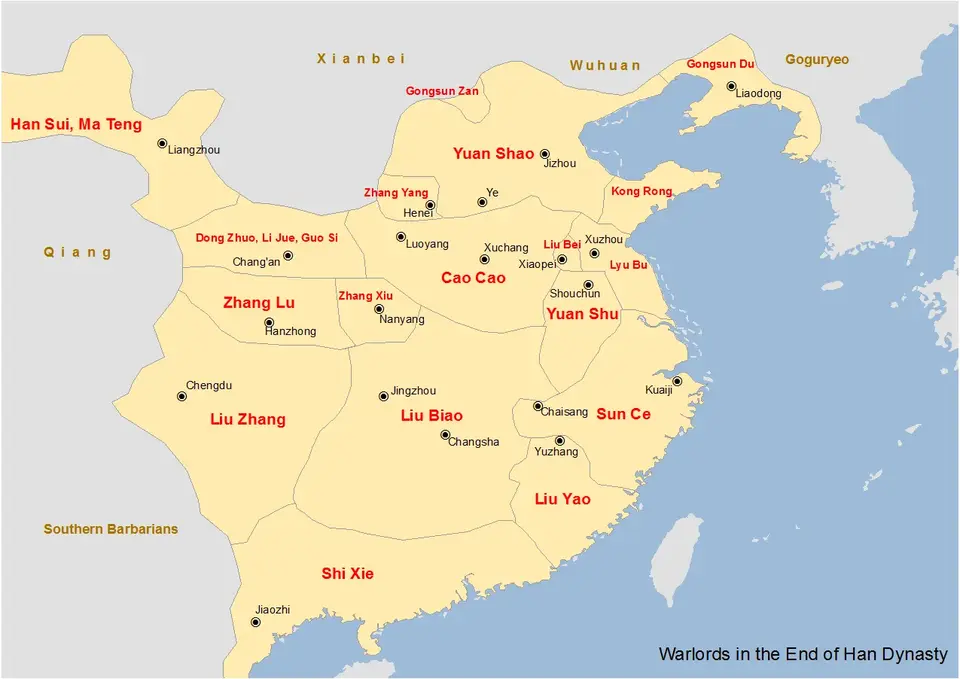
Lu Dai was born into an official family in the eastern parts of Hailing County, Guangling Commandery, Xu Province. Toward the close of the reign of Emperor Ling of Han, the Yellow Turban Rebellion erupted, triggering prolonged civil wars among rival warlords that devastated the Central Plains and the Huai River basin. Lu Dai, who had initially served as a local clerk in his native district, observed the collapse of order and resolved to relocate his household across the Yangtze River, seeking refuge in the Wu region.
In 200, after Sun Ce was assassinated, eighteen-year-old Sun Quan took command of Jiangdong. Sun Quan broadly recruited displaced scholars and capable men across the realm. Lu Dai went to Sun Quan's headquarters to offer his services. Recognizing his diligence and orderly mind, Sun Quan appointed him acting Assistant Prefect of Wu Commandery.
During his tenure as Assistant Prefect, Lu Dai discharged his duties with meticulous care, managing fiscal registers and legal litigation with outstanding precision. When Sun Quan personally inspected granaries, treasuries, and prisons across his commanderies, he summoned local magistrates and assistants for intense oral examinations. While many magistrates grew flustered and drenched in sweat under Sun Quan's sharp cross-examination, Lu Dai stood calm and collected, presenting official records and answering with reference to legal statutes and exact facts. Sun Quan was exceedingly impressed, immediately retaining Lu Dai by his side as a confidential scribe before promoting him to Magistrate of Yuyao.
At Yuyao, Lu Dai demonstrated remarkable military organizational talent. Aware that governance in troubled times required armed deterrence, he recruited and trained over a thousand stout youths into an elite municipal corps. When notorious bandit leaders Lu He and Qin Lang rose in rebellion across Kuaiji and Dongye, Sun Quan commissioned Lu Dai as Military Supervisor Commandant, dispatching him alongside Western Division Commandant Jiang Qin. Lu Dai marched deep into rugged terrain, laid ambushes, and captured both Lu He and Qin Lang alive, restoring peace across five counties and receiving the rank of Palace Commandant of Bright Trust. In 211, Lu Dai was tasked with leading two thousand troops west to induce the surrender of Zhang Lu in Hanzhong, though rugged plank roads prevented completion of the mission.
In 215, after Liu Bei took Yi Province and refused to return the southern commanderies of Jing Province, Sun Quan sent General Lu Meng with twenty thousand troops to seize Changsha, Lingling, and Guiyang. Lu Dai was ordered to supervise Sun Mao and nine other field commanders in supporting the campaign. During the advance, local officials and militias of Ancheng, You County, Yongxin, and Chaling allied against Eastern Wu, withdrawing into the formidable stronghold of Yinshan Fortress with tens of thousands of defenders. Lu Dai personally directed the siege, deploying heavy crossbow volleys to neutralize defenders while launching diplomatic appeals. Disheartened, the garrison opened the gates in surrender, allowing the three commanderies to be secured.
Following the victory, Sun Quan placed Lu Dai in charge of Changsha's defense. Soon after, Guan Yu dispatched secret agents to incite counter-rebellions among former commanders. Wu Dang, the former magistrate of Ancheng, and General Yuan Long coordinated with Guan Yu's partisans, inciting widespread revolts. Wu Dang entrenched himself in You County, while Yuan Long fortified Liling. Sun Quan dispatched Lu Su to strike You County, causing Wu Dang to flee, while Lu Dai advanced alone against Liling. Lu Dai directed the siege day and night, braving arrows and stones to urge his men over the battlements, storming the fortress and capturing Yuan Long, whom he executed on the spot. Sun Quan rewarded Lu Dai with the post of Administrator of Luling. In Luling, Lu Dai curbed lawless magnates and established agricultural colonies, rapidly bringing tranquility and prosperity to southern Jiangxi.
In 220, Cao Pi accepted the abdication of Emperor Xian and founded Cao Wei, cementing the tripartite division of the empire. To reinforce the Jing Province front against northern threats, Sun Quan reassigned veteran general Bu Zhi to Jing Province and appointed Lu Dai Inspector of Jiao Province, entrusting him with complete oversight of the southern frontier.
Jiao Province was an isolated, mountainous borderland populated by diverse ethnic groups with proud traditions. Upon Lu Dai's arrival, Qian Bo, a prominent tribal chieftain of Gaoliang, recognized Lu Dai's martial reputation and submitted voluntarily. Lu Dai conferred upon him the title of Western Commandant of Gaoliang, utilizing local leadership to soothe the indigenous populace. Soon after, tens of thousands of tribal insurgents in Yulin besieged several county seats; Lu Dai personally commanded amphibious forces day and night, routing the rebel encampments. Meanwhile, bandit chieftain Wang Jin gathered brigands along the border of Nanhai and Guiyang, raiding neighboring districts. In response to Sun Quan's edict, Lu Dai pursued the rebels into remote valleys, killing or capturing more than ten thousand adversaries and delivering Wang Jin in a prison cart to Jianye. Delighted by his success, Sun Quan appointed Lu Dai General Who Pacifies the South, granted him acting imperial credentials, and enfeoffed him as Marquis of Duxiang.
While governing Jiao Province, Lu Dai demonstrated extraordinary discernment and magnanimity. Xu Yuan, a native of Wu Commandery, was a man of upright character and exceptional talent whom Lu Dai had plucked from obscurity, providing him with robes, carriages, and recommendations until Xu Yuan attained the high office of Imperial Clerk. Xu Yuan was outspoken and fearless; whenever Lu Dai made minor administrative missteps, Xu Yuan publicly criticized him during official court assemblies. When subordinates urged Lu Dai to penalize Xu Yuan for his apparent ingratitude, Lu Dai sighed and said that this unwavering candor was precisely why he valued Xu Yuan so deeply. When Xu Yuan died young, Lu Dai wept bitterly over his coffin, lamenting the loss of his truest friend who had offered bitter yet beneficial counsel, earning widespread admiration among imperial dignitaries.
From the close of the Eastern Han dynasty, actual power across Lingnan had rested in the hands of the Shi clan, led by Shi Xie, who served as Administrator of Jiaozhi for over forty years while his brothers and sons governed surrounding commanderies. In 226, ninety-year-old Shi Xie died, and his son Shi Hui rejected imperial appointments from Eastern Wu, claiming the title of Administrator of Jiaozhi and sealing off sea routes and mountain passes in an attempt to establish an independent kingdom.
To counteract the rebellion, Sun Quan adopted Lu Dai's counsel to divide Lingnan: Jiaozhi, Jiuzhen, and Rinan became Jiao Province under Dai Liang, while Nanhai, Cangwu, Hepu, and Yulin formed Guang Province under Lu Dai. Shi Hui deployed massive forces to block Dai Liang from taking up his post.
Lu Dai understood that prolonged delay would permit the Shi clan to unite tribal populations throughout the seven commanderies, permanently severing Lingnan from Eastern Wu. Acting decisively, Lu Dai mobilized three thousand elite troops and sailed night and day across the ocean directly toward Hepu. When advisers warned that Shi Hui enjoyed deep generational prestige, Lu Dai countered that speed was paramount; an unexpected and rapid sea strike would catch Shi Hui completely unprepared, whereas hesitation would allow the rebels to establish impregnable defenses.
Joining forces with Dai Liang at Hepu, Lu Dai sailed straight toward the provincial seat of Jiaozhi. Shocked by Lu Dai's sudden arrival like an army descended from heaven, Shi Hui panicked and surrendered, accompanied by his six brothers who emerged half-naked with brambles bound to their backs. Lu Dai received their surrender, but recognizing that the Shi clan posed an irreconcilable threat to imperial centralization, he ordered all seven brothers executed and sent their heads to Jianye. In response, Shi Hui's former commanders Gan Li and Huan Zhi gathered tens of thousands of troops to besiege Lu Dai's camp. Lu Dai led his men in fierce counterattacks, shattering the rebel coalition and slaying over ten thousand enemy soldiers. Sun Quan subsequently re-merged the two provinces under Lu Dai's unified command, formally placing the seven southern commanderies under direct central rule. For this decisive accomplishment, Lu Dai was created Marquis of Panyu and appointed General Who Suppresses the South.
Following the stabilization of Lingnan, Lu Dai looked toward broader horizons. He dispatched diplomatic envoys southward across the South China Sea to promulgate imperial authority. Ancient kingdoms of Southeast Asia, including Funan (modern Cambodia), Linyi (central and southern Vietnam), and Tangming, sent grand diplomatic missions bearing ivory, jade, and rare treasures to offer tribute to Eastern Wu, inaugurating a golden era of official diplomatic and maritime trade contact between China and Southeast Asia.
In 231, with the southern frontier pacified, Sun Quan recalled Lu Dai to garrison Oukou in Changsha. When indigenous tribes in Wuling staged an uprising, Lu Dai cooperated closely with Minister of Ceremonies Pan Jun to restore order swiftly.
In 235, rebel chieftains Li Huan and Lu He in Luling, Sui Chun in Dongye, and Luo Li in Nanhai launched coordinated rebellions across three provinces. Sun Quan commissioned Lu Dai to command Generals Liu Zuan and Tang Zi to launch a coordinated counter-offensive. Seeing Lu Dai's approach, Sui Chun surrendered immediately; Lu Dai magnanimously accepted his submission and recommended him for a generalship. Lu Dai then scaled precipitous ridges to hunt down Li Huan and Luo Li, capturing or slaying both rebel leaders and sending their heads to the capital. Sun Quan issued a lavish imperial rescript declaring that without Lu Dai's strategic genius, these perennial threats would never have been erased, securing the empire's southern borders once and for all.
In 239, following the death of Pan Jun, Sun Quan appointed Lu Dai to handle civil and military administration in Jing Province, sharing command at the key regional capital of Wuchang with Grand General and Chancellor Lu Xun while supervising the Puqi defense perimeter. In 241, Liao Shi led a cross-provincial rebellion in Lingling, Cangwu, and Yulin. Despite being eighty years of age, Lu Dai personally petitioned to lead the campaign, marching continuously for a full year until Liao Shi and his officers were defeated and beheaded.
Throughout his advanced years, Lu Dai maintained astounding physical strength and mental clarity. He personally inspected administrative documents daily and entertained visiting dignitaries without tiring. When mounting a horse, he never needed stirrups, leaping directly into the saddle with agility that astonished his contemporaries. General of Inspiring Might Zhang Cheng wrote to Lu Dai praising his endurance and leaping mount, noting that his vitality surpassed even that of the legendary ancient general Lian Po.
During the late reign of Sun Quan, the destructive Crown Prince Dispute divided the court between supporters of Crown Prince Sun He and Prince of Lu Sun Ba. While Chancellor Lu Xun, Gu Tan, and Zhuge Ke favored Sun He, Lu Dai aligned with Bu Zhi and Quan Cong in backing Sun Ba. This bitter rivalry led to the tragic demise of Lu Xun. Following Lu Xun's death in 245, defense of Wuchang was divided into two commands; eighty-five-year-old Lu Dai supervised the right sector from Wuchang up to Puqi. In 246, Sun Quan conferred upon Lu Dai the rank of Senior General-in-Chief and made his son Lu Kai Assistant Army Commandant to aid in command.
In 252, Emperor Da of Wu (Sun Quan) passed away, and his young son Sun Liang ascended the throne. To reassure the armed forces and honor elder statesmen, the court elevated ninety-two-year-old Lu Dai to Grand Minister of War (Da Sima), placing him at the absolute summit of civil and military hierarchy.
Despite holding immense military authority and supreme rank for decades, Lu Dai remained steadfastly incorruptible and poor. While stationed in Jiao Province for over ten years, he gave away all his salaries and imperial bounties to frontier soldiers and destitute locals, never sending private savings home to his family. When Sun Quan learned that Lu Dai's wife and children lived in extreme poverty, he was deeply moved and severely reprimanded his court officials for failing to report such selflessness sooner. Sun Quan immediately granted substantial stipends and grain allocations to Lu Dai's family, establishing a lifelong imperial subsidy.
On October 21, 256 (Jichou day, 9th month, 1st year of the Taiping era), Grand Minister of War Lu Dai passed away peacefully in his military residence at Wuchang at the venerable age of ninety-six. On his deathbed, he strictly instructed his son Lu Kai that his funeral must not burden state coffers; his body was to be shrouded only in unadorned coarse cloth without lacquer on his wooden coffin, forbidding any lavish ceremony. Lu Kai scrupulously obeyed his father's testament, escorting his remains back to Hailing for a simple burial at Gaoyangdang (modern Linzi, Rugao, Jiangsu). Spanning four reigns of the Sun family, Lu Dai's heroic pacification of Lingnan and unblemished integrity remained celebrated across Jiangdong for centuries.
Promoted to Magistrate of Yuyao by Sun Quan, Lu Dai raised a crack unit of a thousand men, struck Kuaiji and Dongye, captured bandit leaders Lu He and Qin Lang, and stabilized five counties, receiving the title of Palace Commandant of Bright Trust.
In 215, Lu Dai supervised ten commanders in conquering Changsha, capturing Yinshan Fortress and securing four counties. He then crushed the uprising in Liling, executing Guan Yu's former partisan Yuan Long, and was appointed Administrator of Luling.
In 226, when Shi Hui rebelled in Jiaozhi, Lu Dai overruled cautious advice, launched an amphibious lightning strike with three thousand troops, forced Shi Hui's surrender, executed the rebel brothers, and integrated the seven southern commanderies into direct central rule.
While governing Jiao Province, Lu Dai dispatched envoys southward across maritime routes, prompting kingdoms such as Funan, Linyi, and Tangming to send tribute missions, inaugurating official Chinese diplomatic relations with Southeast Asia.
In 235, Lu Dai coordinated generals to suppress widespread rebellions led by Li Huan in Luling, Sui Chun in Dongye, and Luo Li in Nanhai, earning Sun Quan's praise that the realm would never again worry about southern threats.
Taking over Jing Province administration after Pan Jun, Lu Dai personally led forces to crush the massive inter-provincial rebellion of Liao Shi across Lingling and Cangwu over the course of a year, restoring total stability to the south.
Past eighty years of age, Lu Dai managed civil paperwork without exhaustion and vaulted onto horses without stirrups, drawing admiration from Zhang Cheng who compared his vigor favorably to the famed general Lian Po.
Promoted through positions of Inspector of Jiao Province, Governor of Jiao Province, and Senior General-in-Chief, Lu Dai was appointed Grand Minister of War at ninety-two under Sun Liang, dying at ninety-six with instructions for a frugal burial as a paragon of loyalty.
FIGURES ASSOCIATED WITH THIS DYNASTY