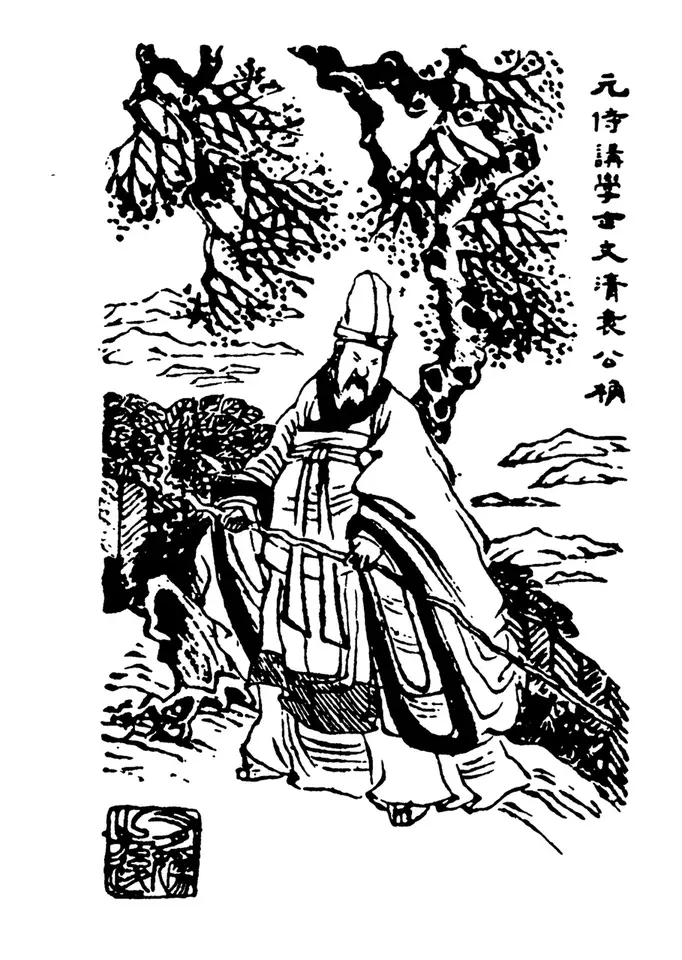
Life and Career
Ministerial Lineage and Philosophical Foundations
Lü Benzhong descended from the eminent Donglai Lü clan, one of the most distinguished ministerial dynasties of the Song period. From the early Northern Song onwards, the family produced eminent statesmen: his great-great-grandfather Lü Yijian and great-grandfather Lü Gongzhu both served as Grand Councilors, his grandfather Lü Xizhe served as Lecturer in Waiting, and his father Lü Haowen served as Minister of Personnel and took a decisive part in defending imperial authority during the Jingkang Crisis. As a child, Lü Benzhong displayed exceptional comprehension and memory, becoming a favorite of his great-grandfather Lü Gongzhu. When Empress Dowager Gao received Lü Gongzhu in the palace, she affectionately patted the young boy on the head, encouraging him to pursue exemplary scholarship to serve the state.
Because his grandfather Lü Xizhe had studied under the Neo-Confucian masters Cheng Hao and Cheng Yi, Lü Benzhong was reared in the intellectual core of the Luoyang School. As he matured, he traveled extensively to learn from foremost disciples of the Cheng brothers, including Yang Shi, You Zuo, and Yin Tun. Lü Benzhong studied with meticulous critical acumen; whenever questions arose regarding his teachers' expositions, he refused to assent blindly, repeatedly tracing doctrines back to fundamental classics. This formed his lifelong scholarly ethos of balancing classical synthesis with conscientious personal practice.
During the Shaosheng reign of Emperor Zhezong, court factional conflict flared violently as Zhang Dun came to power. Lü Gongzhu and other Yuanyou ministers were posthumously disgraced, and younger descendants including Lü Benzhong suffered institutional suppression. Under Emperor Huizong, Lü Benzhong was admitted to bureaucracy through ancestral privilege, receiving appointment as Registrar of Luoyang. From the Yuanfu through Chongning periods, he served in subordinate provincial offices such as Revenue Adjutant of Qinzhou. Throughout these regional postings, he performed his administrative duties with punctilious integrity, dedicating his leisure to books and stone rubbings while cultivating friendships with regional literati.
Frontier Observations and the Southern Exodus
In 1124, Lü Benzhong was recalled to the capital to serve as Compiler in the Bureau of Military Affairs. At that juncture, court favorites led by Tong Guan were recklessly pursuing military alliances with the Jurchen Jin to destroy the Liao Dynasty and recover the Yanyun territory, leaving northern defenses acutely exposed. Working in the military archives, Lü Benzhong recognized the acute emptiness of imperial frontier garrisons and repeatedly addressed memorials detailing looming catastrophes, though his warnings were disregarded. In 1126, he advanced to Vice Director of the Operations Directorate. That winter, Jin armies breached the Yellow River and besieged Bianjing. Trapped inside the barricaded capital, Lü Benzhong witnessed firsthand the abduction of the imperial house and the slaughter of urban citizens, suffering deep psychological distress.
Following the fall of Northern Song, Lü Benzhong joined the masses of refugees fleeing south. His father Lü Haowen had supported the ascension of Emperor Gaozong at Shangqiu but was soon pushed out by appeasement factions, forcing the Lü household to live as wandering exiles across the Huai River, Zhejiang, and Jiangxi. Cast down from the luxury of a ministerial residence to the privations of a displaced refugee, Lü Benzhong frequently struggled to procure daily meals. This national catastrophe stripped away the ornamental ease of his earlier poetry, turning his verse into a poignant historical testament of wartime suffering, patriotic agony, and philosophical endurance.
Court Remonstrance and Resistance to Qin Hui
In 1136, seeking to reassemble respected scholar-officials, Emperor Gaozong awarded Lü Benzhong an imperial jinshi degree and promoted him to Imperial Diarist and concurrently Provisional Secretariat Drafter. Operating at the administrative hub of the inner court, Lü Benzhong demonstrated unswerving outspokenness. In 1137, he delivered consecutive memorials detailing sweeping strategic plans for northern recovery, while strongly censuring the growing influence of palace eunuchs such as Zheng Chen in administrative appointments, demanding that ministerial promotion be based strictly on merit.
In 1138, Lü Benzhong was formally promoted to Secretariat Drafter and Lecturer in Waiting, concurrently serving as Acting Drafter of the Hanlin Academy, tasked with expounding classical texts to the emperor and composing solemn dynastic decrees. At this moment, Grand Councilor Qin Hui had seized unchecked authority and was coercing the court into a shameful peace settlement with the Jin involving massive territorial concessions. Lü Benzhong vehemently challenged this policy in open audience, arguing that concessions would never guarantee border peace but would fatally extinguish popular loyalty across the Central Plains.
Deeply affronted by Lü's intransigence, Qin Hui directed censors to fabricate political charges against him. In October 1138, Lü Benzhong was dismissed from his central posts and assigned to an exterior temple sinecure as Supervisor of the Taiping Abbey in Taizhou. Facing political persecution with stoic calm, Lü Benzhong packed his belongings and departed Lin'an, leaving government office permanently to dedicate his final years to civilian education and academic scholarship.
Rural Lecturing and Academic Output
In his retirement, Lü Benzhong resided in Fuzhou and Xinzhou in Jiangxi. Shunning secular politics, he lived quietly in temples and rural academies, spending his days reading and writing. Blending the Luoyang School's introspective Neo-Confucianism with his clan's rigorous ritual heritage, he established classrooms where scholars from across the empire gathered to study under his guidance. Prominent intellectuals, including the future top palace graduate Wang Yingchen, studied under him during their formative years, absorbing his intellectual principles.
During this productive twilight phase, Lü Benzhong completed monumental treatises that exerted lasting historical influence. He authored the ten-fascicle Spring and Autumn Annals Commentary, emphasizing dynastic sovereignty and border righteousness; composed Lessons for the Young in one fascicle, providing structured moral codes of personal rectitude, prudent speech, and official conduct; and compiled his reflections on poetic technique into the single-fascicle Ziwei Poetry Talks, a cornerstone of Song literary criticism.
In 1145, Lü Benzhong passed away of illness in Fuzhou at the age of sixty-two. The scholar-official community deeply mourned his loss. Following the ascension of Emperor Xiaozong, the court posthumously rehabilitated upright officials and conferred upon Lü Benzhong the honorable posthumous name Wenqing in recognition of his unbending moral integrity and scholarly contributions.
Major Achievements
Creating the Jiangxi Genealogy and the "Living Method" Theory
Lü Benzhong made transformative contributions to traditional Chinese literary theory. During the Huizong era, he authored the renowned Diagram of the Jiangxi Poetry Society's Lineage, systematically grouping twenty-five poets alongside Huang Tingjian into a coherent aesthetic lineage. This document formalized the organizational identity of the Jiangxi Poetry Society, establishing it as one of the most influential poetic movements in imperial Chinese history, with Lü recognized as its principal late leader.
Recognizing that epigones of the Jiangxi School were lapsing into mechanical pedantry and obscure allusion, Lü introduced the revolutionary concepts of "living method" (huofa) and "spiritual enlightenment" (wuru). He argued that while poets must fully master classical rules and meters, true mastery required transcending rigid frameworks to achieve spontaneous vitality and natural fluidity. His living method liberated verse from formulaic constraints, directly inspiring Southern Song masters like Lu You, Yang Wanli, and Fan Chengda to craft fresh, emotionally resonant poetry.
Preserving Central Plains Learning and Pedagogy in Lessons for the Young
As the direct inheritor of the Donglai Lü family's "Central Plains heritage," Lü Benzhong served as a vital intellectual bridge connecting early Northern Song classical scholarship with mature Southern Song Neo-Confucianism. Rejecting vacuous metaphysics, he demanded that ethical principles be embodied in daily actions. His seminal treatise Lessons for the Young provided practical guidelines for scholar-officials in family management, verbal restraint, public administration, and classical studies. Written in direct and pragmatic prose, the manual was lauded as a golden standard for moral discipline. Zhu Xi heavily incorporated maxims from Lessons for the Young when compiling his influential Xiaoxue, cementing Lü's family rules into mainstream Confucian culture.
Steadfast Opposition to Appeasement and Moral Fortitude
Throughout his official life, Lü Benzhong embodied the uncompromising spirit of Song scholar-officials. Confronted with the humiliation of the Jingkang Incident and the menace of Jurchen invasion, he never wavered in his commitment to dynastic restoration. When Qin Hui exercised autocratic power and silenced criticism, Lü Benzhong risked his life and familial security to protest against ceding sovereign territory. Though punished with exile and poverty, his steadfast defense of principle earned him universal veneration across the Southern Song realm and enduring praise in historical annals.