Birth in Huai'an
Born on August 8 in Shanyang County (modern Huai'an), Jiangsu, with ancestral lineage in Shangyu, Zhejiang.
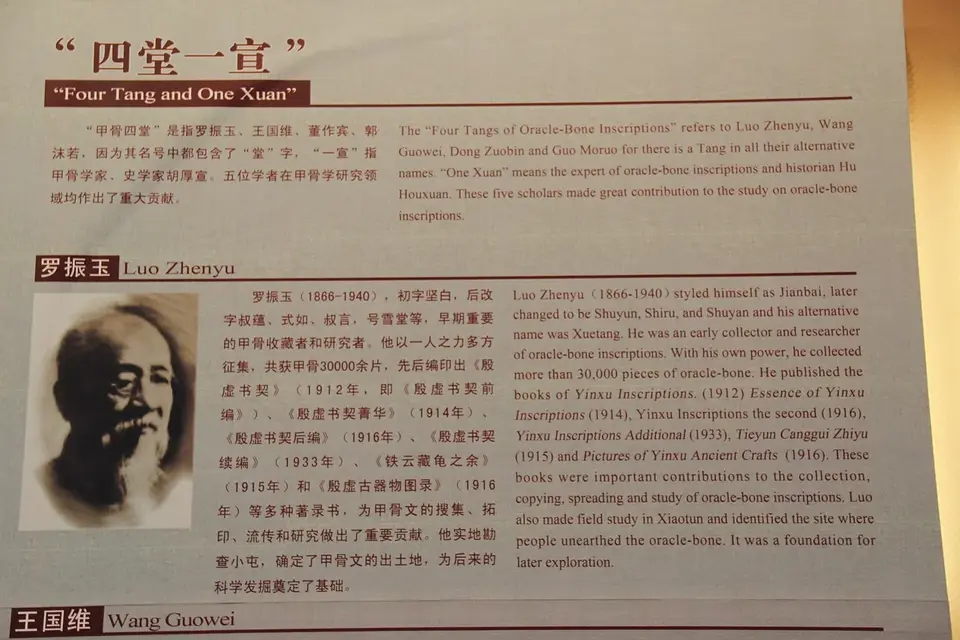
罗振玉
Luo Zhenyu (罗振玉, 1866–1940), originally named Baoyu, courtesy names Shiru (式如), Shuyun (叔蕴), and Shuyan (叔言), art name Xuetang (雪堂), later styled Zhensong Laoren (贞松老人), was a native of Shangyu, Zhejiang, born in Shanyang County, Huai'an Prefecture, Jiangsu. He was a preeminent scholar, epigrapher, paleographer, Dunhuangologist, bibliographer, and pioneer of cultural relic preservation in modern China, celebrated alongside…
Luo Zhenyu (罗振玉, 1866–1940), originally named Baoyu, courtesy names Shiru (式如), Shuyun (叔蕴), and Shuyan (叔言), art name Xuetang (雪堂), later styled Zhensong Laoren (贞松老人), was a native of Shangyu, Zhejiang, born in Shanyang County, Huai'an Prefecture, Jiangsu. He was a preeminent scholar, epigrapher, paleographer, Dunhuangologist, bibliographer, and pioneer of cultural relic preservation in modern China, celebrated alongside Wang Guowei, Dong Zuobin, and Guo Moruo as one of the Four Halls of Oracle Bones. Following the First Sino-Japanese War, Luo established the Agricultural Society, the Agricultural Journal, and the Eastern Literature Institute in Shanghai, systematically introducing modern agricultural science and Japanese academic methodologies while mentoring young luminaries such as Wang Guowei and Fan Bingqing. In 1906, he was summoned to Beijing as a consultant in the Qing Ministry of Education, later concurrently directing agricultural studies at the Imperial University of Peking. During this period, he successfully urged the imperial court to transport surviving Dunhuang manuscripts to Beijing for national preservation, used personal funds to rescue eight thousand sacks of Ming-Qing grand secretariat archives from papermill destruction, and first scientifically determined Xiaotun Village in Anyang as the site of the Yin Ruins, collecting over thirty thousand oracle bones and deciphering hundreds of Shang characters. After the 1911 Revolution, Luo lived in Kyoto for eight years as a Qing loyalist, producing profound scholarship alongside Wang Guowei known collectively as Luo-Wang Learning. In his late years, his political collaboration with the puppet state of Manchukuo severely compromised his historical reputation. Over his lifetime, Luo edited, collated, and published hundreds of foundational volumes, including Yinxu Shuqi, Fallen Slips of the Flowing Sands (co-authored with Wang Guowei), Lost Books from the Cave of Dunhuang, and Bronze Inscriptions of the Three Dynasties, rendering monumental contributions to modern Chinese archaeology and paleography.
Born on August 8 in Shanyang County (modern Huai'an), Jiangsu, with ancestral lineage in Shangyu, Zhejiang.
Immersed himself in Ruan Yuan's Imperial Qing Exegeses of the Classics, mastering Qianjia evidential methodology.
Founded the Agricultural Society and launched the Agricultural Journal in Shanghai to disseminate agricultural science.
Established the Eastern Literature Institute in Shanghai, employing Japanese instructors and mentoring youth Wang Guowei.
Appointed consultant in the Ministry of Education in Beijing, inspecting provincial educational affairs.
Learned of Paul Pelliot's acquisitions and persuaded the Ministry of Education to transport remaining Dunhuang scrolls to Beijing.
Served as agricultural director at Imperial University of Peking; purchased eight thousand sacks of endangered palace archives.
Published Studies on Yin-Shang Divination Characters, identifying Xiaotun as the Yin Ruins and deciphering hundreds of glyphs.
Relocated to Kyoto with his family and Wang Guowei after the 1911 Revolution, building the Dayun Library.
Published Fallen Slips of the Flowing Sands with Wang Guowei, pioneering Chinese wooden slip studies.
Returned from Japan to reside in Tianjin, continuing the publication of rare manuscripts and epigraphic rubbings.
Joined the puppet administration of Manchukuo, serving in official capacities and staining his political legacy.
Died on May 14 at his Dayun Library residence in Lushun at age seventy-five.
Luo Zhenyu was born into a cultured scholar-gentry lineage in Huai'an, Jiangsu, whose forebears had migrated from Shangyu, Zhejiang. His great-grandfather Dunxian had settled in the Huai River basin as a legal adviser, establishing four generations of literati heritage. Precocious and insightful from childhood, Luo entered private school at age five to study under Li Minshan, an inheritor of the Qianjia evidential school. Li recognized his extraordinary gifts, remarking that if the boy attained long life, his scholarly achievements would be vast.
During his formative years, Luo concentrated on classical texts, phonology, and historical epigraphy. Employing comparative collation methods, he meticulously examined ancient variants. After placing seventh in the county examinations at age sixteen, he twice failed the provincial civil examinations and permanently abandoned the examination track to pursue unconstrained research. Traveling to Hangzhou, he inspected Stone Classics inscribed by Emperor Gaozong of Song and Ruan Yuan's replicas of the Stone Drums, associating with antiquarian scholars Wang Xiecheng and Wu Kangfu.
At seventeen, Luo purchased Ruan Yuan's massive compendium Imperial Qing Exegeses of the Classics at a Nanjing bookstore. Reading the collection three times through, he internalized Qing philological rigor. By age twenty, he mastered Duan Yucai's Annotations on Shuowen Jiezi and Wu Dacheng's Supplementary Bronze Scripts to Shuowen, authoring Short Biographies of Inscribed Stele to inaugurate his prolific publication career.
The shocking Chinese defeat in the First Sino-Japanese War awakened Chinese intellectuals to systemic crises. Luo recognized that Western learning could revitalize Chinese civilization, arguing that intellectual stagnation stemmed from the lack of modern academies. Convinced that agriculture formed the bedrock of national prosperity, he resolved to advance agricultural science and educational reform. In 1896, he co-founded the Agricultural Society with Jiang Bofu in Shanghai and established the Agricultural Journal, translating modern Japanese agricultural treatises and inaugurating modern Sino-Japanese agronomic exchange.
In 1898, Luo founded the Eastern Literature Institute in Shanghai, engaging instructors from the Japanese consulate to teach modern Japanese. The academy nurtured remarkable talents including Wang Guowei, Fan Bingqing, and Shen Hong, whose translations introduced modern disciplinary frameworks and Spencerian evolutionary historiography to China.
In 1900, Governor-General Zhang Zhidong invited Luo to serve as Director of the Hubei Agricultural Bureau and oversee the Agricultural Academy. Returning to Shanghai the following year, Luo launched the Educational World magazine, advocating textbook compilation, modern curricular design, and the establishment of a national ministry of education alongside public libraries and museums. In late 1901, he conducted an educational survey of Japan commissioned by Zhang Zhidong and Liu Kunyi, publishing his findings as Two Months in Fusang and acquiring valuable rare editions.
In 1906, recommended by Governor-General Duanfang, Luo was transferred to Beijing as a consultant in the newly founded Qing Ministry of Education, subsequently inspecting educational affairs across Henan, Shandong, Jiangxi, and Anhui. In 1909, he was concurrently appointed director of agricultural education at the Imperial University of Peking, traveling again to Japan to inspect agricultural sciences and publishing the Agricultural Science Series.
During his service in Beijing, Luo engineered critical rescue operations for endangered national treasures. In the autumn of 1908, returning from Japan, he learned that French sinologist Paul Pelliot had brought ancient manuscripts from the Dunhuang Mogao Caves to Beijing. Visiting Pelliot with Wang Guowei, Luo was astonished to behold Six Dynasties, Sui, and Tang dynasty scrolls, comparing their rediscovery to the legendary Jizhong bamboo texts. Within four days, Luo published photographic reproductions of eight manuscripts and urgently petitioned the Ministry of Education to wire the Gansu Provincial Administration, ordering that all remaining manuscripts in the Mogao Caves be sealed and escorted to Beijing to form the core of the National Library.
In 1909, the Qing Grand Secretariat conducted archive purges, selling eight thousand sacks of imperial archives to a papermill as scrap paper for four thousand silver taels. Recognizing their priceless historical value, Luo expended his personal resources to purchase the entire collection, transporting the documents to his residence for cleaning and repair, thereby preserving millions of central government edicts, memorial drafts, and diplomatic treaties from annihilation.
When the 1911 Revolution overthrew the Qing Dynasty, Luo viewed the dynastic collapse as an existential crisis for classical Chinese ethics and cultural continuity. Encouraged by Japanese sinologists Naito Torajiro and Kano Naoki, Luo evacuated his extended household and Wang Guowei to Kyoto, Japan. Residing near the Jodo Temple, he erected the four-story Dayun Library to focus exclusively on textual research.
During eight years in Kyoto, Luo secluded himself from public politics, producing over forty major scholarly editions. He published Lost Books from the Cave of Dunhuang, Rare Paintings of Gaochang, four major compilations of Yinxu Shuqi, and co-authored the foundational work on Han-Jin frontier wooden slips, Fallen Slips of the Flowing Sands, alongside Wang Guowei.
Luo maintained an uncompromising empirical stance, criticizing late Qing New Text theorists for neglecting philological rigor while rebutting contemporary skepticism by authenticating ancient history through archaeological excavations. Wang Guowei enriched Luo's material discoveries with deep historical synthesis, establishing the celebrated intellectual partnership known as Luo-Wang Learning.
In the spring of 1919, Luo returned to China, taking up residence in the Tianjin concessions. In 1921, he helped found the Dunhuang Classical Texts Preservation Society, was honored as a correspondent of the Ecole Francaise d'Extreme-Orient, and accepted Cai Yuanpei's invitation to serve as an honorary archaeological mentor at Peking University. Collaborating with Ma Heng and Shen Jianshi, he facilitated the scholarly processing of the Grand Secretariat archives and the collation of the Xiping Stone Classics, contributing extensively to the university's Sinological Quarterly.
In 1924, Luo entered the Forbidden City's South Study to catalogue ancient palace bronzes for the deposed emperor Puyi, subsequently escorting Puyi to the Japanese concession in Tianjin in 1925. Following Wang Guowei's suicide in 1927 and factional friction among monarchists, Luo retired to Lushun in late 1928, utilizing his vast Dayun Library to compile Ancient Inscriptions in sixteen volumes.
Following the Mukden Incident of 1931, Luo succumbed to political opportunism, assisting in establishing the Japanese-sponsored puppet state of Manchukuo. He accepted appointments as Privy Councilor, President of the Supervisory Yuan, and President of the Manchu-Japan Cultural Association, severely tarnishing his lifelong reputation. In 1937, he withdrew to his Lushun residence, focusing on his monumental compendium Bronze Inscriptions of the Three Dynasties. Luo passed away in Lushun on May 14, 1940, at age seventy-five.
Luo was the foremost architect of oracle bone studies. Following the discovery of inscribed bones in 1899, antique dealers concealed their origin to monopolize profits, falsely claiming they derived from Tangyin or Weihui. Through rigorous field investigations and dealer interviews, Luo proved conclusively that the bones originated from Xiaotun Village in Anyang, Henan, identifying the site as the late Shang capital of Yin. His travelogue Antiquarian Tour of Huan and Luo documented Anyang topography, directly preparing the groundwork for the Academia Sinica scientific excavations in 1928.
Luo amassed over thirty thousand oracle bone specimens, publishing landmark photographic corpuses including Yinxu Shuqi Qianbian, Yinxu Shuqi Houbian, and Yinxu Shuqi Jinghua. Comparing archaic glyphs with bronze scripts and the Shuowen Jiezi, he accurately deciphered nearly five hundred Shang characters and pioneered the eightfold categorization of divination records into sacrifices, announcements, travels, hunting, warfare, harvests, and meteorology, establishing oracle bone studies as an international discipline.
Confronting the catastrophic dispersal of the Dunhuang manuscripts, Luo successfully mobilized state authority to transport thousands of medieval scrolls from Mogao Caves to Beijing, laying the bedrock for China national Dunhuang collection. He transcribed and collated seminal texts in Lost Books from the Cave of Dunhuang, publishing photographic facsimiles of the Tangyun phonology and Mahayana treatises that inaugurated modern Chinese Dunhuangology.
In Tangut (Western Xia) studies, Luo was an early pioneer. He alerted Chinese academia to Pyotr Kozlov discoveries at Khara-Khoto, acquired photographic plates of the Tangut-Chinese bilingual dictionary Pearl in the Palm from Russian scholar Aleksandr Ivanov, and instructed his sons Luo Fucheng and Luo Fuchang in deciphering the Tangut script. His publications on Tangut seals and imperial tallies established the field of Tangut philology in China.
In 1909, when the Grand Secretariat discarded eight thousand sacks of imperial archival files as industrial scrap, Luo intervened using personal savings to purchase the entire lot. He hired conservators to clean, mount, and categorize millions of confidential state papers, later printing selections in Initial Collection of Historical Materials. These preserved records provide irreplaceable firsthand evidence for Ming and Qing institutional, economic, and frontier history.
Analyzing photographic negatives of Han and Jin wooden slips recovered by Aurel Stein from Dunhuang watchtowers and the Lop Nor desert, Luo and Wang Guowei produced Fallen Slips of the Flowing Sands in 1914. Luo paleographical decipherment and Wang institutional reconstructions deciphered frontier garrison administration, postal communication, and signal flare signaling.
In traditional epigraphy, Luo systematically surveyed seals, clay impressions, clay figurines, mirrors, and tiles through an archaeological lens. His masterwork Bronze Inscriptions of the Three Dynasties compiled nearly five thousand Shang and Zhou bronze rubbings into twenty volumes, remaining an indispensable paleographical reference worldwide.
Luo was a visionary advocate of agricultural modernization and educational institutionalization. Through the Agricultural Society and the Agricultural Journal, he introduced modern pedology, fertilizers, and agronomy into China, urging land reclamation and agricultural colleges. Through the Educational World, he proposed establishing a central Ministry of Education, constructing municipal public libraries and natural history museums, and compiling modern graded textbooks, laying progressive foundations for 20th-century Chinese education.
FIGURES ASSOCIATED WITH THIS DYNASTY