Military Elevation
Promoted to Commander of the Tiger Ferocity for meritorious battlefield service under Emperor Yang.
627 CE
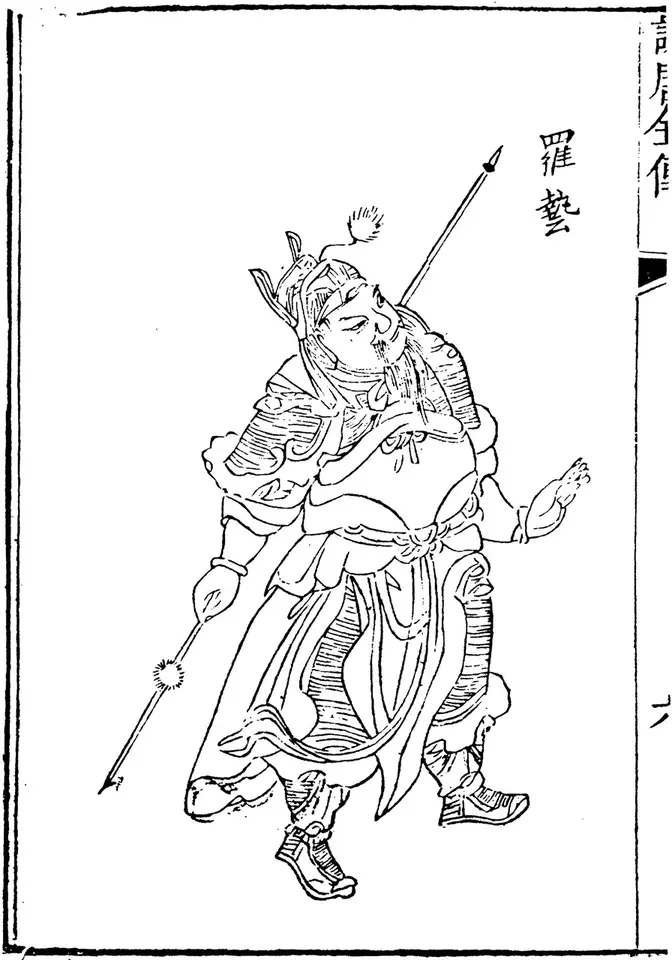
罗艺
Luo Yi (罗艺, died 627), original name Ziyan, courtesy name Yanchao (also Ziting), was a prominent regional warlord and general during the transition from Sui to Tang, tracing his ancestral home to Xiangyang County in Xiangzhou and later settling in Yunyang of Jingzhao. Born into a military household as the son of Sui Palace Gate General Luo Rong, Luo was cunning, aggressive, and skilled in horsemanship and mounted archery.…
Luo Yi (罗艺, died 627), original name Ziyan, courtesy name Yanchao (also Ziting), was a prominent regional warlord and general during the transition from Sui to Tang, tracing his ancestral home to Xiangyang County in Xiangzhou and later settling in Yunyang of Jingzhao. Born into a military household as the son of Sui Palace Gate General Luo Rong, Luo was cunning, aggressive, and skilled in horsemanship and mounted archery. Rising through military merit during the Daye era of Sui, he attained the rank of Commander of the Tiger Ferocity at Zhuojun. Amidst the collapse of the Sui dynasty, Luo expelled the imperial garrison directors, proclaimed himself Area Commander of Youzhou, and consolidated control over You and Ying provinces, rejecting overtures from rival warlords Yuwen Huaji, Dou Jiande, and Gao Kaidao, and executing Yuwen's envoy to observe three days of official mourning for Emperor Yang. In 619, recognizing the rising ascendancy of the Tang court, Luo submitted to Emperor Gaozu of Tang, receiving exceptional imperial favor, the imperial surname Li, and the title Commandery Prince of Yan, along with inclusion in the imperial clan register. In 620, when Dou Jiande attacked Youzhou with one hundred thousand troops, Luo utilized ambushes to crush the invading host. He subsequently joined Qin Prince Li Shimin to defeat Liu Heita, advancing to Grand General of the Left Wing Guard, before being dispatched to guard Jingzhou against the Turks as General of Heavenly Seasons, covertly aligning himself with Crown Prince Li Jiancheng. Following the Xuanwu Gate Incident and Emperor Taizong's accession, Luo was appointed to Open the Office with Equal Rank to the Three Excellencies. Anxious over his past factional hostility toward the new emperor and swayed by superstitious prophecies, Luo launched a rebellion at Binzhou in the first month of 627. Imperial armies under Zhangsun Wuji and Yuchi Jingde moved against him; abandoned by his troops, Luo fled toward the Turks and was slain by his retainers at the Wushi Postal Relay, his severed head displayed in the capital.
Promoted to Commander of the Tiger Ferocity for meritorious battlefield service under Emperor Yang.
Stationed at Xinchang under General Li Jing during the Korean campaign, clashing with his superior.
Expelled garrison director Zhao Shizhu amidst imperial collapse, proclaiming himself Area Commander of Youzhou.
Executed Yuwen Huaji's envoy and observed three days of mourning for Emperor Yang upon news of his murder.
Submitted to Emperor Gaozu of Tang; granted the imperial surname Li and ennobled as Commandery Prince of Yan.
Annihilated Dou Jiande's one-hundred-thousand-strong army outside Youzhou using an ambush devised by Xue Wanjun.
Routed Liu Heita's brother Liu Shishan at the Xu River, joined Crown Prince Li Jiancheng at Mingzhou, and became Grand General.
Stationed at Jingzhou as General of Heavenly Seasons to deter Turkic raids, allying with Crown Prince Li Jiancheng.
Elevated to Open the Office with Equal Rank following Emperor Taizong's accession, remaining deeply anxious over past enmities.
Fabricated imperial orders to seize Binzhou; defeated by loyalist forces and beheaded by his retainers at Wushi Postal Relay.
Luo Yi was a native of Xiangyang County in Xiangzhou, whose family later relocated to Yunyang County in the Jingzhao metropolitan region. His father, Luo Rong, served the Sui dynasty as General of the Palace Gates. From his youth, Luo was thoroughly trained in horsemanship, mounted archery, and lance warfare. Fierce, cunning, and unbending in temperament, he lacked benevolence but excelled in offensive operations and personal courage on the battlefield.
During the middle of the Daye era of the Sui dynasty, Luo participated in numerous counterinsurgency campaigns and frontier engagements, rising through military distinction to the rank of Commander of the Tiger Ferocity. In 612, when Emperor Yang launched his massive expedition against Goguryeo, Luo was ordered to command detachments stationed at Xinchang in Beiping Commandery, operating under the overall jurisdiction of Right Militant Guard Grand General Li Jing. While Luo maintained rigorous discipline within his units and possessed sharp tactical instincts, his haughty and insubordinate character led him to repeatedly insult the veteran commander Li Jing. When Li Jing disciplined him according to military regulations, Luo harbored deep resentment, subsequently attempting to fabricate charges of treason against his commander, though the accusation was dismissed for lack of evidence.
As the Sui dynasty collapsed into widespread civil war, rival warlords and insurgent confederations emerged across the empire. Zhuojun served as the primary supply depot for northern expeditions, housing vast arsenals, granaries, and tens of thousands of garrison troops, which made it a prime target for roving rebel armies. The imperial garrison directors, including Zhao Shizhu, Helan Yi, and Jin Wenyan, proved timid and incompetent in combat. In contrast, Luo Yi personally led his elite cavalry in frequent sorties against the raiding bands, slaying countless insurgents and establishing unquestioned authority among the local soldiers.
Envious of his rising influence, Zhao Shizhu and his colleagues plotted to eliminate Luo. Learning of their scheme, Luo exploited popular dissatisfaction, addressing the soldiers and citizens of Zhuojun: We have shed our blood to defend the frontier, yet the city granaries and treasuries are monopolized by the garrison commanders, who refuse to relieve the starving population. Enraged, the populace turned against the directors. Shortly thereafter, Luo led his army back into the city, seizing the commandery administrator as he emerged to welcome the troops. Threatening the gates in battle formation, Luo compelled Zhao Shizhu and the other commanders to submit. Luo then opened the state granaries to feed the destitute and distributed imperial silks to reward his soldiers, winning the complete devotion of the garrison. He formally proclaimed himself Area Commander of Youzhou, consolidating administrative and military control over You and Ying provinces.
In the third month of 618, following the assassination of Emperor Yang by Yuwen Huaji at Jiangdu, the usurper marched into Shandong and dispatched an envoy to demand Luo's submission. Luo sternly declared: I was an officer of the late emperor; with the sovereign murdered, I cannot submit to a traitor. He executed the envoy and ordered his troops to observe three days of official mourning for Emperor Yang. When rival northern lords Dou Jiande and Gao Kaidao sent envoys to court his alliance, Luo declared to his subordinates that Dou and Gao were mere bandits with whom no lasting enterprise could be achieved, whereas Duke of Tang Li Yuan had occupied the Guanzhong region in accordance with popular sentiment and was destined to establish an empire. He resolved to send envoys to Chang'an to submit to the Tang court.
In the tenth month of 619, Luo Yi dispatched an official memorial formally offering his allegiance to the Tang dynasty. Emperor Gaozu was delighted and issued a decree appointing Luo Area Commander of Youzhou, creating him Commandery Prince of Yan, bestowing the imperial surname Li, and entering his lineage into the imperial clan register. From that time, Luo adopted the name Li Yi.
In 620, having annexed Jizhou, Dou Jiande, the King of Xia, mobilized an army of one hundred thousand troops to lay siege to Youzhou. Remaining composed, Luo adopted an operational plan devised by his subordinate commanders Xue Wanjun and Xue Wanche. Deploying weakened units to form defensive lines with their backs to the city walls and waterways, Luo baited the enemy forward. As Dou's forces were crossing the river, Xue Wanjun charged from the city flank with several hundred elite cavalry, smashing into the disordered enemy columns. Dou's army broke into general retreat, unable to approach the ramparts. When Dou detached columns to assault neighboring outposts, Luo's cavalry intercepted them in a series of engagements lasting over one hundred days, forcing Dou to withdraw in defeat to Leshou.
In 622, when Prince of Qin Li Shimin marched to suppress the insurrection of Liu Heita, Luo led several tens of thousands of his northern troops southward to coordinate with the main army. At the Xu River, Luo struck the column commanded by Liu Heita's younger brother Liu Shishan, capturing and executing eight thousand enemy troops. Several months later, when Liu Heita returned with Turkic cavalry, Luo joined forces with Crown Prince Li Jiancheng at Mingzhou to bring about Liu's final defeat. Visiting the capital in triumph, Luo was received with high honors by Emperor Gaozu and appointed Grand General of the Left Wing Guard.
Conscious of his extensive military achievements, Luo grew arrogant and dismissive of court protocol. While residing in Chang'an, he formed a close alliance with Crown Prince Li Jiancheng, becoming deeply entangled in the factional struggle over imperial succession. When retainers and officers of Prince of Qin Li Shimin passed through Luo's military encampment, Luo ordered them detained and beaten without provocation. Incensed, Emperor Gaozu had Luo imprisoned and placed on trial, though he was eventually pardoned in consideration of his past services.
As the Eastern Turkic Khaganate intensified its raids along the northern border, Emperor Gaozu, mindful of Luo's formidable martial reputation among nomadic tribes, appointed him commander of the Heavenly Seasons Army to garrison Jingzhou, fortifying strategic passes at Huating and Danzheng Gorge to defend the Guanzhong approaches. In the sixth month of 626, following the Xuanwu Gate Incident, Li Shimin eliminated Crown Prince Li Jiancheng and ascended the throne as Emperor Taizong. Although Emperor Taizong elevated Luo to Open the Office with Equal Rank to the Three Excellencies with a fief of twelve hundred households, Luo remained gripped by fear and suspicion, aware that his past hostility toward the new monarch left him in extreme political danger.
During this period, a sorceress named Lady Li from Jiyin, claiming communion with spirits, gained widespread influence in the region. Visiting Luo's residence, she examined the features of Luo's wife, Lady Meng, declaring that her physiognomy foretold she would become the mother of the realm. Lady Meng then had the sorceress examine Luo Yi; the woman flattered him by claiming his imperial fortune would soon reveal itself. Deeply influenced by these predictions, Lady Meng urged Luo to revolt.
On the seventeenth day of the first month of 627, Luo decided upon rebellion. Falsely claiming that he had received secret imperial decrees to lead troops to the capital, he mobilized his garrison and seized the regional administrative seat of Binzhou, imprisoning the loyalist prefect. Emperor Taizong dispatched Minister of Personnel Zhangsun Wuji and Grand General of the Right Militant Guard Yuchi Jingde to lead a punitive expedition.
Before the imperial army arrived at Binzhou, local administrator Zhao Cihao and military officer Yang Ji organized an internal resistance. When the conspiracy was discovered, Luo imprisoned Zhao, but Yang Ji launched an assault from outside the gates. Luo's army disintegrated, and he abandoned his family, fleeing with several hundred horsemen toward the Turkic frontier. Arriving at the Wushi Postal Relay near the borders of Ningzhou, his remaining escorts abandoned him. His closest attendants turned upon him, slaying him within the station and conveying his severed head to Chang'an. Emperor Taizong ordered his head exhibited in the Western Market, stripping him of the imperial surname Li and restoring his original name Luo Yi. His wife Lady Meng, the sorceress Lady Li, and his brother Luo Shou, Regional Commander of Lizhou, were all executed.
Amidst the chaos of the late Sui dynasty, Luo Yi emerged as a capable military leader who stabilized the northeast. Confronted by the incompetence of imperial garrison directors in Zhuojun, he expelled the corrupt officials, distributed granary reserves to relieve the starving population, and rallied local soldiers, establishing order across You and Ying provinces. When pressured by the usurper Yuwen Huaji, he demonstrated personal integrity by executing the envoy and observing three days of formal mourning for Emperor Yang.
In 619, Luo recognized the mandate of the Tang dynasty and submitted peacefully, securing the vital northeastern gateway without imperial bloodshed. During the subsequent wars of unification, he defeated Dou Jiande's one-hundred-thousand-strong army through coordinated ambushes outside Youzhou, and later destroyed Liu Heita's southern divisions at the Xu River, providing indispensable operational support for the Tang consolidation of the Central Plains.
Luo's reputation for ferocity in combat made him widely feared among the nomadic tribes of the northern steppe. Commissioned as General of Heavenly Seasons to command the Jingzhou frontier, he fortified passes along the northern approaches, maintaining a vigilant defense that deterred Turkic cavalry from penetrating the Guanzhong heartland during the final years of the Wude era.
Luo's career offered an enduring historical lesson on the dangers of overweening pride and political factionalism. Aligning himself with Crown Prince Li Jiancheng and mistreating the retainers of Li Shimin, he found himself isolated following the Xuanwu Gate Incident. Succumbing to paranoia and superstitious flattery, he staged a reckless revolt that ended in abandonment and death at the Wushi Postal Relay, standing as a stark example of a talented general destroyed by personal flaws and political miscalculation.
FIGURES ASSOCIATED WITH THIS DYNASTY