European Origins
Born in Spinazzola, Kingdom of Naples; completed doctorates in both civil and canon law at Naples.
罗明坚
Luo Mingjian (罗明坚, Michele Ruggieri, 1543–1607), courtesy name Fuchu, was an Italian Jesuit missionary, legal scholar, and sinologist from Spinazzola in the Kingdom of Naples, who served as the trailblazing pioneer of cultural exchange between China and the West during the Wanli reign of the Ming Dynasty. Holding doctorates in civil and canon law from the University of Naples, he abandoned a court career to join the Society…
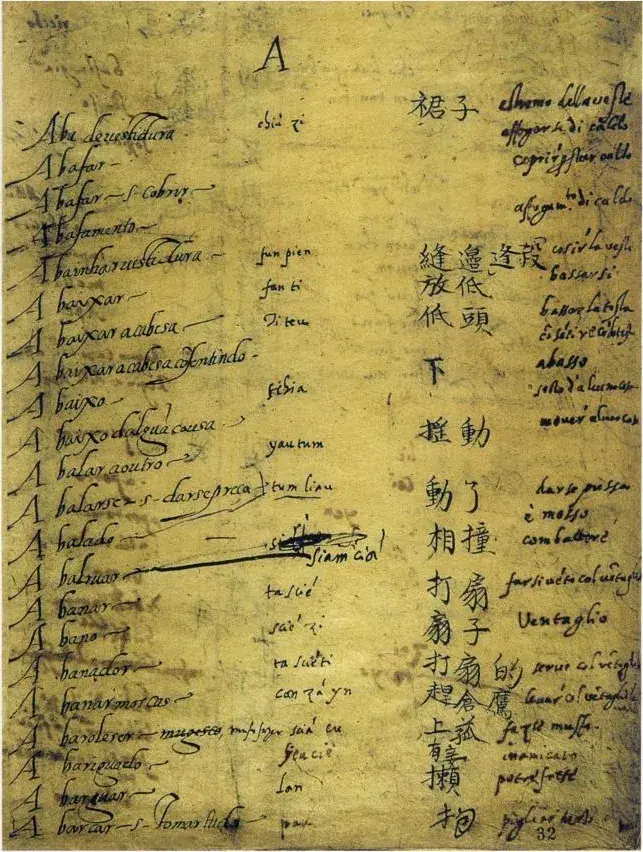
Luo Mingjian (罗明坚, Michele Ruggieri, 1543–1607), courtesy name Fuchu, was an Italian Jesuit missionary, legal scholar, and sinologist from Spinazzola in the Kingdom of Naples, who served as the trailblazing pioneer of cultural exchange between China and the West during the Wanli reign of the Ming Dynasty. Holding doctorates in civil and canon law from the University of Naples, he abandoned a court career to join the Society of Jesus. Assigned to Macau in 1579, he became the first Catholic missionary explicitly instructed by Visitor Alessandro Valignano to master the Chinese language, customs, and administrative etiquette. In autumn 1583, authorized by Viceroy Guo Yingpin and Prefect Wang Pan, Ruggieri and the young Matteo Ricci secured official permission to settle in Zhaoqing, Guangdong, where they founded the Xianhua Temple, the first Catholic establishment in mainland China. Collaborating with Ricci, Ruggieri compiled the Portuguese-Chinese Dictionary (Dicionário Português-Chinês), the first European-Chinese bilingual dictionary featuring a pioneering romanized phonetic transcription of Ming official speech (Mandarin). He also translated The Great Learning (Daxue) into Latin, inaugurating Western academic sinology. Returning to Rome in 1588 to lobby for an official papal embassy to the Ming court, he spent his retirement in Salerno producing monumental maps of China until his death in 1607 at age sixty-four.
Born in Spinazzola, Kingdom of Naples; completed doctorates in both civil and canon law at Naples.
Relinquished civil advancement at the viceregal court to take solemn vows in the Society of Jesus in Rome.
Dispatched to Macau by Alessandro Valignano, commencing intensive immersion in Mandarin and Chinese literacy.
Journeyed to Canton during trade fairs, winning administrative clearance through refined mastery of Chinese protocol.
Entered Zhaoqing with Matteo Ricci, purchasing land with prefectural approval to build the Xianhua Temple.
Published the first Chinese Catholic catechism and collaborated with Ricci on the pioneering Portuguese-Chinese Dictionary.
Dispatched back to Rome to petition the papacy for a formal diplomatic embassy to Beijing; delayed by papal conclaves.
Passed away in Salerno at age sixty-four, leaving behind extensive manuscripts and cartographic surveys of Ming China.
Michele Ruggieri was born in 1543 in Spinazzola, in the Kingdom of Naples. Exhibiting intellectual acuity from boyhood, he studied jurisprudence at the University of Naples, culminating in doctorates in both civil and canon law (Doctor Utriusque Juris). Following graduation, he entered the administration of the Spanish Viceroy of Naples, gaining valuable diplomatic experience.
However, amidst the spiritual currents of the Counter-Reformation, Ruggieri abandoned worldly advancement. In 1572, he joined the Society of Jesus in Rome. Ordained a priest in Lisbon in 1578, he volunteered for the Asian maritime missions. At this juncture, the Jesuit Visitor to the East Indies, Alessandro Valignano, concluded that previous attempts to penetrate China had foundered due to European cultural arrogance and language barriers. Valignano resolved that only missionaries thoroughly trained in the Chinese language and respectful of Confucian etiquette could secure lasting acceptance. Ruggieri's formidable legal background, linguistic facility, and diplomatic poise marked him as the ideal scholar to execute this strategic transformation.
In July 1579, the seventh year of Emperor Wanli's reign, Ruggieri arrived in Macau. He was the first missionary to implement Valignano's cultural accommodation policy systematically. In his quarters, Ruggieri engaged Chinese tutors, studying colloquial Mandarin, calligraphy, and classical texts. Applying his legal training to phonetic analysis, he rapidly acquired functional command of written and spoken Chinese.
Between 1580 and 1582, taking advantage of biannual trade fairs, Ruggieri made three visits to Guangzhou. Dressed in modest garments and displaying impeccable observance of Confucian etiquette, he presented petitions to the Coast Defense Vice Commissioner and provincial authorities, dispelling official suspicions regarding foreign merchants. In autumn 1583, the newly appointed Prefect of Zhaoqing, Wang Pan, and Viceroy Guo Yingpin granted formal authorization for Ruggieri and his junior colleague Matteo Ricci to establish permanent residence in Zhaoqing. Near the Chongxi Pagoda, they constructed a residence known as the Xianhua Temple, inaugurating the first legal, permanent Catholic mission in the Chinese interior.
In Zhaoqing, Ruggieri and Ricci initially adopted Buddhist robes to conform to local expectations of foreign ascetics, but their intellectual discourse was firmly rooted in Confucian concepts. Ruggieri understood that to win over the Confucian scholar-gentry, the mission required high-quality printed literature in classical Chinese.
In 1584, supported and refined by Prefect Wang Pan, Ruggieri published Tianzhu Shengjiao Shilu (True Record of the Holy Religion of the Lord of Heaven), the first Catholic catechism printed in China. Composed in dialogue format accessible to literati, the work blended Christian theology with Confucian filial piety and moral benevolence, circulating widely throughout Guangdong, Fujian, and Zhejiang.
Concurrently, Ruggieri undertook a foundational linguistic endeavor. Between 1583 and 1588, working closely with Ricci and Chinese convert Zhong Mingren, he compiled the monumental Portuguese-Chinese Dictionary (Dicionário Português-Chinês). This manuscript represented the first bilingual dictionary connecting a European language with Chinese. Crucially, Ruggieri developed a systematic Latin-alphabet phonetic transcription system that marked the tonal distinctions of late Ming official Mandarin, laying the structural groundwork for modern romanization. Furthermore, within the same manuscript, Ruggieri produced the first known Latin translation of The Great Learning (Daxue), initiating the scholarly translation of Confucian classics into European languages.
In 1588, recognizing that local permissions remained vulnerable to arbitrary bureaucratic shifts, Valignano instructed Ruggieri to return to Rome. His mission was to persuade Pope Sixtus V to dispatch a formal diplomatic legation to the Wanli Emperor in Beijing, thereby providing imperial treaty guarantees for the mission.
Ruggieri returned to Europe in 1589. However, the subsequent years witnessed extraordinary instability in the Holy See; four popes died in rapid succession within two years, paralyzing Vatican diplomacy and causing the planned Chinese embassy to be indefinitely shelved. Acknowledging that political circumstances precluded his return to Asia, Ruggieri retired to the Jesuit house in Salerno.
In southern Italy, Ruggieri devoted his remaining eighteen years to Chinese studies. He drafted the extensive Atlas of China, incorporating thirty-three hand-drawn maps that detailed the two metropolitan regions and thirteen provinces of the Ming Dynasty, annotated with demographic and administrative data. He also translated classical Chinese verses into Latin poetry. On May 11, 1607, Ruggieri passed away peacefully in Salerno at the age of sixty-four. Although Matteo Ricci's subsequent achievements in Beijing garnered greater fame, modern historians universally affirm that Ricci's breakthroughs stood upon the foundational linguistic, diplomatic, and institutional groundwork painstakingly prepared by Michele Ruggieri.
FIGURES ASSOCIATED WITH THIS DYNASTY