Born into Literati Family
Born in Jishui, Jiangxi; named Hongxian by his father, who was departing to superintend canal flood control.
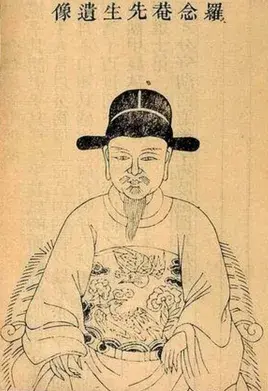
罗洪先
Luo Hongxian (罗洪先, November 20, 1504 – September 19, 1564), courtesy name Dafu and art name Nian'an, was a native of Jishui County, Ji'an Prefecture, Jiangxi Province. He was an eminent Ming dynasty Neo-Confucian philosopher, geographer, cartographer, and prose essayist, as well as a cornerstone leader of the Jiangyou branch of the School of Heart-Mind (Wang Yangming school). In 1529, he achieved first place (Zhuangyuan) in…
Luo Hongxian (罗洪先, November 20, 1504 – September 19, 1564), courtesy name Dafu and art name Nian'an, was a native of Jishui County, Ji'an Prefecture, Jiangxi Province. He was an eminent Ming dynasty Neo-Confucian philosopher, geographer, cartographer, and prose essayist, as well as a cornerstone leader of the Jiangyou branch of the School of Heart-Mind (Wang Yangming school). In 1529, he achieved first place (Zhuangyuan) in the imperial palace examination and was appointed Senior Compiler in the Hanlin Academy. Known for his uncompromising uprightness, he requested sick leave the following year to attend to his parents and cultivate moral learning in his native place. Later recalled to imperial service as Left Supporter in the Supervisorate of Imperial Instruction to tutor the Crown Prince, he co-authored a memorial urging Emperor Shizong (Jiajing) to grant audiences to the heir apparent and rectify palace governance. This incurred the monarch's furious wrath, leading to his dismissal from the bureaucracy and stripping of his official status. Returning home as a commoner, he repeatedly turned down invitations from Senior Grand Secretary Yan Song to return to ministerial office, remaining steadfastly retired for the rest of his life. He applied his intellect to diverse disciplines, mastering astronomy, historical geography, water conservancy, and military defense, winning renown for scientific cartography. Drawing upon the fourteenth-century geographic masterwork of Zhu Siben, Luo devoted over a decade of fieldwork and archival research to compiling the Guang Yu Tu (Enlarged Terrestrial Atlas) around 1541. Systematically implementing the coordinate grid method ("drawing squares to calculate miles") and inventing standardized cartographic legends, the atlas became the first comprehensive scientific provincial atlas in Chinese history. In philosophical inquiry, he championed "maintaining tranquility" (zhujing) as the disciplined path to realizing innate moral knowledge, wielding enduring influence throughout the late Ming intellectual world.
Born in Jishui, Jiangxi; named Hongxian by his father, who was departing to superintend canal flood control.
Heard of Wang Yangming's lectures in southern Jiangxi and copied the Instructions for Practical Living by hand to study day and night.
Passed initial civil exams to become a county student in Jishui, immersing himself in the Confucian Classics.
Passed the Jiangxi provincial examination as a provincial graduate (Juren); postponed national exams due to his father's illness to study under scholar Li Zhong.
Placed first in the metropolitan and palace examinations, personally selected by Emperor Shizong, and appointed Senior Compiler in the Hanlin Academy.
Weary of bureaucratic flattery and superficial court rhetoric, requested leave to return to Jishui to nurse his health and serve his parents.
Recalled to the capital as Left Supporter of the Supervisorate of Imperial Instruction to serve as reader for the Crown Prince.
Jointly submitted a memorial with Tang Shunzhi and Zhao Shichun urging the emperor to receive the Crown Prince; dismissed and stripped of official status.
Completed the draft of Guang Yu Tu, transforming Zhu Siben's ancient chart into a standardized scientific atlas.
Cleared Shilian Cave to lecture to scholars, advocating sitting in meditation and establishing the Jiangyou emphasis on tranquility.
Declined Tang Shunzhi's invitation to join coastal defense staff against pirates, and turned down Grand Secretary Yan Song's overtures.
Audited local population registries to relieve taxation burdens, established waterborne granaries for famine relief, and organized river defenses against bandits.
Undertook critical editing of Wang Yangming's chronological biography brought by Qian Dehong and authored its celebrated preface.
Passed away peacefully in an upright seated posture at the Zhizhi Abode in Songyuan at the age of sixty-one.
Posthumously granted the rank of Sub-director of the Court of Imperial Entertainments, conferred the posthumous title Wenzhuang, and enshrined in local shrines.
Luo Hongxian was born on November 20, 1504, in Gucun, Jishui County, Ji'an Prefecture, Jiangxi. His father, Luo Xun, was a Jinshi degree-holder who had just been transferred from magistrate of Baihe County to director in the Ministry of Works to oversee flood-prevention engineering along the canal in Lulianghong. In commemoration of this civic assignment, the infant was named Hongxian, embodying aspirations for hydraulic tranquility and public welfare. Naturally gifted, Luo was slender in stature with sharp, composed facial features, clear brows, focused eyes, and a resounding voice.
At eight, under the guidance of his maternal grandfather, he practiced poetic couplet matching with remarkable eloquence and wit. His grandfather stroked his head and predicted that he would surely grow into an outstanding Pillar of the State. At nine, he entered a private tutorial school to study classical syntax. Within three years, he had thoroughly mastered the Classic of Documents (Shangshu) and secretly read through past prose anthologies, forming profound admiration for Ming scholar Luo Lun, whose unyielding integrity he adopted as his personal compass.
In 1518, when Luo was fifteen, Wang Yangming was serving as grand coordinator in southern Jiangxi, expounding the philosophy of mind and innate moral intuition. Luo was deeply moved by these teachings, coming to view examination prestige and official rank as trivial pursuits. He often shut himself in his room to sit in silent introspection. His roommates frequently mocked him by calling him "Luo the Moralist," yet he remained entirely unaffected. Upon obtaining a woodblock copy of Instructions for Practical Living, he transcribed it by hand and studied it untiringly day and night.
Beyond the School of Heart-Mind, Luo also thoroughly examined the writings of Northern Song masters including Zhou Dunyi, Cheng Hao, Cheng Yi, and Southern Song thinker Zhu Xi. He scrutinized theoretical lineages while actively training his own physical and mental discipline in daily conduct. In an era dominated by worldly competition for fame and profit, Luo constantly measured his thoughts against the conduct of ancient sages, earning growing respect among local scholars despite his youth.
In 1522, Luo passed the county examinations to become a government student in Jishui. In the autumn of 1525, he passed the provincial examinations with distinction. Although scheduled to sit for the metropolitan examinations in the capital the following spring, he gave up the opportunity when his father fell severely ill, remaining at home to attend to his medication. During this period, retired imperial censor Li Zhong was residing in Ji'an; Luo, accompanied by fellow scholars Wang Luzhi and Zhou Zigong, formally became Li's student to study the Classics and moral cultivation.
In the spring of 1529, Luo journeyed to Beijing and passed the metropolitan examination. In April, during the palace examination, he submitted a policy treatise boldly arguing that the root of good governance lay in the sovereign's moral vigilance and receptivity to honest counsel, addressing imperial governance directly. Emperor Shizong personally reviewed the paper and praised its lucid logic and fearless counsel, ranking him first among all candidates as Zhuangyuan and conferring upon him the post of Senior Compiler in the Hanlin Academy.
Placed at the center of the imperial academy, Luo witnessed firsthand the factional intrigues of powerful ministers and the decadent pursuit of flattery by court officials, which caused him deep dismay. Possessing an unyielding and reclusive temperament, he refused to visit the private residences of senior ministers and loathed composing ornamental bureaucratic prose. In 1530, having served for only one year, he submitted a memorial requesting sick leave under the pretext of frail health and the need to nurse his aging mother, securing imperial permission to return south.
Back in Jishui, Luo closed his doors to social callers and constructed the Yun Guan study south of the town, dedicating himself to study and filial care. He shifted his scholarly focus from literary composition to statecraft disciplines, exhaustively examining celestial movements, historical geography, water conservancy, border fortifications, and military strategy. He frequently spread ancient maps across his desk, comparing historical boundaries with mountain defiles to identify strategic patterns, firmly anchoring his scholarship in practical statecraft.
During this period, he attended to his parents every morning and evening while discussing practical learning with local scholars during his leisure hours. He insisted that the true purpose of reading was to understand human virtue and resolve national difficulties, rather than pursuing selfish honors or verbal exhibitionism. Many talented youths from surrounding counties visited Yun Guan to seek his guidance, and Luo received them warmly, urging them toward moral integrity and civic duty.
In 1532, his father Luo Xun passed away. Luo observed mourning rites for three full years in strict accordance with classical prescriptions, sleeping on a straw mat with a clod of earth for a pillow and grieving deeply. Throughout this period of mourning, he reflected deeply on human nature, contemplating the authentic moral feeling underlying funeral ceremonies. Following the completion of mourning, he showed no inclination to return to the civil service, remaining in his village to nurse his elderly and ailing mother, winning widespread praise for his filial devotion.
At that time, Neo-Confucian studies flourished throughout Jiangxi. Prominent disciples of Wang Yangming, such as Zou Shouyi, Ouyang De, Nie Bao, Peng Zan, and Liu Bangcai, were residing in their native villages after official service. Sharing identical scholarly convictions, Luo met frequently with them at Qingyuan Mountain, Bailuzhou Academy, and Yangming Academy. Scholars traveled from far and wide with their books, and audiences at these gatherings frequently numbered in the hundreds.
Among these learned discussions, Luo proved the most humble and modest. He never flaunted his Zhuangyuan status before peers; when academic disagreements arose, he presented his arguments with gentleness and dispassionate reasoning. His Jiangyou contemporaries admired his solemn bearing and steadfast practice, recognizing him as a premier intellectual figure of the Wang School. During this era, he repeatedly deliberated the essence of innate knowledge, becoming convinced that without rigorous mental tranquility, intellectual cleverness would degenerate into superficial posturing.
In 1539, Emperor Shizong issued an edict to select scholarly Hanlin officials of upright character to serve in the Supervisorate of Imperial Instruction to tutor the Crown Prince. The Ministries of Personnel and Rites unanimously recommended Luo, prompting an imperial summons appointing him Left Supporter in the Supervisorate. However, Emperor Shizong had become obsessed with Daoist rituals and elixirs, residing secluded in the Western Park and neglecting imperial audiences, leaving administrative matters in the hands of entrenched grand secretaries.
Luo observed with dismay the deterioration of administrative discipline; although the Crown Prince had been designated, he was denied access to his imperial father and lacked structured ethical guidance, causing widespread anxiety across the empire. In the winter of 1540, Luo conferred with Director of the Household Tang Shunzhi and Secretary of the Ministry of Revenue Zhao Shichun, agreeing that they must fulfill their remonstrance duties regardless of mortal peril. Together, they submitted a joint memorial requesting regular audiences between the sovereign, the Crown Prince, and court ministers.
Upon reading the memorial, Emperor Shizong flew into a fury, accusing the petitioners of meddling in palace affairs, alienating imperial kin, and attempting to form a faction. He issued a harsh edict stripping Luo, Tang, and Zhao of all official ranks and dismissing them to commoner status forever. This imperial purge shocked the capital; literati deeply admired the trio's courage, honoring them informally as the "Three Worthies of Jiajing." Receiving the edict with composure, Luo packed his books and lute and departed the capital that same day to return south.
In 1542, following his return to Jishui, his younger brothers Luo Shouxian and Luo Juxian proposed dividing the family estate. Luo willingly relinquished all prime ancestral farmland and spacious residential compounds to them, reserving for himself only a small patch of barren ground outside the estate where he built a humble thatch dwelling named Yun Guan. In village life, he upheld strict personal rectitude, declining to petition local magistrates for private favors while fearlessly advocating for public welfare. Learning that commoners were burdened by false cadastral taxation, he petitioned the governor-general to remeasure the county's fields.
Soon afterward, his second brother fell critically ill, and Luo exhausted his savings to nurse him and summon physicians. When his brother passed away, Luo was grief-stricken, losing sleep and appetite. After the funeral, seeking to dispel his sorrow, he traveled alone to Hunan to ascend Mount Heng. Reaching Zhurong Peak, the mountain's highest summit, he burned incense before the mountain shrine and the memorial altar of early Ming philosopher Chen Xianzhang, pledging to dedicate his remaining years to sage learning.
Below Zhurong Peak lay the perilous Huixian Bridge, beyond which jutted a solitary rock barely two feet wide hanging over a sheer abyss, terrifying ordinary sightseers. Luo stepped calmly onto the rock, seated himself, and sang loudly into the mountain wind with supreme composure. Descending past Guanyin Cliff, he met the monk Chushi, who was struck by his dignified bearing and offered to transmit an esoteric Daoist alchemical formula. Luo politely declined, remarking: "My own mind already possesses the sufficient true Way; why should I seek external elixirs?"
In 1546, while escorting his younger brother Luo Juxian to the Imperial College in Nanjing, Luo passed through Piling to visit his disgraced former colleague Tang Shunzhi. The two companions spent the night by lamplight discussing statecraft and inner cultivation, finding their minds in perfect harmony and talking until daybreak. In October, upon his return to Jiangxi, Luo discovered a deep grotto in the western hills of Jishui, previously occupied by wild beasts. He personally led laborers in clearing the brambles, removing debris, and chiseling stone steps.
Once cleared, the cave interior proved capable of holding over a hundred people, while its stone cliffs clustered like the petals of an open lotus, prompting Luo to name it "Shilian Cave" (Stone Lotus Cave). Thereafter, he resided in the cave for extended periods, immersed in meditation and study. Disciples of the Wang school, including Qian Dehong and Wang Ji, traveled great distances to join him. At Qingyuan and Longhu mountains, Luo instructed them on extirpating selfish desires and proposed establishing permanent assembly centers for scholars.
One day, while sitting in deep contemplation within the cave, Luo broke into a sudden profuse sweat, experiencing an immediate dissolution of inner attachments and attaining comprehensive spiritual clarity regarding the unaroused state of innate moral knowledge. Magistrate Wang Zhigao admired his virtue and, observing that disciples crowded the cave without lodging, refurbished the Xuelang Pavilion beside the county's deep pools as a lecture hall. There Luo expounded the Four Books and inner mental cultivation, elevating Jiangyou Neo-Confucian scholarship to its apex.
While lecturing at Xuelang Pavilion, Luo gained intimate knowledge of commoners' burdens. In Jishui, official grain tax depots were located within the elevated district seat; peasants had to transport grain over long overland distances, resulting in grain mixed with sand and chaff. When shipped at the Gan River docks, corrupt clerks rejected the shipments for impurity and levied exorbitant transport surcharges, forcing local transport agents to sell their lands to cover losses, ruining numerous households.
Distressed by this exploitation, Luo submitted a proposal to Magistrate Wang Zhigao, volunteering to organize villagers in constructing a new waterfront transport granary directly along the Gan River piers. County authorities permitted peasants to weigh and submit grain directly at the river depot, eliminating intermediate overland transport and clerk extortions, bringing immense relief to the county's agricultural population.
After building the riverfront granary, Luo personally formulated rigorous management guidelines. He mandated that grain transactions be overseen by two upright elders elected by the community in presence of the farmers, with daily accounting posted publicly outside the depot and clerks barred from interfering. This transparent system eliminated fraudulent deductions and provided a lasting model for communal grain storage across southern China.
In the autumn of 1550, when Mongol troops under Altan Khan breached Gubeikou and besieged the capital, Luo spent sleepless nights in anguish. An acquaintance sent a letter urging him to pursue Daoist immortal transcendence to escape political turmoil, which Luo indignantly rebuffed. Writing to his disciple Guo Yingkui, he elucidated the Mengzian proofs of innate goodness—the child falling into a well, filial affection, and morning tranquility—stressing that scholars must cultivate virtue amidst active life rather than abandoning societal responsibilities.
In 1551, Luo reached the age of fifty. Reflecting on his lifelong spiritual path, he composed his famous poem Reflections at Fifty (Banbai Yin), examining his spiritual progress and reminding himself to eliminate even the subtlest selfish inclinations. In 1554, wokou pirate raids ravaged the coastal provinces of Jiangsu, Zhejiang, Fujian, and Guangdong, devastating communities along thousands of miles of shoreline.
Grand Coordinator Li Sui was tasked with organizing southern defenses. Aware of Luo's mastery of military strategy and topography, Li dispatched an envoy seeking his counsel on anti-pirate operations. Despite his status as an outcast commoner, Luo immediately penned a comprehensive memorial analyzing pirate tactics, advising the deployment of trained naval squadrons, control of strategic river mouths, appointment of valiant commanders, and rigorous mutual-surveillance checks against spies. Li implemented these strategies with notable success.
In 1555, fellow scholar Wang Zongmu was appointed to supervise sea transport of grain and sought Luo's counsel. Luo observed that frequent siltation along the Yellow River and Grand Canal made inland transport unreliable, making the revival of Yuan dynasty maritime routes essential. He shared his decades of research into Zhu Siben's navigational charts, detailing coastal channels, shoals, and reef hazards, presenting annotated maps to Wang that provided crucial reference for reviving late Ming sea grain transport.
In January 1558, Tang Shunzhi was appointed grand coordinator to oversee anti-pirate military operations north of the Yangtze. Passing through Qiyun Cliff, he invited Luo to join his headquarters staff. Luo declined gracefully: "Matters of state are carried out by whoever steps forward; since you have assumed the burden, it is as though I am present myself. Why must I serve in person?" Respecting his steadfast independence, Tang did not press further.
In 1559, Luo moved to Songyuan, naming his new studio "Tiren Tang" (Hall of Embodying Benevolence). Over decades of fraudulent reporting, Jishui's tax registers had become grossly distorted, concentrating labor levies unfairly upon impoverished peasants. Luo confronted local authorities and directed a comprehensive household census, authoring Record of Verifying the Census (He Ding Ji), which reduced fabricated population counts to a verified seventy thousand, equalizing taxes across the district. Senior Grand Secretary Yan Song wrote to invite him to accept a ministerial post, but Luo politely and firmly refused, earning Yan's admiration for his uncorrupted character.
That summer, several thousand bandits from Fujian and Guangdong invaded Ji'an Prefecture, defeating government garrisons and threatening Jishui. Though a civilian, Luo sent urgent dispatches to Surveillance Commissioner Wang Zongmu and Military Defense Circuit Duan Tibing for military reinforcements. He personally organized local community defense units along strategic Gan River crossings, commanding dozens of armed skiffs to patrol the waterway day and night. Finding the river defenses impregnable, the bandits withdrew without crossing, preserving Jishui from devastation.
Following the bandit suppression, Luo declined all social visits due to illness, retiring to the Zhizhi Abode in Songyuan. He fashioned a simple wooden couch where he sat in silent daily contemplation, exploring the doctrine of "knowing where to rest" (zhizhi) drawn from the Classic of Documents. He maintained that when one recognizes proper limits, desires cease and the mind becomes clear, achieving spiritual harmony. Although keeping his doors shut, he meticulously answered scholarly letters from across the realm and remained deeply concerned for imperial security.
During this era, noting that fellow scholar Nie Bao's doctrine of "returning to silence" tended toward lifeless passivity, Luo engaged him in deep correspondence, authoring the three-part Treatise on Heterodoxy (Yiduan Lun) to expose how Buddhist detachment abandoned fundamental human relationships and practical governance. In 1560, tax officials invited him to oversee the verification of the county's Yellow Registers; seated in a simple room, he interviewed widows and impoverished commoners directly, eradicating corrupt manipulation by wealthy clans.
In May 1563, Luo suffered an attack of wind-cold accompanied by forgetfulness, recovering the next month. Zhezhong scholar Qian Dehong traveled from afar carrying the draft manuscript of Wang Yangming's chronological biography, requesting Luo's editorial supervision. Disregarding his infirmity, Luo worked through the night to verify Wang's biographical records, authoring a celebrated ten-thousand-word preface outlining three progressive stages of scholarship, which became an indispensable foundational text in Yangming studies.
In the spring of 1564, Luo's illness deteriorated, with heavy phlegm and laboured breathing. Yet he remained calm, sitting upright upon his wooden couch in inner reflection without fear of death. He wrote parting admonitions to his family, strictly forbidding Daoist or Buddhist rituals during his upcoming funeral and mandating strict adherence to classical Confucian rites.
On the Mid-Autumn Festival (August 15 of the lunar calendar), Luo sensed his departure was at hand. At dawn, he bathed, donned fresh robes, and assembled his family and disciples beside his couch. In a tranquil voice, he exhorted them to prioritize moral rectitude over superficial rhetoric, making no mention of property or estate matters.
At noon, straightening his cap and robes, Luo Hongxian sat cross-legged upon his wooden couch, closed his eyes with a serene smile, and passed away at sixty-one. In 1567, Emperor Muzong (Longqing) ascended the throne and rehabilitated upright officials of the Jiajing reign, posthumously granting Luo the rank of Sub-director of the Court of Imperial Entertainments, conferring the posthumous title Wenzhuang, and enshrining his tablet in local and provincial shrines.
Luo achieved historic breakthroughs in geography and cartography; his masterpiece, Guang Yu Tu (Enlarged Terrestrial Atlas), is universally celebrated as the first comprehensive scientific provincial atlas in Chinese history. Ming official maps, inherited from Song and Yuan predecessors, were riddled with omissions and lacked uniform coordinate systems, proving inadequate for frontier defense and civil administration. Drawing on Yuan cartographer Zhu Siben's Yu Di Tu (created over thirty years), Luo gathered local gazetteers and frontier reports, compiling the atlas over more than a decade.
Zhu's original scroll was seven feet long, making it unwieldy for desk study or military campaigns. Luo innovatively adopted a folded album format, dividing the massive national chart into forty-five separate regional and thematic maps. He systematically implemented the grid system ("drawing squares to calculate miles") and Pei Xiu's six cartographic principles, marking grid squares corresponding to precise distances on every sheet to establish mathematical proportionality between terrain features and actual travel distances.
Significantly, Luo invented a standardized system of cartographic symbols (legends) in Guang Yu Tu. He designed distinct geometric symbols to represent prefectures, subprefectures, counties, guard posts, mountain passes, beacon towers, peaks, and postal courier stations, replacing pictorial landscape conventions with objective cartographic standards. The work included general maps, provincial maps, frontier defense maps, sea transport charts, river systems, and charts of foreign territories, establishing an authoritative cartographic model for subsequent dynasties.
Luo also placed immense value on historical geography. Each map was accompanied by detailed expository essays describing administrative evolution, registered households, tax quotas, strategic defiles, garrison deployments, and tribute products. This integration of maps and analytical texts transformed the atlas into an indispensable statecraft handbook. The work was reprinted numerous times, spread to Korea and Japan, and won international acclaim from Western sinologists as a pinnacle of East Asian cartography.
In frontier military geography, Guang Yu Tu featured nine detailed maps of the Nine Frontier Garrisons, depicting walls, passes, forts, and beacon towers along Liaodong, Jizhou, Xuanfu, Datong, Shanxi, Yansui, Ningxia, Guyuan, and Gansu. The accompanying military treatise analyzed nomadic cavalry movement patterns and Ming garrison supply chains, offering realistic strategic recommendations that served as an essential operational manual for Ming commanders.
During his compilation work, Luo surveyed major river networks, including the Yellow River, Yangtze River, and Grand Canal. In his Yellow River Map and Canal Transport Map, he recorded water locks, rapids, reservoirs, and historical breach points, proposing comprehensive hydraulic strategies for embankment reinforcement and sediment dredging that reflected advanced geographical foresight and civic dedication.
In Ming intellectual history, Luo was recognized as a premier theoretician and leader of the Jiangyou branch of the Wang Yangming school. Following Wang Yangming's death, his disciples divided into two main camps: the Zhezhong branch, led by Wang Ji, emphasized "ontological spontaneity" and sudden enlightenment, which in later iterations drifted toward eccentric, nihilistic "wild Chan" tendencies; meanwhile, the Jiangyou branch, led by Luo Hongxian, Nie Bao, and Zou Shouyi, championed rigorous self-discipline and experiential practice.
To counter the intellectual laxity of degenerate followers, Luo advocated "maintaining tranquility" (zhujing) to restore the innate moral mind. He argued that before common people realize the pure moral essence, they risk mistaking selfish impulses for innate knowledge unless they undergo quiet introspection and mental refinement. He urged scholars to avoid external distractions and sit in silent meditation to perceive the balanced state of mind prior to emotional arousal, developing a disciplined foundation for active engagement in the world.
Luo authored the three-part Treatise on Heterodoxy (Yiduan Lun) to delineate the philosophical boundaries separating Confucianism, Buddhism, and Daoism. He pointed out that while Buddhism spoke of seeing one's nature, it ultimately abandoned cardinal social bonds and mundane governance in favor of quietist escape, whereas true Confucian moral knowledge found fulfillment in human relations and daily affairs. His rigorous arguments helped steer late Ming thought away from escapism toward practical ethics.
In ongoing debates with fellow scholar Nie Bao, Luo refined the dialectic between quietude and moral responsiveness. He opposed Nie's tendency to isolate quietude into an absolute state, arguing that "knowing where to rest" represented the natural balance of things rather than passive withdrawal. Through his personal practice at Shilian Cave and Zhizhi Abode, he integrated inner contemplation with social responsibility, solidifying the intellectual architecture of Jiangyou Neo-Confucianism.
Throughout his life, Luo upheld the principle of the "unity of knowing and acting," rejecting empty philosophical talk disconnected from common welfare. During his decades in retirement, he focused intensely on grassroots governance and humanitarian relief. By the mid-Ming era, Jishui's tax registers were plagued by corruption; wealthy landowners bribed clerks to hide prime lands, shifting heavy labor service onto destitute tenant farmers and causing severe social friction.
Stepping forward as a private citizen, Luo initiated and directed a comprehensive cadastral audit of the county. Overcoming resistance from entrenched gentry, he held open hearings in modest public quarters, interviewing impoverished families and verifying household figures throughout summer and winter. He successfully reduced inflated registered levies to seventy thousand actual adult males and composed Record of Verifying the Census (He Ding Ji), eradicating systemic tax abuses and offering a reform model for southern China.
In disaster relief and local security, Luo demonstrated exceptional logistical acumen and strategic vision. He pioneered a network of floating river granaries, circumventing bureaucratic pilferage and exorbitant haulage costs to distribute grain to starving refugees. When bandits invaded, he organized river defense flotillas to protect the prefecture. Through these actions, Luo demonstrated that true Neo-Confucian scholars were capable of practical crisis management and statecraft.
In mediating clan disputes and social conflicts, Luo consistently acted with fairness and rectitude. He implemented the community compact system (xiangyue) in Tongshui township, establishing rules for mutual assistance and moral encouragement to foster civic harmony. Local magistrates regularly sought his counsel on land disputes and administrative reforms, establishing Luo as an indispensable bridge between official administration and communal self-governance.
Luo possessed profound expertise in the natural sciences. Realizing that the official Datong Calendar, in use for over two centuries, had accumulated substantial predictive errors regarding celestial eclipses and planetary positions, he studied the principles of Guo Shoujing's Yuan dynasty Shoushi Calendar. Synthesizing historical treatises from the Han and Tang dynasties, he authored specialized astronomical studies such as Exegesis on the Five Planets Aligning Across Five Cycles (Wuxing Ju Wuji Kao), correcting traditional calculation errors and exemplifying empirical rigor.
In hydraulic engineering and water transport, Luo contributed insightful analyses. Synthesizing the canal engineering experiences of his father Luo Xun with his own field observations, he drafted comprehensive proposals addressing the siltation mechanisms of the Yellow River, Huai River, and southern canals. He championed coastal maritime transport over silted inland waterways, demonstrating strategic vision far ahead of most court contemporaries.
In literary composition, Luo wrote in a solemn, robust, and classical style, eschewing ornate and superficial rhetorical trends. His descriptive essays, such as Record of Shilian Cave and Record of Winter Excursions, used landscape encounters to illuminate inner mental discipline, while his polemical letters, such as Three Replies to Zhou Hongzu and Letter to Wang Longxi, were celebrated for their incisive philosophical analysis.
His extensive writings were compiled by his disciples into the twenty-two-volume Collected Works of Master Nian'an (Nian'an Luo Xiansheng Wenji), later preserved in the Qing Imperial Manuscript Library (Siku Quanshu). Furthermore, his critically edited edition of Wang Yangming's chronological biography remains an indispensable primary source for the study of Yangming philosophy. Luo's versatile achievements in cartography, philosophy, science, and literature cemented his enduring stature in Chinese intellectual history.
FIGURES ASSOCIATED WITH THIS DYNASTY