Birth in Taiyuan
Born into a merchant family in Taiyuan Prefecture; began studying Confucian classics in private school during childhood.
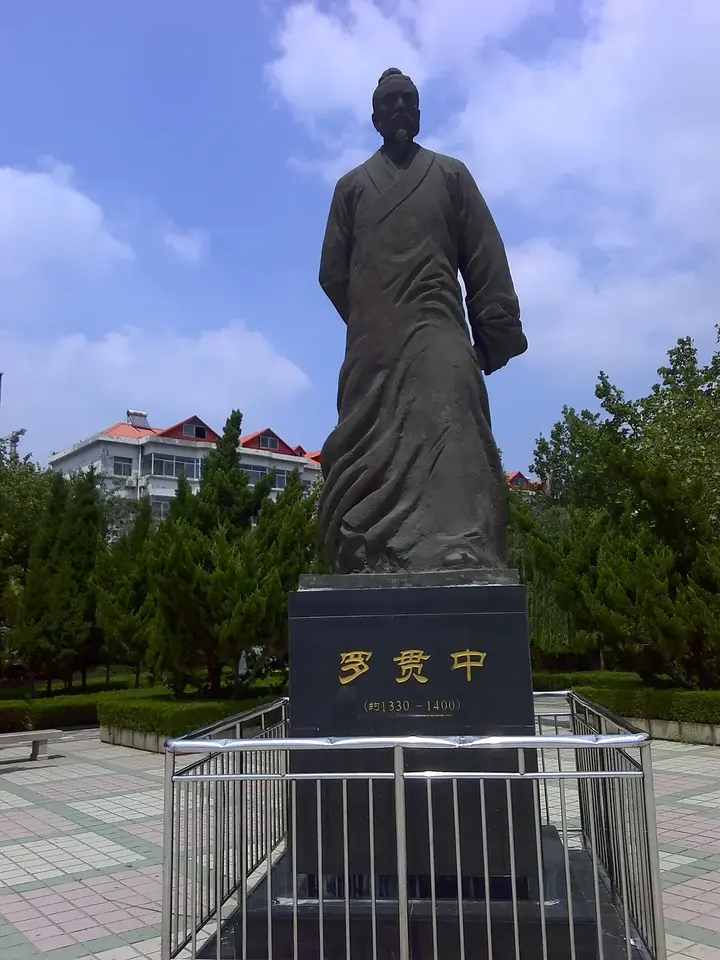
罗贯中
Luo Guanzhong (罗贯中), given name Ben, courtesy names Guanzhong and Yanzhi, art name Huhai Sanren, was an ancestral native of Taiyuan Prefecture. He was a monumental novelist, playwright, and lyricist of the late Yuan and early Ming dynasties, universally venerated as the founding father of classical Chinese vernacular chapter-titled fiction (zhanghui xiaoshuo). His magnum opus, Romance of the Three Kingdoms (*Sanguozhi…
Luo Guanzhong (罗贯中), given name Ben, courtesy names Guanzhong and Yanzhi, art name Huhai Sanren, was an ancestral native of Taiyuan Prefecture. He was a monumental novelist, playwright, and lyricist of the late Yuan and early Ming dynasties, universally venerated as the founding father of classical Chinese vernacular chapter-titled fiction (zhanghui xiaoshuo). His magnum opus, Romance of the Three Kingdoms (Sanguozhi Tongsu Yanyi), stands foremost among the Four Great Classical Novels of Chinese literature, exerting an incomparable and permanent impact on historical consciousness, military strategy, and cultural values throughout China and the East Asian cultural sphere. Born into an affluent merchant household, Luo received a rigorous classical education before studying statecraft, history, and ancient rhetoric under the renowned late Yuan Confucian scholar Zhao Baofeng. During the chaotic Zhizheng era, when peasant rebellions erupted against Mongol rule, Luo embraced aspirations of political statesmanship and entered the retinue of insurgent leader Zhang Shicheng in Suzhou as a staff advisor. Witnessing the Zhang brothers lapse into complacency, factional infighting, and surrender to the Yuan court, Luo grew deeply disillusioned and severed ties with the regime, renouncing political ambition. Adopting the art name Huhai Sanren ("Wanderer of Lakes and Seas"), Luo spent decades traveling across Jiangnan, immersing himself in urban entertainment quarters, theater companies, and storytelling circles. Transforming his political ideals into popular literary creativity, he synthesized historical chronicles like Chen Shou's Records of the Three Kingdoms and Pei Songzhi's annotations with centuries of oral storytelling traditions to create Romance of the Three Kingdoms, the first full-length chapter-titled novel in Chinese history. He also played an indispensable role in editing and finalizing Shi Nai'an's Water Margin, and authored the supernatural romance The Three Sui Quash the Demons' Revolt, as well as historical chronicles Records of the Sui and Tang Dynasties and Romance of the Late Tang and Five Dynasties. Luo established the structural paradigm and narrative conventions of classical Chinese long-form fiction, revered by subsequent generations as an unmatched literary giant.
Born into a merchant family in Taiyuan Prefecture; began studying Confucian classics in private school during childhood.
Following his mother's early death, suspended studies and accompanied his father on silk trading ventures to Suzhou and Hangzhou.
Relinquished commercial trade with his father's permission and journeyed to Cixi to study history and statecraft under Zhao Baofeng.
Arrived in Suzhou to serve as a staff advisor to insurgent leader Zhang Shicheng, advising on military strategies.
Formulated successful tactical plans against Zhu Yuanzhang's commander Kang Maocai, but grew disheartened by Zhang's growing corruption.
Resigned in disgust over Zhang Shicheng's submission to the Mongol court; adopted the title Huhai Sanren to wander Jiangnan.
Remained in seclusion in Hangzhou after the founding of the Ming, gathering historical prompt-books in urban theaters.
After years of intensive research and writing, completed the manuscript of Romance of the Three Kingdoms, pioneering chapter fiction.
Authored The Three Sui Quash the Demons' Revolt, Romance of the Late Tang and Five Dynasties, and several zaju dramas.
Passed away in his later years while wandering in Jianyang or Huai'an; Jia Zhongming lamented his unknown final fate in Sequel to the Register of Ghosts.
Luo Guanzhong was born into a commercial household in Taiyuan Prefecture, Shanxi. During the mid-to-late Yuan dynasty, inter-regional commerce flourished, and his father engaged in large-scale silk trade between northern hubs and Jiangnan commercial centers. Luo received systematic Confucian instruction in his native locality from childhood, entering a private academy at age seven where his sharp memory and classical eloquence won the praise of tutors.
In 1344, when Luo was fourteen, his mother died of illness. This family misfortune forced him to suspend his studies temporarily and accompany his father southward to Pingjiang (Suzhou) and Hangzhou to learn commercial operations. However, possessing an expansive and noble disposition, young Luo was enchanted by historical narratives and folklore rather than mercantile bookkeeping. He spent his leisure hours in the bustling urban theaters and entertainment quarters, listening to professional storytellers narrate epic dynastic changes and heroic battles.
Perceiving his son's passionate scholarly ambition, his father granted him permission to abandon commerce for classical learning. Around 1346, Luo traveled to Cixi in eastern Zhejiang to enter the academy of Zhao Baofeng, one of the most prominent Confucian masters of the era. Zhao was celebrated for his deep comprehension of classical statecraft, military strategy, and historical cycles. Under Zhao's mentorship, Luo systematically studied foundational historical chronicles, including the Zuo Zhuan, Records of the Grand Historian, Book of Han, and Comprehensive Mirror in Aid of Governance, forging a lifelong political aspiration to achieve administrative glory and assist a noble sovereign.
Following the eruption of the Red Turban rebellions in 1351, Yuan imperial control collapsed into countrywide warfare among competing warlords. In 1353, salt merchant Zhang Shicheng launched an uprising at Baiju Field, rapidly capturing Gaoyou, repulsing Grand Councilor Toqto'a's imperial expedition, and subsequently crossing the Yangtze River to occupy Suzhou, declaring himself King of Great Zhou.
In 1356, perceiving a pivotal opportunity for dynastic transformation, Luo bid farewell to Master Zhao and traveled to Suzhou to join Zhang Shicheng's military retinue. Luo was warmly received by Zhang's capable younger brother, Zhang Shide. In 1357, when Zhu Yuanzhang's commander Kang Maocai mounted an offensive against Zhang's territory, Luo formulated an ambush strategy that enabled Zhang Shide to defeat the invading forces, preserving regional stability.
However, as their territorial domain expanded, the fatal weaknesses of the Zhang regime surfaced. Zhang Shicheng and his brother Zhang Shixin indulged in lavish luxury within the fertile southern metropolis, abandoning territorial ambition and submitting to the Mongol Yuan in late 1357 to secure temporary comfort. Senior ministers engaged in bitter jealousies and corrupt rivalries, ignoring Luo's urgent remonstrances against imperial conciliation.
During his service, Luo vigorously urged Zhang Shicheng to seize the moment while the main Mongol armies were engaged elsewhere, advocating a swift northern expedition across the Huai River to conquer the Central Plains. Yet Zhang remained complacent, placing absolute trust in corrupt favorites such as Pan Yuanshao while marginalizing upright advisors. In the autumn of 1357, when the courageous Zhang Shide was captured and died in Changzhou, the regime's military resolve dissolved entirely into factional inertia. Realizing that Zhang lacked the virtue and vision of a true dynastic founder, Luo severed all connections with the court around 1363 and withdrew into private life.
Following his departure from politics, Luo discarded all ambition for official rank. He adopted the pseudonym Huhai Sanren ("Wanderer of Lakes and Seas"), wandering across the scenic rivers and mountains of the Three Wu and eastern Zhejiang regions. This title conveyed both his philosophical serenity following political disillusionment and his enduring panoramic perspective on the rise and fall of empires. In Sequel to the Register of Ghosts, early Ming playwright Jia Zhongming recorded: "Luo Guanzhong, a native of Taiyuan, styled Huhai Sanren. Reserved and unaccommodating, his theatrical songs and enigmatic lyrics were exceptionally fresh. We met during the Zhizheng era; none knows how he ended his days."
In 1367, Zhu Yuanzhang's forces eradicated the Zhang regime, capturing Suzhou, and Zhu ascended the throne in Nanjing in 1368 to establish the Ming dynasty. While the new dynasty recruited former regional scholars, the early Ming administration exercised intense surveillance over literati who had served rival regimes. Wary of Hongwu's draconian penal code and literary inquisitions, Luo steadfastly refused to seek imperial office, choosing instead to reside in Hangzhou and Jianyang among urban storytellers and theatrical troupes.
In Hangzhou, Luo witnessed the historical transition of theatrical arts as northern zaju yielded to southern nanxi opera. He penned dramatic scripts for performance troupes, composing works such as The Gathering of Dragon and Tiger (Zhao Taizu Longhu Fenghunhui), The Chained Admonition of Filial Piety, and Three Councilors Mourn at Shuanglin Ferry. Concurrently, he recognized the boundless expressive vitality that long-form vernacular storytelling possessed among the urban masses, resolving to dedicate his classical erudition and strategic intellect to composing comprehensive historical fiction.
During the early and middle decades of the Hongwu era, living in modest material circumstances, Luo commenced the most monumental enterprise in Chinese narrative history. Drawing together official histories—including Chen Shou's Records of the Three Kingdoms, Pei Songzhi's exhaustive annotations, and Sima Guang's Comprehensive Mirror in Aid of Governance—alongside popular prompt-books such as Sanguozhi Pinghua, he sifted facts from fabrications to reconstruct the epic narrative. Working late into the night in a humble studio in Hangzhou, he spent years completing the twenty-four-volume, two-hundred-and-forty-chapter epic Romance of the Three Kingdoms.
Concurrently with and following this achievement, Luo maintained an intimate literary camaraderie with fellow reclusive scholar Shi Nai'an. According to historical tradition, during Shi's composition of Water Margin in Huai'an and Baiju Field, Luo visited frequently to discuss narrative developments. Following Shi's death, Luo meticulously preserved his scattered manuscripts, refining the character dialogue and structural progression of the first seventy chapters, while arranging and polishing the subsequent expedition campaigns to forge a seamless tragic epic.
In his later years, drawing upon historical accounts of Wang Ze's Song rebellion and urban supernatural lore, Luo authored China's first full-length demon-quelling novel, The Three Sui Quash the Demons' Revolt, and compiled historical chronicles including Records of the Sui and Tang Dynasties and Romance of the Late Tang and Five Dynasties. Ming and Qing popular printing houses consistently adopted Luo's chapter-titled format as an unalterable standard.
Historical records regarding Luo's final years remain shadowy and obscure. Jia Zhongming recorded that none knew where his life concluded. Late Ming scholar Xu Shupi noted in Shi Xiao Lu that Luo traveled in his final years to the commercial printing center of Jianyang in Fujian and passed away in Huai'an or Hangzhou in his seventies. The peerless master who gifted Chinese civilization its most enduring popular literary treasures departed this world in quiet anonymity.
Luo Guanzhong's foremost historic achievement was his independent invention of the full-length chapter-titled novel (zhanghui xiaoshuo), elevating Chinese vernacular narrative into a mature classical literary form. Prior to Luo, vernacular narrative was restricted to fragmented oral prompt-books (huaben) and crude historical summaries (pinghua), characterized by disjointed episodes, unrefined language, and shallow characterization.
Possessing visionary artistic ambition, Luo created the architectural formula of structured volumes, thematic chapters, antithetical chapter couplets, and overarching narrative arcs. He organized historical tumult into discrete, self-contained chapters, crafting balanced poetic couplets as chapter titles and placing climactic narrative suspensions at chapter ends with the formula: "If you wish to know what happened next, listen to the explanation in the following chapter." This design accommodated the listening and reading habits of urban audiences while dramatically expanding the novel's capacity to contain complex societal panoramas. His design became the universal archetype for all subsequent masterpieces, including Water Margin, Journey to the West, The Golden Lotus, The Scholars, and Dream of the Red Chamber.
Luo Guanzhong's Romance of the Three Kingdoms represents the inaugural and defining monument in classical Chinese historical fiction. Spanning roughly a century from the Yellow Turban Rebellion in 184 to the Western Jin reunification in 280, the epic presents a breathtaking canvas of political machinations, strategic clashes, and diplomatic intrigue among the Three Kingdoms of Wei, Shu, and Wu.
In methodology, Luo established the foundational rule of historical romance: "seven parts historical truth, three parts literary invention." Rooting his structural spine in Chen Shou's Records of the Three Kingdoms and Pei Songzhi's commentary, he organically integrated folk legends and theatrical dramas, achieving an exquisite balance between documentary veracity and imaginative grandeur. His sweeping prose brought monumental military engagements—such as the Battle of Guandu, the Battle of Red Cliffs, and the Battle of Yiling—to vivid life. First printed in the seminal Jiajing edition of 1522, the work has been continuously published for five centuries, shaping the collective historical consciousness of the Chinese nation and standing as an encyclopedia of political and military acumen throughout East Asia and the world.
In character portrayal and moral philosophy, Luo forged a gallery of immortal archetypes endowed with permanent psychological resonance. The transcendent wisdom and selfless devotion of Zhuge Liang, the towering righteousness and valor of Guan Yu, the brilliant statecraft and treacherous duality of Cao Cao, the fiery candor of Zhang Fei, and the benevolent compassion of Liu Bei were delineated with extraordinary psychological vitality, becoming cultural emblems of wisdom, villainy, courage, and virtue.
Throughout the epic, Luo articulated a profound political philosophy championing the legitimacy of Shu-Han (yong Liu fan Cao) grounded in benevolent governance and popular welfare. Aligning himself with the suffering populace, he traced dynastic collapse to eunuch corruption, imperial tyranny, and bureaucratic decay, celebrating Liu Bei's compassionate rule while condemning Cao Cao's ruthless cynicism. The concept of "loyalty and righteousness" (zhongyi) championed by Luo transcended blind subservience to an imperial house, evolving into an eternal standard of personal honor, moral integrity, and social justice.
Beyond Romance of the Three Kingdoms, Luo made a foundational contribution to Chinese narrative literature through his compilation, polishing, and structural finalization of Water Margin. Classical bibliographies, including Hu Yinglin's Shaoshi Shanfang Bitan and Gao Ru's Baichuan Shuzhi, attest that Shi Nai'an composed the initial draft and Luo collaborated closely in editing, refining character dialogue, and standardizing the narrative arc of the Liangshan rebels' defiance and tragic demise.
Simultaneously, Luo authored The Three Sui Quash the Demons' Revolt, the earliest full-length supernatural fantasy novel in Chinese literature, establishing the narrative template for subsequent masterpieces such as Journey to the West and Investiture of the Gods. His chronicles of the Sui, Tang, and Five Dynasties inaugurated the sequential historical romance cycle. Through this astonishing output across historical, heroic, and supernatural genres, Luo established himself as the undisputed architect of the classical Chinese novelistic tradition.
FIGURES ASSOCIATED WITH THIS DYNASTY