Birth into Aristocracy
Born into the illustrious Fanyang Lu clan; demonstrated prodigious memory and literary aptitude in childhood.
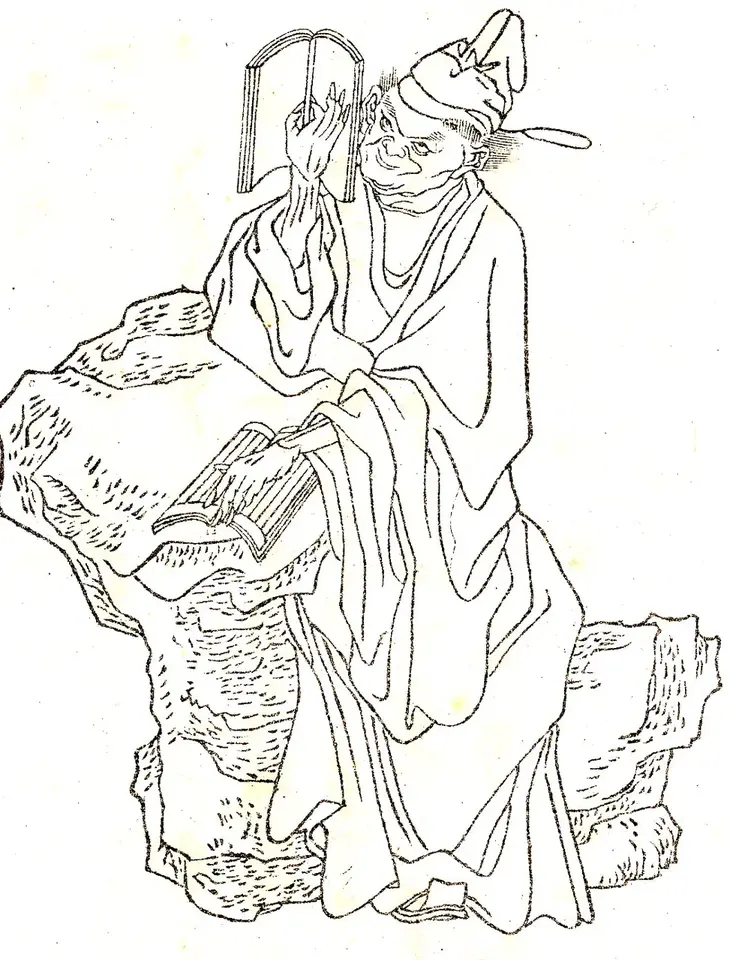
卢照邻
Lu Zhaolin (c. 635–c. 689), courtesy name Shengzhi and art name Youyouzi, was a native of Fanyang in Youzhou, hailing from the prestigious Northern Lineage of the Fanyang Lu clan. A celebrated literary innovator of the early Tang dynasty, he is venerated alongside Wang Bo, Yang Jiong, and Luo Binwang as one of the Four Paragons of the Early Tang. Precociously learned, he traveled to Jiangnan at age ten to study philology and…
Lu Zhaolin (c. 635–c. 689), courtesy name Shengzhi and art name Youyouzi, was a native of Fanyang in Youzhou, hailing from the prestigious Northern Lineage of the Fanyang Lu clan. A celebrated literary innovator of the early Tang dynasty, he is venerated alongside Wang Bo, Yang Jiong, and Luo Binwang as one of the Four Paragons of the Early Tang. Precociously learned, he traveled to Jiangnan at age ten to study philology and classical historiography under master scholars Cao Xian and Wang Yifang. Entering the capital in his youth, his exceptional genius earned the admiration of Prince of Deng Li Yuanyu, who retained Lu Zhaolin as a private secretary for a decade and hailed him as his "own Sima Xiangru." Subsequently appointed as Defender of Xindu in Yizhou (modern Sichuan), Lu Zhaolin immersed himself in the dramatic landscapes of the southwest, composing vibrant poetry alongside young talents like Wang Bo. However, his literary brilliance brought severe political misfortune: his celebrated masterpiece Ancient Themes of Chang'an (Chang'an Guyi) provoked the wrath of imperial favorite Wu Sansi, who perceived satirical slights and imprisoned him on fabricated charges. Shortly after his exoneration through the desperate appeals of friends, Lu Zhaolin contracted an agonizing paralytic condition historically identified as fengji (likely severe lepromatous neuropathy or ankylosing spondylitis). Seeking a cure, he climbed Mount Taibai to live with the legendary physician-hermit Sun Simiao. Despite intensive medical treatment and Daoist alchemy, toxic medicine and grief over his father's death triggered an irreversible deterioration that permanently paralyzed his legs and withered his left arm. In his final years, destitute and unable to walk, he established a hermitage at the foot of Mount Juci in Yangzhai, excavated his own burial crypt, and lay inside it while composing monumental tragic prose such as the Rhapsody on the Diseased Pear Tree and the Five Laments. Overwhelmed by unbearable physical pain, he bade a solemn farewell to his family and drowned himself in the Ying River, leaving behind an immortal legacy of tragic lyricism.
Born into the illustrious Fanyang Lu clan; demonstrated prodigious memory and literary aptitude in childhood.
Traveled south to Jiangnan to master classical lexicography under philologists Cao Xian and Wang Yifang.
Gained the favor of Minister Lai Ji in Chang'an; appointed Editorial Assistant to Prince of Deng Li Yuanyu.
Appointed Defender of Xindu in Yizhou; governed with clean integrity and toured the scenic wonders of Shu.
Met fellow prodigy Wang Bo in Zizhou, forging an intimate poetic friendship that invigorated southwestern literature.
Composed the epic song Ancient Themes of Chang'an; imprisoned on trumped-up charges by Wu Sansi before securing release.
Struck down by severe paralytic illness; retreated to Mount Taibai to live and study medicine with Sun Simiao.
Suffered severe mercury toxicity and paternal bereavement; retreated to Luoyang's Longmen Mountains and penned Rhapsody on the Diseased Pear Tree.
Relocated to Mount Juci in Yangzhai, calling himself Youyouzi; excavated a subterranean tomb where he rested during the day.
Authored his tragic masterpieces Explication of Sickness and Five Laments; drowned himself in the Ying River to escape endless agony.
Lu Zhaolin belonged to the Northern Branch of the eminent Fanyang Lu clan, one of medieval China's most revered aristocratic lineages. Blessed with natural intellectual brilliance, he exhibited an extraordinary capacity for composition in his boyhood, mastering Confucian classics and historical treatises by the age of ten. Seeking the highest levels of textual philology and phonological scholarship, young Lu Zhaolin departed northern China to travel southward to the cultural centers of Jiangnan.
There, he apprenticed under Cao Xian, the preeminent authority on ancient lexicography, and Wang Yifang, an illustrious master of classical exegesis. Under their guidance, Lu Zhaolin absorbed the esoteric philological traditions of the Erya, Fangyan, and the ancient character lexicon Sancang. This rigorous philological training gave Lu Zhaolin an extraordinary command of classical diction, enabling him to write poetry and parallel prose marked by profound erudition, effortless classical allusion, and philosophical gravity that set him apart from his contemporaries.
During the Yonghui reign of Emperor Gaozong, Lu Zhaolin journeyed to Chang'an to pursue official advancement, presenting his writings to Chancellor Lai Ji. Astounded by his soaring literary power, Lai Ji lauded him before the imperial court, rapidly elevating the young scholar's reputation throughout the capital. Learning of his brilliance, Emperor Gaozu's seventeenth son, Prince of Deng Li Yuanyu, invited Lu Zhaolin into his private retinue with ceremonial deference, commissioning him as the prince's Editorial Assistant.
Prince Li Yuanyu was a cultured aristocrat who maintained an immense private library of rare manuscripts. He cherished Lu Zhaolin's companionship, seating the young scholar at the head of noble banquets and famously exclaiming to his assembled courtiers that Lu Zhaolin was his very own Sima Xiangru. For a decade, Lu Zhaolin remained in the prince's service, moving between the imperial capital and provincial postings. He utilized this unhindered access to imperial archives to read extensively in philosophy, astronomy, and history, solidifying his stature as one of the realm's premier men of letters.
During the Qianfeng era, Lu Zhaolin was dispatched to the southwest as Defender of Xindu in Yizhou (modern Chengdu, Sichuan). In this regional posting, he administered judicial affairs with compassionate fairness while marveling at the towering cliffs of Jianmen and the turbulent gorges of the Min River. When his three-year tenure expired, enchanted by the landscape, he chose to linger in Sichuan rather than return immediately to the capital. In Chengdu and Zizhou, he crossed paths with fellow literary luminary Wang Bo. The two kindred spirits formed an enduring poetic bond, exchanging resonant verses that revolutionized southwestern literary circles.
In the Zongzhang era, Lu Zhaolin relocated to the auxiliary capital of Luoyang. Observing the opulent extravagance and hollow vanity of the imperial aristocracy in the twin capitals, he poured his critical reflections into a monumental seven-character musical poem, Ancient Themes of Chang'an (Chang'an Guyi). In sixty-eight lines of dazzling verbal splendor, the poem juxtaposed the nocturnal revelry, courtesans, and cavalier aristocrats of the capital against the quiet poverty of scholars, culminating in the immortal couplet: "If two can merge like flounders in love, who would fear dying? One would rather be a mandarin duck than envy immortals!"
However, the poem contained piercing satirical barbs. Lines such as "The Liang family's painted pavilions rise toward mid-sky; the Han emperor's golden dew-collectors pierce directly beyond the clouds" deeply offended Wu Sansi, the powerful nephew of Empress Wu Zetian. Taking the references to the corrupt Liang Ji as a deliberate attack upon the rising Wu clan's nepotism, Wu Sansi had the poet seized and thrown into imperial prison on fabricated treasonous charges.
Incarcerated in a squalid dungeon facing potential execution, Lu Zhaolin found himself abandoned by fair-weather acquaintances. However, his literary companions and principled court officials rallied to his defense, petitioning senior magistrates and clarifying that the poem was traditional allegorical satire. After months of grueling confinement, Lu Zhaolin was finally cleared and released. Yet the psychological shock and physical privations of prison permanently compromised his delicate constitution.
Shortly after his release, Lu Zhaolin was struck down by a catastrophic affliction referred to in medieval sources as fengji. Modern clinical historians identify this disease as severe lepromatous neuropathy or advanced ankylosing spondylitis. Beginning with agonizing migratory joint pain and sensory numbness, the malady rapidly invaded his nervous system. His finger and hand tendons contracted into rigid claws, and his leg muscles wasted away until his knees locked, depriving him of the ability to stand or walk.
Hearing that the revered centenarian master physician Sun Simiao was living as an ascetic in the Zhongnan and Taibai mountains, the desperate poet had himself transported to Mount Taibai to seek treatment. Moved by the young genius's tragic plight, Master Sun welcomed him into his mountain hermitage, administering herbal decoctions and acupuncture while sharing his quarters.
During their mountain retreat, Lu Zhaolin developed a profound spiritual discipleship under Sun Simiao, marveling at the master's profound synthesis of Daoist quietude and clinical wisdom. When Lu Zhaolin queried him on the parallels between healing diseases and governing empires, Sun Simiao articulated his celebrated medical aphorism: "The gall must be bold while the heart must be cautious; the intellect must be round while the conduct must be square." When Emperor Gaozong summoned Sun Simiao to the Jiucheng Palace to oversee court health, Lu Zhaolin, immobilized by paralysis, remained behind in the mountain cottage. Looking out at a withered pear tree struggling against frost, he composed his famous Rhapsody on the Diseased Pear Tree, using the blighted tree as an agonizing metaphor for his own ruined youth.
Desperate to reverse the paralysis, Lu Zhaolin consumed toxic mercury-based alchemical preparations known as Xuanming Ointment. The caustic mineral elixir severely burned his internal organs. While he was suffering from chemical fever, news arrived that his beloved father had passed away. Paralyzed by grief, Lu Zhaolin wept so violently that he regurgitated blood and cinnabar residue, triggering a catastrophic toxic reaction. The disaster caused total muscular atrophy: both his legs curled into rigid deformities and his left arm lost all motor function, leaving him completely helpless.
Bankrupted by medical expenses, the crippled poet moved to the Longmen Mountains near Luoyang, subsisting on simple grains provided by loyal friends such as Luo Binwang and Yang Jiong. Around 685, seeking a quiet place to die without burdening his impoverished friends, Lu Zhaolin moved south to the foot of Mount Juci in Yangzhai (modern Yuzhou, Henan). Using the last remnants of his savings, he purchased a small plot of stony land, channeled a branch of the Ying River around his modest cottage, and named his hermitage Youyouzi (The Secluded Mourner).
Anticipating his approaching end, Lu Zhaolin directed stonemasons to excavate a subterranean stone tomb in his fields. In his final years, he had attendants carry him into the freezing stone crypt during daylight hours, lying inside his coffin to accustom his mind to the silence of death, returning to his cottage only at nightfall to chant the Elegies of Chu (Chuci).
Within the cold dark of his living tomb, the physical agony of his decomposing nerves reached unbearable extremes, yet his intellectual clarity remained incandescent. In his final winter, he transformed his profound suffering, metaphysical despair, and social fury into two crowning masterpieces of Chinese tragic prose: Explication of Sickness (Shiji Wen) and the Five Laments (Wu Bei Wen).
In the Five Laments—mourning his talent, his status, his ambition, his sickness, and his destiny—Lu Zhaolin unleashed an overwhelming emotional torrent composed in the majestic cadence of Qu Yuan. He passionately interrogated the injustice of heaven and the cruelty of mortality, producing what critics consider the greatest tragic lament in Chinese literature since the Li Sao.
At dawn in the early Chuigong era, realizing that his body was completely breaking down and unwilling to prolong his degradation, Lu Zhaolin chose to end his existence. Dressing himself in clean scholar's robes, he called his family and friends to his bedside, weeping openly as he bade them an affectionate farewell. After settling his few worldly affairs, the paralyzed poet had himself conveyed to the banks of the Ying River. In the mist of morning, he cast his body into the deep currents, drowning himself at the age of approximately forty. His tragic departure shocked the literary world, leaving behind an indelible standard of lyrical courage.
Prior to his illness, Lu Zhaolin possessed an exuberant spirit and grand ambitions. His early verse, whether on frontier campaigns, traveling departures, or panoramic landscapes, radiated resonant vigor and fresh vitality. In his frontier poems, he adapted Han and Wei Yuefu forms to express the heroic zeal of warriors guarding northern bastions, replacing delicate courtly sentiment with the clash of cold blades and vast desert sunsets.
The onset of severe leprosy plunged Lu Zhaolin into physical agony and spiritual torment. Stripped of his bureaucratic prospects and abandoned by fair-weather acquaintances, his poetic voice underwent a profound mutation from youthful exuberance to existential anguish. He forged an innovative somatic aesthetic centered on vivid motifs of solitary birds, withered trees, biting winds, and graying temples, transforming personal agony into a towering monument of tragic literature.
Lu Zhaolin's parallel prose and rhapsodies broke free from the rigid, superficial formalism of late Six Dynasties court styles. In works like Rhapsody on the Diseased Pear Tree and Essays in Five Sorrows, he combined the sweeping architecture of Chu elegies with Han rhapsodies, utilizing varied line lengths and emotionally authentic diction to voice philosophical defiance against fate.
As a core architect among the Four Paragons of the Early Tang, Lu Zhaolin dismantled the decadent, insular aesthetic inherited from the Liang and Chen dynasties. He expanded poetic subject matter from the imperial bedchamber to the vast borders, bustling urban avenues, and turbulent personal tragedies, restoring the vital moral spirit of the Classic of Poetry.
Lu Zhaolin's most enduring formal contribution lay in elevating the seven-character balladic song (qiyan gexing) to architectural and lyrical maturity. By blending melodic shifts, intricate narrative pacing, and tonal fluidity, he transformed a formerly minor folk song form into the premier poetic medium capable of capturing the epic sweep of the Tang empire.
Written under relentless somatic deterioration, Lu Zhaolin's late elegiac rhapsodies achieved an extraordinary fusion of subjective lyricism and cosmic grief. In Rhapsody on the Diseased Pear Tree and Dispelling Affliction, he transfigured bodily decay into an allegory of human suffering and intellectual defiance, standing alongside Qu Yuan's Li Sao in Chinese literary history.
Lu Zhaolin's masterpiece Ancient Themes of Chang'an stands as an immortal milestone in Chinese literature. Across sixty-eight lines of dazzling music and visual splendor, the poem paints a comprehensive portrait of the imperial metropolis, juxtaposing royal opulence and courtesan romance against the inevitable vanity of power and the enduring solace of philosophical truth.
FIGURES ASSOCIATED WITH THIS DYNASTY