Born in Dezhou
Born into an illustrious scholarly family in Dezhou, Shandong; endured family tragedy in youth and studied classical canons with rigorous determination.
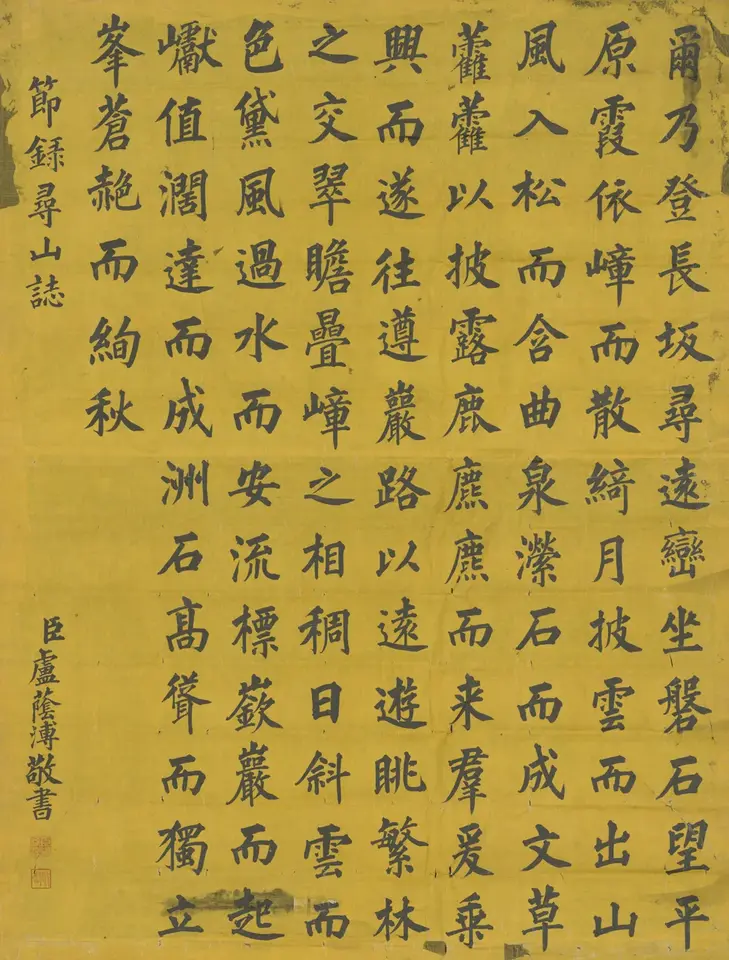
卢荫溥
Lu Yinpu (卢荫溥; 1760–1839), courtesy names Linsheng and Runfu and art name Zhixuan, was a native of Dezhou, Jinan Prefecture, Shandong. He was a distinguished civil minister and core statesman during the Qianlong, Jiaqing, and Daoguang eras of the Qing Dynasty, and the grandson of Lu Jianzeng, the renowned Lianghuai Salt Distribution Commissioner. In 1781, he earned his jinshi degree and entered the Hanlin Academy as a…
Lu Yinpu (卢荫溥; 1760–1839), courtesy names Linsheng and Runfu and art name Zhixuan, was a native of Dezhou, Jinan Prefecture, Shandong. He was a distinguished civil minister and core statesman during the Qianlong, Jiaqing, and Daoguang eras of the Qing Dynasty, and the grandson of Lu Jianzeng, the renowned Lianghuai Salt Distribution Commissioner. In 1781, he earned his jinshi degree and entered the Hanlin Academy as a compiler. Deeply appreciated by Grand Secretary Agui, he served as a secretary in the Ministry of Rites, presided over provincial examinations in Shanxi, and inspected education as Commissioner of Henan. In 1800, he was selected as a Grand Council Secretary, actively contributing to military strategies during the White Lotus Rebellion. In 1811, due to his intimate mastery of central statecraft, Lu was granted the fourth-rank title and inducted into the Grand Council. During the 1813 Eight Trigrams uprising when rebels attacked the Forbidden City, Lu accompanied the Jiaqing Emperor at the Rehe Mountain Resort, offering decisive strategic counsel late into the night and coordinating the swift suppression of the uprising. He successively served as Minister of Rites, Minister of War, and Minister of Revenue, overseeing national finances and codifying state ritual protocols. In 1818, he directed the revision of imperial chronicles, and in 1820, he presided over the metropolitan examination, discovering Chen Jichang, one of only two scholars in the entire Qing Dynasty to earn first place in all three tiers of civil examinations. During the Daoguang reign, Lu served as Minister of Personnel and Mayor of Shuntian before rising to Grand Secretary of the Hall of Embodying Benevolence in 1830. Known for his judicious legal clarity, he exonerated falsely accused upright officials such as Pan Gongchen. He retired with full imperial stipends in 1833 and died in 1839 at the age of eighty. Posthumously granted the title of Grand Preceptor and canonized as "Wensu," he was universally respected for his integrity, administrative diligence, and lifelong devotion to imperial governance.
Born into an illustrious scholarly family in Dezhou, Shandong; endured family tragedy in youth and studied classical canons with rigorous determination.
Passed the metropolitan examination; selected as Hanlin Bachelor and appointed Compiler, gaining the mentorship of Grand Secretary Agui.
Selected as a Grand Council Secretary; formulated operational and logistical strategies for the suppression of the White Lotus Rebellion.
Promoted to Probationary Grand Councilor with the fourth rank; advanced to Vice Minister of the Court of Transmission.
Attended the Jiaqing Emperor at Rehe during the Eight Trigrams palace raid; advised emergency mobilization to crush the insurrection.
Promoted to Minister of Rites, transferred to Minister of War, and elevated to Minister of Revenue with the rank of Junior Guardian of the Heir Apparent.
Directed the metropolitan examination, selecting Chen Jichang as the first-rank scholar in a rare triple-triumph.
Reassigned as Minister of Personnel and Governor of Shuntian Prefecture, concluding his direct Grand Council tenure.
Appointed Grand Secretary of the Hall of Embodying Benevolence and assigned to supervise the Ministry of Punishments.
Permitted to retire due to failing health, honored with the title of Junior Guardian and granted full lifetime stipends.
Attended the re-banquet ceremony of his degree anniversary, advanced to Grand Tutor, and passed away at age eighty; canonized as Wensu.
Lu Yinpu was born into a prominent bureaucratic lineage in Dezhou, Shandong. His grandfather Lu Jianzeng had obtained his jinshi degree in 1721 and served as Lianghuai Salt Distribution Commissioner, renowned for patronizing poets and artists across southern China. In 1768, the massive Lianghuai salt administration corruption scandal erupted. Although Lu Jianzeng had retired, he was arrested and sentenced to execution, dying in prison while the family estate was confiscated. Lu Yinpu’s father Lu Qian was banished to frontier military exile. Only nine years old at the time, Lu Yinpu experienced sudden destitution and followed his mother to live under the care of his maternal grandfather in Changshan.
Amidst these severe hardships, Lu applied himself tirelessly to Confucian classical texts. Three years later, Grand Secretary Liu Tongxun intervened, petitioning the Qianlong Emperor to rehabilitate the family name and allow Lu Qian to return to serve as Vice Prefect of Guangping. This enabled Lu Yinpu to sit for official examinations.
In 1781, Lu achieved his jinshi degree and was appointed Compiler in the Hanlin Academy. The distinguished general and Senior Grand Secretary Agui, who presided over the academy, recognized his extraordinary administrative talent. Although an imperial evaluation in 1791 temporarily demoted Lu to Secretary in the Ministry of Rites over poetic forms, the Qianlong Emperor observed that assigning him to ministerial administration would hone his practical executive abilities. Lu soon presided over the Shanxi provincial examination and supervised education as Educational Commissioner of Henan with great distinction.
In 1800, Lu was selected as a Grand Council Secretary. At the time, the White Lotus Rebellion raged across Sichuan, Hubei, and Shaanxi. Stationed in the Grand Council day and night, Lu drafted military directives and coordinated grain transport networks with exceptional clarity. In 1803, when Empress Xiaoshurui was interred in the imperial mausoleum, court ritualists struggled to formulate proper protocols. Lu conducted exhaustive research into dynastic precedents, drafting funeral regulations that the Jiaqing Emperor readily approved and instituted.
Over the ensuing decade, Lu accompanied senior commissioners on extensive judicial investigations across multiple provinces, gaining steady promotions to Junior Minister of the Court of Imperial Sacrifices. In 1811, following the death of Chief Grand Councilor Dai Quheng, the Jiaqing Emperor elevated Lu to fourth-rank status and appointed him a Grand Councilor, bringing him into the empire's ultimate decision-making body.
In 1813, Lu accompanied the emperor on the annual imperial journey to the Rehe Mountain Resort. In the middle of their stay, the Eight Trigrams sectarian movement led by Lin Qing launched a surprise attack on the Forbidden City in Beijing. When midnight dispatches reached the imperial entourage, panic swept the encampment. Lu maintained absolute composure, entering the imperial presence late at night to formulate mobilization strategy, helping stabilize the situation and escorting the emperor back to the capital to restore order. His performance earned high commendation, and his son Lu Ben was granted the provincial degree by imperial favor.
In 1817, Lu was promoted to Minister of Rites, swiftly transferred to Minister of War, and subsequently named Minister of Revenue, commanding imperial fiscal policies while concurrently supervising the Ministries of Punishments and Personnel. The Jiaqing Emperor commended him for his sincerity and administrative integrity, bestowing upon him the title of Junior Guardian of the Heir Apparent. In 1818, when initial drafts of the imperial history Comprehensive Mirror of Ming failed to meet royal expectations, the emperor appointed Lu alongside Tuojin and Yinghe as chief compilers to thoroughly revise the chronicle.
In legal administration, Lu was renowned for rectifying wrongful convictions. While supervising the Ministry of Punishments, he reviewed the case of Pan Gongchen, a Secretary in the Ministry of Works who had audited an imperial ceramic kiln. Pan had rigorously banned illicit customary fees and disciplined subordinate clerks, prompting corrupt subordinates to forge financial evidence and accuse him of embezzlement. Being impoverished and lacking political patronage, Pan faced imminent execution. Upon hearing rumors of the injustice, the Jiaqing Emperor ordered Lu to conduct a reexamination.
Lu meticulously inspected every account ledger and interrogated the clerks, uncovering systematic perjury and exonerating Pan entirely while subjecting the conspirators to judicial punishment. Pan subsequently rose to Provincial Administration Commissioner of Yunnan, revered as an incorruptible administrator.
In the spring of 1820, Lu directed the imperial metropolitan examination, awarding top honors to Chen Jichang. Chen subsequently took first place in the palace examination, becoming one of only two candidates in the entire Qing Dynasty to sweep first place in provincial, metropolitan, and palace examinations (Sanyuan Jidi). Later that autumn, following the sudden death of the Jiaqing Emperor at Rehe, Lu received a minor bureaucratic reprimand over minor wording in the imperial testamentary edict, but remained firmly in executive service as Minister of Works.
Upon the accession of the Daoguang Emperor in 1821, Lu was reassigned as Minister of Personnel and Governor of Shuntian Prefecture, concluding his active Grand Council rotation. Appreciating his extensive experience, the emperor promoted him to Assistant Grand Secretary in 1827.
In 1830, Lu reached the apex of civil service when he was installed as Grand Secretary of the Hall of Embodying Benevolence, overseeing the Ministry of Punishments. In 1833, having passed seventy years of age and suffering from illness, he submitted repeated petitions requesting retirement. The Daoguang Emperor praised his long service, granting him the title of Junior Guardian of the Heir Apparent with full pension stipends.
In 1839, on the sixtieth anniversary of passing his examinations, Lu attended the celebratory state banquet and received the honor of Grand Tutor. He passed away on June 16, 1839, at age eighty. The Daoguang Emperor dispatched imperial sacrifices, granted the posthumous rank of Grand Preceptor, and bestowed the posthumous name "Wensu."
Serving across three imperial reigns for six decades, Lu Yinpu rose from personal hardship to the apex of the Grand Council and Grand Secretariat. In legal justice, he exhibited profound discernment, and in ministerial administration, he displayed meticulous integrity, standing as an elder statesman of the Jiaqing and Daoguang eras.
"Lu Yinpu possessed seasoned familiarity with central statecraft and made enduring contributions to imperial defense planning. He acted with wholehearted devotion and preserved unbending personal dignity. Presiding over civil examinations and judicial trials with exemplary fairness, he was truly an elder statesman of our dynasty." — Daoguang Emperor (Minning), Imperial Sacrificial Edict
"In the governance of our dynasty during prolonged peace, ministers often adhered strictly to precedent without independent vigor. Duke Wensu balanced martial decisions and statecraft, serving at the pinnacle of power without vanity and adjudicating criminal appeals with deep humanitarian empathy. He truly fulfilled the essence of his office." — Zhao Erxun, Chief Editor, Draft History of Qing (Qing Shi Gao), Volume 364, Biographies 151
FIGURES ASSOCIATED WITH THIS DYNASTY