PROFILE
Lu Xiujing (406–477), courtesy name Yuande, was a native of Dongqian County, Wuxing Commandery (modern Deqing County, Huzhou City, Zhejiang Province). He was an illustrious Daoist scholar, philosopher, and religious reformer of the Liu Song Dynasty during the Southern Dynasties period. Universally revered as the founder of the Southern Celestial Masters (Nan Tianshidao), the creator of the Three Caverns and Four Supplements (Sandong Sifu) scriptural taxonomy, and the consummate codifier of Daoist fasting and offering rituals, he holds the prestigious honorifics of Master of the Three Caverns (Sandong Fashi) and Patriarch of Liturgy. Following his demise, Emperor Shun of Song posthumously granted him the honorary title Master of Simplicity and Serenity (Jianji Xiansheng).
Originating from the elite Wuxing Lu lineage—one of the premier aristocratic scholar-gentry houses of the Southern Dynasties—Lu Xiujing was thoroughly educated in the Confucian classics and dynastic chronicles before renouncing secular office to dedicate himself to the Way. He traveled extensively across prominent southern mountains, including Mount Tiantai, Mount Heng, and Mount Luofou, eventually establishing a secluded hermitage at Mount Lu known as the Xiujing Thatched Cottage (later the celebrated Jianji Abbey). There, he devoted decades to collating Daoist manuscripts and purifying liturgical rituals. During the Yuanjia, Daming, and Taishi eras of the Liu Song Dynasty, he enjoyed the profound veneration of Emperors Wen, Xiaowu, and Ming. In 467, Emperor Ming issued an imperial summons inviting him to the imperial capital of Jiankang, constructing the grand Chongxu Abbey at the foot of Mount Fozhou for his residence, transforming the abbey into the national center of Daoist scholarship.
Lu Xiujing's historical contributions to the development of Daoism were foundational. Confronted by institutional corruption, administrative disorder, and secular commercialization within the Celestial Masters tradition, he authored the landmark regulatory treatise Lu Xiansheng Daomen Kelüe, reforming the twenty-four dioceses, restoring the three assemblies census system, enforcing monastic celibacy, and establishing the Southern Celestial Masters. In 471, he submitted the Catalogue of the Scriptures of the Three Caverns (Sandong Jingshu Mulu) to Emperor Ming, establishing the tripartite cavern division (Dongzhen, Dongxuan, Dongshen) that became the permanent organizational framework for all subsequent editions of the Daoist Canon (Daozang). Furthermore, he synthesized the Shangqing and Lingbao textual corpuses into the structured system of the Nine Fasts and Twelve Offerings (Jiuzhai Shi'erjiao), elevating Daoism from folk sorcery into an orthodox imperial religion.
- Courtesy Name
- Yuande
- Posthumous Name
- Master Jianji (conferred by Emperor Shun of Song)
- Native Place
- Dongqian County, Wuxing Commandery (present-day Deqing County / Nanxun District, Huzhou City, Zhejiang Province)
- Date of Birth
- 406 (Second year of the Yixi era, Jin)
- Date of Death
- 477 (Fifth year of the Yuanhui era, Song)
- Age
- 72
- Historical Role
- Preeminent Daoist theologian, institutional reformer, founder of the Southern Celestial Masters, and patriarch of Daoist liturgical codification during the Liu Song Dynasty
BIOGRAPHY
Chronology
- 406 (Second year of the Yixi era, Jin) | Birth into Elite Lineage | Born into the aristocratic Wuxing Lu clan in Dongqian; received comprehensive education in the Confucian classics and historical treatises.
- 430 (Seventh year of the Yuanjia era, Song) | Renunciation of Secular Office | Renounced bureaucratic prospects, abandoned private property, and departed into the mountains to pursue Daoist cultivation.
- 453 (Thirtieth year of the Yuanjia era, Song) | Audience with Emperor Wen | Traveled to Jiankang and was summoned to an imperial audience at Xianyuan Palace by Emperor Wen, who praised his spiritual integrity.
- 461 (Fifth year of the Daming era, Song) | Seclusion at Mount Lu | Established a mountain hermitage at Mount Lu (the future Jianji Abbey), collating scriptures and formulating monastic rules.
- 467 (Third year of the Taishi era, Song) | Imperial Residence at Chongxu | Summoned to the capital by Emperor Ming, who constructed Chongxu Abbey at Mount Fozhou as his national teaching center.
- 471 (Seventh year of the Taishi era, Song) | Submitting the Three Caverns Catalogue | Completed and presented the Catalogue of the Scriptures of the Three Caverns to the throne, founding the canonical Daoist taxonomy.
- 477 (Fifth year of the Yuanhui era, Song) | Peaceful Ascension | Passed away peacefully at Chongxu Abbey at the age of seventy-two; posthumously honored as Master Jianji and reinterred at Mount Lu.
Biography
Noble Lineage and Early Devotion to Daoism
Lu Xiujing was born in 406 in Dongqian County, Wuxing Commandery. The Wuxing Lu clan was among the premier aristocratic houses of the Southern Dynasties, possessing high political standing and classical learning. Reared in a cultured family environment, Lu exhibited exceptional intellectual talent from youth, mastering the Confucian Five Classics, the historical dynastic chronicles, and astronomical reckoning, while demonstrating profound fascination with yin-yang cosmology and medicine.
However, observing the relentless court bloodshed and violent dynastic transitions that accompanied the collapse of the Eastern Jin and the rise of Liu Song, Lu perceived the ephemeral vanity of secular status. In his twenties, he resolved to abandon the official career arranged by his family. Overriding strong protests from relatives, he parted from his wife and children, renounced his ancestral patrimony, and donned the traditional yellow cap and coarse robes of a Daoist recluse.
Wandering Famous Mountains and Mountain Seclusion
Determined to recover authentic Daoist scriptures and celestial talismans, Lu Xiujing commenced decades of rigorous ascetic travel across the southern provinces. Traveling on foot with staff and straw sandals, he traversed the famous mountains of Jiangnan and the middle Yangtze. His early pilgrimage led him to the Tiantai mountain range in Zhejiang, where he studied early Shangqing and Lingbao scriptures around the Tongbai Abbey.
Subsequently, he sailed west across Lake Dongting, explored the caves of the Yunmeng marshes, climbed Mount Heng in Hunan, and explored Mount Luofou in Guangdong, establishing simple huts along sheer cloud-wrapped cliffs. During these austere years, Lu sought out hermits and collected hidden Daoist scrolls, talismans, and medical recipes. He collated texts from the Zhengyi Celestial Masters, the Shangqing Revelations, the Lingbao scriptures, and the Sanhuang canons, distinguishing authentic scriptures from folk fabrications and earning widespread renown.
Hermitage at Mount Lu and the Jianji Monastic Code
In 461, amid political unrest in northern and central China, Lu Xiujing withdrew to Mount Lu in Jiangzhou. Mount Lu was already a celebrated spiritual center following the establishment of the Donglin Monastery by Buddhist master Huiyuan. On the southern slopes of Mount Lu, near the converging waterfalls beneath the Five Old Men Peaks, Lu cleared the forest to build the Xiujing Thatched Cottage, later designated the Jianji Abbey.
During his residence at Mount Lu, Lu synthesized natural landscape contemplation with Daoist quietude, establishing a rigorous monastic discipline. He erected an altar hall, leading disciples in dawn-to-dusk scripture recitation and dynamic pacing rituals (bugang tadi), while enforcing vegetarian diets and prohibiting food after noon.
During this period, Lu evaluated over a thousand scrolls of Daoist texts collected during his travels, excising vulgar folk incantations. Investigating the historical evolution and institutional decay of the Celestial Masters, he authored foundational texts including the Lu Xiansheng Daomen Kelüe, laying the doctrinal groundwork for the transformation of medieval Daoism.
Imperial Veneration and Residence at the Chongxu Abbey
Lu Xiujing's erudition and ascetic reputation attracted the attention of Liu Song emperors. In 453, during his initial visit to Jiankang, Emperor Wen summoned him to the Xianyuan Palace to consult on Daoist philosophy and statecraft, showering him with imperial gifts as a transcendent recluse. Emperor Xiaowu subsequently issued decrees summoning him to court, but Lu declined.
Upon ascending the throne in 465 following civil strife, Emperor Ming sought divine legitimation through Daoist sanction. In 467, Emperor Ming dispatched trusted couriers with imperial gifts to Mount Lu, imploring Lu Xiujing to establish his seat in the capital. Recognizing that institutional reform required imperial patronage, Lu accepted.
Upon his arrival in Jiankang, Emperor Ming welcomed him at the northern suburbs. To provide a worthy sanctuary for the master and his scriptural collation, the emperor constructed the expansive Chongxu Abbey at the foot of Mount Fozhou (modern Mount Jiuhua, Nanjing) near Lake Xuanwu, providing generous court subsidies. Elite courtiers and scholars, including Wang Jian and Xie Fei, flocked to Chongxu Abbey to receive precepts, establishing the abbey as the premier intellectual center of southern Daoism.
Compiling the Three Caverns and Finalizing Liturgical Codes
The decade Lu Xiujing spent directing Chongxu Abbey represented the zenith of his scholarly career. Emperor Ming placed the entire imperial secretarial collection of Daoist manuscripts and talismans at his disposal. Aided by senior disciples such as Sun Youyue, Lu conducted the first state-sponsored collation and cataloguing of Daoist literature in Chinese history.
In 471, Lu completed and submitted his landmark bibliographic work, the Catalogue of the Scriptures of the Three Caverns, to Emperor Ming. Recording one thousand two hundred and twenty-eight volumes of Daoist scriptures, talismans, and medical recipes, the catalogue categorized texts into the Three Caverns and Four Supplements, resolving centuries of sectarian confusion.
Simultaneously, Lu reformed Daoist sacrificial rites. Purging vulgar folk blood-sacrifices and shamanic spirit-medium practices, he drew upon the dignified ritual decorum of the Lingbao scriptures to formulate a comprehensive system of fasting and offering rituals (zhaijiao). This ritual code rivaled court Confucian state rites and Buddhist monastic discipline, establishing the ceremonial foundation of medieval Daoism.
Demise at Chongxu Abbey and Enduring Daoist Legacy
On April 1, 477, having completed his religious reforms, scriptural catalogue, and liturgical codes, Lu Xiujing passed away peacefully at Chongxu Abbey at the age of seventy-two.
In his final hours, Lu gathered his disciples, designated his senior student Sun Youyue as his successor, and arranged the affairs of the abbey with composure. Following his death, Emperor Shun of Song conferred upon him the posthumous title Master Jianji. His disciples conveyed his remains back to Mount Lu, interring him beneath the pines behind the Jianji Abbey. The Southern Celestial Masters tradition he founded was transmitted through Sun Youyue to Tao Hongjing, profoundly shaping the Shangqing, Maoshan, and Celestial Masters traditions for over a millennium.
Major Achievements
Reforming Celestial Masters Abuses and Establishing Southern Celestial Masters
Lu Xiujing's primary organizational contribution was the comprehensive reform of the Celestial Masters tradition. By the fifth century, the movement had fractured into regional factions characterized by unauthorized sale of clerical titles, arbitrary rice-tax levies, and the infiltration of vulgar sexual practices (heqi) that degraded its reputation among scholar-officials.
In his regulatory treatise Lu Xiansheng Daomen Kelüe, Lu enacted sweeping reforms. He reaffirmed the sacred authority of the twenty-four dioceses established by Zhang Daoling, prohibited unauthorized appointments, and revived the three assemblies census system (held on the seventh day of the first, seventh, and tenth months) to verify parish registers, enforce moral discipline, and expel corrupt leaders. He abolished vulgar sexual rites, substituting rigorous asceticism, scriptural recitation, and communal charity. This reform rescued the Celestial Masters from decline, transforming it into an orthodox state religion known to history as the Southern Celestial Masters.
Pioneering the Three Caverns Scriptural Taxonomy and Founding the Daoist Canon
In Daoist bibliography and textual history, Lu Xiujing's Catalogue of the Scriptures of the Three Caverns (471) holds canonical status. Prior to this work, Daoist sects operated in sectarian isolation, lacking a unified organizational taxonomy.
Lu established the foundational tripartite division: the Dongzhen (Cavern of Realization) category dedicated to the Shangqing scriptures; the Dongxuan (Cavern of Mystery) category housing the Lingbao scriptures; and the Dongshen (Cavern of Divinity) category comprising the Sanhuang texts. He supplemented this with the Four Supplements (Taixuan, Taiping, Taiqing, and Zhengyi) to integrate peripheral traditions. This Twelvefold Division (Sandong Sifu) served as the structural framework for all future imperial editions of the Daoist Canon, including the Kaiyuan Daozang of the Tang and the Zhengtong Daozang of the Ming.
Synthesizing Daoist Fasting Liturgies and Establishing the Nine Fasts and Twelve Offerings
Revered across traditions as the Patriarch of Liturgy, Lu Xiujing created the standard liturgical architecture of medieval Daoism. Recognizing that spiritual doctrine required dignified ritual forms to inspire reverence, he authored foundational liturgical codes including the Lingbao Jing Zhaiyi and Dongxuan Lingbao Zhaishuo Guangzhu Jiefa Deng Zhuyuan Yi.
He classified communal liturgies into the Nine Fasts and Twelve Offerings: the Golden Register Fast (Jinlu Zhai) for imperial prosperity and state protection; the Yellow Register Fast (Huanglu Zhai) for the salvation of ancestral spirits from the underworld; and the Jade Register Fast (Yulu Zhai) for scholar-officials and commoners seeking blessings. He codified altar geometry, ritual implements, pacing patterns, and the prose format of green-paper memorials (qingci) addressed to Heaven. These liturgies embedded Confucian filial piety and Buddhist universal compassion within Daoist ritual.
Standardizing Clerical Vestments and Structuring Disciple Ordination Ranks
To establish professional hierarchy, Lu Xiujing instituted a graduated system of ordination ranks (daojie). He established a progressive curriculum: novices began as Zhengyi Disciples through receiving the Zhengyi registers, advanced to Gaoxuan Disciples upon mastering the Dongshen division, rose to Shengxuan Disciples in the Dongxuan texts, and achieved the supreme status of Master of the Three Caverns (Sandong Fashi) only upon mastering the Shangqing scriptures.
In conjunction with these ranks, Lu designed differentiated robes, headdresses, swords, and ritual seals for each grade, enforcing clerical decorum. He promulgated strict monastic regulations, mandating the expulsion of clerics guilty of financial greed, sexual misconduct, or insubordination, substantially elevating the ethical and scholarly standing of the Daoist priesthood.
Harmonizing Shangqing and Lingbao Traditions into Systematic Theology
At the doctrinal level, Lu Xiujing dissolved sectarian divisions between competing Daoist traditions. Prior to his work, Ge Hong's southern traditions focused on external alchemy, the Celestial Masters emphasized talismans and healing, the Shangqing tradition prioritized internal meditation, and the Lingbao corpus emphasized liturgical salvation.
Lu harmonized Shangqing internal visualization (cunshen) with Lingbao universal salvation (pudu). Drawing upon Neo-Daoist metaphysics and Mahayana Buddhist compassion, he argued that immortality encompassed moral purification and universal deliverance alongside physical cultivation. This integration elevated Daoism from folk occultism into a sophisticated theological philosophy capable of addressing existential concerns.
Founding the Chongxu Abbey and Fostering the Tri-Religious Dialogue
Established by Emperor Ming in 467, Chongxu Abbey functioned as an intellectual hub for medieval philosophical inquiry. In the capital of Jiankang, where Confucian, Buddhist, and Daoist thinkers engaged in fierce debates regarding karma, the immortality of the soul, and cultural identity, Lu Xiujing maintained an open, inclusive intellectual sanctuary.
Lu engaged in collegial dialogues with Buddhist scholars such as Zhu Fadu and Dao You, adopting Buddhist monastic discipline and lecture techniques to refine Daoist institutions. Simultaneously, he harmonized Daoist morality with Confucian ethics, requiring initiates to uphold filial piety and loyalty. Chongxu Abbey became an essential crucible for tri-religious synthesis, directly inspiring the philosophical syncretism later articulated by Emperor Wu of Liang and Tao Hongjing.
The Cultural Legend of the Three Laughers of Tiger Creek
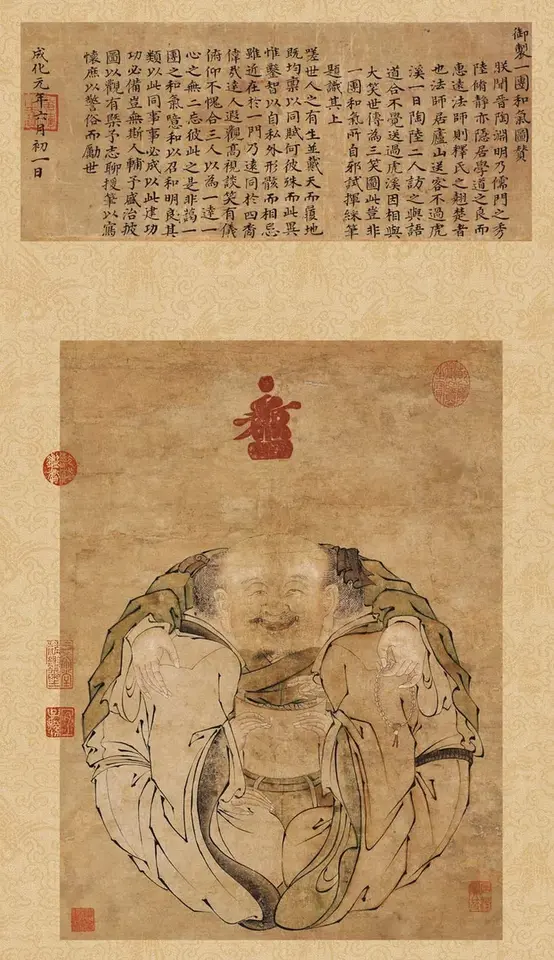
In Chinese literati culture, the legendary friendship between Lu Xiujing, Buddhist master Huiyuan, and hermit poet Tao Yuanming gave rise to the enduring cultural motif of the Three Laughers of Tiger Creek (Huxi Sanxiao). Tradition holds that Huiyuan had pledged never to walk beyond the Tiger Creek boundary; yet while conversing with Lu Xiujing and Tao Yuanming, he inadvertently crossed the stream, prompting a mountain tiger to roar and the three companions to burst into laughter.
While historical chronology demonstrates that Huiyuan and Tao Yuanming had passed away decades before Lu's arrival at Mount Lu, making the encounter a fictional legend, its emergence in Song dynasty art—such as Li Gonglin's famous painting—reflected deep literati admiration for Lu's transcendent spirit and harmonious synthesis of the three traditions. In 1119, Emperor Huizong posthumously honored Lu Xiujing as the Realized Immortal Danyuan, preserving Jianji Abbey as a preeminent national heritage site.
Personal Connections
- Imperial Patron: Emperor Wen of Song (Liu Yilong): Emperor of the Liu Song Dynasty; granted Lu an imperial audience at Xianyuan Palace in 453, treating him with reverence.
- Imperial Patron: Emperor Ming of Song (Liu Yu): Emperor of the Liu Song Dynasty; summoned Lu to Jiankang in 467 and constructed the Chongxu Abbey for his residence.
- Imperial Sovereign: Emperor Shun of Song (Liu Zhun): Final emperor of Liu Song; posthumously conferred the title Master Jianji upon Lu Xiujing.
- Senior Disciple: Sun Youyue: Chief indoor disciple of Lu Xiujing; inherited the leadership of Chongxu Abbey and transmitted the lineage to Tao Hongjing.
- Lineage Successor: Tao Hongjing: Master of Mount Mao and synthesizer of the Shangqing school; inherited Lu's Three Caverns classification and liturgical heritage.
- Cultural Associate (Legendary): Master Huiyuan: Renowned Eastern Jin Buddhist monk and founder of the White Lotus Society; depicted in the Three Laughers legend.
- Cultural Associate (Legendary): Tao Yuanming: Celebrated Eastern Jin pastoral poet and hermit; depicted alongside Lu in the Three Laughers legend.
Historical Evaluations
- Shen Yue et al. in Book of Song (Biographies of Recluses): "Lu Xiujing, courtesy name Yuande, was a native of Dongqian in Wuxing. His grandfather Chang served as Cavalier Regular Attendant. From youth, Lu cultivated pure aspirations, retreating to Mount Heng and later settling at Mount Lu. He collated the Three Caverns, compiled the Scriptural Catalogue, and illuminated liturgical rules, winning the veneration of clergy and laymen alike. During the Taishi era, Emperor Ming summoned him to reside at Chongxu Abbey, supporting him with lavish provisions. He died in the fifth year of Yuanhui and was posthumously honored as Master Jianji."
- Li Yanshou in History of the Southern Dynasties (Biographies of Recluses): "Lu Xiujing was the supreme master of Daoism; the catalogues of the Three Caverns were all established by him. Emperor Ming of Song was fond of mystery learning and built the Chongxu Abbey at Mount Fozhou for him, where all charts, talismans, and regulations were compiled by Lu's hand."
- Tao Hongjing in Declarations of the Perfected: "Master Jianji, Lu Xiujing, was profoundly versed in classical scriptures and possessed transcendent brilliance. He collated the Shangqing and Lingbao canons, establishing statutes that serve as the standard for myriad generations—truly a pillar of the Daoist community."
- Du Guangting in Liturgies of the Supreme Yellow Register: "Master Lu compiled the liturgies of the Nine Fasts and Twelve Offerings, clarifying regulations and illuminating orthodox rites while refuting heterodoxy. Among those who perform fasting rituals in later generations, not a single one has stepped beyond his framework."
- Chen Guofu in Textual Research on the History of the Daoist Canon: "Lu Xiujing pioneered the Catalogue of the Scriptures of the Three Caverns, establishing the division into Three Caverns and Four Supplements. From the Six Dynasties through the Ming dynasty's Zhengtong Daozang, all editions adhered to his methods. He was truly the founding father of Daoist canonical bibliography."
Related Entries
- Jianji Abbey
- Chongxu Abbey
- Catalogue of the Scriptures of the Three Caverns
- Three Caverns and Four Supplements
- Southern Celestial Masters
- Tao Hongjing
- Zhaijiao
- Three Laughers of Tiger Creek