Songshan Hermitage
Lived in ascetic seclusion at Mount Shaoshi near the Tea Immortal Spring, studying classics and developing tea rituals.
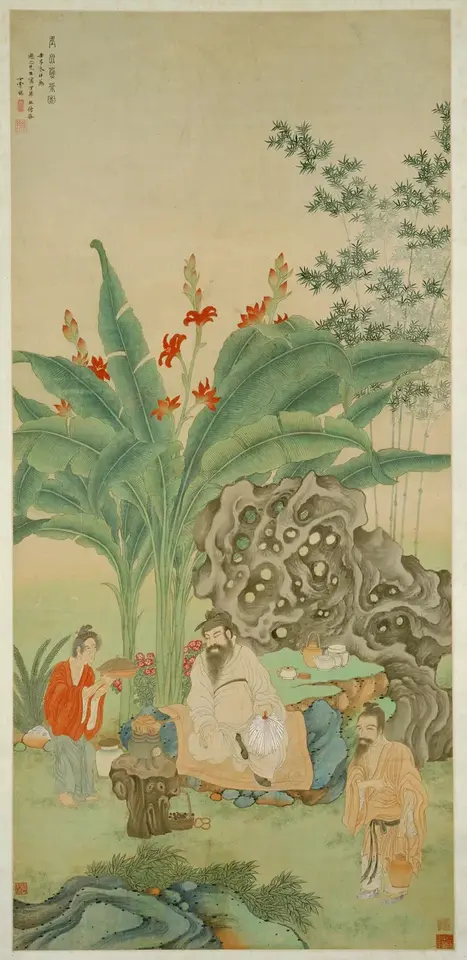
卢仝
Lu Tong (卢仝, c. 775–835), styling himself Yuchuanzi (Master of Jade Stream), was a native of Jiyuan in Henan (alternatively recorded as Fanyang) and an illustrious poet and revered tea master of the Tang dynasty, universally venerated by posterity as the "Immortal of Tea" (Chaxian). Displaying remarkable literary talent in his youth, he rejected bureaucratic ambition and lived in austere hermitage near the Tea Immortal…
Lu Tong (卢仝, c. 775–835), styling himself Yuchuanzi (Master of Jade Stream), was a native of Jiyuan in Henan (alternatively recorded as Fanyang) and an illustrious poet and revered tea master of the Tang dynasty, universally venerated by posterity as the "Immortal of Tea" (Chaxian). Displaying remarkable literary talent in his youth, he rejected bureaucratic ambition and lived in austere hermitage near the Tea Immortal Spring at Mount Shaoshi in the Songshan range. Despite living in severe poverty in a dilapidated cottage with only mountains of books, he twice declined imperial summons to serve as Grand Admonisher (Jianyi Dafu), choosing to remain a commoner recluse. He later relocated to Luoyang, forging a lifelong literary friendship with Han Yu, who revered his moral rectitude and noble character. Lu Tong's poetic style was daring, jagged, and fiercely imaginative, establishing him alongside Meng Jiao and Jia Dao as a central figure of the eccentric Han-Meng poetic circle. His celebrated masterpiece Thanks to Admonisher Meng for Sending New Tea—widely known as the Song of Seven Bowls of Tea (Qiwan Cha Ge)—elevated the appreciation of tea into a transcendent spiritual art form, becoming the most famous tea lyric in Chinese cultural history. His grand allegorical ballad The Lunar Eclipse used celestial omens to denounce corrupt court eunuchs. In late 835, while lodging as an innocent guest in Chancellor Wang Ya's private academy in Chang'an, Lu was swept into the violent purges of the Sweet Dew Incident and brutally executed by mutinous palace guards, evoking enduring lamentation throughout the scholar-gentry world.
Lived in ascetic seclusion at Mount Shaoshi near the Tea Immortal Spring, studying classics and developing tea rituals.
Twice summoned by imperial decree to assume the post of Grand Admonisher; declined both offers to remain a recluse.
Relocated to Luoyang, living in extreme material poverty assisted by neighboring monks; befriended Han Yu.
Penned the controversial ballad The Lunar Eclipse, employing terrifying celestial metaphors to attack imperial eunuch dominance.
Received rare Yangxian tribute tea from Meng Jian, composing the immortal poem that established his stature as the Tea Immortal.
Shared close poetic associations with Jia Dao and Meng Jiao, championing difficult syntax and unvarnished emotional truth.
Lodged in Chancellor Wang Ya's residence during the Sweet Dew Incident; wrongfully captured and brutally murdered by eunuch troops.
Lu Tong spent his formative years during the Zhenyuan and early Yuanhe eras. Endowed with extraordinary poetic imagination, he rejected civil examination preparation before his twentieth year and retreated into the wilderness of Mount Song. Establishing a rustic hermitage at Mount Shaoshi beside the Tea Immortal Spring, he lived in voluntary simplicity, surrounded by stacked scrolls of ancient histories and poetry. He drew fresh mountain water to brew tea, finding contentment in solitude and classical study.
During the Yuanhe reign, Emperor Xianzong sought out unheralded talent to staff his reforming administration. Local officials repeatedly recommended Lu Tong's unimpeachable virtue and immense learning. On two separate occasions, the throne issued imperial decrees summoning Lu to Chang'an to serve as Grand Admonisher. Unmoved by bureaucratic prestige and wealth, Lu submitted polite memorials declining both appointments, reaffirming his resolve to spend his life as an unencumbered mountain commoner. This steadfast moral independence earned him widespread veneration among contemporary literati.
In the mid-Yuanhe period, Lu relocated his household to the eastern capital of Luoyang. His residence was a collection of crumbling rooms where he resided with a single disheveled old manservant and a barefoot elderly maid. His material condition was so destitute that he frequently relied on surplus grain provided by friendly local Buddhist monks. Yet despite extreme physical privation, Lu remained cheerful, reading and writing verse with unyielding dignity.
When the great prose master Han Yu served as magistrate of Henan in Luoyang, he admired Lu's uncompromising integrity and paid him personal visits. The two men formed an intimate friendship. Lu's gentle nature was demonstrated when a local rogue threatened him; when Han Yu offered to mobilize the judicial machinery to punish the offender, Lu pleaded with Han to drop the matter, fearing that the criminal gang would direct their vengeance against Han Yu. Han was deeply touched by Lu's selflessness and consideration for others.
During the Yuanhe and Muzong reigns, palace eunuchs expanded their control over the imperial guard, dictating state policy and assassinating emperors. Living among the common people, Lu observed this systemic crisis with profound grief. In the autumn of 818, an eclipse of the moon prompted Lu to compose The Lunar Eclipse, a sprawling, hallucinatory allegorical poem. Deploying horrifying imagery of mythical toads swallowing celestial light, he delivered a scathing indictment of corrupt eunuchs suffocating imperial authority. While Han Yu praised the ballad as a masterpiece of moral courage, the powerful court eunuchs were enraged by its exposure of their treachery.
During the Baoli reign, Meng Jian, an imperial admonisher serving as prefect of Changzhou, dispatched a gift of freshly harvested Yangxian tribute tea to Lu Tong in Luoyang. Deeply grateful, Lu composed Thanks to Admonisher Meng for Sending New Tea. The poem charted the sensory and psychological stages of tea appreciation through its famous "seven bowls" sequence: the first bowl moistening throat and lips, the second banishing loneliness, the third scouring the mind, the fourth expelling grievances through sweat, the fifth purifying sinew and bone, the sixth opening communion with immortals, and the seventh generating refreshing breezes beneath the armpits to carry the drinker toward mythical Penglai. This lyric established tea drinking as an authentic pathway to spiritual transcendence, earning Lu the eternal title of "Immortal of Tea."
In late 835, Emperor Wenzong collaborated with Chancellor Wang Ya, Li Xun, and other court reformers in an attempt to annihilate the dominant eunuch faction, an event known as the Sweet Dew Incident. When the conspiracy prematurely collapsed, eunuch warlord Qiu Shiliang unleashed thousands of imperial guard cavalry across Chang'an, hunting down and executing reform officials and their families without trial.
Lu Tong, who had recently arrived in Chang'an on a literary journey, happened to be lodging as an overnight guest in the private library of Chancellor Wang Ya. Eunuch soldiers breached the gates and dragged everyone into the courtyard. Lu protested his innocence: "I am Lu Tong, a recluse of the mountains. I have had no involvement in court affairs nor grievance against you; why do you bind me?" A soldier mocked him: "If you are truly a mountain recluse, why are you sleeping in the residence of the chancellor?" Without allowing any defense, the mutinous troops dragged him into the street. Because Lu was elderly and bald, the soldiers barbarically drove an iron nail into the back of his skull, murdering him on the spot. He was approximately sixty-one years old. News of his senseless execution horrified the scholarly world, and his remains were later recovered by friends and interred in his native Jiyuan.
Lu Tong's most enduring legacy is his transformation of tea appreciation into a profound philosophical and aesthetic tradition. While Lu Yu's eighth-century Classic of Tea established the technical taxonomy and processing methods of tea, Lu Tong's Song of Seven Bowls of Tea provided tea culture with its spiritual essence.
Lu demonstrated that tea was not merely a refreshing beverage, but a medium for moral introspection, the purification of worldly distress, and spiritual communion with nature. His vivid depiction of inner tranquility—"All grievances of a lifetime are dissipated through the pores"—became the foundational creed of Chinese and East Asian tea ceremonies. For over a millennium, Lu Tong has been venerated alongside Lu Yu as the co-founder and spiritual patron of Chinese tea civilization.
In literary history, Lu Tong stood as one of the most daring and innovative masters of the mid-Tang Han-Meng poetic school. He deliberately overturned the rigid prosodic balance and polite diction of High Tang court poetry, proclaiming that verse should possess eccentric linguistic vigor and an unmistakable personal stamp.
His poems deployed startling metaphors, dramatic monologues, and prose cadences to convey emotional urgency and moral indignation. His experimental style directly influenced the bold vernacular voice of the Song dynasty, providing vital artistic inspiration for Su Shi and Huang Tingjian. In Biographies of Tang Talents, Xin Wenfang recognized Lu as a pioneering patriarch of stylistic innovation whose jagged originality remains unique in Chinese literature.
FIGURES ASSOCIATED WITH THIS DYNASTY